

The safety file and the schedule usually live in two different worlds. The safety manager logs incidents, near-misses, and corrective actions into one system. The PM runs the schedule and cost forecast in another. They talk at the weekly meeting, sure, but the data almost never crosses over in a way that actually changes a forecast number.
That gap is where money leaks. A recordable injury on the deck crew doesn't just generate an incident report — it triggers a stand-down, a re-brief, possibly a partial area shutdown, and a productivity dip that lingers for days after everyone's back to work. But when the schedule slips, the delay gets logged as "weather" or "sequencing" or "labor availability." The actual root cause — the safety event — quietly disappears from the controls conversation.
The safety incident schedule impact in construction is real and measurable. Most teams just never bother to measure it, so it stays invisible, and invisible costs never get managed.
Why safety stays in its own silo
There's a structural reason this happens, and it's worth naming — because you can't fix it by telling people to "communicate better."
Safety reporting exists mostly to satisfy regulators and insurers. The forms are built around OSHA recordability, root-cause categories, and corrective actions — not around days lost, crews idled, or float consumed. So the data comes out shaped for compliance, not for controls. You get a beautifully documented incident that tells you nothing about whether it cost you three days on the critical path.
The second reason is ownership. The safety manager doesn't own the schedule. The scheduler doesn't sit in the incident review. Nobody's job description includes "convert this near-miss into a reforecast trigger." So even when the info exists, there's no handoff.
A pattern that shows up across a lot of mid-sized GCs: the safety team is genuinely good at their job — low incident rates, solid documentation — but the project controls team has no idea that the two-day slip in the MEP rough-in three weeks ago traced directly back to a lockout/tagout violation that shut down an entire electrical room. The information was in the building. It just never made the trip from one department to another.
What actually breaks when you scale
On a single small job, you can hold all of this in your head. One superintendent knows the deck crew got rattled after the fall arrest incident and slowed down for a week. He adjusts informally. Nobody needs a system.
Keep your construction projects on schedule and budget.
Projbrick helps you plan, track, and manage every project phase with precision and ease.
- Real-time project tracking
- Resource & budget management
- Team collaboration tools
No credit card required
Then you're running four concurrent projects with different safety managers, different superintendents, and a shared labor pool. Now the informal knowledge doesn't travel. Here's where it breaks:
-
Cross-project labor effects go unnoticed. An incident on Project A pulls your best foreman into investigation meetings for two days. Project B, which was borrowing that foreman next week, takes the hit — but nobody connects the two.
-
Repeat patterns hide in aggregate. Three similar struck-by near-misses across three sites, each logged locally, never get seen as one systemic problem until one becomes an actual injury.
-
Reforecasts stay reactive. Without a rule that says "this incident category triggers a schedule review," the delay only shows up after the fact, when the monthly report is already red.
-
Insurance and EMR consequences surprise everyone. The cost impact of incidents on your experience modification rate is a next-year problem that never gets tied back to this-year decisions.
The core issue at scale: the connection between a safety event and its downstream schedule and cost consequences has to be built into a workflow, because no single person can see the whole picture anymore.
The incident-to-controls loop
The fix isn't more meetings or a better incident form. It's a closed loop that takes an incident at capture and pushes it through to a quantified schedule and cost impact, with governance and corrective SLAs attached. Five stages:
-
Capture with controls fields. When an incident or near-miss is logged, it also captures the affected work area, the crews involved, the activities on the schedule that touch that area, and an initial estimate of the disruption (none / hours / days / area shutdown).
-
Triage against a matrix. The event gets classified not just by severity for compliance, but by likely schedule and cost impact. This determines whether it triggers a reforecast.
-
Reforecast if the trigger fires. If the triage crosses a threshold, the scheduler pulls the affected activities and adjusts durations, logic, and cost using pre-agreed rules — not gut feel.
-
Govern the decision. The impact goes to a short governance review where the PM, super, and safety lead agree on the revised forecast and the corrective actions.
-
Assign corrective SLAs and close the loop. Corrective actions get owners and deadlines, and the loop checks whether they actually happened before the same hazard reappears.
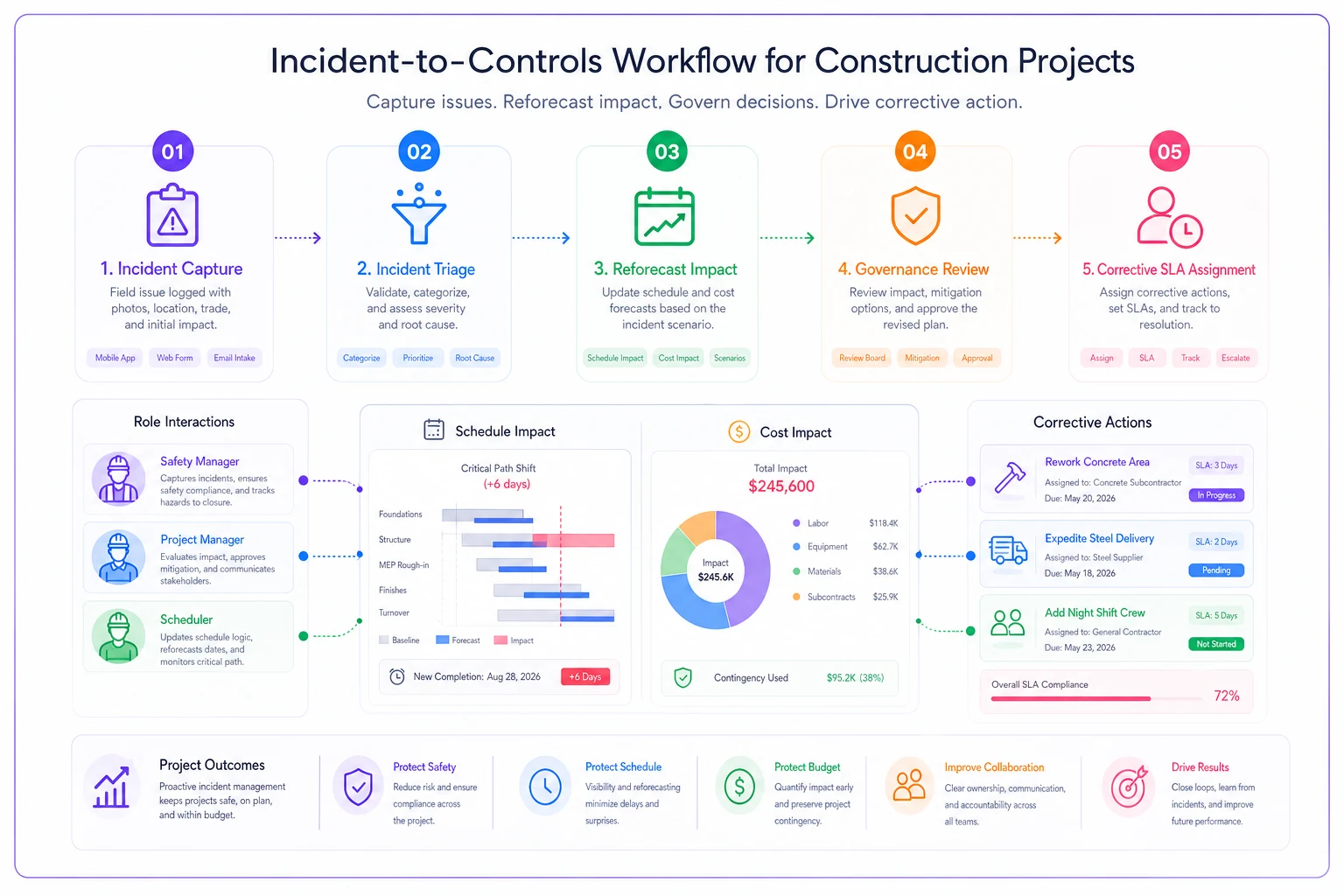
The point of the loop is that safety data stops being a dead-end report and becomes an input to your integrated project controls — sitting alongside cost, risk, and change like it always should have.
The triage matrix
This is the piece that does the heavy lifting. You need a quick, repeatable way to decide whether an incident is a controls event or just a documentation event. Not every near-miss should trigger a reforecast — that would bury the scheduler in noise. But the ones that matter need to route immediately.
Here's a workable triage structure. Adjust the thresholds to your project size and float tolerance.
| Impact tier | What it looks like | Schedule effect | Controls action | Governance |
|---|---|---|---|---|
| T0 — Log only | Minor near-miss, no work stoppage, isolated | None | Document, add to trend log | Monthly trend review |
| T1 — Localized | Short stand-down, single crew, <4 hrs lost | Absorbed by float | Note in lookahead, monitor | Flag at weekly |
| T2 — Activity-level | Area partial shutdown, 0.5–2 days, one activity affected | Possible float consumption | Reforecast affected activities | Weekly controls meeting |
| T3 — Path-level | Multi-day shutdown, critical-path activity, investigation pulls key staff | Direct critical-path slip | Full reforecast + cost impact | Dedicated review within 24 hrs |
| T4 — Program-level | Serious injury, regulator involvement, site-wide stop | Major slip, cascading | Reforecast + change/claim review | Executive escalation |
The mistake most teams make here is over-classifying. Everybody wants to mark their incident as serious because it feels responsible. But if T3 and T4 lose meaning because half the log lives there, the scheduler stops trusting the trigger. Keep the top tiers genuinely rare, and defend them.
One thing worth flagging: near-misses often deserve higher triage attention than minor recordables, because a near-miss frequently signals a systemic hazard that will cause a real stoppage soon. A guy who almost got hit by a swinging load isn't a T0. That's a warning that your rigging and lift-window coordination has a hole in it, and the next one might close a work zone for a day.
Reforecast rules, so nobody argues about numbers
The reason schedule impacts from safety events get fudged is that the adjustment feels subjective. How many days does a stand-down "really" cost? Leave that to a debate, and the answer will always be whatever protects the PM's status report.
-
Stand-down productivity drag. After a T2+ event, apply a productivity factor to the affected crew for the recovery window — say 80–85% for the first 2–3 days back. Crews don't return to full pace immediately after a serious incident, and pretending they do is why reforecasts stay optimistic.
-
Investigation staff drain. When a key super or foreman is pulled into an investigation, deduct their availability from the activities they were driving. If your foreman is in meetings for a day and a half, the work he was coordinating slows, even if the crew is technically on site.
-
Area re-access lag. A shutdown doesn't end the moment the area reopens. Build in re-mobilization time — repositioning tools, re-briefing, re-establishing temporary works.
-
Rework-from-incident. If an incident damaged installed work or temporary works, treat the repair as a distinct activity with its own duration, not an invisible absorption.
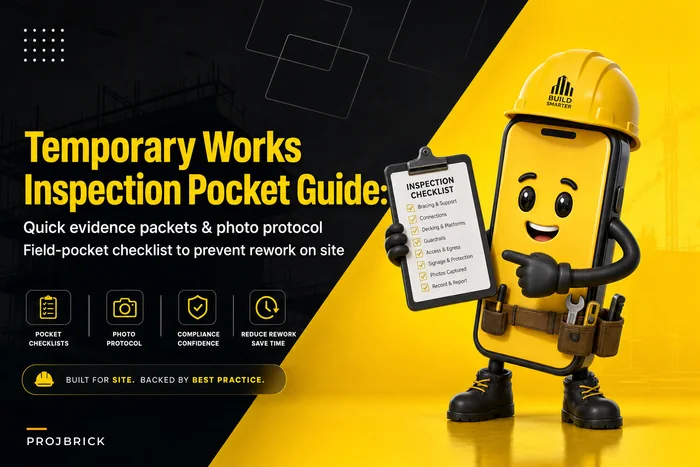
On temporary works specifically — incidents there deserve their own attention, because a failure or near-failure in shoring or formwork is both a safety event and a rework event. The evidence discipline in the temporary works inspection pocket guide feeds directly into a clean triage: if you already have photo protocols and inspection packets in place, classifying the schedule impact of a temporary-works incident becomes a lot faster and less contentious.
Governance meetings that actually decide something
Most safety review meetings are read-outs. Someone presents the incidents, everyone nods, corrective actions get listed, meeting ends. Nothing about the schedule changes because the schedule wasn't in the room.
The governance layer in this loop is different because it has one job: agree on the revised forecast and lock the corrective SLAs. Keep the templates tight.
For a T2/T3 controls review (should take 20–30 minutes):
-
The incident and its triage tier (already classified, not debated live)
-
Affected activities pulled from the schedule
-
Proposed reforecast using the standard rules
-
Cost impact estimate — lost productivity, rework, standby, any equipment idle
-
Corrective actions with named owners
-
SLA deadlines for each corrective action
-
Whether this triggers a change notice or claim consideration
The discipline that makes this work is that the triage and the reforecast math are done before the meeting, using the rules. The meeting confirms and decides — it doesn't do the analysis from scratch. That's what keeps it to half an hour instead of an hour of arguing about whether the slip was "really" the incident's fault.
Corrective SLAs and closing the loop
A corrective action without a deadline and an owner is a wish. The failure mode that quietly kills safety-to-schedule programs: corrective actions get logged, everyone feels good, and then nobody checks whether they were done. Three weeks later the same hazard causes the same near-miss, and now you're paying for it twice.
-
Immediate hazards — contained same day, verified next day
-
T2 corrective actions — closed within a week, verified before the crew returns to full pace
-
Systemic actions (procedure changes, retraining) — 2–3 weeks with a named owner
-
Verification is mandatory — an action isn't closed until someone confirms it happened, not just that it was assigned
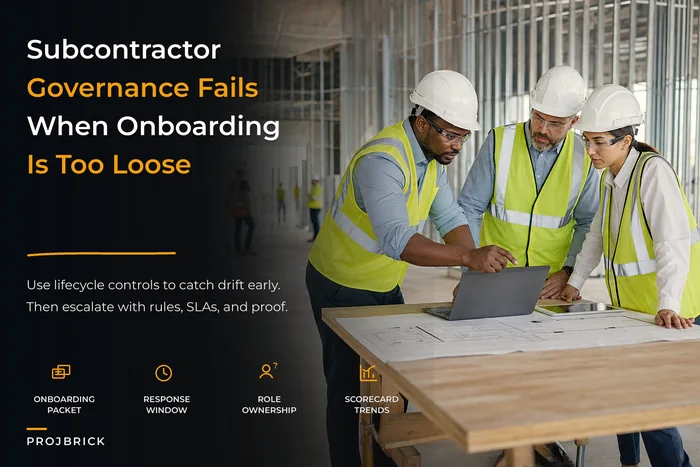
When incidents trace back to a specific subcontractor's crew repeatedly, the corrective loop needs to reach into your sub governance too. A pattern of safety events from one trade is a scorecard problem, and the subcontractor lifecycle governance system is where those repeat offenders should surface — because the schedule impact of a chronically unsafe sub is a procurement and selection issue long before it's a single-incident issue.
A real scenario
A mid-sized GC running a six-story mixed-use build had a struck-by incident during a curtain-wall lift — a panel shifted, no one was hurt, but the crane zone shut down for the afternoon and the lift crew got stood down for a full re-brief the next morning.
Under their old process, this got logged as a safety event, corrective actions noted, and the schedule showed a "two-day curtain-wall delay" attributed vaguely to "coordination." No one connected the dots on cost.
Running it through the loop looked different. Triage put it at T3 — critical-path activity, area shutdown, key rigging super pulled into the investigation. The reforecast applied the standard rules: the afternoon lost, a re-mob morning, and an 85% productivity factor on the lift crew for two days after. Total honest schedule impact came out closer to three and a half days than two. The cost side — idle crane standby, the crew's lost hours, and the knock-on delay to the following trade — landed somewhere around $18k–$22k, most of which had previously been invisible.
More useful than the number: the corrective action (revised lift-plan review and updated rigging checks) got an owner and a five-day SLA, and it was verified before the next lift. The next three curtain-wall lifts went clean. The incident stopped being a compliance line item and became a documented input that changed how the following month's forecast was built.
When this makes sense — and when it doesn't
This system earns its keep on projects with real complexity: multiple concurrent jobs, shared labor, tight critical paths where a few days actually matter, or work with inherently higher incident exposure like heavy civil, high-rise, or industrial.
It's overkill on a small, low-risk job with one crew and a fat schedule buffer. If your super can hold the whole thing in his head and adjust informally, adding a triage matrix and governance templates just creates friction. Don't build bureaucracy to solve a problem you don't have.
Who should NOT rush into this: teams that don't yet have basic incident capture working. If your near-misses aren't being reported reliably in the first place, a triage-to-reforecast loop has nothing to run on. Fix the reporting culture first, then build the controls connection on top of it. A loop that only sees half the incidents produces forecasts that are confidently wrong.
Where tooling helps — and where it doesn't
You can run a lightweight version of this on spreadsheets and disciplined meetings, and plenty of teams should start there to prove the loop works before automating anything. The rules and the triage matrix matter far more than the software.
Where operational software with some automation genuinely helps is the handoff — the part humans forget. When an incident gets logged with the affected area and crews, a system can automatically flag which scheduled activities touch that zone, route a T3 event to the right people within the SLA window, and surface repeat patterns across multiple sites that no single person would catch. It reduces the manual coordination that causes the loop to break down at scale, and it keeps safety data flowing into controls instead of dying in a compliance folder. But the tool only enforces a process you've already designed. Buy software to run a good loop; don't buy software hoping it'll invent one for you.
Bringing it together
Safety incidents already cost you schedule and money — the only question is whether you measure it or absorb it blind. Treating safety as a compliance silo means those costs stay invisible, get misattributed to weather or sequencing, and never inform the next forecast. Building the incident-to-controls loop — capture with controls fields, a disciplined triage matrix, pre-agreed reforecast rules, tight governance, and corrective SLAs that actually get verified — turns your safety data into one of the most honest inputs your project controls will ever have.
The teams that do this well don't have fewer incidents by magic. They just stop being surprised by the schedule and cost consequences, because they've built the pathway for a near-miss on Tuesday to show up in Friday's forecast — with a number attached and someone's name on the fix.
Safety incidents already cost you schedule and money — the only question is whether you measure it or absorb it blind. Treating safety as a compliance silo means those costs stay invisible, get misattributed to weather or sequencing, and never inform the next forecast. Building the incident-to-controls loop — capture with controls fields, a disciplined triage matrix, pre-agreed reforecast rules, tight governance, and corrective SLAs that actually get verified — turns your safety data into one of the most honest inputs your project controls will ever have.
Ready to build smarter and faster?
Join 2,000+ construction teams using Projbrick to improve project visibility, reduce delays, and increase profitability.