


The worst budget surprises don't come from bad estimating. They come from good information sitting in the wrong place, at the wrong time, in front of the wrong person.
It plays out in a very specific way. A field crew flags a differing site condition on a Tuesday. The super notes it in a daily log. Three weeks later, the change order gets priced. Two weeks after that, someone updates the risk register — except by then the "risk" already became a cost, and the contingency line that should have absorbed it was quietly drained by four other small events nobody connected together. The month-end report shows the number. Everyone's surprised. Nobody should be.
That gap — between something happening in the field, something changing in the budget, and something being tracked in the risk register — is the whole ballgame. Integrated project controls in construction is really just the discipline of making those three systems talk to each other on a predictable cadence, with clear ownership and clear triggers. Not more reports. Not a fancier dashboard. A tighter loop.
This is a systems article, not a tips list. The goal is to show how cost, risk, and change actually connect (and where the connections snap), then give you the governance cadence, triage checklists, and templates to close the control gaps most teams live with without realizing it.
The three systems most teams run in parallel — and never wire together
On paper, most projects have all the pieces:
-
A budget / cost report (buyout, committed cost, cost-to-complete, forecast at completion)
-
A risk register (identified risks, probability, impact, owner, contingency draw)
-
A change workflow (RFIs, potential change orders, change order log, subcontractor change requests)
The problem is these usually live in three different tools, owned by three different people, updated on three different rhythms. The cost report is the PM's world, updated monthly. The risk register is often a spreadsheet somebody set up at project start and touches quarterly, if that. The change log lives with the PE and moves whenever an RFI comes back.
Because the update cycles don't match, the systems drift. A typical example: an RFI response comes back with a scope implication. The PE logs it as a potential change order. But the risk register still shows that item as an "open design risk" with an assigned $50k contingency allocation. Now the same dollar is being counted twice — once as a live PCO, once as a reserved risk. The forecast looks healthier than it is, right up until reality collides.
The failure isn't in any single system. It's in the handoffs. Every one of these tools works fine on its own. Integrated project controls is the plumbing between them.
How information is supposed to flow (the loop most projects are missing)
Below is the flow when it actually works. Read it as a loop, not a list:
Keep your construction projects on schedule and budget.
Projbrick helps you plan, track, and manage every project phase with precision and ease.
- Real-time project tracking
- Resource & budget management
- Team collaboration tools
No credit card required
[Trigger Event] ↓ [Classify: Risk / Change / Both] ↓ ┌──────────────────────┐ │ │ [Risk Register] [Change Workflow] (probability + (PCO logged, impact assigned, budget line owner named) consumed) │ │ └──────────┬───────────┘ ↓ [Risk Materializes → Retired from Register, Converted to PCO or Cost Draw] ↓ [Cost Forecast Updates from Change Log + Risk-Weighted Contingency — not manual guess] ↓ [Governance Review: what moved, why, and what it means for FAC] ↓ [Back to top]
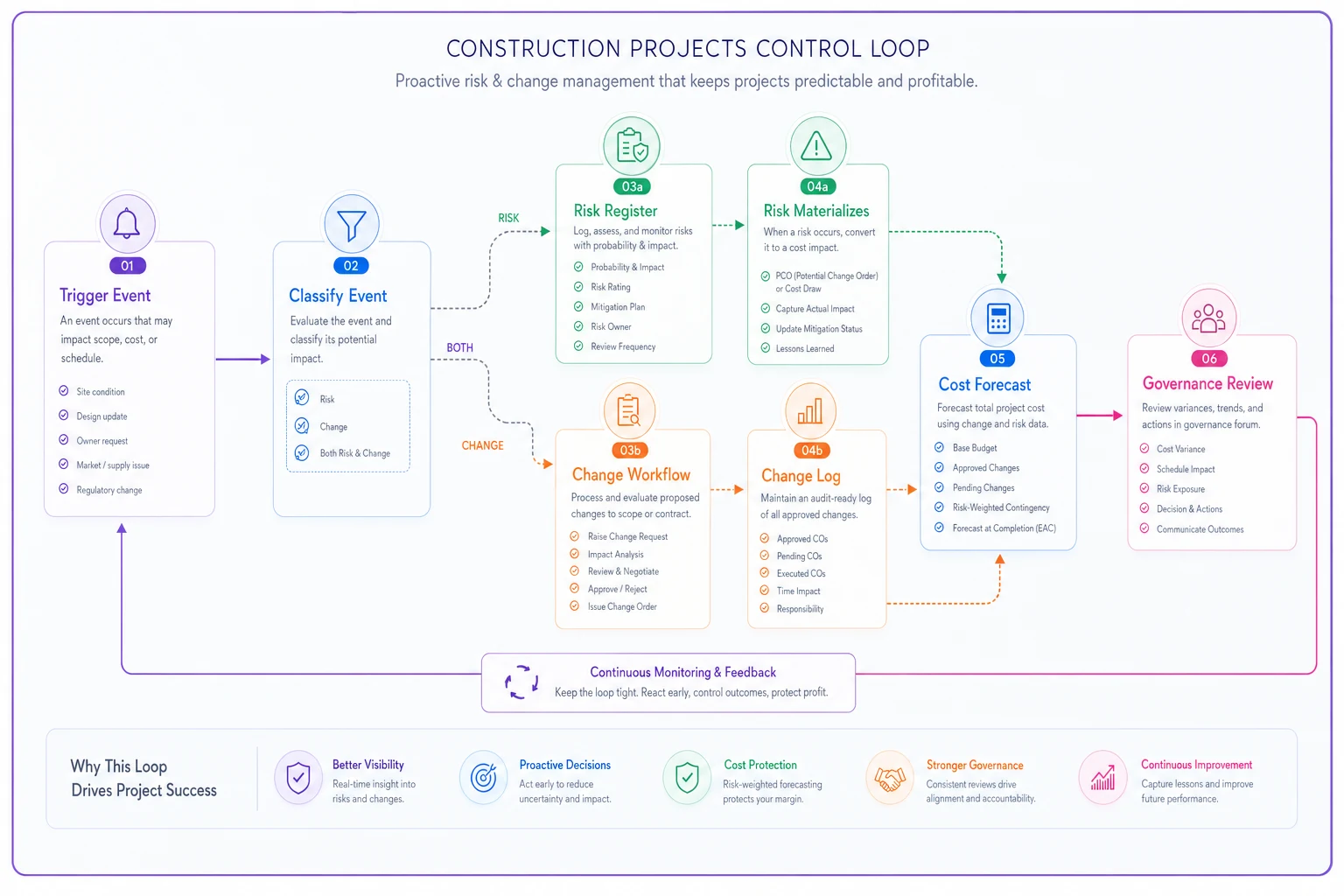
Step 4 — the conversion step — is where nearly everyone loses money. Risks that materialize don't get cleanly retired, so contingency looks available when it's already spent. Or the reverse: a risk passes its window (the foundation's in, the differing-condition risk is dead) and nobody releases the reserve, so you're carrying phantom contingency that could've covered something real.
Worth naming directly: on projects that overrun late, the risk register almost always went stale around 40–50% completion. The team was heads-down in production, stopped feeding the register, and it silently detached from reality. By the time anyone looked again, it was a historical document, not a control tool.
Where it breaks as the project — and the company — scales
One small project, one sharp PM, and you can hold all three systems in your head. You know that the differing-condition risk turned into PCO #14. You remember the contingency's really at $80k, not the $130k the sheet says.
That mental model falls apart the moment you scale. Three concurrent projects, a couple of PEs, a rotating cast of subs — the informal wiring in your head stops working. Nobody else has that context. The handoffs that used to happen in your brain now have to happen in a system, or they don't happen at all.
| Dimension | Single project (works informally) | Multiple projects at scale (needs a system) |
|---|---|---|
| Risk-to-change conversion | PM remembers it | Gets missed; double-counting appears |
| Contingency status | Known intuitively | Overstated on paper, unclear who drew it |
| Update cadence | Ad hoc, still current | Drifts; register goes stale mid-project |
| Change ownership | One person tracks all | Splits across PEs, gaps open in handoff |
| Forecast accuracy | "Feels right" and usually is | Feels right and is quietly wrong |
| Surprise frequency | Rare | Monthly, at cost review |
The other scaling failure is portfolio blindness. Each project might be individually fine, but the same risk — say, a supplier slipping on lead times across three jobs — shows up as three separate, unconnected register entries. Nobody sees the pattern until all three projects take the hit in the same month. Integrated controls at the portfolio level is what turns three coincidences into one visible, manageable exposure.
The governance cadence that keeps the loop alive
Cadence is the part teams skip because it feels like overhead. It's actually the cheapest insurance you'll buy on any job. The point isn't the meeting — it's forcing the three systems into sync on a schedule so drift can't accumulate quietly.
-
Weekly (15–20 min, PM + PE + super) Review new trigger events from the week. Classify each as risk, change, or both. Confirm every open PCO is tied to a budget line. Nothing fancy — just catch things before they age.
-
Bi-weekly (risk sync) Walk the risk register. Retire risks that have passed or materialized. Release contingency on dead risks. Re-rate probability/impact on anything that shifted. This is the meeting that stops the register from going stale.
-
Monthly (cost review, wider group) Reconcile the forecast at completion against committed cost, change log, and risk-weighted contingency. The number here should have no surprises because the weekly and bi-weekly sessions already caught the movement.
-
Milestone / phase-gate Before each major gate, a full sweep — close out risks tied to the completed phase, open risks tied to the next one, and rebaseline contingency accordingly.
Keep the weekly session short (15–20 minutes) and focused so it actually happens.
The monthly cost review should be boring. If your month-end is where surprises show up, the upstream cadence isn't doing its job. A dramatic cost meeting is a symptom, not a normal event.
A triage checklist for every trigger event
When something happens, run it through this before it disappears into a daily log. This is what keeps events from falling between systems:
-
What happened, in one sentence, with a date?
-
Which budget line or trade does it touch?
-
Is it a risk (may cost), a change (will cost), or both?
-
If both — which bucket holds the dollars until it resolves? (Pick one. Don't reserve twice.)
-
Who owns it? (A name, not "the team.")
-
What's the cost range? (Low / likely / high — ranges beat false precision.)
-
What's the trigger date or decision deadline? (When does this stop being a risk and become a cost?)
-
Does it connect to anything already logged? (Same sub, same design area, same supplier?)
-
Has the forecast been updated, or does it need to be?
The one people consistently skip is the connection question — "does this link to anything already logged." That's what surfaces portfolio patterns and stops the same root cause from being tracked as five unrelated entries.
Templates worth standardizing
You don't need heavy software to start. You need consistent fields so the systems can actually reconcile. Three templates carry most of the weight:
1. Trigger-event intake (single entry point). Date, description, source (RFI/field/owner/market), classification, owner, cost range, linked items, current status. Everything enters here first, then routes to the register or the change log.
2. Risk register with conversion tracking. Standard fields plus two that most registers lack: "trigger/expiry date" (when the risk resolves either way) and "converted to" (the PCO or cost draw it became). Those two columns are what stop double-counting and phantom contingency. Without them, the register just accumulates entries that nobody ever closes.
3. Contingency ledger. One running sheet showing starting contingency, every draw, every release from retired risks, and current available balance. Treat contingency like a bank account, not a general feeling about how much buffer is left. This single ledger prevents the most common surprise of all — discovering at 70% complete that the reserve is gone.
These aren't complicated builds. Most teams could set them up in a day. The value is in using them consistently, not in their sophistication.
A real scenario: three jobs, one drained contingency
A mid-size GC running three concurrent commercial fit-outs — roughly $6M–$9M each — kept hitting the same wall. Individually, every project's monthly report looked fine through the middle third. Then two of the three would post surprise overruns in the same 60-day window, usually $150k–$250k each.
When they traced it, the pattern was almost identical every time. Risks got logged at project start and never revisited. Change orders got priced against the general budget, not against the specific contingency reserved for that risk. So the register kept showing contingency "available" that had already been eaten by change orders nobody reconciled back. The forecast wasn't lying — it was just working off two disconnected sets of books.
The fix wasn't glamorous. They added a single trigger-intake step, a bi-weekly risk sync, and one contingency ledger per job. Every risk that materialized got retired and converted; every dead risk released its reserve. Within a couple of project cycles, month-end reviews stopped producing surprises — the movement was already visible weeks earlier. They didn't eliminate overruns (nobody does), but the surprise overruns — the ones that blow up owner trust — mostly went away, and the contingency draws they did have were traceable to a specific event and a specific owner.
The dollars mattered, but the bigger shift was cultural. Cost reviews stopped being confrontations and started being confirmations.
Where a connected system helps — and where it doesn't
Once the volume of trigger events crosses a certain point, spreadsheets start losing the reconciliation battle. This is where AI-assisted project controls software earns its keep: not by making decisions for you, but by keeping the three systems synchronized without a human manually copying entries between them.
In practice that looks like a platform where a logged field event automatically flags whether it's already linked to an open risk, where retiring a risk prompts you to convert or release its contingency, and where the forecast pulls live from the change log and risk-weighted reserve instead of a hand-updated cell. The automation is useful for the grunt work — catching duplicate entries, surfacing that the same supplier appears in three registers, flagging risks that have passed their trigger date and gone stale. It reduces the two failure modes that cause most surprises: things that fall between systems, and things that get counted twice.
What it won't do is fix a team that doesn't hold the cadence. The tool enforces the plumbing; the people still have to run the reviews and make the calls. Software that promises to "manage risk for you" is selling a fantasy. Risk judgment is yours. Coordination and reconciliation, though — that's exactly the kind of repetitive, error-prone work worth automating.
When integrated controls are overkill
Not every job needs this. Be honest about scale.
-
A single small project with one PM who knows everything? A clean spreadsheet and discipline may be enough. Don't build governance theater for a $500k job.
-
Very short-duration work where risks resolve before a review cycle even comes around? Lighter is fine.
-
Teams that won't commit to the cadence? The system is worthless without the rhythm. Better to run a simple version consistently than an elaborate one nobody feeds.
The trap to avoid is the opposite one, though — assuming you're "too small" while running three or four concurrent jobs on informal memory. That's precisely the size where the wheels come off, because the informal system that worked at one project quietly fails at three, and you usually find out at month-end.
Budget surprises aren't a pricing failure or an estimating failure. They're what happens when your cost report, risk register, and change workflow run on separate clocks and stop reconciling. The fix isn't more data — it's the connective tissue: a single intake point, honest risk-to-change conversion, a contingency ledger you actually trust, and a cadence that catches drift before it compounds.
Get that loop running and the monthly cost review turns into the least dramatic meeting on your calendar. Which, when you're managing real money across real projects, is exactly what you want it to be.
Ready to build smarter and faster?
Join 2,000+ construction teams using Projbrick to improve project visibility, reduce delays, and increase profitability.