

Temporary works inspections create a documentation problem that most PMs don't take seriously until they're sitting across from a subcontractor's attorney. Unlike permanent structures where defects get caught in final walkthroughs, temporary works disappear. Formwork gets stripped, shoring comes down, access scaffolds get dismantled. When a sub claims you approved their setup three weeks ago, you're digging through blurry phone photos and half-filled inspection sheets trying to reconstruct what actually happened.
The real problem isn't catching defects—most experienced PMs spot issues immediately. The problem is proving you caught them, communicated them, and got them fixed before that temporary structure came down. Without solid documentation, you end up in he-said-she-said arguments that end with you eating rework costs or accepting liability for failures you tried to prevent.
Why Standard Inspection Forms Fail Temporary Works
Traditional inspection documentation assumes the thing you're inspecting will still exist when a dispute comes up. Walk into any trailer and you'll find binders full of permanent work reports—concrete strength tests, steel connection photos, waterproofing sign-offs. Flip to the temporary works section and it's sparse. A few signatures on generic forms. Maybe some wide-angle photos that show nothing useful.
This happens because temporary works move too fast for traditional documentation. Your formwork carpenter installs shores at 6 AM, your concrete crew pours at noon, and by next week those shores are on a different floor. The inspection window is measured in hours, not days. Standard forms that require office processing, supervisor review, and formal filing don't work at this pace.
The legal exposure compounds fast. A 20-story residential tower might have 500+ individual temporary works setups across its construction. Miss documenting even 2% properly and you've got 10 potential dispute points. At $30k to $50k per disputed rework claim, that's a significant exposure hiding in your incomplete photo folders.
What makes this especially frustrating is that PMs usually do catch these issues. You walk the pour deck at 7 AM, spot undersized reshores, tell the foreman to fix it, they fix it. Then three months later when cracks appear in the slab above, suddenly nobody remembers that conversation. The sub claims their shores were perfect. Without time-stamped photos showing the deficient shores and the corrected setup, you lose that argument.
The Three-Photo Protocol That Actually Works
After seeing enough temporary works disputes play out, a pattern emerges in what evidence actually moves the needle. Courts and arbitrators don't care about a 47-page inspection report if it doesn't show specific conditions at specific times. They want three things: what was wrong, proof you communicated it, and evidence it got fixed.
Keep your construction projects on schedule and budget.
Projbrick helps you plan, track, and manage every project phase with precision and ease.
- Real-time project tracking
- Resource & budget management
- Team collaboration tools
No credit card required
Here's the photo sequence that makes disputes go away:
Photo 1: The Deficiency Shot Take this within 30 seconds of spotting an issue. Include enough context to identify location but zoom in enough to clearly show the problem. Hold a tape measure or pencil in frame for scale. Your phone captures the timestamp automatically. Text yourself the photo immediately with a three-word description: "Pier 4 undersized."
Text yourself the photo immediately with a three-word description: "Pier 4 undersized."
Photo 2: The Communication Proof Screenshot your text message, email, or photo markup showing you communicated the issue. Send the deficiency photo to the responsible foreman with clear direction: "Replace with 4x4 minimum before pour." Their response—even just "OK"—becomes your proof of acknowledged receipt.
Photo 3: The Resolution Shot Take this from the same angle as Photo 1, showing the corrected condition. Include something that proves it's a different time—changed lighting, workers in different positions, or even just holding up your phone showing the current time. This photo must exist before the temporary structure comes down or gets loaded.
The power isn't having perfect photos. It's having the right photos taken at the right moments. A blurry photo of undersized shoring with a timestamp beats a professional photo of "general site conditions" every time.
Building Evidence Packets in Real-Time
Evidence packets fail when they require desk work. The moment you tell yourself "I'll document this properly when I get back to the trailer," you've already lost. The fix either happens without documentation or the documentation happens without accurate details.
Build your packet as you walk. Create a simple folder structure on your phone: Date > Location > Issue. Drop photos directly into these folders as you take them. Every modern phone can do this in under 10 seconds. This isn't about being organized—it's about creating evidence that's hard to dispute later.
-
24 hours
Initial installation check
-
48 hours
Load application check (workers, materials now on structure)
-
72 hours
Stability check before major operations
The cadence matters more than comprehensiveness. Check critical temporary works every four hours during active operations. That sounds excessive until you realize a shore configuration can change three times in a single shift as workers adjust for site conditions. Your morning inspection showing proper shoring means nothing if crews modified it at lunch.
A quick visual of the real-time packet workflow.
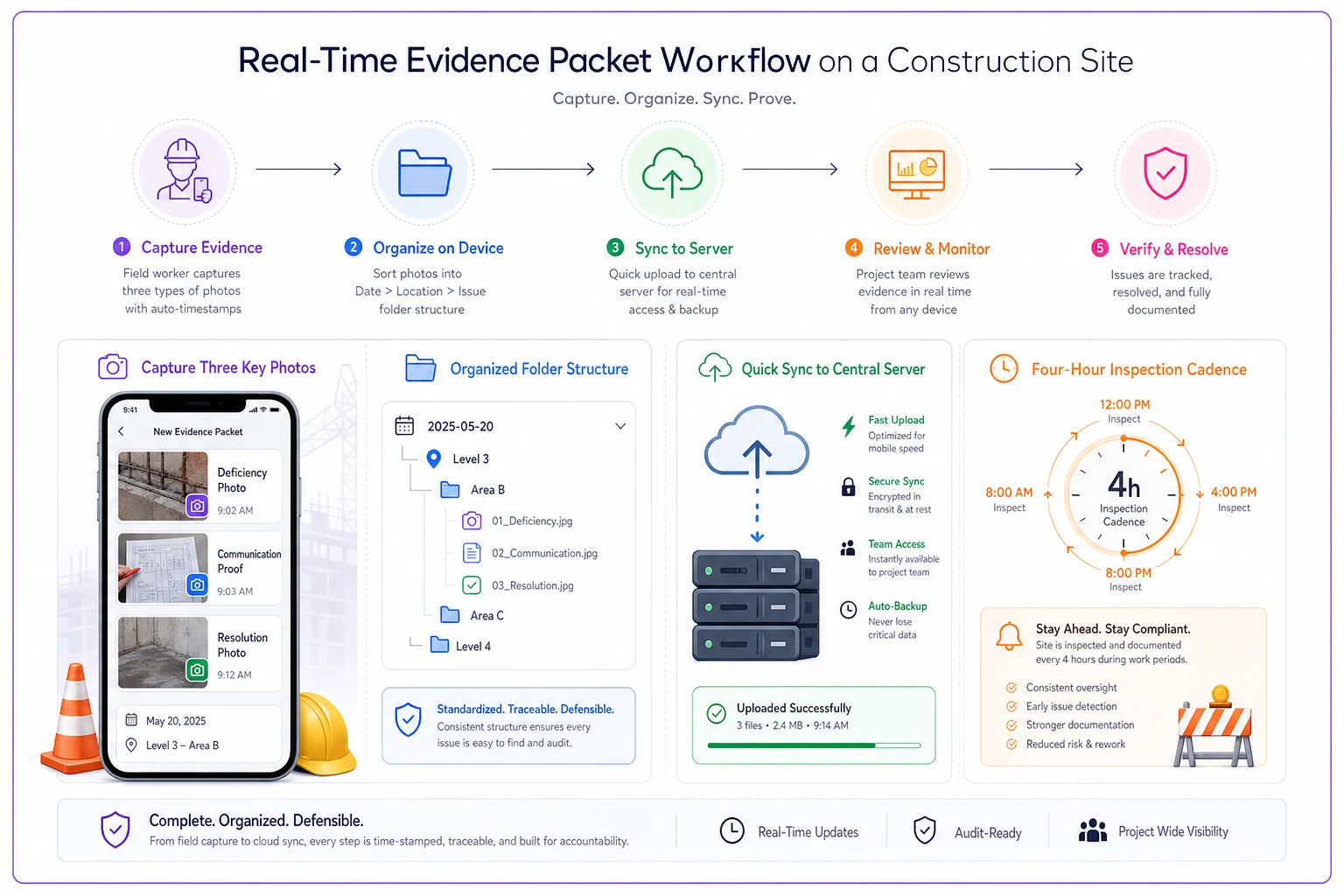
Keep packet creation faster than the work itself. If documenting a shoring issue takes longer than fixing it, crews will fix without documenting. That's why the three-photo protocol prioritizes speed over detail. Three clear photos in 45 seconds beats a detailed report that takes 20 minutes.
Sample Rejection Notes That Stick
Writing rejection notes for temporary works requires different language than permanent work rejections. You're not rejecting for code compliance or aesthetic standards—you're rejecting for immediate safety and structural concerns. Vague language invites arguments. Specific, measurable language ends them.
| Weak rejection | Strong rejection |
|---|---|
| "Shoring insufficient for load." | "Post shores at Grid C-4 measured at 3.5" diameter. Minimum 4" required per submitted shoring plan. Replace before any deck loading." |
| "Formwork not properly secured." | "Form ties missing at 6 locations between Grid 2-3. Install ties at 24" centers maximum per manufacturer spec before concrete placement." |
| "Scaffold doesn't meet requirements." | "Scaffold bay at north elevation missing mid-rail between 4th-5th level. Install 2x4 minimum rail before allowing worker access." |
State what you measured, state what's required, state the specific fix needed. This prevents the classic subcontractor response of "we interpreted your note differently." There's no interpreting "3.5 inches when 4 inches required."
-
Immediate
Stop work until corrected (imminent collapse risk)
-
Before next operation
Fix before pouring, loading, or climbing (structural risk)
-
Within 24 hours
Fix before next inspection (compliance risk)
Document the delivery method. A photo of your red-tagged scaffold beats a signature on a form. Email confirmations beat verbal notifications. Text messages with read receipts beat most alternatives—except certified mail, and nobody has time for certified mail on active pour decks.
Digital Tools Without the Digital Overhead
Construction's relationship with inspection software is complicated. Powerful platforms exist that can timestamp, geo-tag, and automatically organize every photo you take, generate reports, track corrections, and maintain audit trails. They also require training, licenses, connectivity, and crews who actually use them. In real operations, the perfect system nobody uses loses to the simple system everyone follows.
This is where operational software becomes genuinely useful—not as a replacement for field judgment but as a backstop for human memory. Modern platforms can automatically organize photos by location and time, flag missing inspection intervals, and compile evidence packets without manual filing. The key is choosing tools that enhance your existing workflow rather than adding to it.
A good temporary works inspection platform operates mostly in the background. Photos sync from phones without manual uploads. Critical timing gets tracked automatically across all temporary structures. Evidence packets compile based on GPS location and timestamp data. When a dispute comes up three months later, you pull a complete evidence chain in minutes rather than hours.
The efficiency shows up during dispute resolution too. Instead of searching through thousands of photos across multiple phones and folders, AI-assisted search can surface "all shoring photos from Level 12 between March 10-15" in seconds. Natural language queries like "show me all rejected scaffolding that was later approved" return exactly what you need.
But the real value is consistency. When evidence collection runs automatically in the background, you stop missing critical documentation because someone forgot to take photos. The system captures, indexes, and maintains chain of custody without anyone having to think about it.
What This Looks Like in Practice
Consider a mid-size commercial project in downtown Denver. The GC implemented this temporary works inspection approach after eating $180k in rework claims on their previous project. Same crews, same subs, same project management team—different outcomes.
Week one: Pour deck on Level 3. The PM spots understrength reshores during his 6 AM walk. Three photos: deficient shores, text to carpenter foreman, corrected shores by 7:30 AM. Total documentation time: 90 seconds.
Week six: Cracks appear in Level 2 slab. Structural engineer suspects inadequate shoring during the Level 3 pour. Sub claims their shoring was perfect, points to their internal inspection sheets. PM pulls up his evidence packet: time-stamped photos showing 2x4 shores where 4x4s were required, text message directing correction, photos of properly installed 4x4s before the pour.
Dispute resolved in one meeting instead of six months of back-and-forth.
The system caught 47 temporary works deficiencies across the project's 18-month duration. Previous projects averaged 8-10 documented deficiencies—not because there were fewer problems, but because documentation was too slow to capture them all. The evidence packets prevented an estimated $350k in potential rework claims, not counting legal fees and schedule impacts.
What actually mattered was that field teams used it. Unlike previous digital inspection systems requiring tablets, forms, and uploads, this approach worked with what crews already carried. Superintendents who previously resisted any documentation now had folders full of evidence photos, simply because the process was faster than arguing about it later.
Common Mistakes That Kill Your Evidence
Even with a solid system, certain mistakes consistently destroy otherwise good evidence. These aren't technical failures—they're human patterns that show up when documentation feels like overhead.
The batch documentation trap. Walking the entire pour deck, noting multiple issues, then trying to photograph everything at once. By the time you return to the first issue, crews have already started fixes. Now you have no "before" photos and your "after" photos mean nothing without context. Document each issue completely before moving to the next.
The wide-angle worthlessness. Photos from too far away to show anything useful. A photo of an entire scaffolding bay tells you nothing about connection points, plank overlaps, or rail heights. Get close enough that the deficiency fills at least half your frame.
The assumption of permanence. Carefully documenting permanent work while treating temporary works as temporary problems. Formwork affects concrete quality for the building's entire life. Shoring failures can cause progressive collapse. Temporary structures cause permanent consequences—document them that way.
The verbal confirmation comfort. Having a detailed conversation with a foreman about needed fixes, getting verbal confirmation, then moving on without documentation. Three weeks later, that foreman works for a different company and has no memory of the conversation. Screenshot every text. Email every verbal discussion. Photo every field markup.
The single-source vulnerability. Keeping all evidence on one person's phone. When that person leaves, changes companies, or drops their phone in concrete, your evidence is gone. Set phones to auto-upload photos whenever they hit WiFi. Evidence that only exists in one place effectively doesn't exist.
Making This Stick with Your Team
The best inspection protocol means nothing if only the PM follows it. Getting consistent adoption across superintendents, foremen, and field engineers requires making the protocol easier than the alternative—dealing with undocumented disputes.
Start with real examples. Share specific cases from your company or region where missing documentation cost serious money. That crack dispute that took six months to resolve. That scaffold collapse investigation where nobody could prove when deficiencies were identified. Make it concrete, not theoretical.
Implement buddy verification for the first two weeks. Pair experienced users with new adopters. Have them inspect the same temporary structure independently, then compare evidence packets. This surfaces gaps in understanding and builds muscle memory for the three-photo protocol. After two weeks, most people can complete the entire process in under a minute per issue.
-
Issues identified
47
-
Issues documented properly
44
-
Disputes prevented
3
-
Money saved
$180k
Update it weekly. This turns documentation from overhead into visible value. Teams that see their evidence packets preventing real disputes start taking the process seriously.
Standardize the filing structure across all phones. Date > Location > Issue isn't just a suggestion—it's the only structure that works under pressure. When everyone uses the same system, anyone can find critical evidence during emergencies. This connects directly to broader coordination systems that prevent miscommunication across teams.
Celebrate catches, not just prevention. When someone's photo evidence stops a dispute cold, share it with the team. Print the key photos, post them in the trailer: "Tom's shoring photos saved us $45k." That kind of recognition sticks.
The Economics of Evidence
Running the numbers on documentation ROI feels academic until you're in a dispute. A typical temporary works dispute costs $30k-$50k to resolve assuming settlement without litigation. Full litigation can run $200k+ in legal fees alone, not counting the actual rework or schedule impacts.
Against that, proper documentation rounds to zero in cost. Phone photos cost nothing. Text messages cost nothing. Thirty seconds of documentation time is maybe $0.50 in labor. Even at 100 issues per month documented at one minute each, you're spending roughly $100 in labor to prevent potentially hundreds of thousands in disputes.
The real economics show up in insurance and bonding. Contractors with documented evidence protocols sometimes see 10-15% reductions in insurance premiums after demonstrating consistent use. Surety companies factor documentation discipline into bonding capacity decisions. One prevented dispute can improve your bonding capacity more than three successful projects.
Schedule impacts multiply the savings further. A disputed temporary works failure typically triggers a stop-work order while investigations proceed. Even a three-day stop on an active pour deck costs $50k-$100k in crew standby, equipment rental, and schedule compression. Your evidence packet can reduce a three-day investigation to a three-hour meeting.
Across five projects annually with proper documentation, a contractor might prevent 10-15 disputes per year. At $40k average resolution cost, that's $400k-$600k in direct savings, plus avoided schedule impacts, legal fees, and damaged sub relationships.
Beyond Basic Compliance
This system does more than prevent disputes—it changes how teams think about temporary works. When documentation becomes automatic, inspection becomes proactive. Teams start catching issues earlier because they know they'll need to document them anyway. The three-photo protocol forces a certain discipline: What exactly is wrong? What exactly needs to happen? When do I verify it happened?
Quality patterns emerge from consistent documentation. After two months of photos, you might notice the same shoring contractor makes the same spacing error on every floor. The scaffolding crew consistently forgets mid-rails at corner conditions. These patterns, invisible without documentation, become opportunities for targeted training before they become disputes.
Connecting this to phase planning prevents larger systematic failures. When temporary works inspections feed into milestone reviews, you catch negative trends before they compound. A pattern of reshoring deficiencies might indicate calculation errors affecting the entire structure, not just individual floors.
The documentation habit also spreads beyond temporary works. Teams that get good at the three-photo protocol for shoring start applying it to material deliveries, equipment conditions, site logistics. Once field teams experience winning a dispute with good photos, they document everything.
Temporary works inspection doesn't need to be complex to work. The three-photo protocol, combined with smart filing and specific rejection language, prevents more disputes than any elaborate inspection system. It's not about perfect documentation—it's about capturing the right evidence at the right moment, consistently.
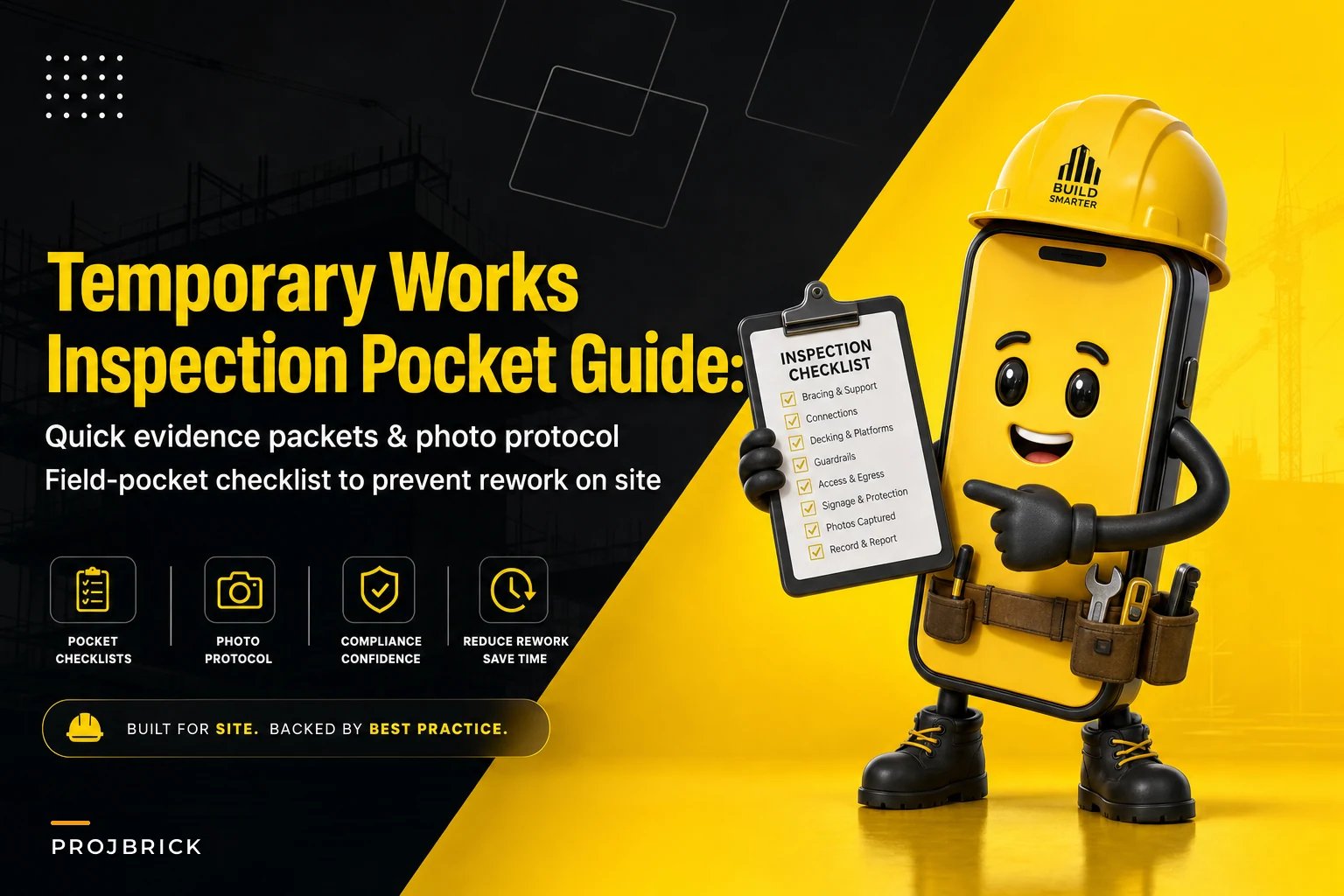
The pocket guide approach works because it fits how construction actually moves. Fast work, changing conditions, multiple decision points throughout the day. Keeping documentation under one minute per issue means teams actually follow through. Focusing on evidence that matters in disputes means every photo serves a purpose.
Most importantly, this protects everyone involved. It protects the GC from false claims. It protects subs from wrongful back-charges. It protects workers from unsafe conditions. Good documentation isn't about assigning blame—it's about establishing truth when memories fade and positions harden.
Tomorrow morning, walk your temporary works with your phone in hand. Apply the three-photo protocol to the first deficiency you find. See how 45 seconds of documentation could save $45k in disputes. Once you see it work once, you won't inspect temporary works the same way again.
Ready to build smarter and faster?
Join 2,000+ construction teams using Projbrick to improve project visibility, reduce delays, and increase profitability.