


Your electrical sub was stellar on the first three projects. Never missed a deadline, crew showed up prepared, documentation always clean. Then project four hits and suddenly they're sending junior guys who can't read the drawings, missing inspections, and the foreman keeps promising fixes that never materialize.
The frustrating part? You probably saw warning signs weeks before it got bad. Maybe they started missing coordination meetings. Submittal quality dropped. Response times stretched from hours to days. But without a real subcontractor governance system, those early signals get buried in daily chaos until you're staring at a two-week delay and explaining to ownership why the MEP rough-in is holding up the entire schedule.
Most PMs manage subs reactively. They wait for problems to become critical before stepping in. No structured onboarding, no systematic way to track performance trends, and when something blows up, they're scrambling to figure out escalation paths instead of following established protocols.
The hidden cost of informal sub management
Walk onto most job sites and ask the super how they track subcontractor performance. You'll get vague answers about "keeping an eye on things" or "we know who the good ones are." Press harder and you might hear about a spreadsheet somewhere. But an actual governance system with onboarding requirements, performance metrics, and escalation triggers? Rare.
This informal approach works fine when you're running one or two projects with familiar subs. Scale up to multiple concurrent projects, bring in new contractors, or face market pressure to use lower-tier subs, and the lack of structure gets expensive fast.
What typically happens on a 40-unit apartment complex when your framing sub starts slipping: first, they're a day behind on the third floor. The PM mentions it at the weekly meeting, gets reassurance. Next week they're three days behind. More promises. By week four, the delay cascades—drywall can't start, MEP rough-in gets compressed, the flooring crew you booked months ago now conflicts with another project. What started as a manageable performance issue becomes a six-figure problem because nobody had clear triggers for intervention.
The real damage goes beyond schedule impacts. When subs know there's no systematic accountability, performance drifts. The A-team they brought for bid walks gets replaced with whoever's available. Quality control loosens. Safety shortcuts creep in. By the time you realize you need to supplement crews or bring in another sub entirely, you're negotiating from weakness.
Building the four-pillar governance framework
A functional governance system doesn't need to be complex, but it needs to be consistent. The framework that actually holds up breaks into four connected components: structured onboarding, continuous scoring, performance-based governance triggers, and clear escalation paths.
Keep your construction projects on schedule and budget.
Projbrick helps you plan, track, and manage every project phase with precision and ease.
- Real-time project tracking
- Resource & budget management
- Team collaboration tools
No credit card required
Onboarding that prevents problems
Most subs get "onboarded" with a contract signature and a brief site orientation. That's not onboarding—that's paperwork. Real onboarding establishes operational alignment before work starts.
The onboarding packet should force clarity on the stuff that causes problems later. Not just insurance certificates and safety plans, but operational details: Who's the dedicated foreman for this project? What's their cell number? Who has authority to make field decisions? What's the escalation path within their company? How will they handle overtime or acceleration if needed?
A mechanical contractor once described a situation worth remembering—eight weeks into a hospital renovation, they discovered the plumbing sub's "project manager" was handling six other jobs and hadn't visited the site once. Every RFI, every coordination issue, every minor decision bottlenecked through someone who barely knew the project existed. Proper onboarding would have surfaced that resource allocation problem on day one.
The packet should also establish performance expectations with specific metrics. Not vague language about "timely completion" but actual targets: RFIs answered within 24 hours, shop drawings submitted per the agreed schedule, daily reports filed by 4 PM. When the glazing contractor later claims they didn't know about the 48-hour RFI response requirement, you have their signed acknowledgment from onboarding.
Tiering and scorecards that track reality
Every PM mentally categorizes their subs—the reliable ones, the ones that need watching, the ones they'd never use again if they had a choice. But mental categories don't drive systematic management. You need actual scoring that captures performance data and triggers appropriate oversight levels.
The scoring system doesn't need twenty metrics. Focus on what actually impacts project success:
-
Schedule adherence (percentage of milestones hit)
-
Quality metrics (inspection pass rates, punch items per phase)
-
Coordination participation (meeting attendance, RFI response times)
-
Safety compliance (violations per crew-hour, near-miss reporting)
-
Administrative compliance (submittal timing, daily reports, billing accuracy)
Weight these based on project priorities. On a fast-track data center, schedule adherence might carry 40% of the score. On a luxury condo, quality metrics might dominate.
The key is making scoring systematic, not subjective. Track actual data points, not impressions. When the concrete sub consistently scores 85+ on schedule but drops to 60 on quality metrics, you know exactly where to focus oversight. When their overall score drops below 70 for two consecutive periods, that triggers increased governance—not because someone's annoyed, but because the data demands it.
This tiering naturally creates a governance hierarchy. Tier 1 subs earning consistent 85+ scores operate with minimal oversight—standard progress monitoring. Tier 2 subs in the 70–84 range get weekly performance reviews and coordination checks. Tier 3 below 70 triggers daily monitoring, required check-ins, and preparatory meetings before critical activities.
Performance triggers that prevent surprises
The most useful part of any subcontractor governance system is automatic triggers based on performance indicators. Instead of waiting for problems to compound, the system flags issues while they're still manageable.
Start with schedule-based triggers. Two consecutive missed daily targets triggers a same-day field meeting. A missed weekly milestone triggers a formal recovery plan requirement within 48 hours. Fall behind baseline by more than 5%, and it triggers escalation to senior management with potential crew supplementation.
Quality triggers work similarly. First failed inspection triggers immediate remediation planning. Second failure on the same issue triggers retraining requirements. Third failure triggers stop-work until root cause analysis is complete. The staging and coordination issues we've covered before often trace back to quality problems that weren't addressed systematically.
Don't overlook administrative triggers. Subs who repeatedly submit late daily reports, miss coordination meetings, or fail to update schedules might not seem like a major problem—until their lack of communication causes a coordination clash that stops work. Three missed administrative requirements in a week should trigger a formal warning. Five, and you're in breach of contract territory.
Resource triggers catch degradation before it hits the work. If the electrical sub promised eight journeymen and shows up with four apprentices and two journeymen, that's an immediate trigger. If their designated foreman hasn't been on site for three consecutive days, trigger. If they're pulling crews to another project without notice, trigger.
The escalation playbook that actually works
Triggers without escalation paths are just alerts nobody acts on. The escalation playbook needs to spell out exactly what happens when triggers fire, who's responsible, and what the timelines look like.
Level 1 escalations stay at the field level. The superintendent addresses the issue directly with the sub's foreman, documents the discussion, and monitors for improvement. Timeline: resolution within 24 hours or escalate to Level 2. This handles roughly 70% of issues—miscommunications, resource hiccups, minor coordination problems.
Level 2 brings in project management. The PM meets with the sub's project manager, not the field crew. They review performance data, establish a correction plan with specific deliverables, and set monitoring milestones. Timeline: correction plan within 48 hours, measurable improvement within one week or escalate to Level 3. This is where you catch systemic issues—understaffing, skill gaps, resource conflicts with other projects.
Level 3 involves senior management from both organizations. The GC's project executive meets with the sub's owner or senior VP. They review contractual obligations, discuss supplementation or replacement options, and make go/no-go decisions. Timeline: meeting within 72 hours of escalation, decision within one week. By this point, you're talking cure notices, backup contractors, and potential termination.
Level 4 is contractual action—formal notices of breach, activation of supplementation clauses, or termination. Legal gets involved, bonds might be called, replacement subs mobilize. If you reach Level 4, the relationship is essentially over, but at least you arrived there through a documented process, not an emotional explosion.
The playbook should include sample templates for each level. The Level 1 field note documenting a missed concrete pour window. The Level 2 correction plan detailing how the steel erector recovers a five-day delay. The Level 3 senior management meeting agenda. The Level 4 cure notice that legal has pre-approved. When escalation is needed, project teams shouldn't waste time figuring out how to document it.
Below is a quick reference for escalation ownership and timing:
| Level | Who Handles It | Timeline | Common Trigger |
|---|---|---|---|
| 1 | Superintendent + sub foreman | Resolve within 24 hours | Missed daily target, minor safety gap |
| 2 | PM + sub's PM | Correction plan within 48 hours | Systemic delay, skill gap, coordination miss |
| 3 | Project executive + sub owner/VP | Meeting within 72 hours | Schedule slippage >5%, repeated Level 2 failures |
| 4 | Legal, senior leadership | Decision within 1 week | Breach of contract, bond activation, termination |
Here’s a quick visual to share with teams so everyone understands the sequence from trigger detection to final resolution.
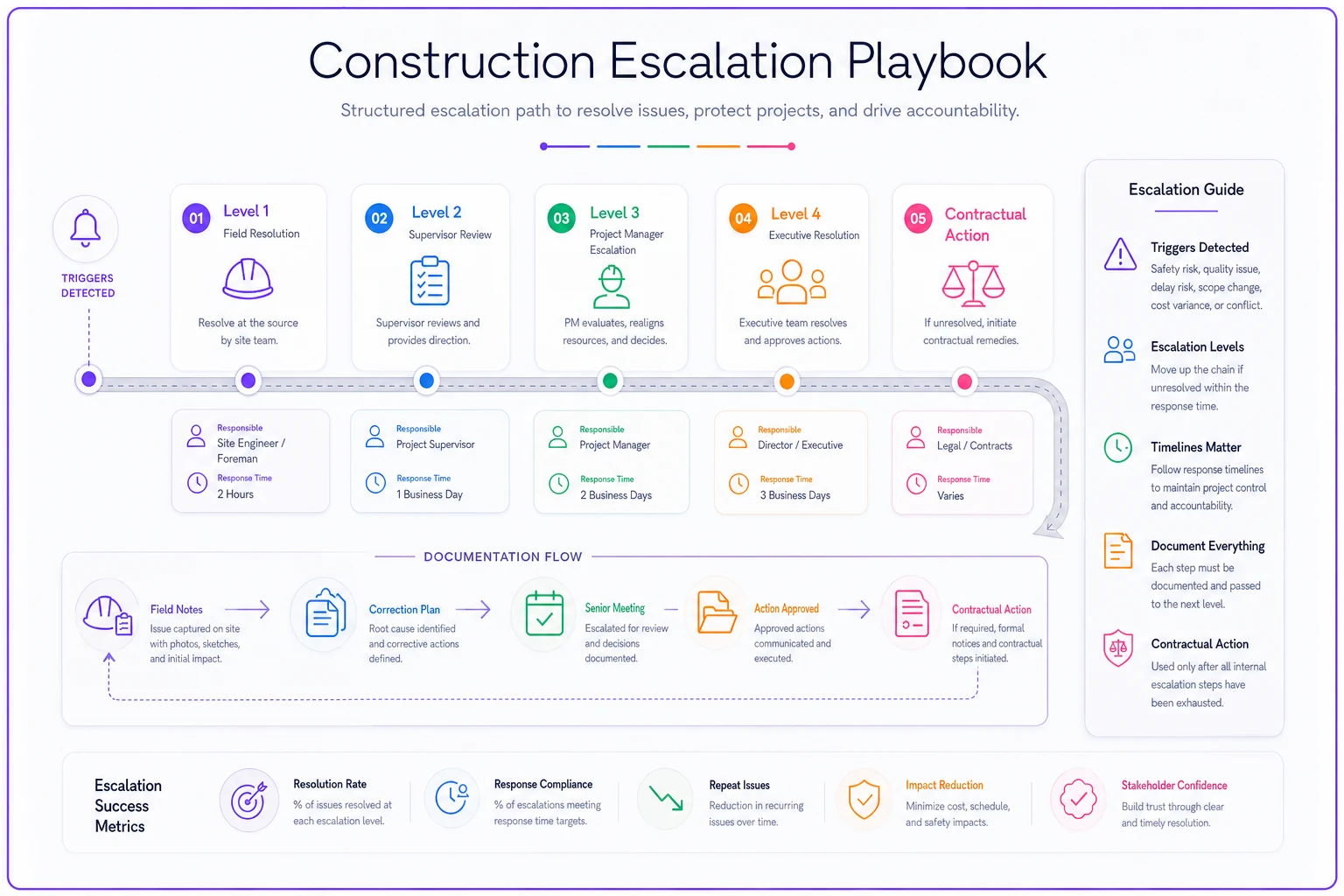
The playbook should include sample templates for each level so teams don't waste time figuring out how to document escalations.
Sample SLAs tied to real KPIs
Service Level Agreements feel corporate, but they're really just clear expectations with consequences. The key is tying them to measurable KPIs that actually matter for project success.
Schedule SLAs:
-
Daily work plan submission
Due by 6 AM for next day's work, 95% compliance required
-
Milestone achievement
90% of weekly milestones hit on time, measured over rolling 4-week periods
-
Recovery plans
Required within 48 hours of any missed milestone, must show path to baseline recovery within two weeks
-
Crew levels
Minimum 85% of committed crew size daily, measured weekly
Quality SLAs:
-
First-time inspection pass rate
Minimum 80% for rough-in, 90% for finish work
-
Punch list items
No more than 5 items per 1,000 SF for rough work, 2 per 1,000 SF for finish
-
Rework completion
All rework addressed within 72 hours of identification
-
QC documentation
Daily quality checks documented and submitted within 24 hours
Coordination SLAs:
-
Meeting attendance
100% required for weekly coordination, 90% for daily huddles
-
RFI response
24 hours for critical path items, 48 hours for standard
-
Submittal timing
Per approved schedule with no more than one revision cycle
-
Model coordination
Conflicts resolved within 72 hours of identification
Safety SLAs:
-
Violation rate
No more than 1 per 100 crew-hours
-
Incident reporting
Within 2 hours for any incident, near-miss, or unsafe condition
-
Training compliance
100% of crew with required certifications on site
-
Safety meeting participation
100% attendance at weekly toolbox talks
Administrative SLAs:
-
Daily reports
Submitted by 5 PM same day, 95% compliance
-
Schedule updates
Weekly updates by Thursday noon
-
Billing accuracy
No more than 5% variance from verified quantities
-
Change order pricing
Submitted within 5 days of request
The enforcement mechanism matters as much as the SLAs themselves. Minor violations trigger notifications. Repeated violations trigger performance improvement plans. Systematic violations trigger financial consequences—reduced retention, delayed payment, or contract action.
One concrete contractor learned this lesson the hard way after repeatedly missing daily report SLAs, treating it as meaningless paperwork. When a differing site condition claim came up months later, they couldn't prove when they encountered the condition because their documentation was sporadic. The missing contemporaneous records cost them a six-figure claim. Suddenly daily reporting didn't seem so trivial.
Common governance failures (and early warning signs)
The slow fade: A previously solid sub gradually declines. They still hit major milestones but quality drops, coordination gets sloppy, and their best people disappear. This often happens when subs win larger projects elsewhere and treat yours as a backup resource pool. Early warning: key personnel changes without notification, increasing apprentice-to-journeyman ratios, and delayed responses to routine communications.
The feast or famine: The sub alternates between over-resourcing and under-resourcing based on their other work. One week you have twelve electricians, next week you have three. They're not failing entirely, but the inconsistency wreaks havoc on your overall schedule coordination. Early warning: highly variable daily crew counts, frequent requests to "make up time" on weekends, and supervisors mentioning other projects.
The competence gap: The sub's management promises capabilities their field crews can't deliver. You contracted for a firm that does complex hospital MEP, but the crew they sent has only done simple commercial work. Every coordination meeting becomes a training session. Early warning: excessive RFIs on standard details, field crews constantly calling supervisors for decisions, and resistance to anything beyond basic scope.
The documentation disaster: Work gets done but paperwork doesn't. No daily reports, sketchy quality records, missing certifications. Everything seems fine until you need to prove compliance for inspections or close out phases. Then you're scrambling to recreate months of records. Early warning: late or missing administrative submittals from day one, verbal updates instead of written reports, and "we'll get you that tomorrow" becoming a pattern.
The cash flow casualty: The sub's financial problems bleed into your project. They can't maintain crew sizes, material deliveries get held for payment, and their focus shifts to getting paid faster rather than executing work. Early warning: requests for accelerated payment, suppliers calling about unpaid bills, key employees mentioning delayed paychecks.
Technology and system automation
Manual governance systems fail because they require constant human attention that project teams simply don't have. Systematic tracking, automatic triggers, and clear escalation paths are exactly where AI-powered operational software earns its place on complex projects.
Modern platforms can pull performance data from multiple sources automatically—schedule updates from your project management system, quality reports from field inspection apps, safety incidents from your EHS platform—all feeding into a unified governance score. No manual data entry, no delayed updates, just real-time performance visibility across every active sub.
The automation shines in trigger management. Instead of hoping someone notices the mechanical sub missed their third coordination meeting, the system flags it immediately, notifies the right people, starts escalation timers, and tracks resolution. Pattern recognition helps too—when a sub's performance starts declining ahead of their other project milestones, the platform can flag resource conflicts before they hit your job.
AI-assisted tools also help with the subjective signals that pure rule-based systems miss. Natural language processing can scan daily reports for phrases that indicate brewing problems—"waiting on materials," "crew reassigned," "unable to complete"—and surface them automatically. It can also analyze communication patterns, flagging when response times increase or key personnel disappear from correspondence.
The documentation benefit is significant for avoiding material-driven delays and payment disputes. Every trigger, escalation, and resolution gets captured automatically with timestamps and responsible parties. When the drywall sub claims they were never told about quality issues, you have the complete trail—the failed inspection, the Level 1 field discussion, the Level 2 correction plan they signed, and their subsequent performance data.
Predictive elements help prevent issues rather than just respond to them. When a sub's score drops 15% over three weeks while their change order requests jump sharply, that can flag a likely cash flow problem before it affects crew availability. When quality scores decline every time a specific foreman runs the crew, you know exactly where to focus attention.
Making governance stick
The best governance system means nothing if it's not consistently applied. Implementation fails when teams treat it as extra work instead of essential process.
Start with your next project, not retroactively on current ones. Trying to impose governance mid-project creates resistance and contractual arguments. Make it part of the bid package for new work—subs know the requirements upfront and price accordingly.
Keep the initial system simple. Better to have five metrics you track consistently than twenty you ignore. Focus on what kills projects: schedule adherence, quality pass rates, and safety compliance. Add sophistication once the basic rhythm is established.
Train the field team, not just management. Superintendents and foremen do the daily observation that feeds the governance system. If they don't understand why you're tracking certain metrics or how escalation helps them, they'll pencil-whip reports and ignore triggers.
Assign a superintendent as the governance lead to keep daily reports accurate and escalate issues promptly.
Make the data visible. Post weekly governance scores where everyone can see them—not to shame anyone, but to create transparency. When the electrical sub sees they're trending toward Tier 3, they often self-correct before escalation is needed. When high performers see their Tier 1 status, they tend to protect it.
Review and adjust quarterly. Which triggers fired most often? Which SLAs proved too tight or too loose? Which subs improved with governance, and which didn't respond? The system should evolve based on what actually drives better project outcomes, not what looked good on paper at the start.
The governance payoff
When people ask about the ROI of structured subcontractor governance, the math isn't complicated. On a typical $20M commercial project with 15–20 major subs, catching and correcting one significant performance issue early saves more than the entire cost of implementing governance. Prevent one major schedule slip, avoid one substantial rework event, or eliminate one sub replacement crisis, and you're well ahead.
But the real value isn't crisis prevention—it's performance optimization. When subs know they're being measured consistently, behavior changes. The concrete crew that used to show up "sometime in the morning" starts arriving at 6 AM. The mechanical contractor who treated coordination meetings as optional becomes a regular participant. The electrical sub who always had excuses for missed milestones suddenly finds ways to stay on schedule.
Good governance also improves sub relationships over time. Clear expectations and consistent enforcement remove ambiguity and emotion from performance discussions. Strong subs appreciate working with GCs who have professional systems—they know what's expected, how they're measured, and what happens if issues arise. It's the unprofessional contractors who resist governance, usually because they rely on confusion and weak oversight to cover for poor performance.
The data collected through governance becomes invaluable for future projects too. You're not just tracking project performance—you're building a database of contractor capabilities. Which electrical subs excel at hospitals but struggle with high-rises? Which concrete contractors maintain quality when accelerated? Which mechanical contractors have deep benches versus those running skeleton crews? That intelligence improves bid evaluation, contract negotiation, and project planning for years.
The construction market is getting more complex, not less. Labor shortages mean working with whoever's available, not always who you prefer. Schedule compression leaves less room for error. Tighter margins mean you can't absorb the cost of sub failures. In that environment, systematic governance isn't optional—it's what separates professional contractors from everyone else hoping things work out.
Ready to build smarter and faster?
Join 2,000+ construction teams using Projbrick to improve project visibility, reduce delays, and increase profitability.