



Urban construction sites break every rule you learned on suburban projects. That 40x60 foot lot downtown doesn't just limit your crane radius—it fundamentally changes how trades need to sequence their work. The standard approach of scheduling foundation, framing, and MEP in broad phases falls apart when your plumber needs to occupy the exact same 200 square feet where your framer is storing materials.
Why physical space—not time—is the real critical path on constrained urban projects
Most project managers discover this problem around week three, when the electrician shows up to rough-in but can't access the building because the framing crew has lumber stacked against every wall.
Or when the plumber needs to run waste lines but the foundation crew's rebar is blocking the only path through the site. These aren't scheduling conflicts—they're physical space conflicts that traditional scheduling can't solve.
The hidden physics of trade sequencing on urban sites
Space constraints create a domino effect that most scheduling software misses entirely. When you only have room for one trade's materials at a time, the sequence becomes critical. Get it wrong and you're not just dealing with delays—you're dealing with crews standing around because they literally can't work.
Keep your construction projects on schedule and budget.
Projbrick helps you plan, track, and manage every project phase with precision and ease.
- Real-time project tracking
- Resource & budget management
- Team collaboration tools
No credit card required
Consider a typical 4,000 square foot urban infill project. The lot measures 50x80 feet. After setbacks, you're building on roughly 40x60 feet. Your actual working space? Maybe 800 square feet total, split between four sides of the building. That's where materials get staged, where crews move, where equipment sits. Now try fitting foundation forms, rebar, framing lumber, MEP materials, and three different crews into that space.
The math doesn't work unless you sequence down to the day—sometimes the hour.
Traditional scheduling assumes trades can overlap because they're working in different areas. Urban sites destroy that assumption. Your foundation crew pouring footings on the north side blocks access for everyone else. Your framer setting posts means nobody can move materials through that zone for the next four hours. Your plumber trenching for underground waste lines just cut off half your site access.
Micro-sequencing templates that actually prevent conflicts
Forget broad phase scheduling. Urban sites need micro-sequences that plan trade movements in 4-hour blocks. Here's a template that handles the foundation-to-rough-in transition on a constrained site:
-
Monday AM
Excavator completes final grade (north and east sides)
-
Monday PM
Foundation crew sets forms (north wall only)
-
Tuesday AM
Inspector reviews forms, rebar delivered to east staging
-
Tuesday PM
Rebar placement north wall, forms started east wall
-
Wednesday AM
North wall pour (6am start), concrete truck exits by 10am
-
Wednesday PM
East wall rebar while north wall cures
Notice how each block specifies not just what happens, but where it happens and what space it occupies. This level of detail prevents the classic urban site problem: two trades showing up to work in the same 100 square feet.
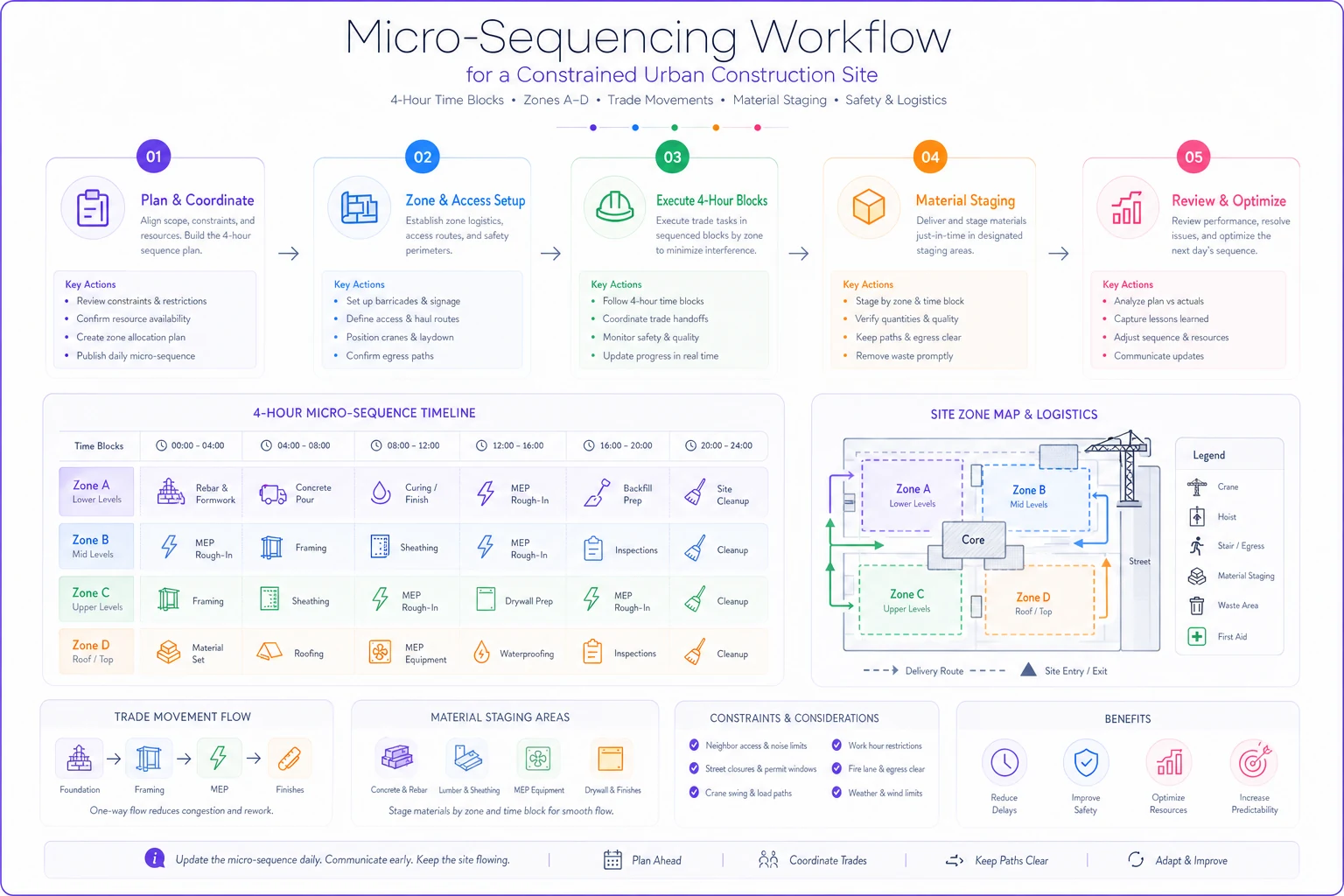
Week 3-4: Foundation to framing transition
-
Monday
Strip north/east forms, stage at street for pickup
-
Tuesday AM
Plumber trenches north side for underground waste
-
Tuesday PM
Framer delivers bottom plates and posts (south staging only)
-
Wednesday
Plumber completes underground, backfills trenches
-
Thursday
Framer starts south and west walls while foundation crew works north
That Tuesday afternoon gap between plumbing and framing isn't wasted time—it's preventing a collision.
Buffer rules that keep trades moving
Standard scheduling adds buffer time between phases. Urban sites need buffer space between trades. These rules keep work flowing:
The 4-hour minimum rule: No trade gets less than 4 hours in a zone. Shorter windows create more conflicts than they solve. If electrical needs 2 hours to run conduit, give them the full morning block.
The 24-hour material rule: Materials arrive maximum 24 hours before installation. Any longer and you're storing materials in active work zones. Your framing lumber shows up Tuesday afternoon for Wednesday morning installation, not Monday for Thursday's work.
The one-trade-per-zone rule: Divide your site into four zones (typically by building face). Only one trade works per zone per half-day. Sounds restrictive, but it eliminates the majority of space conflicts.
Stagger deliveries so each zone receives materials within the 24-hour window to avoid on-site stacking.
The exit-path rule: Every trade must maintain one clear path minimum 4 feet wide from street to active work zone. Block this path and you've trapped whoever's working behind them.
Sample site maps for 3,000-6,000 sq ft projects
Take a real 4,500 square foot mixed-use building on a 55x90 foot corner lot. After setbacks, you're building on 45x70 feet. Here's how to divide the space:
Zone A (North face): 45 feet x 8 feet = 360 sq ft working space Primary access from street, best for material delivery. Foundation and concrete trades get priority here since trucks need direct access.
Zone B (East face): 70 feet x 6 feet = 420 sq ft working space Secondary access, good for MEP staging. Narrower but longer—ideal for running mechanical/electrical parallel to building.
Zone C (South face): 45 feet x 8 feet = 360 sq ft working space Limited access, typically last to be worked. Framing materials stage here while foundation work happens north side.
Zone D (West face): 70 feet x 4 feet = 280 sq ft working space Tightest space, property line adjacency. Reserved for tool storage and waste containers. No material staging.
During foundation phase, concrete trucks use Zone A while Zone C stages rebar. During framing, lumber delivers to Zone C while rough carpentry happens in A and B. During MEP rough-in, Zone B becomes the highway for mechanical runs while electrical works from Zone A.
The coordination happens through assigned time blocks:
| Trade | Primary Zone | Rotation | Notes |
|---|---|---|---|
| Foundation | A and C | Alternating days | Concrete truck access required |
| Framing | C → A → B | Sequential rotation | Follows foundation clearance |
| Plumbing | B primary | Scheduled A access | Vertical runs need coordinated windows |
| Electrical | A primary | Scheduled B access | Panel connections require B access |
| HVAC | B exclusive | During duct runs | No sharing during main runs |
Each of those zone assignments came from hard lessons, not theory. When HVAC shares Zone B during main duct runs, something always gets bent or blocked. Giving them exclusive access for that window is easier than dealing with the repair.
Trade-specific sequencing rules that eliminate rework
Each trade has triggering conditions that most schedules miss. Get these wrong and rework is basically guaranteed.
Foundation to framing triggers:
-
Forms stripped AND removed from site (not just stripped)
-
Concrete tested at 7-day strength minimum
-
Anchor bolts checked for placement (before framing arrives)
-
Grade beam waterproofing complete
-
Temporary shoring removed from adjacent zones
Most schedules just say "foundation complete, start framing." That's how you end up with framers showing up to find forms still stacked against the building.
Framing to MEP triggers:
-
Bottom plates secured and inspected
-
Wall framing complete per zone (not entire building)
-
Temporary bracing installed
-
Fire blocking locations marked
-
Ceiling joists minimum 50% complete
The critical detail: MEP doesn't wait for all framing. They follow zone by zone, starting rough-in while framers work the opposite side.
MEP sequencing rules:
-
Plumbing underground goes first (always)
-
HVAC main runs before electrical panels
-
Electrical follows HVAC but before plumbing vertical
-
Plumbing vertical runs last
-
Low voltage after everything else
This sequence minimizes conflicts. Plumbing underground can't be moved once backfilled. HVAC ducts take the most space so they get priority routing. Electrical needs access to everything but can route around obstacles. Plumbing drain lines need slope, so they go after electrical sets the ceiling height.
Coordination meeting agendas for 10-minute stand-ups
Daily coordination on urban sites isn't about status updates—it's about physical space allocation. These 10-minute meetings happen at 6:45 AM, before work starts.
Monday planning meeting (15 minutes):
-
Review week's zone assignments (2 minutes)
-
Confirm material deliveries and staging locations (3 minutes)
-
Identify space conflicts in next 48 hours (5 minutes)
-
Assign buffer zones for this week (2 minutes)
-
Walk the exit paths together (3 minutes)
Daily stand-up (10 minutes):
-
Yesterday's zones cleared on schedule? (1 minute)
-
Today's zone assignments and timing (2 minutes)
-
Tomorrow's material deliveries and staging (2 minutes)
-
Space conflicts in next 24 hours (3 minutes)
-
Safety path verification (2 minutes)
Every item relates to physical space. Not "are you on schedule?" but "will you be out of Zone A by noon?" Not "any issues?" but "what's blocking the north access path?" That distinction matters more than it sounds.
What poor trade sequencing actually costs you
Poor sequencing on urban sites creates specific, expensive problems:
The cascade delay: Electrician can't access Zone B because plumber's materials are staged there. Plumber can't move materials because framer's saw station blocks the path. Framer can't move saw station because concrete forms are stacked behind it. Three trades, zero work happening.
The double-handle penalty: Moving the same materials multiple times because there's nowhere to stage them properly. That stack of lumber gets moved four times before installation. Each move takes 30 minutes with two people. You just burned several labor hours to poor sequencing.
The inspection trap: Inspector arrives but can't access the work because another trade's materials are in the way. Inspection gets rescheduled, delaying the next trade. On urban sites, this happens constantly with electrical and plumbing rough-ins.
The damage spiral: Trades working on top of each other inevitably damage completed work. Plumber breaks electrical conduit reaching past it. Framer's lumber scratches finished foundation walls. HVAC duct installation knocks out fire blocking. Each repair disrupts the sequence further.
A typical 4,000 square foot urban project sees somewhere between 15-20% schedule growth from space conflicts alone. That's 3-4 weeks on a 16-week project. At roughly $2,000 per day in carrying costs—site overhead, supervision, equipment rental, financing—you're looking at $40,000 to $55,000 in pure waste. And that's before counting overtime to catch up, damaged materials, or the goodwill you burned with good subcontractors. The coordination effort to prevent this? Maybe 2 hours weekly in detailed planning plus 10 minutes daily in morning stand-ups.
When micro-sequencing makes sense (and when it's overkill)
Micro-sequencing isn't always the answer. It depends on specific site constraints.
Good fit for micro-sequencing:
-
Lot size under 7,000 square feet
-
Working space less than 1,000 square feet total
-
Zero on-site material storage
-
Three or more trades overlapping phases
-
Street parking only for deliveries
-
Adjacent buildings within 10 feet
Probably overkill for these sites:
-
Suburban lots over 12,000 square feet
-
Dedicated material storage areas
-
Multiple access points
-
Single trade working at a time
-
On-site parking for crews
A rough rule of thumb: if moving materials takes longer than 15 minutes, or trades spend more than 30 minutes daily sorting out space, you need micro-sequencing. Otherwise, standard scheduling with daily coordination works fine.
Building the sequence around your constraints
Most scheduling starts with duration estimates then tries to fit them into available space. Urban sites need the reverse: start with space constraints, then build durations around them.
Map your constraints first:
-
Total working area per zone
-
Material staging capacity (cubic feet, not just square feet)
-
Access path widths
-
Turning radius for deliveries
-
Crane reach limitations
-
Neighbor agreements on space usage
Then sequence based on space, not time. If Zone A only holds 20 sheets of plywood, your framing sequence breaks into 20-sheet increments. If your concrete truck needs 14 feet clearance, that determines when you strip forms. If the crane can't reach the back corner, MEP goes in before framing closes it off.
This feels backwards at first. You're letting physical space drive the schedule rather than optimal trade sequencing. But on constrained sites, space is the critical path. Fighting that reality just creates conflicts.
Making micro-sequences work with modern tools
Paper schedules can't handle micro-sequencing complexity. You need tools that show space and time simultaneously—zone assignments by half-day, material staging locations, crew paths, and some way to flag conflicts before they happen.
Modern construction operations platforms handle this through automated conflict detection. Instead of manually checking whether the plumber and electrician will collide in Zone B next Tuesday afternoon, the system flags it automatically. Instead of guessing if 400 square feet is enough for framing materials, it pulls from similar projects and warns you if you're undersized.
The most practically useful feature is real-time updates when trades finish early or run late. If framing clears Zone A two hours ahead of schedule, MEP gets notified immediately. If foundation runs long in Zone C, downstream trades shift automatically and the whole sequence recalculates. It's not replacing the judgment of an experienced PM—it's catching the smaller conflicts that slip through when you're managing a dozen moving pieces on a tight site.
The bottom line on trade sequencing urban construction
Urban construction sites operate under different physics than suburban projects. The constraint isn't time or labor—it's physical space. Traditional scheduling assumes trades can overlap because they work in different areas. Urban reality means everyone needs the same 800 square feet of working space.
Micro-sequencing solves this by planning space allocation down to 4-hour blocks. It feels like overkill until you watch three trades standing around because nobody can access their work area. The investment in detailed planning and daily coordination pays for itself by preventing just one major space conflict.
The sites that run smoothly downtown aren't lucky. They've accepted that space drives schedule, not the other way around. They plan material deliveries around staging capacity, sequence trades around zone availability, and coordinate daily on physical space rather than abstract timelines.
Build the micro-sequence upfront, enforce the buffer rules, and run those 10-minute morning meetings. The trades will stop colliding, the work will flow, and you'll finish on schedule despite having nowhere to put anything.
Urban construction sites operate under different physics than suburban projects. The constraint isn't time or labor—it's physical space. Traditional scheduling assumes trades can overlap because they work in different areas. Urban reality means everyone needs the same 800 square feet of working space.
Build the micro-sequence upfront, enforce the buffer rules, and run those 10-minute morning meetings. The trades will stop colliding, the work will flow, and you'll finish on schedule despite having nowhere to put anything.
Ready to build smarter and faster?
Join 2,000+ construction teams using Projbrick to improve project visibility, reduce delays, and increase profitability.