


Last month, a commercial GC showed me their project schedule for a medical office buildout. Twelve phases mapped out in Microsoft Project, color-coded, dependencies linked, the works. Looked bulletproof.
Six weeks later? Phase three was bleeding into phase five, electrical rough-in happened before HVAC ducting, and the flooring contractor showed up while drywall was still being patched. The PM was updating three different spreadsheets, sending daily emails about schedule changes, basically playing whack-a-mole with subcontractor coordination.
This wasn't their first rodeo. Company's been around eighteen years, runs 15-20 projects simultaneously, and they still struggle with the same phase management problems on every job.
What kills me about construction planning—everyone treats each project like it's completely unique. Sure, every building is different. But the fundamental phases? The handoff points? The critical decision gates? Those repeat constantly. Most PMs rebuild their planning framework from scratch every time, then wonder why phases slip and budgets explode.
Why construction phases actually collapse
The typical construction project has 8-20 distinct phases, depending on complexity. Simple tenant improvement might have 8. Ground-up commercial build might have 20+. The pattern I keep seeing: companies have no standardized way to define what constitutes a "complete" phase.
Think about your last project that went sideways. I'd bet the problem started when someone moved to the next phase before the current one was actually done. Maybe framing crew started before foundation inspection was complete. Maybe finish carpentry began while HVAC was still running ductwork. These aren't coordination failures—they're framework failures.
Most construction companies operate with what I call "soft transitions." Phase 2 starts when Phase 1 is "mostly done." Nobody defines what "mostly" means. 80% complete? 95%? Are punch list items included? What about inspections?
This ambiguity compounds as projects scale. Three jobs? You can keep details in your head. Fifteen jobs across multiple PMs? Those soft transitions become massive profit leaks.
A residential GC tracked this across 23 projects. Unclear phase transitions added an average of 12 days to project timelines. Not from delays or problems—just from confusion about when work could actually start. Twelve days of carrying costs, twelve days of delayed revenue, twelve days of tied-up crews.
The modular framework that actually works
Successful companies treat phases like modular blocks with hard edges, not soft suggestions.
Keep your construction projects on schedule and budget.
Projbrick helps you plan, track, and manage every project phase with precision and ease.
- Real-time project tracking
- Resource & budget management
- Team collaboration tools
No credit card required
Phase Definition Template:
-
Entry criteria (what must be 100% complete before starting)
-
Core deliverables (the actual work of this phase)
-
Exit criteria (what defines "done")
-
Required approvals/inspections
-
Next phase dependencies
Most companies create the framework but don't enforce it. The framework only works when you add governance checkpoints that can't be skipped.
The Three-Gate System
A quick visual makes the gate sequence easier to grasp.
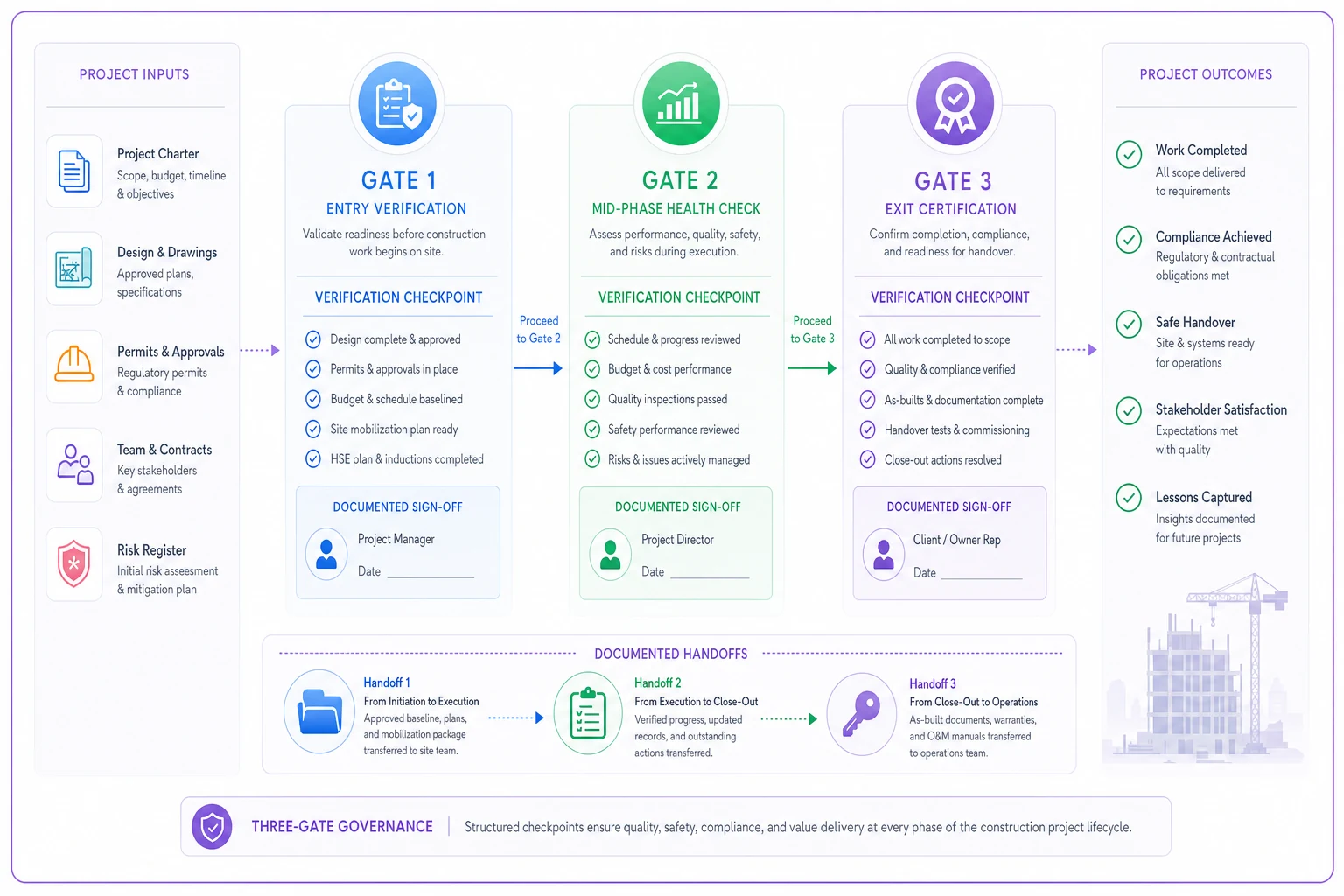
Gate 1: Entry Verification Before any work begins, someone (not the PM running behind schedule) verifies all entry criteria are met. Not a quick email check. Documented verification with sign-off.
Gate 2: Mid-Phase Health Check Halfway through the scheduled phase duration, assess whether you're on track to hit exit criteria on time. If not, adjust now, not when it's too late.
Gate 3: Exit Certification Before anyone moves to the next phase, all exit criteria get verified and documented. No exceptions.
Sounds like overhead? A specialty contractor in Phoenix implemented this system across their division. First month was rough—crews complained about the "paperwork." By month three, they'd reduced rework by 40% and eliminated almost all of the "surprise" delays that used to derail schedules.
Real templates you can steal
This is from an actual framework used by a GC that runs about $30M in projects annually.
Phase 3: MEP Rough-In
Entry Criteria:
| Entry Criteria | Core Deliverables | Exit Criteria | Required Approvals | Dependencies for Next Phase |
|---|---|---|---|---|
| Framing inspection passed and signed off | Electrical rough wiring to code | All three MEP rough inspections passed | City/County inspection certificates | Inspector signatures physically on-site or uploaded |
| All wall locations verified against plans | Plumbing supply and waste lines installed | Photo documentation uploaded to project folder | MEP subcontractor sign-offs | Zero open RFIs related to MEP work |
| Structural modifications complete | HVAC ductwork and equipment placed | Conflicts resolved and documented | GC quality control verification | All change orders processed and approved |
| MEP drawings approved by architect | Coordination between trades documented | Wall closing authorization signed by all three trades | Owner's rep walkthrough (if required) | |
| Permits pulled for all three trades | As-built markups created | Quality checklist completed and signed |
Core Deliverables:
Exit Criteria:
Required Approvals:
Dependencies for Next Phase:
Notice how specific this is? "Inspection passed" isn't good enough—you need the certificate in hand or uploaded. "Plumbing complete" isn't good enough—you need sign-off from the plumber that walls can be closed.
The Decision Rules That Matter
Creating templates is only half the battle. The real value comes from clear decision rules that PMs can follow without thinking.
-
Rule 1
No phase starts without documented entry criteria
If even one criterion isn't met, the phase doesn't start. No "we'll catch up later" exceptions. -
Rule 2
Mid-phase pivots require written approval
If something changes mid-phase that affects the exit criteria, it gets documented and approved before continuing. -
Rule 3
Exit gates are binary
A phase is either complete or it's not. No "substantially complete" or "ready enough" status. Binary decisions prevent scope creep. -
Rule 4
Dependencies chain forward
If Phase 3 exits late, all dependent phases automatically adjust. No pretending you'll "make up time" in the next phase.
Require inspection certificates to be uploaded before allowing wall closing or moving to the next phase.
The real value comes from clear decision rules that PMs can follow without thinking.
How specialized workflows plug into the system
Once you have the modular phase structure, you can plug in specialized processes without breaking the whole system.
Take concrete pours. Every concrete phase—footings, slab-on-grade, or elevated deck—follows the same basic framework:
Concrete Pour Module:
-
Entry
Forms inspected, rebar placed and tied, embeds positioned
-
Core
Pour, finish, cure
-
Exit
Break tests passed, forms stripped, curing complete
The module adapts to its position in the project. A footing pour has different entry criteria than a topping slab, but the governance structure remains identical.
The same principle works for any specialized work. Millwork installation, curtain wall systems, elevator installation—each becomes a module that slots into your master framework. The boundaries stay hard, the governance stays consistent, but the specific work adapts to the project needs.
A mechanical contractor built 22 specialized modules for different types of installations. New project comes in? They grab the relevant modules, arrange them in sequence, and the framework is 80% complete. The remaining 20% is project-specific customization, not rebuilding from zero.
When phases slip anyway (and the recovery protocol)
Even with perfect frameworks, phases slip. Weather happens. Materials don't show up. Inspectors get backlogged. The difference is how you handle the slip within the framework.
Most PMs try to absorb delays by compressing later phases. "We lost three days on framing, but we'll make it up during drywall." This almost never works and usually makes things worse.
The framework approach handles slips differently:
-
Step 1
Stop at the gate
When a phase can't meet its exit criteria on schedule, you stop. No bleeding into the next phase. -
Step 2
Assess impact
Every day of slip affects specific downstream phases. Map it out. If framing slips three days, maybe rough-ins slip three days too. But finish work might not be affected if there's float in the schedule. -
Step 3
Rebuild forward
Adjust all dependent phases based on the new reality. Update all gate dates. Communicate the new schedule to every affected trade. -
Step 4
Document the lesson
Why did this phase slip? Was it an entry criteria problem? A scope definition issue? A resource constraint? Update the phase template so it doesn't happen again.
I watched a GC go through this process on a retail buildout. HVAC equipment arrived two weeks late, completely blowing up Phase 4. Instead of scrambling, they stopped, rebuilt the schedule forward, and communicated clear new dates to everyone. The project still finished late, but only by two weeks instead of the potential four-week disaster it could have been.
Scaling the framework across multiple projects
Once you have your modular phases defined and your governance gates established, you can run multiple projects without the chaos multiplication effect.
Think about running ten projects simultaneously. Without a framework, you're managing 10 different scheduling approaches, 10 different definitions of "complete," and 10 different communication styles. It's exhausting and error-prone.
With the framework, you're managing one system applied 10 times. Your PMs speak the same language. Your subs know exactly what's expected. Your gates create natural communication points.
A concrete example: A commercial GC with eight PMs was struggling with consistency. Some PMs were detail-obsessed, others were big-picture focused. Projects succeeded or failed based on PM style, not process quality.
They implemented this modular framework across all projects. Took about two months to get everyone aligned. Project delay rates dropped from around 35% to under 15%. Not because they got better PMs, but because they gave their PMs a better system.
The operational difference is huge. Instead of weekly firefighting meetings about who screwed up what, they have structured gate reviews. Instead of surprise delays, they have early warning signals. Instead of finger-pointing about phase transitions, they have documented handoffs.
The software piece nobody talks about
This framework generates a lot of checkpoints and documentation. You can do it with spreadsheets and emails, but it's painful. This is exactly where operational software makes a massive difference.
The right platform can automate gate checks, trigger notifications when phases are ready to transition, and maintain all your documentation in one place. AI automation can even flag when phases are drifting toward their deadlines or when entry criteria might not be met based on current progress.
But the software isn't the solution. The framework is the solution. Software just makes the framework easier to execute consistently. Without the framework, you're just digitizing chaos.
Companies try to solve phase management with fancy scheduling software alone. Doesn't work. The software can't enforce governance, can't define completion criteria, can't make go/no-go decisions. That's what the framework does.
Common framework killers to avoid
Too many phases Some PMs create 30+ micro-phases. This creates more overhead than value. Stick to 8-15 major phases for most projects.
Soft gates The moment you allow "conditional approval" to proceed through a gate, the framework falls apart. Gates are binary. Open or closed.
Skipping documentation "We passed the inspection, everyone knows it." If it's not documented in the framework, it didn't happen.
PM override authority If PMs can override gates when they're behind schedule, they will. The framework needs teeth, which means even senior PMs follow the rules.
One-size-fits-all phases A ground-up build needs different phases than a tenant improvement. Build framework variants for different project types.
Making it stick in your organization
Implementing this framework isn't a technical challenge—it's a change management challenge. Your PMs are used to running projects their way. Your subs are used to starting when they feel like it. Your clients are used to pushing for schedule compression.
Start with one project. Pick a PM who's frustrated with the current chaos. Build the framework together, specifically for their next project. Run it as a pilot. Document everything—the good, the bad, and the ugly.
When that first project runs smoother (it will), use it as your proof point. Other PMs will want in. Scale gradually, refining the framework based on real project feedback.
Within six months, you can have your entire operation running on the framework. The consistency alone will transform your business. No more hero PMs saving disaster projects through sheer will. No more surprise delays in month three of a six-month project. No more playing schedule Tetris because nobody knows what's actually complete.
The bottom line on phase management
Construction phase management isn't complicated—it's just usually undefined. The companies struggling with delays and overruns don't have a skills problem. They have a systems problem.
The modular framework solves this by creating clear boundaries, enforced governance, and consistent execution across all projects. It's not about adding bureaucracy. It's about removing ambiguity.
Every phase becomes a contract: "If you give me these inputs, I'll deliver these outputs by this date." Every gate becomes a quality check: "Did we actually deliver what we promised?" Every project becomes predictable: "We know exactly where we are and what's next."
Your choice is simple. Keep managing projects with soft phases and hope for the best. Or implement a framework that makes phase management systematic, scalable, and predictable.
The companies crushing it in construction right now? They've stopped treating every project like a unique snowflake and started treating phase management like the repeatable process it actually is.
Construction phase management isn't complicated—it's just usually undefined. The companies struggling with delays and overruns don't have a skills problem. They have a systems problem.
The modular framework solves this by creating clear boundaries, enforced governance, and consistent execution across all projects. It's not about adding bureaucracy. It's about removing ambiguity.
Ready to build smarter and faster?
Join 2,000+ construction teams using Projbrick to improve project visibility, reduce delays, and increase profitability.