

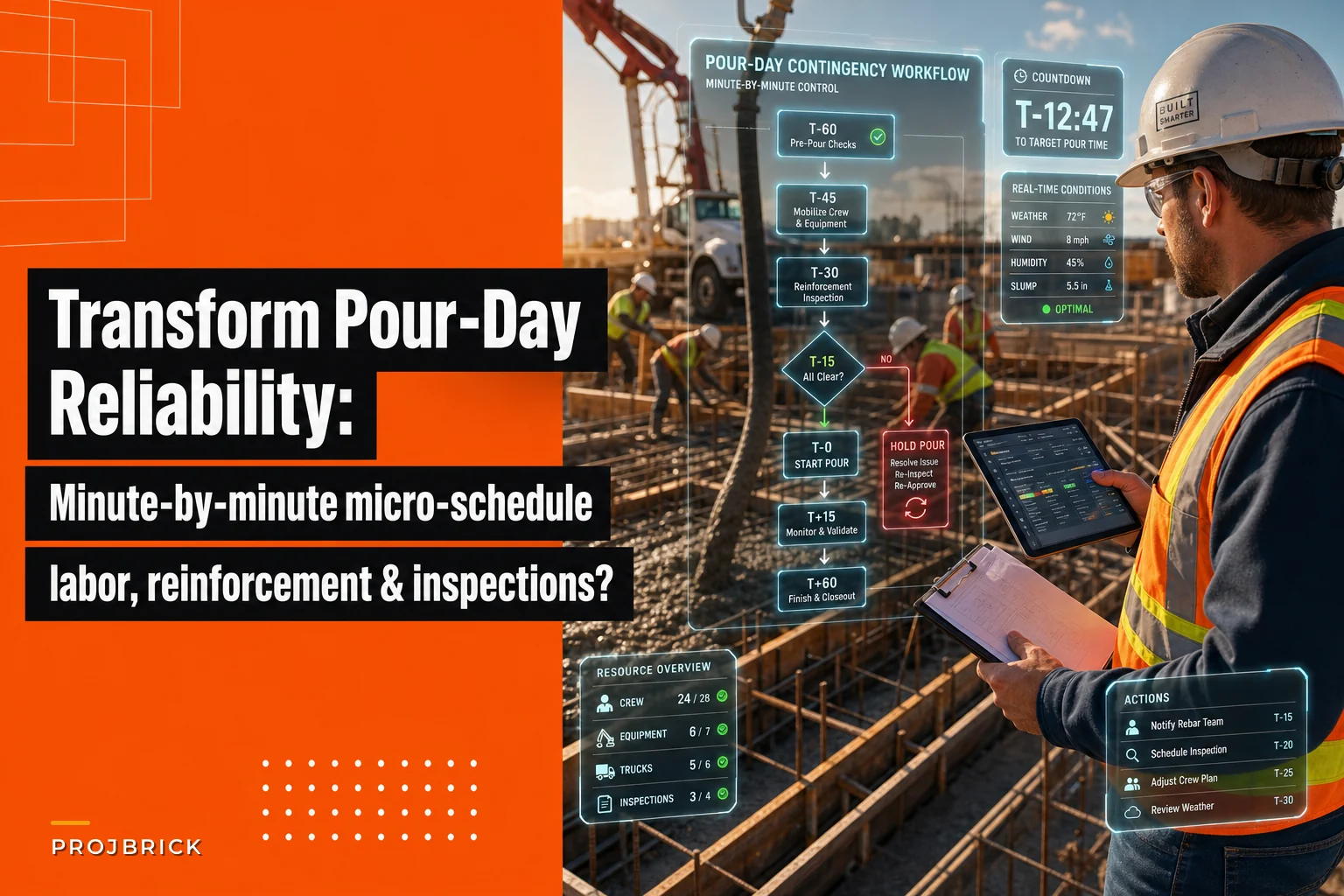

Pour day chaos starts around 5:47 AM.
Concrete trucks are scheduled for 7:00 sharp. Your finisher crew lead just texted—two guys called out sick. The pump operator shows up but nobody told him about the access road change. The rebar inspector arrives at 6:30 asking for documentation that's sitting in someone's truck across site. By the time concrete starts flowing at 7:45, you're already burning overtime and the temperature's climbing past ideal placement conditions.
This pattern costs most concrete contractors somewhere between $8,000 and $15,000 per major pour in labor overruns, material waste, and rework. Not because crews lack skill—but because nobody has an actual minute-by-minute framework that accounts for how small delays compound into expensive ones.
The hidden math behind pour day delays
A 45-minute delay on a 400-cubic-yard deck pour creates a ripple most project managers underestimate. Pump rental running $185 per hour burns roughly $140 for nothing. Six-person finishing crew at overtime rates adds another $420. But the real damage happens downstream.
Concrete sitting too long in hot weather starts setting before proper consolidation. You won't see the honeycombing until form stripping three days later. Patching voids on a typical deck section usually runs around $3,500 in labor and materials.
The breakdown follows a predictable sequence: pre-pour inspection delays trigger truck arrival confusion, which creates placement bottlenecks, which leads to finishing crew standby time, which ultimately causes quality control gaps that generate callbacks weeks later.
What makes pour days particularly vulnerable is the compressed timeline. Unlike framing or mechanical rough-in where you can absorb delays across multiple days, concrete placement happens in hours. You're racing against hydration chemistry.
Building contingency triggers that actually work
Most pour day planning stops at "concrete arrives at 7 AM." That's not planning—that's a wish.
Keep your construction projects on schedule and budget.
Projbrick helps you plan, track, and manage every project phase with precision and ease.
- Real-time project tracking
- Resource & budget management
- Team collaboration tools
No credit card required
Real pour day control means having specific triggers for specific problems. Not vague "if this then that" statements, but actual operational responses tied to clock times.
Take crew shortage scenarios. Standard approach: scramble for replacements when someone calls out. Better approach: pre-assign overflow responsibilities. At T-minus-60 minutes, if you're short finishers, your rod buster lead automatically shifts two people to finishing after final tie-offs complete. This isn't a maybe—it's a documented handoff that happens at a specific time.
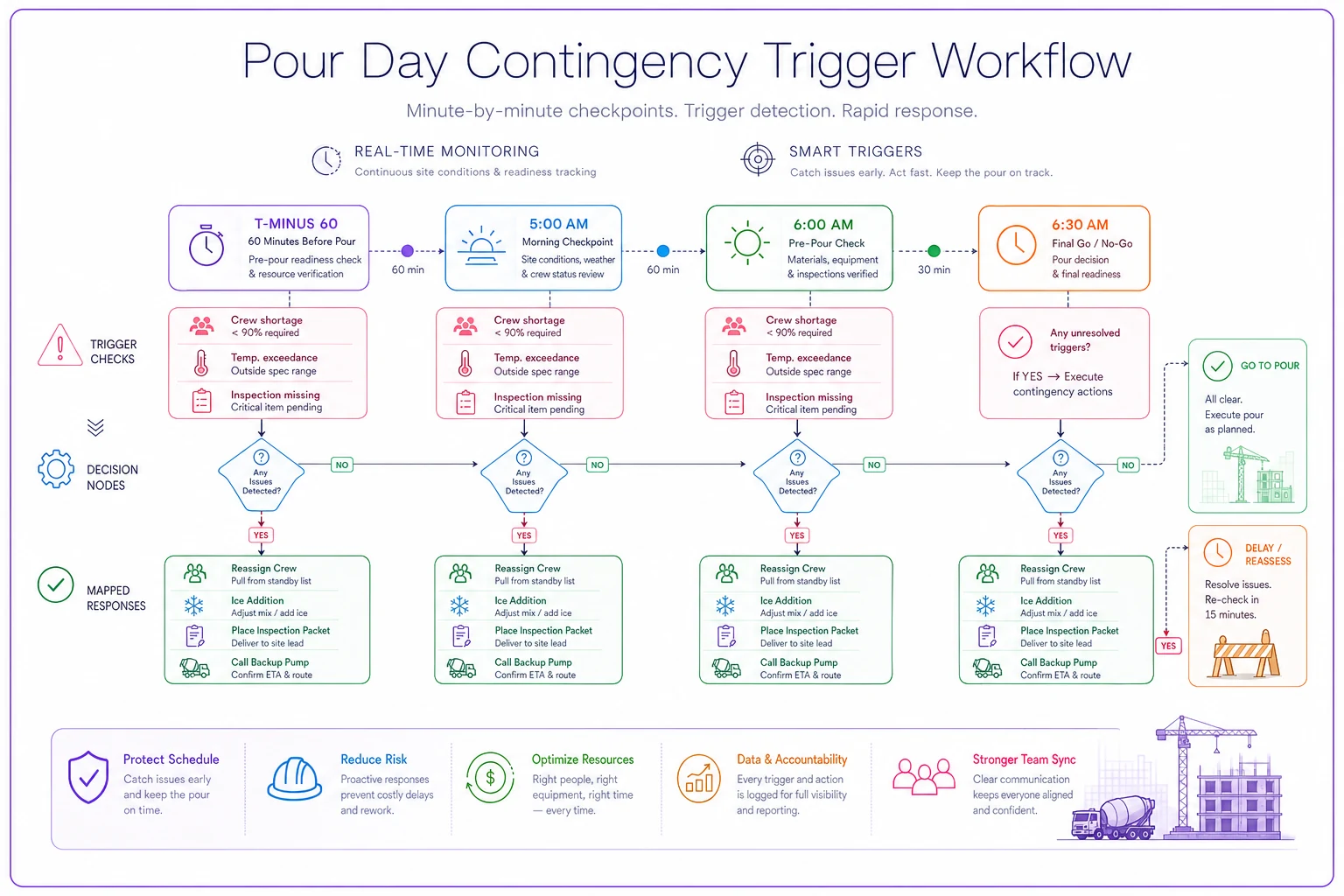
Temperature contingencies need the same precision. Concrete mix designs have placement temperature windows, typically 50–90°F. But waiting until trucks arrive to check temperature means you're already reacting. Set measurement points: 5 AM ambient reading, 6 AM plant confirmation, 6:30 AM first load temperature check. If any reading exceeds limits, you have specific responses—ice additions, retarder adjustments, pour sequence modifications—triggered before problems compound.
The inspection bottleneck deserves special attention. Inspectors showing up mid-pour asking for paperwork kills momentum every single time. Create an inspection packet protocol: all required documents (mix designs, testing reports, reinforcement shop drawings) assembled in a weatherproof folder at the pour location by 5:30 AM. Not "available on request"—physically present at the exact spot where the inspector will stand.
Equipment redundancy follows similar logic. Pump goes down mid-pour and the typical scramble for a replacement burns two to three hours minimum. The prepared approach: pre-negotiate backup pump availability with your rental company for all major pours, guaranteed 45-minute response if called before 8 AM. That might cost $500 in standby fees versus $5,000+ in crew standby and rejected loads.
The actual minute-by-minute breakdown
Here's what a properly scheduled 400-yard deck pour looks like mapped to real time:
5:00 AM – Layout foreman arrives, verifies form elevations at five control points, marks pump location with cones, confirms access routes clear 5:15 AM – Electrical contractor caps all conduit stubs (this always gets missed), removes any tools from deck 5:30 AM – Inspection packet placed at pour entrance, backup printed copies in superintendent truck 5:45 AM – First finishing crew arrives, checks vibrator operation, stages finishing tools along pour path 6:00 AM – Final rebar walk with rod foreman, photograph any questionable areas, adjust chairs for proper coverage 6:15 AM – Pump operator arrives, positions equipment, runs test strokes, confirms hose reaches all pour zones 6:30 AM – Inspector arrival window opens, reinforcement inspection begins immediately with pre-staged documentation 6:45 AM – Testing technician sets up, confirms cylinder molds and slump cone ready 7:00 AM – First concrete truck arrives, slump test on first load 7:10 AM – Pour begins at far corner, working toward pump location 7:25 AM – Second truck arrives and stages, maintains 15-minute truck intervals 8:00 AM – Pour reaches 25% complete, first section ready for initial float 9:30 AM – Pour reaches 75% complete, leading edge finishing continues 10:45 AM – Final concrete placed, pump breakdown begins 11:15 AM – Final finish on last section, cure compound application starts 12:00 PM – Curing complete, site cleanup, tools collected
This timeline assumes zero delays. Reality requires adjustment protocols at each checkpoint.
Role-specific checklists that prevent standstill
Generic pour day checklists fail because they don't assign clear ownership. Every role needs distinct responsibilities tied to specific times.
Foreman Checklist (5:00–7:00 AM)
-
Verify grades at corners and mid-span (5
00)
-
Confirm vapor barrier intact, no tears (5
10)
-
Check formwork for bow/deflection (5
20)
-
Mark concrete placement sequence on deck (5
30)
-
Brief pump operator on pour progression (6
15)
-
Radio check with all crew leads (6
45)
Finisher Lead Checklist (5:45–12:00)
-
Test all vibrators, have spare ready (5
45)
-
Stage straight edges and floats (6
00)
-
Assign coverage zones to crew (6
30)
-
Monitor leading edge consolidation (7
10 onward)
-
Check for cream consistency behind vibrator (continuous)
-
Call for retarder if setting accelerates (as needed)
QC Inspector Checklist (6:30–10:00)
-
Document rebar placement and spacing (6
30)
-
Verify concrete tickets match approved mix (7
00)
-
Witness slump and air testing (7
00, then hourly)
-
Monitor vibration technique (7
30 onward)
-
Check finish tolerances with 10-foot rod (post-float)
-
Document any non-conformance immediately (continuous)
These aren't suggestion lists. They're time-stamped operational requirements that create accountability. The difference matters when things start going sideways.
Catching the cascade before it starts
Small problems compound into pour day disasters through predictable patterns. Recognizing the cascade early changes everything.
The documentation cascade starts when one missing paper halts inspection. Inspector can't sign off on rebar without mill certificates. Pour gets held. Trucks start stacking up. Concrete sits in drums getting hot. Slump drops. Field adds water to restore workability. Strength gets compromised. Failed break tests three weeks later trace back to that missing paper at 6:30 AM.
The access cascade begins with a blocked pump location. Pump sets up in secondary position. Hose runs get longer than planned. Pumping pressure increases. Line speed drops. Placement rate slows. Finishing crew stands idle between sections. Overtime kicks in. Cold joints form between placements.
The weather cascade triggers when morning temperatures spike unexpectedly. Concrete arrives at 85°F instead of planned 75°F. Initial set accelerates. Finishing window shrinks. Crew rushes final floating. Surface tears develop. Power troweling can't correct it. Entire sections need grinding and topping later.
Each cascade follows cause-and-effect logic you can interrupt—but only if you spot the initial trigger and respond before it compounds.
Temperature and timing adjustments
Concrete chemistry doesn't care about your schedule.
At 50°F ambient, concrete gains strength slowly. Your 4-hour finishing window stretches to 6 hours. Sounds beneficial until you realize crew productivity drops as they wait for proper set. Form stripping gets delayed. Following trades can't start.
At 85°F, that same mix sets in roughly 2 hours. Now you're fighting time. A crew size that handles normal conditions can't keep pace. Leading edge hardens before finishing. Surface defects multiply. Touch-up work doubles.
Standard specs say "maintain concrete temperature between 50–90°F." That's not enough for operational planning.
Cold weather adjustments (below 60°F):
-
Reduce pour size by 30% to match slower finishing pace
-
Add one extra finisher per 100 cubic yards
-
Schedule trucks at 20-minute intervals instead of 15
-
Use accelerator only in final 25% of pour
-
Start curing blanket installation immediately after final finish
Hot weather adjustments (above 80°F):
-
Start pours at 5 AM maximum, ideally earlier
-
Pre-cool forms with water spray the evening before
-
Increase crew by 50% for rapid finishing
-
Reduce truck intervals to 12 minutes
-
Stage retarder on-site for emergency additions
-
Apply cure compound in multiple thin coats
Temperature planning happens days before pour day, not hours before.
When micro-scheduling becomes critical vs. overkill
Not every pour needs minute-by-minute control. A 50-yard equipment pad? Basic coordination is fine. But certain conditions demand surgical precision.
High-rise deck pours above floor 10 need micro-scheduling because crane coordination becomes critical. Every concrete bucket ties up the crane for 8–10 minutes. Other trades need that same crane. Without precise timing, either concrete crews wait or other trades shut down.
Post-tension deck pours require similar discipline. Cable stressing happens 18–24 hours after placement. Miss that window because the pour ran late and the entire floor cycle shifts. One bad pour day creates weeks of schedule compression.
Architectural concrete with exposed finishes can't tolerate timing mistakes. Color variation happens when placement gaps create cold joints. Bug holes multiply when vibration timing varies. Repairs on this type of work often run $50–100 per square foot—far more than prevention.
Bridge deck pours are probably the most critical application. Traffic control windows don't flex. Environmental permits restrict working hours. Concrete must hit specific strength before reopening lanes. Every minute matters when you're racing both chemistry and regulations.
The general rule: if pour day problems cost more than $10,000 to fix, micro-scheduling pays for itself. Below that, standard coordination usually suffices.
Inspection coordination that doesn't stop progress
The traditional inspection dance wastes enormous time. Inspector arrives, requests documentation, foreman scrambles, pour holds for 20–30 minutes, trucks back up, concrete overheats. This happens because inspection gets treated as an interruption rather than a workflow component.
Start with pre-positioning. Every required document lives in one physical binder at the pour location before anyone arrives. Mix designs, batch tickets from test pours, reinforcement shop drawings, testing certifications, special inspection forms—all of it. Not in the trailer, not in someone's truck. At the exact spot where concrete placement begins.
The inspector gets a text at 6 AM with GPS coordinates and a photo of the meeting location. No wandering around site. They walk directly to a staged inspection point with everything ready.
During active pours, assign a dedicated liaison—typically your most experienced laborer who understands both construction and documentation. This person's only job: shadow the inspector, answer questions, and retrieve any additional information within 60 seconds. Keeps the inspector away from your foreman during critical placement.
Some inspectors insist on watching specific operations—consolidation around embeds, reinforcement coverage at cold joints, finishing techniques. Build these into your pour sequence. Mark viewing locations with paint. Tell the inspector "vibration around electrical boxes happens at 8:15 at grid line C-4." They show up, observe, document, and leave without disrupting flow.
The post-pour inspection needs equal attention. Have your QC lead complete tolerance checks and curing verification before the official inspection returns. Turns inspection from problem discovery into solution verification.
Making this sustainable for your crew
Perfect pour day execution once means nothing if crews can't repeat it. The challenge isn't creating the plan—it's building systems people actually follow at 5 AM under pressure.
Start with partial implementation. Pick two critical control points—typically concrete arrival and inspection timing—and nail those consistently for a month before adding complexity. Crews need wins to buy into new systems.
Visual management beats written procedures every time. Paint pour sequences directly on the deck. Use color-coded stakes for truck positioning. Hang laminated checkpoint cards at each work zone. The less crews need to remember, the more they execute correctly.
Paint pour sequences directly on the deck and use color-coded stakes so crews don't have to memorize positions under pressure.
Build recovery protocols for when things go wrong. Pour starts 30 minutes late—what's the compressed schedule? Two finishers don't show—who covers which zones? Pump breaks—what's the backup plan? Document these as simple if-then statements.
Rotate responsibilities gradually. The same foreman running every pour day leads to burnout and single points of failure. Train assistants on specific components—one handles inspection coordination, another manages truck scheduling.
Technology helps but isn't magic. Group messaging keeps everyone synchronized. GPS tracking shows truck locations. Weather apps provide real-time temperature data. But the foreman who relies entirely on apps will fail when cell service drops.
After each pour, spend 15 minutes identifying the single biggest delay source. Not five things—one specific bottleneck. Fix that before the next pour. Incremental improvement beats trying to perfect everything at once.
What AI-powered coordination looks like in practice
Modern operational software changes pour day coordination from reactive scrambling to something closer to predictive control—not through magic, but through systematic information flow that catches problems before they cascade.
The real value isn't replacing human judgment. It's pattern recognition across a large volume of pours. When you've logged data consistently, software starts surfacing correlations that aren't obvious. Maybe pours starting after 6:30 AM in July show significantly higher defect rates. Or a specific concrete plant consistently delivers loads hotter than specified. Or certain inspector-crew combinations reliably run 45 minutes behind.
AI automation handles the coordination tasks that quietly burn mental energy. Tracking five concrete trucks in real-time while managing crew assignments while fielding inspector questions while monitoring weather—that cognitive load compounds fast. Operational software maintains visibility across all those variables and alerts supervisors only when something crosses an intervention threshold.
Truck spacing optimization is a practical example. Standard approach: dispatcher sends trucks at fixed intervals, leading to bunching or gaps. An AI-assisted platform monitors actual placement rate, traffic conditions, and plant batch times to dynamically adjust dispatch timing. Trucks arrive when needed—not too early creating hot loads, not too late creating cold joints.
| Coordination Task | Manual Approach | AI-Assisted Approach |
|---|---|---|
| Truck dispatch timing | Fixed intervals from dispatcher | Dynamically adjusted based on placement rate and traffic |
| Inspection documentation | Paper binder, assembled morning of | Digital pour package, QR code accessible on-site |
| Temperature monitoring | Spot checks at scheduled times | Continuous data pull with automated threshold alerts |
| Delay pattern detection | Foreman memory and experience | Cross-pour data analysis surfacing recurring bottlenecks |
| Crew shortage response | Reactive scramble when problem occurs | Pre-triggered reassignment protocol at defined time |
The inspection documentation piece becomes surprisingly useful when systematized. Every required document lives in a digital pour package, accessible by QR code at the site. Inspector scans, reviews, approves. No paper shuffling, no missing forms. And historical inspection data starts revealing which items repeatedly cause holds, so you can address them proactively.
Weather integration goes beyond basic temperature checks. Pulling hyperlocal weather data alongside concrete mix specs and evaporation rate calculations, the software can predict when finishing conditions will turn critical—alerting you something like "surface moisture evaporation will exceed 0.2 lb/sf/hr at 11:15 AM, apply retarder by 10:45 or adjust sequence."
None of this replaces experienced foremen making field decisions. It handles information management, pattern detection, and routine coordination—freeing mental bandwidth for actual problem-solving.
Pour day precision as competitive advantage
Most contractors treat pour days as barely controlled chaos—something to survive rather than optimize. That creates real opportunity for anyone willing to build operational discipline.
The math adds up quickly. Reducing average pour delays from 45 minutes to 15 minutes saves roughly $2,400 per pour in direct costs. Preventing one honeycomb repair per month saves another $3,500. Avoiding one rejected load periodically adds more on top. These aren't theoretical numbers—they're typical results when micro-scheduling gets properly implemented.
Beyond cost savings, reliable pour execution becomes a scheduling advantage. When you consistently hit pour windows, general contractors notice. You become the subcontractor who doesn't blow milestones. That reputation translates directly into negotiating power and preferred status on future work.
The compound effect matters too. Each successful pour generates data. Patterns emerge. Refinements accumulate. While competitors repeat the same mistakes, your operation gets progressively tighter.
The concrete micro-schedule framework outlined here comes from patterns observed across real pour days—not textbook theory. The specific times, triggers, and contingencies reflect actual field execution. Implementation requires discipline, not perfection. Start with time-stamped responsibilities. Add contingency triggers for your most common problems. Build inspection coordination that doesn't interrupt flow. Let operational software handle coordination complexity while your crews focus on execution. The difference between contractors who barely survive pour days and those who consistently dominate them isn't skill or experience—it's systematic preparation that turns chaos into clockwork.
Ready to build smarter and faster?
Join 2,000+ construction teams using Projbrick to improve project visibility, reduce delays, and increase profitability.