
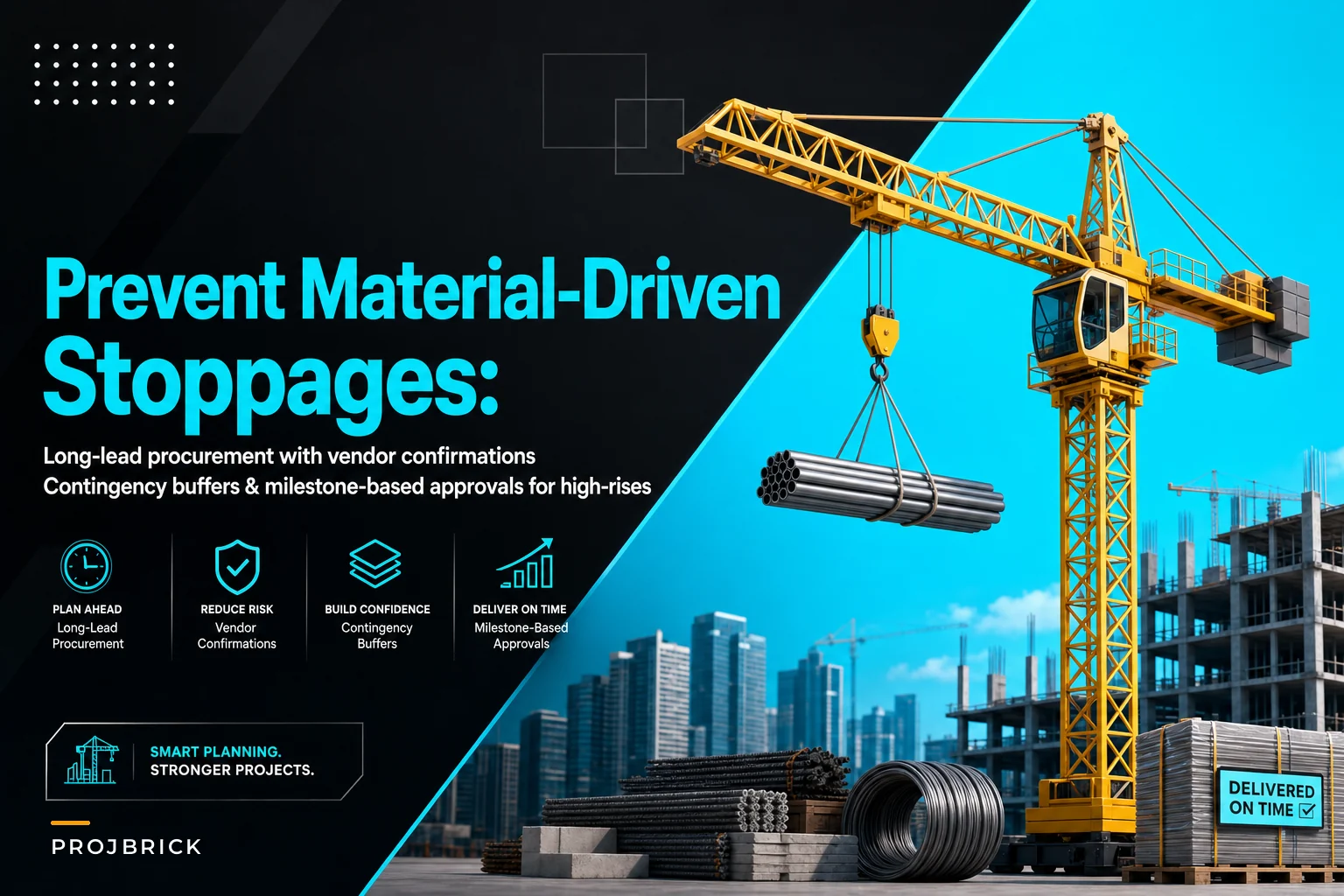

High-rise construction runs on a completely different procurement timeline than standard commercial builds. The vertical constraints create a domino effect where one delayed shipment can idle crews across multiple floors for weeks.
The Vertical Procurement Trap That Kills High-Rise Momentum
Most project managers figure this out too late—usually around floor 12 when the steel delivery gets pushed back three weeks and suddenly you've got concrete crews sitting idle, MEP teams blocked from rough-ins, and a tower crane burning $8,000 a day doing nothing useful.
The problem compounds because high-rise procurement isn't just about ordering earlier. It's about understanding how vertical sequencing creates dependencies that simply don't exist in horizontal construction. When you're building up instead of out, every material delay ripples through your schedule differently.
Why Traditional Procurement Breaks Down Above 10 Floors
Standard procurement assumes you can adjust sequences when materials arrive late. Pour the east side while waiting on west side rebar. Shift crews between areas. Keep momentum going somewhere.
Keep your construction projects on schedule and budget.
Projbrick helps you plan, track, and manage every project phase with precision and ease.
- Real-time project tracking
- Resource & budget management
- Team collaboration tools
No credit card required
That flexibility disappears in vertical construction. You can't pour floor 18 while floor 17's post-tension cables are missing. Can't run MEP risers through floors that don't exist yet. The crane can't skip floors to place materials wherever they happen to show up first.
The sequencing becomes ruthlessly linear. Floor 15 needs its structural steel before floor 16 can start. No workarounds, no parallel paths.
What makes it worse: lead times extend dramatically for high-rise materials. Curtain wall systems need 16–20 weeks. Custom steel connections run 12–14 weeks. Post-tension materials take 8–10 weeks. These aren't things you can grab from a local supplier when you realize you're short.
Then there's the logistical complexity layered on top. A tower crane handles maybe 4–6 major lifts per day. Materials need staging areas that don't fully exist yet. Street-level storage is minimal in urban environments. Every delivery needs choreographing with crane availability, hoist scheduling, and crew coordination.
The Cascade Effect of One Late Delivery
A single delayed material delivery on a high-rise doesn't just cost you that day. It costs you the week the crews sit idle, the overtime to compress afterward, and the penalties that start stacking if the schedule slips past contract milestones.
| Impact Area | Daily Cost | Cumulative 10-Day Delay |
|---|---|---|
| Idle tower crane | $8,000 | $80,000 |
| Concrete crew standby (20 workers) | $12,000 | $120,000 |
| Steel erection crew idle | $15,000 | $150,000 |
| Schedule compression overtime | $18,000 | $180,000 |
| General conditions extension | $6,500 | $65,000 |
| Liquidated damages risk | $10,000 | $100,000 |
That's close to $700,000 for a 10-day delay on one critical material. And delays rarely stay at 10 days once the cascade starts.
The real damage comes in the compression afterward. You're stacking trades to make up time, which increases safety risks, quality issues, and coordination headaches. Overtime premiums eat through contingencies fast. Acceleration costs spiral from there.
Building a Procurement Timeline That Accounts for Vertical Constraints
A functional long-lead procurement schedule for high-rise construction needs three things working together: milestone-based release triggers, vendor confirmation loops, and contingency buffers sized for vertical work.
Start with milestone triggers tied to structural progress, not calendar dates. Floor 8 concrete placement triggers the floor 20 curtain wall order. Floor 12 steel erection releases the floor 24 mechanical equipment purchase. This keeps procurement aligned with actual construction pace instead of theoretical schedules that rarely hold.
Your vendor confirmation system needs teeth. Not just order acknowledgments, but:
-
Manufacturing slot confirmations with specific dates
-
Raw material availability verification
-
Production milestone updates every two weeks
-
Shipping notifications with tracking details
-
Pre-delivery inspections scheduled
Keep a simple vendor scorecard tracking on-time percentage, communication responsiveness, and issue resolution speed. Three late deliveries and that vendor gets bumped to longer lead times automatically.
Contingency buffers for high-rise work need different math than ground-up construction:
-
Structural materials
25% buffer minimum
-
Curtain wall systems
30% buffer
-
Mechanical equipment over 5,000 lbs
35% buffer
-
Custom architectural elements
40% buffer
-
Elevators
45% buffer (seriously—elevators are almost always late)
These buffers feel excessive until you're on floor 22 with no materials and 80 workers standing around.
Visual below shows how milestone triggers, buffer windows, and crane scheduling windows interact across floor progress.
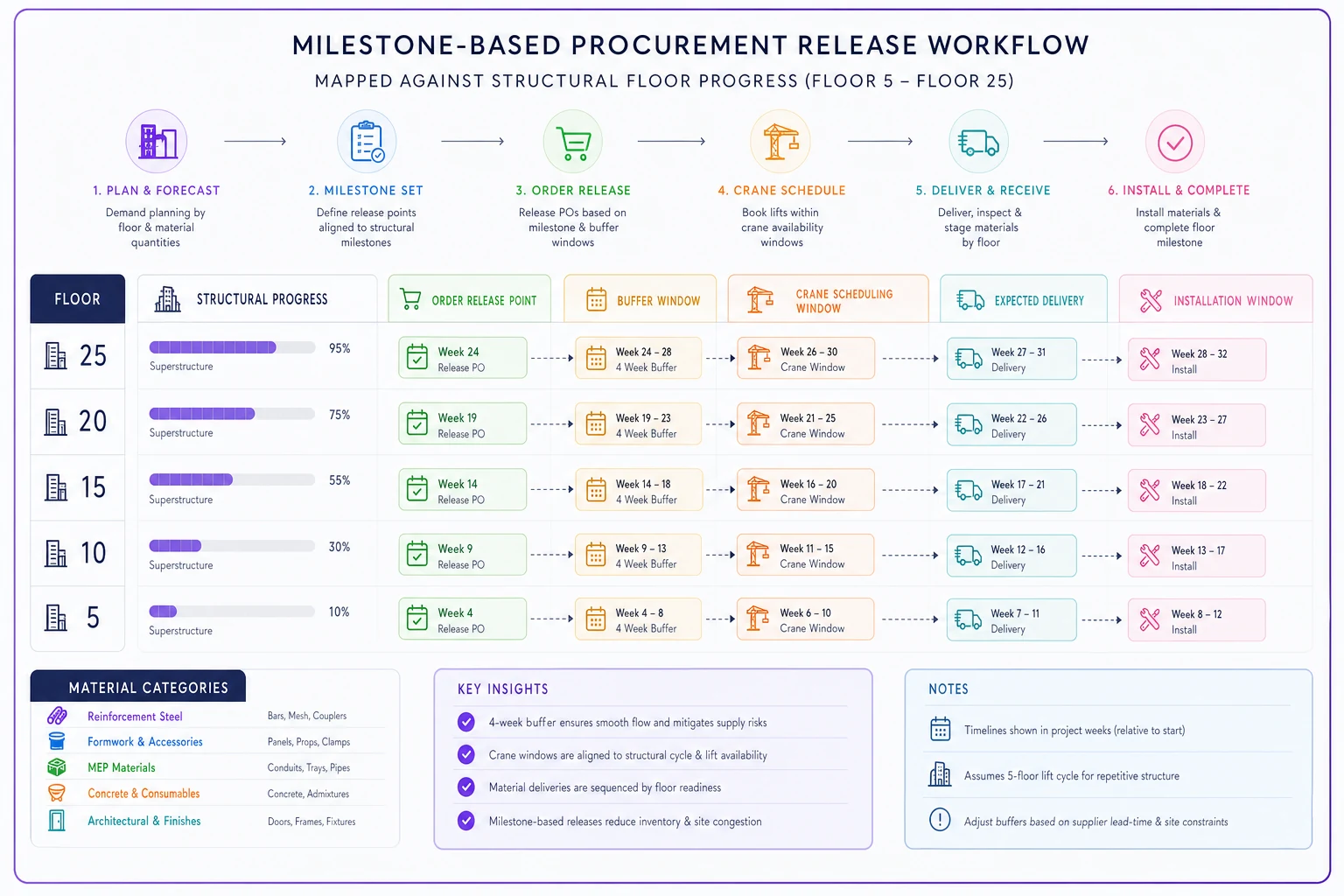
Tie release triggers to slab completion two floors below the installation floor to better align fabrication lead times with crane availability.
Start with milestone triggers tied to structural progress, not calendar dates. Floor-based triggers help procurement match actual site pace rather than theoretical schedules.
Vendor Confirmation Templates That Actually Get Responses
Generic RFIs get generic responses that tell you nothing useful. You need templates that force specific, actionable information.
Manufacturing Status Confirmation (send bi-weekly after order)
-
"Please confirm current status for Order #[X]
"
-
- Current manufacturing stage
[raw materials / fabrication / finishing / testing]
-
- Percentage complete
____%
-
- Materials on hand
Yes/No (if no, expected arrival: ____)
-
- Current projected ship date
____
-
- Factors that could delay shipping
____
-
- Photos of work in progress attached
Yes/No
Critical Milestone Verification (send at 30, 60, 90 days before delivery)
-
"Order #[X] Critical Checkpoint
"
-
- Manufacturing slot still confirmed for
[date]
-
- Any production delays since last update
Yes/No
-
- If yes, new timeline
____
-
- Quality control testing scheduled for
[date]
-
- Shipping arrangement status
[booked / pending / not started]
-
- Name of person accountable for this delivery
____
Pre-Shipping Final Confirmation (send 14 days before scheduled delivery)
-
"Final delivery confirmation for Order #[X]
"
-
- Materials completed and passed QC
Yes/No
-
- Exact shipping date
____
-
- Carrier and tracking info
__
-
- Delivery appointment needed
Yes/No
-
- Special equipment needed for unloading
____
-
- Materials will arrive in [number] of shipments
These work because they demand specifics. A vendor can't respond with "everything's on track" when you're asking for manufacturing percentages and QC dates.
When to Pull the Trigger on Alternates
Every critical material needs an alternate supplier identified by the time you hit floor 5. Not researched, not considered—actually identified, quoted, and pre-qualified.
The decision point comes when your primary vendor:
-
Misses two confirmation checkpoints
-
Gives vague answers to specific questions
-
Changes delivery dates more than twice
-
Can't provide manufacturing progress photos
Don't wait for the third strike. High-rise schedules can't absorb it.
Your alternate activation process:
-
Send notice to primary vendor
"Due to delivery uncertainty, we are activating alternate procurement"
-
Confirm alternate vendor can meet the revised timeline
-
Verify alternate materials meet structural requirements
-
Get architect/engineer approval in writing
-
Place order with a 10% expedite fee built in
-
Keep the primary order active until the alternate ships (eat the potential double order—it's cheaper than the delay)
Once you've activated an alternate twice on the same project, that primary vendor is off your preferred list regardless of how things eventually shake out.
Adapting to Crane and Hoist Scheduling Conflicts
Materials arriving on schedule means nothing if the tower crane is booked solid for three days. Your procurement timeline needs to sync with vertical transportation capacity.
A tower crane typically handles:
-
4–6 major picks per day (structural steel, precast panels)
-
8–10 medium picks (rebar bundles, mechanical equipment)
-
15–20 small picks (miscellaneous materials)
The hoist adds maybe 30–40 trips for materials that fit.
So deliveries need scheduling windows, not just dates. "Deliver week of March 15" needs to become "Deliver Tuesday March 16, 6 AM–10 AM, crane time reserved."
| Material Type | Floors Served | Picks Needed | Crane Hours | Delivery Window |
|---|---|---|---|---|
| Structural steel | 15-17 | 24 picks | 18 hours | Mon-Wed AM only |
| Curtain wall | 12-14 | 45 picks | 30 hours | Full week required |
| Mechanical units | 18 | 8 picks | 8 hours | Thurs-Fri PM |
| Concrete (per floor) | Each | 35 picks | 10 hours | As scheduled |
This table drives your procurement release schedule. You can't take curtain wall delivery if the crane is tied up with concrete pours.
The Software Coordination Gap in Vertical Construction
Traditional procurement tracking fails on high-rise projects because it treats all materials equally. A box of screws and a custom steel beam both show up as line items with delivery dates—no indication of crane requirements, floor destinations, or installation sequences.
Most teams end up juggling between procurement spreadsheets, crane schedules, hoist logs, delivery calendars, vendor communications, and installation sequences. The disconnection between those systems is where coordination failures actually happen. Procurement doesn't know the crane is booked. The crane operator doesn't know what's arriving. Site logistics doesn't know what needs staging where.
AI-powered operational software for construction addresses this by centralizing procurement, logistics, and vertical transportation planning in one place. When procurement logs a curtain wall delivery, the system checks crane availability, reserves time slots, and alerts the right teams about staging requirements—automatically, without someone manually cross-referencing four different spreadsheets.
Some platforms now flag delivery risk before it becomes a crisis—tracking vendor confirmation patterns and identifying when responses are getting vague or updates are drying up. That early signal gives you time to activate alternates instead of reacting to a missed delivery on a Monday morning with 60 workers on site.
Above 20 floors, this kind of integrated coordination stops being optional. Manual tracking just can't keep up with the complexity.
Realistic Procurement Timeline Example
Here's what an actual long-lead procurement schedule looks like for floors 15–25 of a 40-story residential tower:
Floor 5 Milestones (T-minus 20 weeks from Floor 15):
-
Order structural steel for floors 15–20
-
Order post-tension cables for floors 15–25
-
Lock in curtain wall shop drawings
Floor 8 Milestones (T-minus 16 weeks):
-
Release curtain wall fabrication for floors 15–18
-
Order mechanical equipment for floors 18–20
-
Confirm elevator rail extensions
Floor 10 Milestones (T-minus 14 weeks):
-
Order architectural precast for floors 20–22
-
Release electrical gear for floor 20 mechanical room
-
Purchase fire-rated doors for floors 15–25
Floor 12 Milestones (T-minus 10 weeks):
-
Expedite check on all Floor 15 materials
-
Order interior framing materials for floors 15–17
-
Release plumbing fixtures for floors 15–18
This timeline assumes everything goes perfectly, which it won't. That's why every order needs those contingency buffers baked in from the start.
Avoiding the Vertical Squeeze
The vertical squeeze hits around floor 25–30 when several things compound at once: crane cycles get longer, staging areas shrink as lower floors get occupied, workers are logging more vertical travel time, and wind exposure increases weather-related delays.
Your procurement schedule needs to anticipate this before you get there:
-
Shift to smaller, more frequent deliveries after floor 25
-
Increase buffers to 40% for floors 30 and above
-
Pre-position materials on mechanical floors before they're needed
-
Move toward night and weekend deliveries to maximize crane time
The teams that hold momentum through the vertical squeeze are the ones who adjusted procurement strategy before hitting those upper floors, not after problems showed up.
Making Procurement Work in the Vertical Dimension
Long-lead procurement for high-rise construction isn't just about ordering earlier—it's about understanding how vertical constraints change every part of material management. The dependencies are stricter, the coordination is more complex, and the consequences of delays multiply with each floor.
Getting it right comes down to three things: triggers tied to actual construction progress instead of calendar dates, vendor management that demands real information instead of empty confirmations, and contingency buffers sized for vertical realities rather than ground-up construction norms.
The teams doing this well recognize that high-rise procurement is fundamentally different. They build schedules around crane capacity, not just lead times. They track vendor performance closely and switch suppliers fast when patterns suggest trouble. They accept that larger buffers and occasional double-orders are cheaper than cascade delays that can stall a tower project for weeks.
One major material delay on a high-rise can cost more than an entire floor's material budget. Building a procurement system that prevents that isn't optional—it's the difference between delivering on schedule and watching your project idle while costs climb out of control.
Long-lead procurement for high-rise construction isn't just about ordering earlier—it's about understanding how vertical constraints change every part of material management. The dependencies are stricter, the coordination is more complex, and the consequences of delays multiply with each floor.
Getting it right comes down to three things: triggers tied to actual construction progress instead of calendar dates, vendor management that demands real information instead of empty confirmations, and contingency buffers sized for vertical realities rather than ground-up construction norms.
The teams doing this well recognize that high-rise procurement is fundamentally different. They build schedules around crane capacity, not just lead times. They track vendor performance closely and switch suppliers fast when patterns suggest trouble. They accept that larger buffers and occasional double-orders are cheaper than cascade delays that can stall a tower project for weeks.
Ready to build smarter and faster?
Join 2,000+ construction teams using Projbrick to improve project visibility, reduce delays, and increase profitability.