


The structural steel contractor swears the column placement matches the model. The MEP crew insists their ductwork routing follows the coordinated BIM exactly. Yet somehow you're standing in a half-finished building staring at a massive clash that nobody caught until installation day.
This disconnect between digital coordination and field execution burns through budgets on every complex project. Not because the models were wrong or the trades were careless, but because most projects lack a systematic BIM to field coordination workflow that actually bridges the gap between clash detection meetings and physical installation.
The pattern becomes clear after watching enough of these failures cascade: teams rely too heavily on weekly clash detection reports without establishing clear ownership, verification requirements, or escalation triggers for when issues slip through. The result? Model conflicts that should've been caught weeks earlier only surface when someone's holding a pipe that won't fit.
The coordination gap that nobody talks about
Most construction teams treat BIM coordination like it ends after the weekly clash meeting. The VDC coordinator runs interference detection, everyone reviews clashes in a conference room, assignments get made, and then nothing systematic happens to verify those resolutions actually work in the field.
Between that Thursday coordination meeting and Tuesday's installation, a dozen things change. The plumber finds an existing condition that wasn't modeled. The electrician realizes the specified junction box won't fit in the coordinated space. The HVAC contractor discovers the duct size was updated but nobody told the modeler.
These aren't random failures. They're predictable breakdowns in the handoff between digital coordination and physical construction. The industry treats clash detection like the finish line when it's really just the starting point.
What's missing is the operational structure that turns clash resolution into verified field readiness — clear role assignments for who owns each type of conflict, standardized verification packets that prove issues are actually resolved before installation begins, and automatic escalation triggers based on schedule impact rather than arbitrary deadlines.
The bigger the project, the wider this gap becomes. On a 200,000 square foot commercial build, you might have 15 different trades modeling their systems, three different BIM platforms trying to federate models, and coordination meetings where half the participants are checking email while "critical" clashes get discussed. Without structured verification and ownership, even resolved clashes have a way of resurfacing during installation.
Building an owner/role matrix that actually gets followed
The first breakdown in most BIM to field coordination workflows happens at ownership assignment. A clash gets identified, someone vaguely assigns it to "MEP team," and three weeks later everyone's pointing fingers about why it wasn't resolved.
Keep your construction projects on schedule and budget.
Projbrick helps you plan, track, and manage every project phase with precision and ease.
- Real-time project tracking
- Resource & budget management
- Team collaboration tools
No credit card required
Clear ownership requires more than just trade assignments. You need specific roles mapped to clash categories, with names attached and escalation paths defined. Here's what a functional matrix looks like:
| Clash Category | Primary Owner | Secondary Review | Field Verification | Escalation Trigger |
|---|---|---|---|---|
| Structural vs MEP | MEP Coordinator | Structural Engineer | MEP Foreman | 14 days to pour |
| MEP Internal | Trade Foreman | VDC Coordinator | Installing Trade | 7 days to rough-in |
| Architectural vs Structural | Architect | Structural PM | Field Super | 21 days to framing |
| Site Conditions | Field Super | VDC Team | Survey Crew | Immediate |
Notice how each category has both office and field roles? That's intentional. Pure model-based resolution fails because nobody's verifying against actual site conditions. The MEP coordinator might resolve a clash perfectly in Navisworks, but if the field foreman hasn't confirmed that solution works with the already-installed hangers, you've just created tomorrow's RFI.
Escalation triggers tie directly to schedule milestones, not arbitrary deadlines. A structural-MEP clash affecting concrete embeds needs resolution 14 days before the pour — not "ASAP" or "by next meeting." This creates urgency that actually aligns with construction sequencing.
For this matrix to work, you need buy-in at the pre-construction meeting. Not a casual mention during the coordination kickoff, but documented agreement with signatures. When the electrical contractor knows their foreman personally owns all electrical-plumbing clashes and must verify solutions within 72 hours of assignment, accountability shifts from theoretical to practical.
Require documented agreement with signatures at pre-construction to make ownership enforceable.
When the electrical contractor knows their foreman personally owns all electrical-plumbing clashes and must verify solutions within 72 hours of assignment, accountability shifts from theoretical to practical.
Priority rules that reflect real schedule impact
Not all clashes matter equally, yet most teams treat every red flag in Navisworks like a five-alarm fire. This wastes coordination time on minor issues while critical path conflicts get buried in the noise.
Effective priority rules connect directly to schedule impact and rework cost, not clash volume or detection software ratings. A 2-inch conduit clash in a ceiling space that won't be installed for three months matters less than a 1/4-inch structural embed deviation that affects tomorrow's pour.
Priority 1: Concrete/Structural Embeds Anything affecting concrete pours or structural steel connections gets immediate attention. These can't be fixed after installation without massive cost. If a sleeve is wrong or an embed plate is mislocated, you're looking at core drilling, structural analysis, and potential redesign. Resolution timeline: 24 hours from detection.
Priority 2: Critical Path Trade Conflicts Clashes between trades on the critical path that could delay successor activities. When fire protection mains clash with HVAC trunk lines and both need installation this week, that drives the schedule. Resolution timeline: 48 hours if within 14-day lookahead.
Priority 3: Major Reroutes Required Conflicts requiring significant redesign or material changes. If resolving a clash means reordering ductwork or changing pipe sizes, you need lead time for procurement and fabrication. Resolution timeline: 5 business days.
Priority 4: Minor Field Adjustments Clashes that can be resolved with standard field modifications. Moving a conduit 6 inches or adjusting hanger locations doesn't need executive coordination meetings. Resolution timeline: Include in weekly coordination report.
Priority gets determined by installation sequence and correction cost, not by what the software flags as severe. A technically "severe" clash that won't be installed for two months gets lower priority than a "minor" clash affecting next week's work.
This priority system feeds directly into meeting agendas. Start with Priority 1 and 2 items only. If those are clear, move to Priority 3. Save Priority 4 for email updates. This keeps coordination meetings focused on what actually impacts the field-to-office data strategy for construction: a minimal schema, ownership rules and three decision dashboards rather than discussing every geometric intersection the software found.
The verification packet template nobody creates (but everyone needs)
Without verification packets, the BIM coordinator marks a clash resolved, updates the model, exports new drawings, and considers the job done. Two weeks later, the installing contractor discovers the solution doesn't work because of an existing condition, material availability, or installation sequence issue nobody considered.
A verification packet proves that clash resolutions work in reality, not just in Revit. It's the documented bridge between model coordination and field installation. Most teams skip this because they think the updated model is enough. It never is.
The packet must contain five essential components:
1. Resolution Documentation
-
Original clash description with model screenshots
-
Proposed resolution with dimensional changes
-
Updated model views showing the fix
-
Sign-off from both trades involved
2. Field Verification Photos
-
Existing conditions at clash location
-
Measuring tape showing actual dimensions
-
Adjacent installations that might conflict
-
Date/time stamps on all images
3. Material Confirmation
-
Verification that materials for the resolution are available
-
Lead times if special orders required
-
Approved substitutions if original spec won't work
-
Procurement status from purchasing
4. Installation Sequence Check
-
Confirmation that resolution doesn't create new sequence problems
-
Trade coordination for revised installation order
-
Labor availability for modified schedule
5. Cost Impact Analysis
-
Material cost changes from resolution
-
Labor hours for modified installation
-
Schedule impact costs if any
-
Change order requirements if applicable
Each packet gets a unique ID tied to the original clash number, making it traceable through the entire workflow. When the superintendent asks why the mechanical contractor is installing something different from the original model, you pull up packet MEP-CLH-0847 showing the field-verified resolution, who approved it, and why the change was necessary.
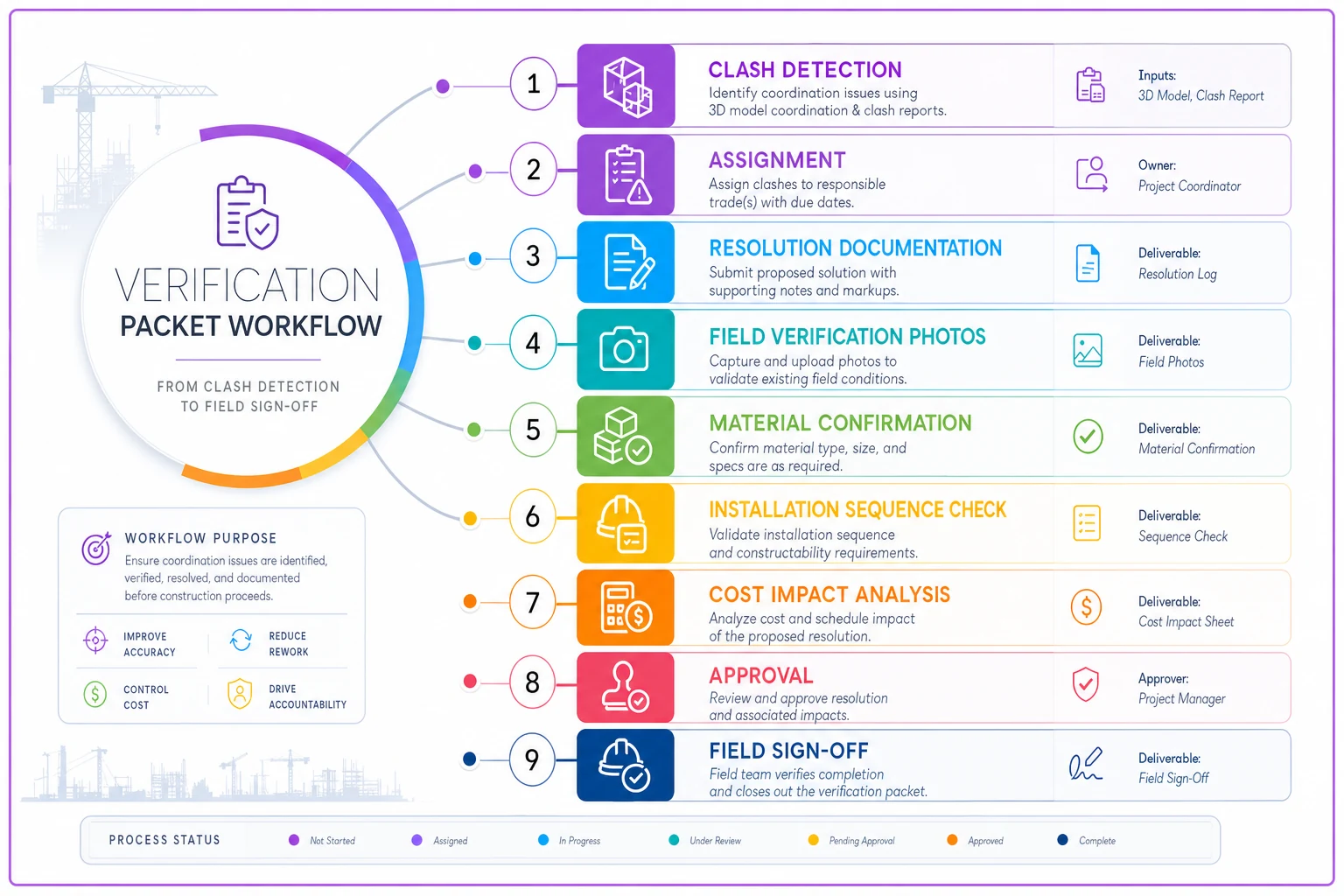
A simple diagram shows the verification packet workflow from clash to field sign-off.
The packet lives in a shared folder accessible to both office and field teams — not buried in some BIM 360 subfolder that only the VDC team knows about, but in the same location as daily reports and inspection records. Field foremen need these during installation, not after.
The hour spent creating each packet is the cheapest insurance you can buy. Ask anyone who's eaten a six-figure rework bill from an "already resolved" clash.
Escalation triggers mapped to actual schedule milestones
Generic escalation rules like "unresolved after 5 days" create noise without driving action. Real escalation triggers tie directly to schedule milestones with specific consequences for missing them.
Map escalation to installation deadlines and their upstream requirements. If concrete pours happen Thursdays, embed-related clashes must escalate by Monday noon to allow for rebar adjustment. If MEP rough-in starts in Area B next Tuesday, those coordination issues escalate by Thursday prior to enable material ordering.
24-Hour Escalation (Tomorrow's Work)
-
Trigger
Clash affects next-day scheduled installation
-
Path
Foreman → Superintendent → PM → Owner's Rep
-
Action
Stop work order if unresolved by 6 AM
-
Documentation
Emergency RFI with cost impact analysis
72-Hour Escalation (This Week's Work)
-
Trigger
Clash affects 7-day lookahead activities
-
Path
Coordinator → Trade PM → GC Project Manager
-
Action
Pull-planning session required within 24 hours
-
Documentation
Formal clash resolution meeting minutes
7-Day Escalation (Next Phase Prep)
-
Trigger
Clash affects upcoming phase or milestone
-
Path
VDC Team → Project Managers → Executive Team
-
Action
Dedicated resolution meeting with decision authority
-
Documentation
Change order preparation if needed
14-Day Escalation (Procurement Impact)
-
Trigger
Resolution requires material or equipment changes
-
Path
Field → Purchasing → Vendor coordination
-
Action
Expedited pricing and availability check
-
Documentation
Updated procurement log with new lead times
Each trigger includes specific actions, not just notifications. When a structural embed clash hits the 24-hour trigger, it doesn't just generate an email. It schedules an emergency coordination call, requires the concrete sub to have a contingency plan, and notifies the testing lab about potential schedule changes.
The enforcement mechanism matters too. If the plumbing foreman ignores a 72-hour escalation, the GC holds their next progress payment pending resolution. If the design team misses a 7-day escalation response, the contractor proceeds with best-judgment installation and documents the liability shift. These aren't harsh rules — they're natural consequences that keep the project moving.
One pattern that shows up repeatedly: teams spend weeks in coordination meetings discussing clashes that won't matter for months, while next week's critical issues get overlooked. Milestone-based escalation forces everyone to focus on what's actually about to be built.
Technology gaps vs process gaps
When coordination failures hit the field, the immediate response is usually "we need better software" or "the model wasn't detailed enough." But throwing technology at a process problem just creates expensive digital failures instead of cheap paper ones.
The real gap isn't between Revit and Navisworks, or between the federated model and trade models. It's between what the coordination team thinks they've resolved and what the field crew can actually build. This gap exists whether you're using cutting-edge 4D simulation or marking up PDFs.
Most projects have plenty of technology:
-
Clash detection software catching thousands of conflicts
-
Cloud platforms storing every model iteration
-
Mobile apps for field access to drawings
Yet issues still reach the field because the human workflow connecting these tools breaks down. The VDC coordinator exports clash reports, but nobody reads them. The foreman has iPad access to models but doesn't know which version is current. The resolution gets documented in meeting minutes that never reach the installation crew.
The fix isn't more sophisticated software. It's operational discipline around the basics:
Version Control Reality Instead of complex model federation protocols, establish simple rules: Thursday 2 PM is the weekly model freeze for coordination. Any changes after that timestamp don't count for next week's work. Period. No exceptions for "quick fixes" that inevitably cascade into field confusion.
Communication Pathways Stop assuming information flows automatically through software notifications. If a clash resolution affects Tuesday's installation, the foreman gets a phone call Monday afternoon — not just a BIM 360 notification they might check Wednesday. Technology enables documentation, but human communication drives action.
Field Feedback Loops The best clash detection happens when someone tries to install something. But most projects lack a systematic way to capture and share these field discoveries. Create a simple process: photo of the issue, measurement of the actual condition, proposed fix, and required-by date. This feedback improves future modeling accuracy and catches similar issues before they repeat.
AI-powered operational software helps here by automating the coordination tasks that people skip when busy — automatic notification when models update, escalation triggers based on schedule logic, verification packet templates that pre-populate from clash reports. The technology handles repetitive workflow management so humans can focus on actually solving the construction problems.
But even with automation supporting the workflow, success comes from clear process. A simple verification packet in Excel beats a sophisticated BIM platform where nobody follows the procedures.
Measuring what matters: installation success rate
Tracking thousands of clashes detected and resolved tells you nothing about field success. The only metric that matters: did the installation happen without rework?
Most teams measure the wrong things:
-
Number of clashes detected (meaningless)
-
Percentage of clashes resolved before installation (misleading)
-
Time from detection to resolution (incomplete)
-
Model update frequency (irrelevant)
These metrics create the illusion of coordination success while field crews deal with constant rework. A project can show 98% clash resolution rate and still have daily field conflicts because the resolutions didn't account for reality.
Installation Success Rate Percentage of planned installations completed without field-discovered conflicts requiring rework. Target: above 95% for repetitive work, above 90% for complex intersections.
First-Time Quality Rate Percentage of installations passing inspection without coordination-related corrections. This separates workmanship issues from coordination failures.
Rework Cost Attribution Every field conflict requiring rework gets coded back to its source: missed in model, changed after coordination, field condition variation, or installation error. This identifies whether you have a modeling problem, a communication problem, or a verification problem.
Schedule Impact Hours Track actual crew hours lost to coordination failures. When six electricians stand around for two hours waiting for clash resolution, that's 12 lost hours directly impacting productivity and schedule.
These metrics create accountability throughout the workflow. When the MEP coordinator sees their resolutions resulting in 60% installation success, they'll start verifying solutions more carefully. When trades see their rework costs tracked and attributed, they'll participate more actively in coordination meetings.
The measurement system also reveals process improvements. If structural embed clashes consistently show lower installation success rates, you need better field verification before concrete pours. If MEP intersections in ceiling spaces have high rework rates, you need more detailed installation sequencing during coordination.
Breaking the "we'll figure it out in the field" culture
That phrase has killed more project margins than almost any other coordination failure. It represents a fundamental breakdown where teams punt decisions until installation day, hoping field crews can magically resolve what weeks of coordination meetings couldn't.
This culture develops from repeated experiences where coordination meetings produce theoretical solutions that don't work in practice. After enough failed resolutions, field crews stop trusting the process and start planning their own workarounds. The coordination team, seeing their solutions ignored, stops putting effort into verification. The spiral continues until BIM coordination becomes a checkbox exercise while real coordination happens through field fixes and RFIs.
Prove Early Wins Start with simple, high-visibility clashes where the coordination solution clearly prevents field problems. When crews see that following the verified resolution actually makes installation easier, trust begins rebuilding. Pick battles you know you can win.
Include Field Leaders in Resolution Don't just assign clashes to trades — require the actual foreman who'll oversee installation to review and sign off on solutions. When their name is on the resolution, they own making it work rather than finding reasons it won't.
Document Save Stories Every time proper coordination prevents a field problem, document it with photos and cost savings. "Following verified packet MEP-089 saved 3 days of rework and $8,400 in materials" makes the value tangible. Share these wins in toolbox talks and coordination meetings.
Make Field Fixes Expensive When crews bypass coordination and create their own solutions, require full documentation of why the coordinated solution wouldn't work, what they did instead, and who bears liability for any issues. The paperwork burden alone encourages following verified resolutions.
Rapid Response to Field Feedback When field crews identify a legitimate issue with a coordinated solution, fix it within 24 hours. Nothing destroys trust faster than reporting a real problem and hearing "we'll discuss it at next week's meeting" while installation deadlines approach.
The cultural shift happens gradually, then suddenly. After enough successful installations following verified resolutions, "we'll figure it out in the field" becomes "let's verify this matches the field." The same crews who once ignored coordination packets start requesting them before installation begins.
This isn't about forcing rigid compliance with models that don't reflect reality. It's about creating a coordination process trustworthy enough that field crews see it as a tool rather than an obstacle.
From clash detection to installation confidence
The gap between BIM coordination and field success isn't a technology problem waiting for the next software update. It's an operational challenge requiring systematic workflow design, clear ownership, and relentless verification of what actually works on site.
Most coordination failures follow predictable patterns. Clashes get detected but not owned. Resolutions get modeled but not verified. Escalations happen too late to prevent rework. Teams trust digital models more than field conditions. The coordination meeting becomes the end goal rather than the beginning of real resolution.
Building an effective BIM to field coordination workflow starts with accepting that clash detection is just step one of a longer process. The real work happens in verification packets that prove solutions work, ownership matrices that create accountability, and escalation triggers tied to actual schedule impacts. These aren't complex concepts, but they require operational discipline that most projects skip.
Shifting measurement from counting clashes to tracking installation success rates changes behavior throughout the project. When everyone sees the direct connection between coordination quality and field productivity, the "we'll figure it out in the field" culture naturally fades. Trades start demanding verification packets. Foremen actively participate in resolution reviews. The coordination meeting becomes a working session rather than a status update.
The projects that excel at BIM to field coordination aren't the ones with the best technology or the most detailed models. They're the ones with operational systems that bridge the gap between digital coordination and physical construction — verifying before they build, escalating before it's too late, and measuring what matters to the field rather than what looks good in reports.
The tools keep advancing. The fundamental challenge doesn't. Ensuring what gets coordinated actually gets built without rework is not a software problem. It's an operational discipline that separates successful projects from the ones burning money on field fixes that should never have been necessary.
Ready to build smarter and faster?
Join 2,000+ construction teams using Projbrick to improve project visibility, reduce delays, and increase profitability.