

MEP commissioning on fast-track fit-outs breaks differently than regular projects. Not because the systems are more complex—they're often simpler. The killer is coordination density. You're cramming 16 weeks of testing into 8, running pre-tests while finishes are happening overhead, and trying to catch defects before trades demobilize.
The real mess starts when handovers blur together. HVAC contractor thinks they handed over VAV boxes to controls. Controls thinks they're waiting on airflow verification. Meanwhile, the TAB contractor is sitting in the parking lot burning hourly rates because nobody documented which zones are actually ready for balancing.
This coordination gap costs more than delays. On a 40,000 square foot medical office fit-out, one missed handover between electrical and mechanical pushed certificate of occupancy by 11 days. The tenant had already scheduled patient appointments. The GC ate $47,000 in liquidated damages, plus another $18,000 in emergency overtime trying to compress the remaining tests.
Why fast-track MEP commissioning actually fails
The standard commissioning process assumes sequential completion. Rough-in, then testing, then balancing, then commissioning. Makes sense on paper. Falls apart when you're installing ceiling grids while running functional performance tests two floors below.
Fast-track projects compress everything into parallel tracks. Your mechanical contractor might be installing diffusers in Suite 300 while the controls tech programs sequences for Suite 100. The electrical crew pulls branch circuits everywhere at once. Fire alarm devices go in whenever ceiling access opens up.
Traditional handover packets can't track this chaos. They're built for complete systems, not partial zones. A typical mechanical completion form asks if ductwork is installed, insulated, and pressure tested. But what if half the floor has permanent duct, a quarter has temporary flex for early cooling, and the rest is still open plenum? The form has no way to capture that granularity.
Three patterns destroy fast-track MEP schedules:
The partial system trap. Your chiller plant works. Primary pumps run. But the bypass valve sticks at 30% open because controls never got the final sequence from mechanical. Now you're bleeding energy through the bypass while trying to commission terminal units. The mechanical contractor claims they're complete because water flows. Controls claims they can't program without mechanical's final valve schedule. Testing stops.
Documentation lag. Submittals show one thing. Field conditions show another. As-builts won't exist for weeks. The commissioning agent needs torque values for smoke dampers, but the installer used three different models based on availability. Nobody documented which damper went where. Now commissioning stops while someone crawls through ceiling spaces with a flashlight and clipboard.
The demobilization scramble. Electrical finishes rough-in, moves to the next project. Two weeks later, commissioning finds 30% of emergency circuits wired to normal panels. Electrical's crew is 200 miles away on another job. You're paying premium rates for whoever's available to fix critical defects that should have been caught at handover.
Building your staged pre-test calendar
Forget trying to commission entire systems at once. Break everything into testable chunks that match your construction sequence. A staged pre-test calendar maps exactly what gets tested when, regardless of overall system completion.
Keep your construction projects on schedule and budget.
Projbrick helps you plan, track, and manage every project phase with precision and ease.
- Real-time project tracking
- Resource & budget management
- Team collaboration tools
No credit card required
Start with commissioning boundaries, not construction areas. These rarely align. Your construction schedule might show "Level 2 East Wing complete 3/15." But commissioning cares about Air Handler Unit #2's complete zone—which serves parts of Level 1, most of Level 2, and two rooms on Level 3.
Mechanical zones by air handler. Each AHU gets its own test track. Include all associated VAV boxes, hot water reheat coils, and controls points. Document which fire/smoke dampers serve each zone. Test sequentially as ductwork completes, not by floor.
Electrical distribution paths. Follow power from switchgear through panels to final circuits. Your emergency generator might serve loads across four floors. Test the complete emergency path as one sequence, even if normal power isn't ready.
Plumbing pressure zones. Domestic water booster pumps might serve floors 3-8. Test that entire zone together once risers are charged, even if floor 2 isn't ready yet.
Controls networks by subnet. BAS networks often split by mechanical zone or building area. Test complete network segments as they come online, not individual controllers.
Here's what an actual staged calendar looks like for a 60,000 square foot tenant improvement:
| Week | Zone/System | Pre-Test Requirements | Documentation Package |
|---|---|---|---|
| Week 1 | AHU-1 (Floors 1-2 West) | Ductwork complete, TAB rough balance, controls powered | Startup reports, preliminary TAB, point-to-point sheets |
| Week 2 | Emergency Power (Building-wide) | ATS installed, load bank ready, fuel system filled | Single-line verified, load calculations, generator run log |
| Week 3 | AHU-2 (Floors 2-3 East) | Static pressure tested, VAVs calibrated, graphics online | Duct pressure test, VAV schedules, graphics screenshots |
| Week 4 | Domestic Water (Floors 1-4) | Risers chlorinated, pressure tested, fixtures roughed | Pressure test cert, chlorination report, valve tags |
| Week 5 | Fire Alarm (Floors 1-2) | Devices installed, pathways complete, panel programmed | Device addresses, voltage drops, preliminary matrix |
| Week 6 | AHU-3 (Floor 4) + Exhaust Fans | Balance complete, controls integrated, sensors calibrated | Final TAB report, trends, calibration certs |
Notice how testing jumps between systems and floors based on readiness, not architectural completion. This requires serious coordination, but it's the only way to maintain momentum on compressed schedules.
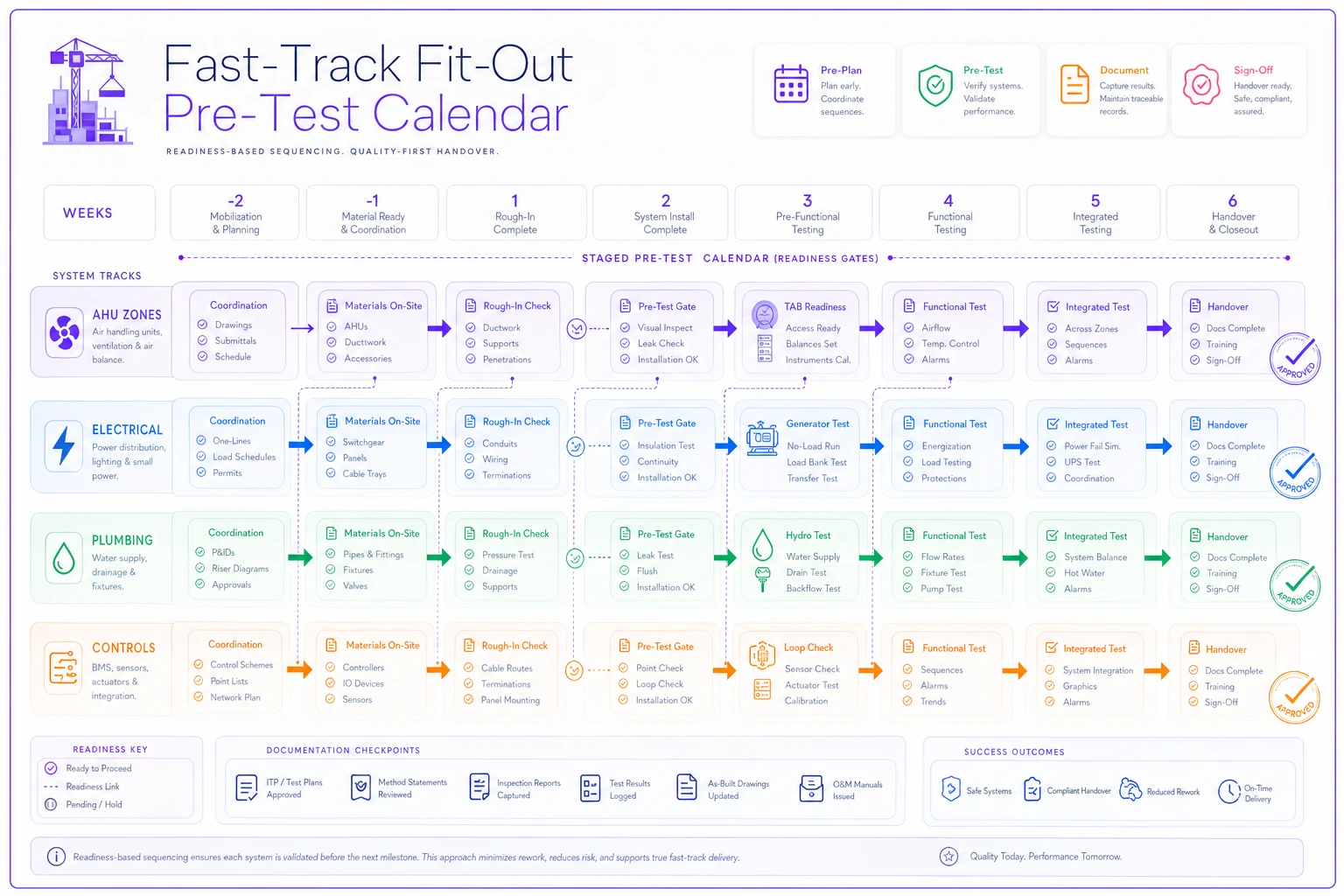
A quick visual of the staged calendar and handover gates.
Minimal documentation that actually prevents re-work
Most commissioning documentation is backwards-looking—proving what you already tested. On fast-track projects, you need forward-looking documentation that prevents problems before testing starts.
The critical difference: capture intent, not just completion. Every handover packet should answer "what was supposed to happen" not just "what got installed."
Mechanical pre-test packets need:
-
Actual setpoints programmed into equipment (not just design setpoints from drawings)
-
Valve positions during startup (locked open, locked closed, or modulating)
-
Temporary settings for early occupancy (if running at 50% capacity, document why)
-
Which zones are on temporary power or temporary controls
-
Any equipment running on manual override and why
A real example: on a laboratory fit-out, exhaust fans needed to run continuously during construction for air quality. Permanent controls weren't ready, so the mechanical contractor wired temporary switches with plans to integrate later. Nobody documented this. During commissioning, what looked like a failed controls integration was actually temporary wiring that was never meant to be permanent. Three days of troubleshooting something that wasn't broken.
Electrical pre-test packets need:
-
Actual breaker settings (not just spec requirements)
-
Which panels are temporarily fed from other panels
-
Any circuits intentionally left off and why
-
Temporary loads that will be removed before final
-
Ground fault and arc fault test results by circuit
Controls pre-test packets need:
-
Points that are intentionally disabled
-
Sequences running in manual mode
-
Graphics that show placeholder data
-
Trends that aren't recording yet
-
Network segments that aren't connected
The goal isn't perfect documentation. It's clarity about what's real versus what's temporary.
The handover gate system that stops defects from hiding
Standard punch lists don't work for MEP commissioning. By the time you find a defect during functional testing, the responsible trade might be gone. You need gates—mandatory verification points that stop work until specific items are confirmed.
Gate 1: Pre-wire verification (Before ceiling close)
-
Verify all homerun circuits pulled
-
Confirm grounding and bonding complete
-
Check fire alarm pathway continuity
-
Document any deviations from design
Gate 2: Pre-insulation mechanical (Before insulation/ceiling)
-
Pressure test all piping
-
Verify hanger spacing and seismic bracing
-
Check slope on condensate drains
-
Photograph all concealed unions and valves
Gate 3: Above-ceiling complete (Before hard lid)
-
All VAV boxes installed and accessible
-
Fire/smoke dampers operational
-
Cable tray and conduit complete
-
Access doors cut and framed
Gate 4: Pre-energization (Before permanent power)
-
Meggering complete on feeders
-
Breaker settings verified and documented
-
Emergency circuits identified and tagged
-
Ground fault protection tested
Gate 5: Pre-balance (Before TAB starts)
-
All ductwork complete and sealed
-
Diffusers and grilles installed
-
Controls points mapped and verified
-
Temporary conditions documented
Each gate requires sign-off from multiple trades. Mechanical can't close ceiling until electrical verifies their rough-in. Controls can't start programming until mechanical provides actual equipment data. This forced coordination catches integration problems early.
Require cross-trade sign-off to prevent premature ceiling closures.
On a recent 50,000 square foot office fit-out, implementing gates caught 47 above-ceiling defects before drywall. Without gates, those would have meant cutting finished ceilings during commissioning. At roughly $3,000 per ceiling access event (including patching, cleanup, and repainting), that's around $141,000 in avoided rework.
Software coordination for compressed commissioning schedules
Paper checklists and email threads can't handle the velocity of fast-track commissioning. You're tracking hundreds of parallel items across dozens of zones with multiple trades working simultaneously. The same principles that keep concrete pours on track apply here—except you're coordinating tests instead of trucks.
Compressed commissioning needs real-time visibility. When the controls tech finishes programming VAV boxes in Zone A, the TAB contractor needs to know immediately so they can start balancing. When balancing is complete, the commissioning agent needs notification that testing can begin. These handoffs happen dozens of times per day on fast-track schedules, and none of them should depend on someone remembering to send an email.
AI-powered operational platforms handle this coordination automatically. Instead of project managers manually tracking every handover, the system monitors completion triggers and notifies the next trade. It tracks which zones are ready for which tests, preventing the confusion that happens when partial systems create unclear readiness boundaries.
The documentation problem also gets easier when everyone works from a single platform. Test results upload directly from field devices. Photos attach to specific equipment records. When commissioning finds a wiring error on VAV-2-15, the system can flag all VAV boxes installed by the same electrician on the same day for verification—that kind of pattern recognition doesn't happen when deficiencies live in separate spreadsheets.
More practically, these platforms prevent the knowledge loss that kills fast-track schedules. When your mechanical foreman who knows every quirk of the temporary setup leaves for another project, that information doesn't evaporate. It's captured in equipment notes, startup records, and handover documentation that stays with the project.
Real numbers from compressed commissioning
A medical office building in Phoenix ran commissioning in parallel with finishes, compressing the typical 12-week commissioning phase into 6 weeks. The key was breaking traditional system boundaries.
Instead of commissioning by floor, they commissioned by system:
-
Week 1-2
Emergency power and life safety (building-wide)
-
Week 2-3
Chilled water and heating water systems (central plant)
-
Week 3-4
Air distribution (by AHU zone, not by floor)
-
Week 4-5
Terminal units and controls (following air handler zones)
-
Week 5-6
Integrated systems testing and owner training
The staged approach meant running functional tests while painters worked two suites over. TAB happened while flooring went in down the hall. But because each test boundary was clearly defined, trades didn't conflict.
The documentation requirements were demanding. Every handover required:
-
Photo documentation of completed work
-
Sign-off from the receiving trade within 4 hours
-
Any deviations documented with proposed resolution
-
Next-step requirements clearly stated
When the electrical contractor handed over power to mechanical equipment, mechanical had 4 hours to verify rotation and voltage. When they found three pumps wired for reverse rotation, electrical was still on site. No callbacks, no delays.
Traditional commissioning on similar projects averaged around 315 deficiencies found during functional testing. This project found 198. More importantly, only 12 required calling trades back to site. The rest were caught at handover gates while crews were still mobilized.
The expensive problems this prevents
Commissioning failures on fast-track projects cascade differently than standard construction delays. Unlike phase slippage you can sometimes absorb, failed commissioning at the end of a compressed schedule has nowhere to hide.
Certificate of Occupancy delays. One failed fire alarm test can stop occupancy for days or weeks. A retail fit-out missed Black Friday opening because smoke detector spacing failed final inspection. The issue would have been caught weeks earlier with proper pre-testing, but everyone assumed shop drawings were correct. The tenant lost an estimated $280,000 in sales.
Energy hemorrhaging during partial occupancy. When you occupy floors while still commissioning others, improperly configured systems burn money. A tech company moved into floors 3-7 while commissioning continued on floors 1-2. The building automation system couldn't properly stage air handlers because the commissioning sequence wasn't designed for partial occupancy. They ran all four air handlers at minimum speed continuously—roughly $8,000 per month in excess energy until commissioning completed.
Warranty claims that go nowhere. Equipment started before proper commissioning often voids warranties. A hotel project started their chillers early to maintain temporary cooling during fit-out. No formal startup, no manufacturer witness, no documentation. Eight months later when a compressor failed, the manufacturer denied the $47,000 warranty claim. Running equipment "temporarily" without proper commissioning eliminated coverage entirely.
The litigation nightmare. When commissioning fails on fast-track projects, finger-pointing intensifies. The compressed schedule means everyone was working around everyone else, and defects found during commissioning could have happened anytime in the overlapping chaos. Without clear handover documentation, proving responsibility becomes nearly impossible. One medical office project spent $180,000 in legal fees arguing about controls integration failures. Documented handover gates would have established responsibility immediately.
Building your fast-track MEP commissioning checklist
Phase 1: Pre-Construction Setup (Before mobilization)
-
Map all commissioning boundaries (not construction areas)
-
Create equipment startup matrix with dependencies
-
Define handover gates with pass/fail criteria
-
Establish documentation requirements per trade
-
Set up real-time tracking system (paper won't work here)
Phase 2: Progressive Installation Tracking (During construction)
-
Daily photo documentation of concealed work
-
Weekly trade coordination on upcoming handovers
-
72-hour notices for upcoming gate requirements
-
Immediate deficiency reporting (not batched weekly)
-
Continuous as-built updates (not waiting until closeout)
Phase 3: Staged Pre-Testing (Parallel with finishes)
-
Test by system capability, not area completion
-
Document all temporary configurations
-
Track partial system performance
-
Maintain running deficiency log by responsible trade
-
Verify corrections before trade demobilization
Phase 4: Integrated Testing (Final weeks)
-
Full sequence of operations testing
-
Emergency condition testing
-
Seasonal changeover verification
-
Owner training on partially complete systems
-
Warranty documentation for all started equipment
Phase 5: Handover to Operations (Before occupancy)
-
O&M manuals for commissioned equipment only
-
Trending data from pre-testing period
-
Remaining work list with responsible parties
-
Temporary operation procedures if needed
-
Post-occupancy commissioning schedule
The checklist looks simple because the complexity lives in the execution timing. Every item has dependencies and gates that must be met first.
Making staged commissioning work with your team structure
Your team structure needs to match the staged approach. The traditional model of a commissioning agent showing up at the end doesn't work on compressed schedules. You need continuous commissioning presence from rough-in through occupancy.
Consider creating a commissioning coordination role—someone whose only job is tracking handovers and gates. This isn't the commissioning agent (who focuses on testing) or the MEP coordinator (who handles installation conflicts). This person manages documentation flow and makes sure every handover meets requirements before work proceeds.
On smaller projects, a senior superintendent can handle this. On larger fast-track projects, it's worth the dedicated position. The cost—roughly $85,000-$110,000 for the project duration—is nothing compared to the delays they prevent.
When mechanical hands over to controls, someone needs to verify that all points are landed and labeled, control valve actuators are mounted and stroked, sensor wells are installed with thermal compound, VFD parameters are programmed, and graphics templates are ready for point mapping. Miss any of those, and controls wastes days troubleshooting problems that aren't actually controls issues. The coordinator ensures completeness before handover, eliminating the back-and-forth that kills compressed schedules.
Speed through preparation, not shortcuts
Fast-track MEP commissioning isn't about working faster—it's about working in parallel without creating conflicts. The staged pre-test calendar and handover gates create structure in what otherwise becomes chaos when multiple trades overlap.
The real pattern from running compressed commissioning schedules: problems compound exponentially as you accelerate. A minor documentation gap that might cause a two-day delay on a normal project can destroy your entire commissioning phase when you have no buffer. The fix isn't better recovery—it's preventing the problem through systematic handovers before anyone has a chance to leave the site.
Most teams think fast-track means accepting more risk and fixing things on the fly. It's actually the opposite. Compressed schedules demand more preparation, clearer boundaries, and better documentation than traditional projects. You can't afford to discover during commissioning that your emergency generator was never properly started up or your chilled water system has air entrainment from a rushed fill procedure.
The framework here—staged calendars, minimal but critical documentation, strict handover gates—creates predictability in compressed schedules. When everyone knows exactly what defines "ready for testing" and documentation proves it was delivered that way, commissioning becomes a verification exercise instead of a discovery process.
Your certificate of occupancy date is set. Tenants have moving trucks scheduled. There's no room for commissioning surprises. Build the structure that prevents them, and fast-track projects become predictable rather than panicked.
Ready to build smarter and faster?
Join 2,000+ construction teams using Projbrick to improve project visibility, reduce delays, and increase profitability.