

Most teams don't fail at pull planning because they don't understand it. They fail because the pull plan lives on a wall — or in a photo somebody took after the session — and then reality drifts away from it by Wednesday of week one. The commitments made in the room don't survive contact with the field.
That gap between a good plan and a plan that actually runs week after week is the whole ballgame. Pull planning gives you the promise-based network of tasks. Percent Plan Complete (PPC) tells you whether people are keeping those promises. But neither does anything unless they're wired into a repeatable cadence: the meetings, the roles, the numbers people look at, and what happens when a promise breaks.
This is a playbook for that cadence. Not the theory of Last Planner — you already know that — but the operating rhythm that makes it stick when you've got three superintendents, eight subs, and a schedule that's already tight.
Why pull planning quietly falls apart
The failure pattern is almost always the same, and it's rarely dramatic. Nobody cancels pull planning. It just erodes.
-
Commitments aren't tied to a person. "Framing crew will be done Thursday" is not a commitment. "Marcus commits framing on levels 3–4 complete by Thursday 3pm" is.
-
Constraints get logged but never worked. People are great at identifying constraints in the room. Whether anyone owns clearing them by a date is a different question.
-
PPC gets calculated but not diagnosed. A number with no reason codes behind it is just a scoreboard nobody can act on.
-
There's no rule for what a broken promise triggers. When a task doesn't complete, does anything happen? Usually not, until it's on the critical path and now it's a fire.
The deeper issue is that pull planning is a coordination discipline, but most teams run it as a documentation activity. They capture the plan and stop. The rhythm — the recurring beats that force follow-through — is where the value actually lives.
The rhythm, laid out
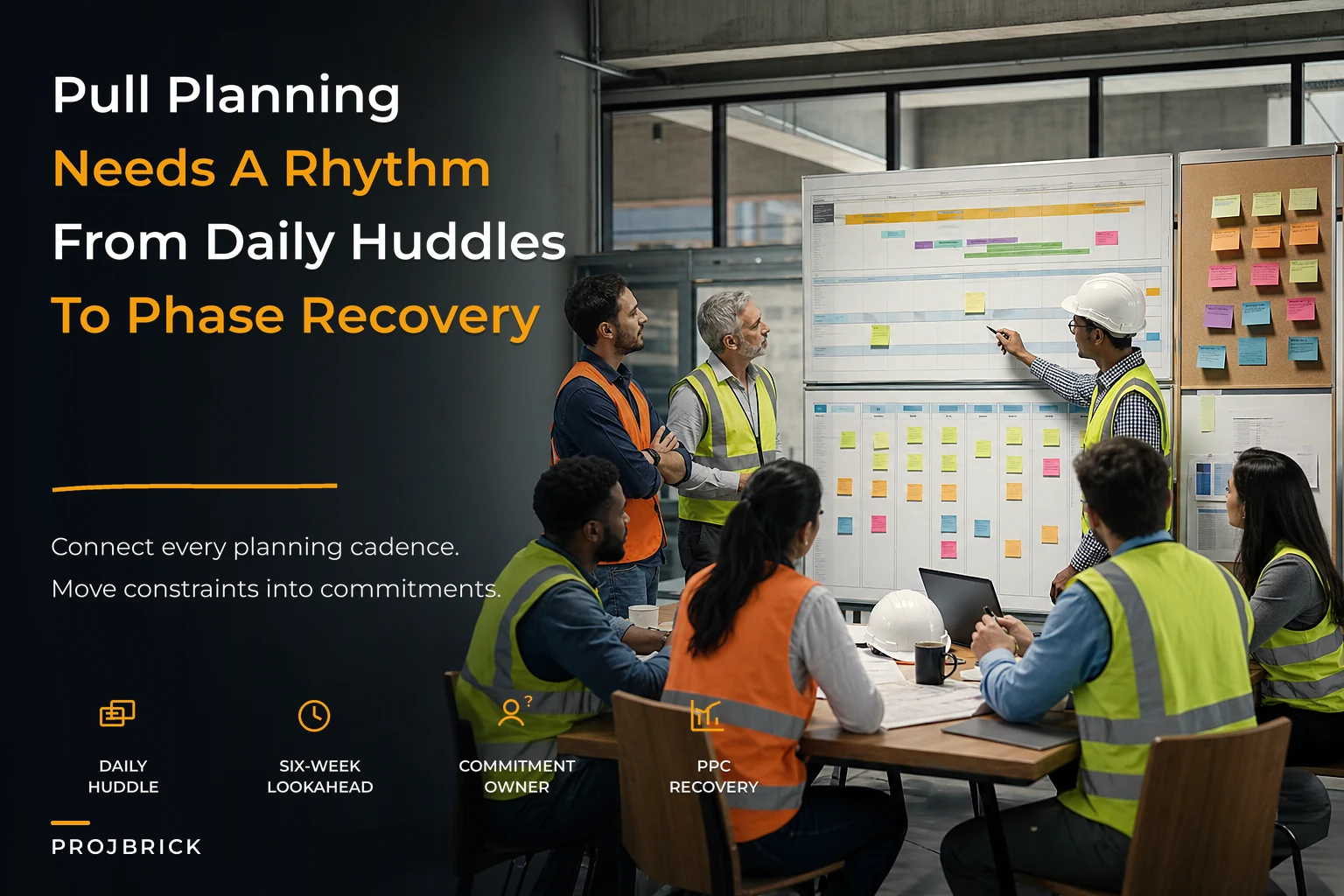
Think of it as four nested cadences, each with a different time horizon and a different job. They connect. What happens in the daily huddle feeds the weekly PPC review, which informs the six-week lookahead, which shapes the next phase pull.
Keep your construction projects on schedule and budget.
Projbrick helps you plan, track, and manage every project phase with precision and ease.
- Real-time project tracking
- Resource & budget management
- Team collaboration tools
No credit card required
| Cadence | Frequency | Time horizon | Core job | Who runs it |
|---|---|---|---|---|
| Daily huddle | 15 min, every morning | Today + tomorrow | Confirm today's promises, surface blockers | Superintendent |
| Weekly work plan / PPC review | 60–75 min | Next 1–2 weeks | Score PPC, diagnose variance, make new commitments | Last Planner facilitator |
| Six-week lookahead | 45 min weekly | 6 weeks out | Clear constraints before they're urgent | PM |
| Phase pull session | Per phase | Full phase | Build the promise network | PM + trade foremen |
The mistake teams make is running only one or two of these well. A great weekly meeting with no daily huddle means blockers sit for a full day before anyone hears about them. A strong lookahead with a weak weekly means constraints get cleared but commitments never get scored. The rhythm only works as a set.
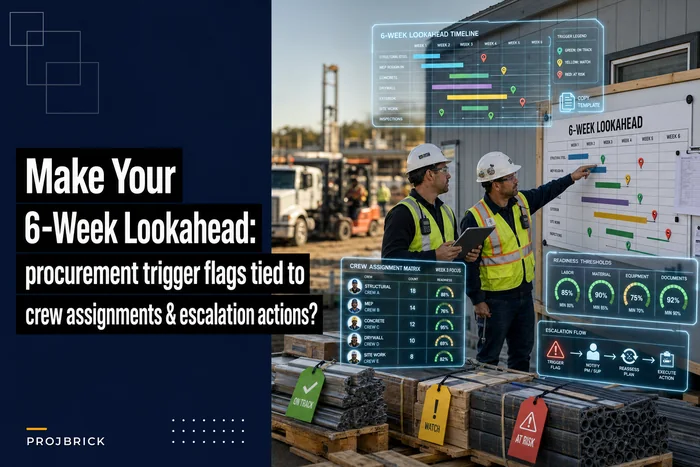
If your lookahead is the weak link — and it often is — it's worth tightening how procurement triggers and crew assignments flow out of it. There's a full breakdown in making your 6-week lookahead actionable that pairs directly with the cadence here.
This visual shows how the four cadences hand off commitments, constraints, and diagnostics so the weekly PPC review isn't operating in isolation.
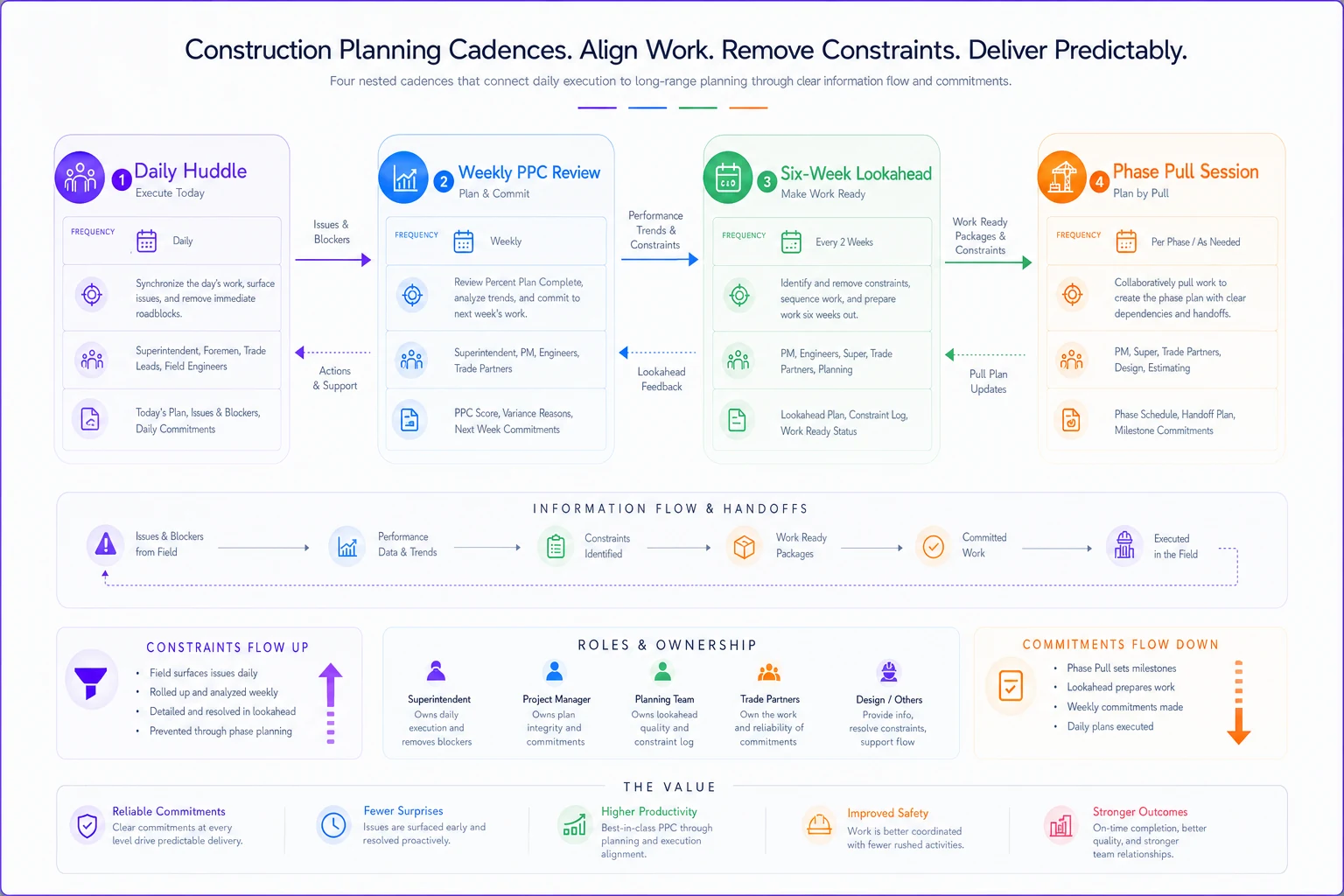
The diagram emphasizes how daily updates feed weekly diagnosis, which informs lookahead clearing and phase-level planning.
The weekly PPC review, run as an actual working session
This is the anchor meeting. Get this one right and the others tend to fall in line. Here's the agenda that keeps it from turning into a status recital:
-
Score last week (10 min). Go task by task. Complete or not complete — binary, no "80% done." Calculate PPC: promises kept divided by promises made. Write the number on the board.
-
Diagnose variance (20 min). For every incomplete task, assign a reason code. Not blame — a category. Was it prerequisite work, materials, labor, information/RFI, weather, or a change? This is the single most valuable 20 minutes in the whole cadence.
-
Review the constraint log (10 min). Anything due to be cleared this week that wasn't? Anything new? Every constraint has an owner and a date, or it doesn't count.
-
Make next week's commitments (20 min). Trade by trade, foremen commit to specific, named, dated tasks. Only tasks that are constraint-free get committed. Everything else stays in the make-ready backlog.
-
Flag anything heading for the critical path (5 min). Quick scan: is any variance pattern starting to threaten a milestone?
A quick note on reason codes, because this is where teams cut corners. If you're not aggregating them over time, you're missing the entire point. One incomplete task tells you nothing. But when you look at eight weeks of data and see that 40% of your misses trace back to prerequisite work not being ready, that's not bad luck — that's a make-ready process that's broken, and now you know exactly where to fix it.
What good PPC actually looks like: Teams new to this get anxious about the number. Realistically, a team just getting started often lands somewhere in the 50s and 60s. A functioning rhythm usually pulls that into the high 70s to mid 80s over a couple of months. Chasing 100% is a mistake — if you're hitting it consistently, you're probably sandbagging commitments to protect the score, which defeats the whole purpose.
Role scripts so the meeting doesn't depend on one person
The single biggest fragility in a pull planning cadence is that it lives in one superintendent's head. They go on leave or move to another job, and the whole rhythm collapses within three weeks. Role scripts fix that by making the behavior repeatable rather than the person.
Keep them short — a few lines each, printed or pinned somewhere visible.
Facilitator (Last Planner lead):
-
Keeps the meeting to time, task by task
-
Refuses vague commitments — pushes for name + scope + date
-
Does not let anyone commit to a task with an open constraint
-
Owns the PPC number and reason-code log
Trade foreman:
-
Commits only to work their crew can actually complete
-
Reports blockers before the meeting, not during
-
Flags constraints on downstream trades they can see coming
Superintendent:
-
Runs the daily huddle
-
Escalates blockers that can't clear within 24 hours
-
Connects field reality back to the weekly plan
Project manager:
-
Owns constraint clearing beyond the field (procurement, RFIs, design)
-
Runs the lookahead
-
Owns escalation to the owner/design team when needed
The meetings that run well aren't the ones with the most disciplined super. They're the ones where everyone knows their one job in the room. When the facilitator's only job is to refuse vague commitments, they'll do it even when it's socially awkward — and honestly, that's where most of the value comes from.
KPI dashboards people actually look at
A dashboard nobody opens is worse than no dashboard, because it creates false confidence. The trick is keeping a small number of metrics that each drive a decision.
The four that matter:
-
PPC trend (weekly). Not just this week's number — the eight-week line. A single week means nothing; the trend tells you whether the rhythm is working.
-
Reason-code distribution. Which category is eating your PPC? This turns the score into an action.
-
Constraint aging. How long constraints sit before they're cleared. If the average is climbing, your make-ready process is falling behind production.
-
Tasks made ready vs. tasks needed. A leading indicator. If you need 40 tasks constraint-free for next week and only 25 are ready, you already know next week's PPC is going to hurt.
Notice what's not on that list: raw percent-complete against the baseline schedule, cost variance, earned value. Those matter, but they're lagging indicators and belong in a different review. The pull planning dashboard is a coordination dashboard. Mixing in financial metrics turns the weekly meeting into a project review and kills the tight, promise-focused energy that makes it work.
Where a lot of teams stumble is data entry. If updating these numbers means someone spends Friday afternoon transcribing sticky-note photos into a spreadsheet, it won't survive a busy month. This is one place where the operational software you're already running earns its keep — when daily huddle updates and commitment tracking feed the PPC and constraint numbers automatically, the dashboard stays current without a weekly data-entry chore. The point isn't the tool; it's that the rhythm can't depend on manual reconciliation or it dies the first week things get hectic.
Recovery sprints: what to do when PPC drops
Almost nobody has this piece: a pre-agreed response to a bad week. Without it, a PPC drop just generates anxiety and a vague "let's do better." A recovery sprint is a short, focused, time-boxed effort with a defined trigger, scope, and exit.
Trigger rule: PPC drops below 70% for two consecutive weeks, or a single reason code accounts for more than half your misses.
-
Name the failing constraint category. Pull the reason codes. Don't guess.
-
Assign a single sprint owner. One person, not a committee. Usually the PM or lead super.
-
Set a specific, measurable target. "Clear all seven open MEP constraints on levels 4–6 by Thursday." Not "improve coordination."
-
Daily 10-minute sprint check-in — separate from the normal huddle, focused only on the sprint target.
-
Close it out. Hit or miss, review what caused the original drop and whether the make-ready process needs a permanent change.
Time-boxing matters because recovery efforts without an end date become the new normal. The team runs in permanent firefighting mode, everyone burns out, and the sprint loses its meaning. A sprint is a spike, not a lifestyle. If you're running back-to-back sprints, the problem isn't execution — it's that your commitments are unrealistic or your make-ready is systematically behind.
Escalation rules mapped to schedule control
The recovery sprint handles coordination failures. But some breakdowns are bigger than the field can solve — a late owner decision, a design gap, a long-lead material slip. Those need to jump out of the pull planning cadence and into formal schedule control before they eat the critical path.
-
Tier 1 — field-resolvable. Blocker surfaces in the daily huddle, super resolves it within 24 hours. Never leaves the field.
-
Tier 2 — recovery sprint. Pattern of misses in one category. PM owns it, resolved inside a week.
-
Tier 3 — critical-path threat. Constraint can't clear internally and threatens a milestone. Formal escalation with time-bound response windows.
That third tier is where a lot of projects quietly lose weeks, because there's no defined trigger for when a stuck constraint becomes an escalation. Teams that handle this well have hard rules tied to the clock — a stuck item gets a defined response window, and if it's not resolved, it climbs. The critical-path escalation protocol with 48/24/8-hour templates maps cleanly onto Tier 3 here, and it's worth wiring the two together so the pull plan's reason codes automatically feed the escalation triggers.
The connective tissue matters. Your reason-code data from the weekly review is your early warning system for escalation. When "information/RFI" starts dominating your misses, that's not just a coordination problem — it's a signal that a Tier 3 escalation is probably coming, and you can get ahead of it instead of reacting to it.
A real scenario
A mid-size GC on a six-story mixed-use build — roughly a $40M job, about fourteen months in total — was running pull planning but treating it as documentation. They held the phase sessions, took photos, and ran a weekly meeting that had drifted into status reporting. PPC was hovering in the low 60s and the structure phase was around two and a half weeks behind by month four.
What they changed was the rhythm, not the technique. They added reason codes to every miss, added a real daily huddle, and set a recovery-sprint trigger at sub-70% PPC.
Within the first month of running reason codes, the pattern was obvious: nearly half their misses were prerequisite work — trades committing to tasks when the preceding trade hadn't actually finished. It wasn't a labor problem, which is what everyone had assumed. It was a make-ready problem. Their lookahead wasn't screening for readiness, so tasks entered the weekly plan that were never truly constraint-free.
They ran two recovery sprints focused specifically on the make-ready process — tightening the rule that no task enters the weekly plan without confirmed prerequisite completion. PPC climbed into the high 70s over roughly six weeks. The structure phase didn't magically catch up, but the slippage stopped. They held the revised date instead of losing another week every few weeks. The super's rough estimate was that they recovered somewhere in the range of two to three weeks over the back half of the phase, mostly by not repeating the same coordination mistake.
The takeaway wasn't the number. It was that they'd been running pull planning for months and getting almost nothing from it, because they were capturing plans instead of running a rhythm.
When this rhythm makes sense — and when it doesn't
When it's worth the overhead: Multi-trade jobs with real interdependency and a schedule tight enough that coordination failures actually hurt. If you've got five or more trades working concurrently and slippage keeps coming from handoffs rather than production rate, this is exactly the fix.
When it's overkill: Small, single-trade or highly linear jobs where the sequence is obvious and there's little to coordinate. Running four nested cadences on a job with two trades and a three-month schedule is process for its own sake. A weekly huddle is plenty.
Who should not attempt this yet: Teams where foremen don't actually control their own crews' schedules, or where subs won't show up to planning sessions. The whole system runs on reliable promising, and reliable promising requires the person committing to have the authority to commit. If your trade partners treat the pull plan as the GC's problem rather than a shared commitment, fix the contractual and cultural piece first — the cadence won't paper over a team that won't collaborate.
There's also a sequencing point worth making: this rhythm assumes you've got a stable underlying phase plan to pull against. If your phases keep sliding and re-baselining, the weekly cadence is fighting a moving target. Getting the multi-phase planning framework solid first — there's a full treatment in stopping phase slippage with a repeatable planning framework — makes everything downstream far more stable.
Making the rhythm survive its first bad month
Nobody tells you this when you start operationalizing pull planning: the technique is the easy part. Every team can run a phase pull session. The hard part is keeping the cadence alive when the job gets busy, someone rotates off, and the temptation to skip "just this one week" starts creeping in.
Start with the weekly PPC review done properly — reason codes and real commitments — and add the daily huddle.
The whole system is built around forcing functions rather than good intentions. Reason codes force diagnosis instead of blame. Role scripts force consistency regardless of who's in the room. The sprint trigger forces a response to a bad week instead of hand-wringing. Escalation tiers force stuck constraints to climb before they hit the critical path. None of it depends on any one person being disciplined on any given Friday.
Start with the weekly PPC review done properly — reason codes and real commitments — and add the daily huddle. Get those two solid before layering in sprints and escalation rules. A rhythm you actually run beats a perfect system you abandon by month two, every time.
A rhythm you actually run beats a perfect system you abandon by month two, every time.
Ready to build smarter and faster?
Join 2,000+ construction teams using Projbrick to improve project visibility, reduce delays, and increase profitability.