

A commercial office project in downtown Chicago gets delayed when structural steel arrives bent. The super calls the GC. The GC emails the PM. The PM texts the owner's rep. Four days pass before anyone approves overtime to fix it. By then, the elevator subcontractor has pulled their crew to another job, and suddenly you're looking at a three-week domino effect that could've been contained to four days.
This happens constantly in construction. Not because people don't care about delays, but because nobody has clear authority levels mapped to specific delay scenarios. The critical path gets hit, everyone scrambles, and then the escalation path itself becomes another bottleneck.
The stakeholder confusion that kills recovery speed
Most construction teams understand their critical path. They track it, update it weekly, sometimes daily. But when that path breaks, the decision-making structure often breaks with it.
Here's what typically unfolds: a delay hits around 2pm on a Tuesday. The field team recognizes it'll affect the schedule. They notify their immediate supervisor. That supervisor spends Wednesday morning figuring out who needs to know. An email chain starts with twelve people copied. Half respond with questions. The other half go quiet, assuming someone else has authority. Thursday rolls around—still no clear decision on recovery.
Meanwhile, every passing hour compounds the problem. Trade partners start making their own assumptions. Some mobilize extra crews without approval, hoping to get paid later. Others pull back and wait for direction. The schedule variance grows from two days to five, then eight.
The core issue isn't communication speed—everyone has phones and laptops. It's decision authority mapping. When a two-day concrete delay happens, who can approve Saturday pours? When steel fabrication runs a week behind, who can authorize air freight? When the curtain wall contractor claims force majeure, who decides whether to accept it or enforce liquidated damages?
Without those answers pre-mapped to specific trigger conditions, every delay turns into organizational hot potato.
Building your escalation matrix (before you need it)
A functional critical path escalation protocol starts with a stakeholder matrix tied to specific delay triggers. Not a generic org chart—a decision authority map calibrated to schedule impact severity.
Keep your construction projects on schedule and budget.
Projbrick helps you plan, track, and manage every project phase with precision and ease.
- Real-time project tracking
- Resource & budget management
- Team collaboration tools
No credit card required
Start by categorizing delays into three tiers based on total project impact:
Tier 1: Operational delays (1-3 days impact) These hit individual activities but don't cascade through the full schedule. A concrete truck breaks down. A small material shipment arrives wrong. An inspector gets sick. The superintendent or field operations manager handles these directly, with authority to approve overtime, expedited shipping up to $5,000, or minor sequence adjustments.
Tier 2: Phase delays (4-10 days impact) Now you're affecting milestone dates. Steel erection runs behind. Electrical rough-in fails inspection. Major equipment ships damaged. The project manager takes lead, with pre-approved authority for recovery measures up to $25,000—weekend work, additional crews, or partial re-sequencing of non-critical activities.
Tier 3: Project delays (10+ days impact) These threaten substantial completion or final delivery. Hurricane damage. Major design errors discovered mid-construction. A key subcontractor goes bankrupt. The senior PM or construction executive engages directly, with immediate access to ownership for decisions exceeding $25,000 or requiring contract modifications.
Bake spending limits into the matrix so approvals don't stall.
Notice that each tier includes both the decision maker and their pre-authorized spending limits. That's what eliminates the "let me check with my boss" delays that eat up critical recovery time.
The 48/24/8 communication cadence
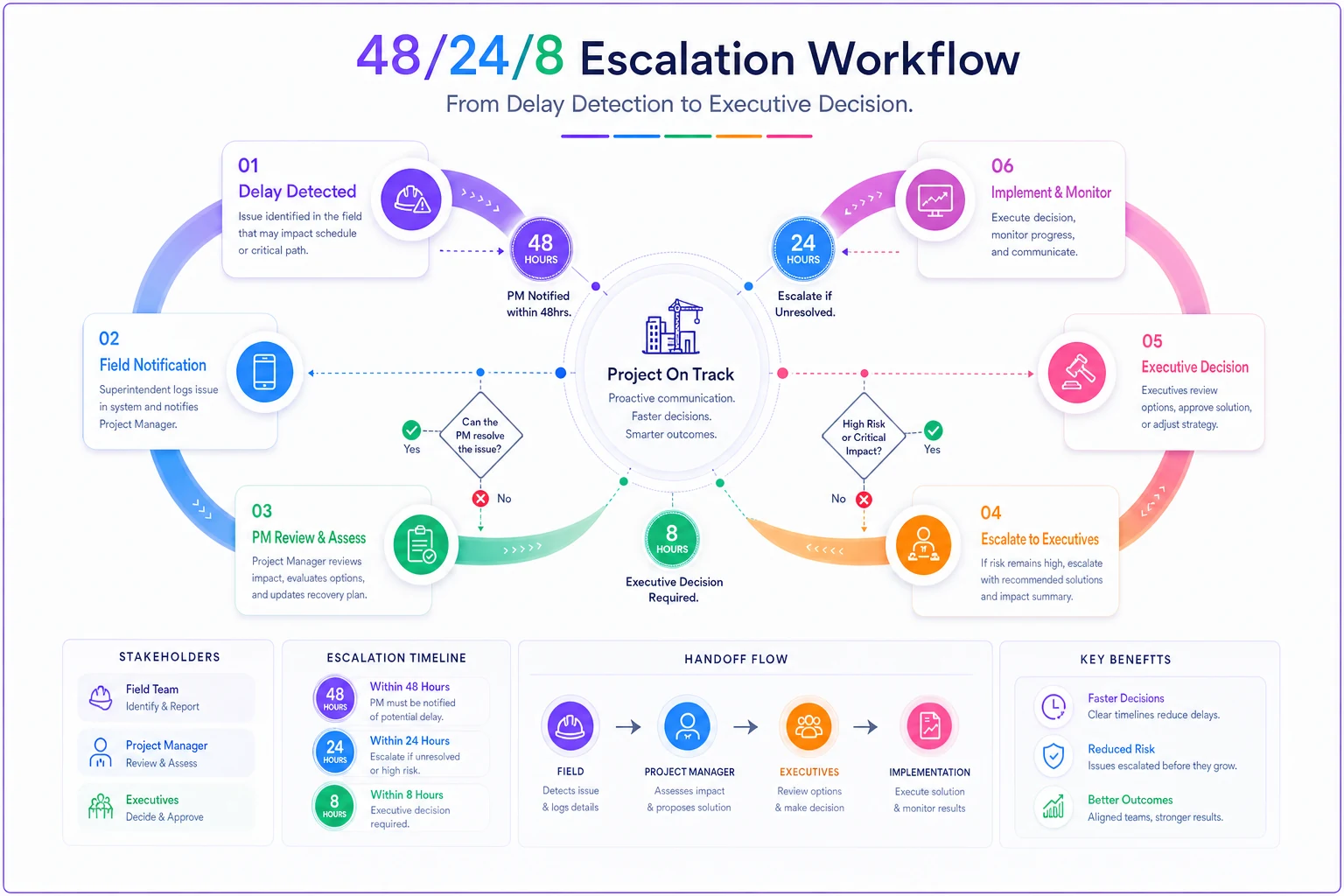
Once you know who decides what, you need communication timelines that match the urgency of each delay tier. The 48/24/8 framework creates predictable information flow without overwhelming everyone with constant updates.
48-hour protocol (Tier 1 delays): Initial notification within 2 hours of delay identification. Include: what happened, immediate impact assessment, and initial recovery plan. Update at 24 hours with refined analysis and confirmed recovery measures. Final update at 48 hours confirming resolution—or escalating to Tier 2 if the delay has grown.
24-hour protocol (Tier 2 delays): Notification within 1 hour to all stakeholders in your matrix. Updates every 4 hours for the first 24 hours covering: recovery progress, resource needs, and any scope changes discovered. After 24 hours, shift to daily updates until resolved—or escalate to Tier 3 if the impact grows past 10 days.
8-hour protocol (Tier 3 delays): All hands notification immediately. Executive briefing within 2 hours. Updates every 2 hours for the first 8 hours, covering: detailed impact analysis, multiple recovery scenarios with costs, and contract implications. After 8 hours, maintain 4-hour cycles until the recovery plan is approved and running.
These aren't arbitrary timeframes. Smaller delays can often self-correct with field-level adjustments. Major delays require rapid executive engagement before options disappear.
Real trigger conditions that actually matter
Generic triggers like "delay to critical path" don't help when you're standing in mud at 6am trying to decide if this is worth waking up the owner. You need specific, measurable conditions tied to actual field scenarios.
Weather-related triggers:
-
3+ consecutive days of weather delays
escalate to Tier 2
-
Hurricane/tornado warning for project area
immediate Tier 3
-
Unexpected freeze affecting concrete/masonry during critical pours
Tier 2 within 4 hours
Material/equipment triggers:
-
Long-lead item delayed 5+ days
automatic Tier 2
-
Structural materials failing inspection
Tier 2 if fix requires more than 48 hours
-
Tower crane breakdown during steel erection
immediate Tier 3
-
Major equipment (chillers, generators, elevators) damaged in shipping
Tier 2, escalate to Tier 3 if replacement exceeds 2 weeks
Labor/subcontractor triggers:
-
Key trade walking off job
immediate Tier 3
-
Critical trade understaffed by 40% or more
Tier 2 after 2 days
-
Failed inspection requiring significant rework
Tier 2 if rework exceeds 5 days
-
Union strike affecting any critical path trade
immediate Tier 3
External triggers:
-
Stop work order from building department
immediate Tier 3
-
Adjacent property damage claim
Tier 2, escalate based on investigation
-
Utility company delaying service connection
Tier 2 at 7 days before needed date
-
Design team RFI response exceeding 5 days on a critical item
Tier 2
Each trigger should specify not just the escalation level, but the exact data needed in the initial notification. For a crane breakdown: time of failure, diagnosis from operator or mechanic, parts availability, alternative crane options, and downstream trade impact.
The stakeholder matrix in practice
Most teams build org charts and call it a day. That's not enough. What you actually need is a matrix that maps delay severity to a specific decision maker, their backup, their spending ceiling, and their contract authority. Without the spending limits baked in, you still end up with approval bottlenecks even when everyone knows who's "in charge."
| Delay Impact | Primary Decision Maker | Backup Authority | Spending Authority | Contract Authority | Key Support Roles |
|---|---|---|---|---|---|
| 1-3 days | Field Superintendent | Operations Manager | $5,000 | Schedule adjustments only | Foreman, QC Manager |
| 4-10 days | Project Manager | Senior PM | $25,000 | Minor change orders | Scheduler, Purchasing |
| 10+ days | VP Construction | Owner/Executive | $100,000+ | All modifications | Legal, Finance, Owner Rep |
The matrix alone doesn't capture full complexity though. You also need clarity on parallel communications. When the PM is managing a Tier 2 delay, the superintendent doesn't stop running the site—they need updates every 4 hours to adjust daily planning. The scheduler needs immediate notification to run what-if scenarios. Affected subcontractors need a commitment on when they'll get definitive direction.
This is where many teams fail even with a matrix in place. They map vertical authority and ignore horizontal coordination entirely.
Walking through an actual escalation scenario
Thursday, 10am: the ironworker foreman discovers that 30% of the beam connections on floors 14-16 have the wrong bolt pattern. Deck installation can't proceed.
Hour 0-1: Foreman notifies superintendent. Super confirms with structural drawings—fabrication error, not a field mistake. Rough impact: 6-8 days to get new connection plates fabricated and shipped. This triggers Tier 2.
Hour 1-2: Superintendent initiates the 24-hour protocol. Sends notification to PM, ops manager, and scheduler. Includes photos of wrong connections, quantity affected, and preliminary impact. PM takes lead per the stakeholder matrix.
Hour 2-4: PM pulls together a response team: structural engineer (can we modify connections in the field?), ironworker foreman (what's the rework sequence?), steel fabricator (how fast can replacements ship?), scheduler (what's the real critical path impact?).
Hour 4: First update goes out. Three options:
-
Field modification with engineer approval
4 days, $18,000
-
Overnight fabrication and air freight
3 days, $35,000
-
Standard fabrication and ground shipping
8 days, $8,000
PM has authority for option 1 but not option 2—it exceeds the $25,000 limit.
Hour 5: PM escalates to Senior PM for option 2 approval, while simultaneously directing the engineer to develop field modification details as a backup.
Hour 8: Senior PM approves option 2 after schedule analysis shows the 3-day delay saves $50,000 in extended general conditions versus the 8-day scenario. Fabricator confirms they can start that night.
Hour 12: Update confirms fabrication started, freight arranged, ironworkers scheduled for weekend installation. Concrete contractor notified of revised pour schedule.
Day 2-3: Updates every 4 hours tracking fabrication, shipping, and installation. Issue resolved in 3.5 days total.
Without a clear protocol, this same scenario typically burns 2-3 days just getting approval on a recovery plan—pushing total delay to 10-12 days.
Who shouldn't use rigid escalation protocols
Not every project benefits from formal escalation structures. Small residential projects where the builder-owner talks daily don't need 48/24/8 protocols—they need consistent daily planning. Projects with a single decision maker create unnecessary bureaucracy with matrices.
The sweet spot for structured escalation: projects with 5+ primary stakeholders, contract values over $5M, or schedules exceeding 12 months. Also worth formalizing for:
-
Multiple funding sources requiring different approval chains
-
Public sector oversight with statutory notice requirements
-
Joint ventures where partners have different risk tolerances
-
International projects with time zone coordination challenges
For smaller projects, a simplified version works better. Designate one field-level decision maker and one office-level escalation point. Skip the tiers and use a simple threshold: field decides anything under 2 days impact, office handles anything larger.
When escalation protocols actually slow recovery
Sometimes the protocol itself becomes the problem. A mechanical contractor discovers asbestos during demo. By the time they work through Tier 3 escalation, notify all stakeholders, and get approval for abatement, they've lost the abatement contractor to another job.
This is why you need circuit breakers—specific conditions where normal escalation gets bypassed:
-
Life safety issues
superintendent has unlimited authority
-
Environmental hazards
immediate regulatory notification trumps internal protocol
-
Opportunity costs
if delay in decision costs more than $10,000 per day, the next level up can act immediately
You also need periodic protocol audits. Track every escalation—how long did each step take, did the right person make the call, did the communication timeline help or create more noise? After a few months, patterns emerge. Maybe Tier 2 delays almost always become Tier 3, which suggests your thresholds need adjustment.
The digital coordination challenge
Modern construction makes escalation both easier and harder. Everyone has instant communication, but that creates its own problems. When a critical delay hits, the PM's phone explodes with texts, calls, emails, and app notifications from twenty different people. The noise drowns out the signal.
Structured templates help here. Not lengthy forms—consistent formats that deliver key information fast:
Tier 1 Template:
-
Issue
[specific problem]
-
Impact
[days and trades affected]
-
Solution
[planned response]
-
Need
[any approvals required]
Tier 2 Template adds:
-
Cost impact
[estimated additional cost]
-
Schedule options
[2-3 recovery scenarios]
-
Risk factors
[what could make this worse]
-
Decision needed by
[specific time]
Tier 3 Template adds:
-
Contract implications
[LD exposure, claims potential]
-
Stakeholder impacts
[lender, permitting, public]
-
Executive summary
[one paragraph for board/ownership]
Here's a quick visual of how the 48/24/8 workflow moves from field detection through each decision node.
The templates seem basic. But they prevent the rambling email chains where critical information gets buried in paragraph six of message fourteen.
AI-powered construction management platforms are increasingly useful here. When the system detects a critical path activity running behind, it can initiate the protocol automatically, pre-populate templates with schedule data, and route notifications based on your stakeholder matrix. That removes the human hesitation factor—nobody has to debate internally whether something is "bad enough" to escalate.
Making escalation protocols stick
Creating the protocol is the easy part. Getting people to actually follow it when chaos hits is the real challenge. The superintendent who's dealt with problems their own way for twenty years won't suddenly start filling out escalation templates because there's a new policy in the binder.
Start implementation during a calm period, not mid-crisis. Run tabletop exercises with real scenarios from past projects. Make people actually use the templates and time the response cycles. When they see how much faster decisions flow, buy-in usually follows.
More importantly, track what happens when protocols aren't followed. That multi-family project where nobody escalated the foundation water intrusion until it had spread to three buildings? Calculate the real cost difference between a 2-day response and a 2-week response. Share those numbers. Make it clear that escalation protocols aren't about covering yourself—they're about saving money and schedule.
Regular reinforcement matters too. During phase planning sessions, review upcoming critical path work and pre-identify likely delay scenarios. When the team knows next week's steel erection could trigger specific protocols, they're mentally prepared to execute when something goes wrong.
The difference clear protocols make
A properly implemented critical path escalation protocol changes how teams handle delays. Instead of four days of confusion over bent steel, you get same-day approval on overtime. Instead of two weeks of finger-pointing over who should have caught a design conflict, you get immediate engineering engagement and a resolution.
Teams using structured escalation protocols with clear stakeholder matrices typically see 30-40% reduction in delay duration for critical path impacts. Not because they work magic on the underlying problems, but because they eliminate the organizational friction that turns 3-day problems into 10-day disasters.
There's also a less obvious benefit: structured escalation reduces the political dynamics that poison project relationships. When everyone knows their role and authority level before problems hit, there's less territorial behavior during crisis response. The ironworker foreman doesn't hide problems hoping to fix them quietly. The PM doesn't delay escalating to ownership out of fear of looking incompetent. The owner doesn't get blindsided by a major delay that's already unrecoverable.
Construction projects will always face delays. Weather, labor, materials, design issues—something will go wrong. But the response to those delays doesn't have to be chaotic. A clear escalation protocol with defined triggers, mapped stakeholders, and structured communication timelines turns crisis management into process execution. The critical path might break, but the decision path stays clear.
Ready to build smarter and faster?
Join 2,000+ construction teams using Projbrick to improve project visibility, reduce delays, and increase profitability.