


Modular and prefab construction gets sold as a way to compress schedule and control quality in a factory environment. That part is true. What nobody puts in the pitch deck is that the risk doesn't disappear — it just moves. Instead of trade coordination problems on site, you now have handoff problems between a factory 300 miles away, a logistics chain that doesn't care about your crane window, and three or four active sites all pulling from the same production line.
The failure mode is rarely a single bad module. It's the accumulation of small governance gaps: a unit that shipped without its factory acceptance sign-off, a delivery that showed up two days early with nowhere to store it, a wall panel that sat in the yard through a rain event and grew mold behind the vapor barrier. Each one is survivable on its own. Stack them across concurrent sites and you've turned a "faster" delivery method into a slower, more expensive one.
This is really a governance problem. Prefabrication delivery governance in construction is the discipline of deciding what gets checked, when a unit is allowed to move, and who has authority to stop it — then enforcing those rules identically across every site pulling from the same factory. Get the governance right and modular delivers what it promises. Get it wrong and you've just added a supply chain to a project that was already hard to run.
The three places prefab programs actually break
Before getting into checklists, it's worth being honest about where the breakage actually happens. In practice it clusters in three zones, and they're all handoffs — the moment responsibility passes from one party to another.
The factory-to-transit handoff is where quality problems get locked in. Once a module leaves the plant, fixing a defect goes from a $200 rework at the bench to a $15k field repair with scaffolding and a crane rental. If your acceptance process is someone walking the floor with a clipboard the morning of shipment, you're going to miss things.
The transit-to-site handoff is where logistics and readiness collide. The factory schedules to its own production efficiency. Your site schedules to install sequence. These two calendars do not naturally agree, and when they diverge you get units arriving before the site can receive them — or worse, arriving out of install order.
The site-to-install handoff is where everything either comes together or exposes the gaps from the first two zones. This is the gate: is the unit inspected, is the location ready, is the crew staged, are the preceding trades signed off? Skip it and you install a module that has to come back out.
Teams pour enormous energy into the factory relationship and almost none into the two downstream handoffs. That's backwards. The factory is the easiest part to govern because it's a controlled environment. The chaos lives in transit and receiving.
Factory acceptance: catch it while it's cheap
Factory acceptance is your one shot to reject a defect while it costs almost nothing to fix. The mistake most programs make is treating it as a final visual walk instead of a staged process with hold points during production.
Keep your construction projects on schedule and budget.
Projbrick helps you plan, track, and manage every project phase with precision and ease.
- Real-time project tracking
- Resource & budget management
- Team collaboration tools
No credit card required
-
In-process checks during framing and rough-in — before drywall closes up the cavity. Once the wall is closed, your MEP inside it is invisible until it fails in the field. This is the single highest-value inspection point and the one most often skipped because production wants to keep moving.
-
Pre-finish checks after mechanical, electrical, and plumbing rough-in but before finishes. You're verifying that what's about to be buried matches the shop drawings and the coordinated model.
-
Final factory acceptance before the unit is released for shipment — dimensional verification, finish quality, protection wrap, and documentation completeness.
The governance rule that matters: no unit ships without a signed final acceptance, and the sign-off authority is yours, not the factory's. If the factory can release its own work, you don't have acceptance, you have a formality. In practice, this usually means either your QA person is physically at the plant on shipment days, or you're running a documented remote acceptance with photo and video evidence tied to a checklist that a named person on your team signs.
A workable factory acceptance checklist for final release:
-
Dimensional check against shop drawings (overall, and critical mating dimensions to adjacent units)
-
MEP rough-in verified against coordinated model and photographed before close-up
-
Finish quality inspected and defects logged with location and severity
-
Fire-rated assemblies verified and labeled
-
Lifting points and rigging hardware inspected and rated
-
Protection wrap and edge guards installed per storage spec
-
Serial number / unit ID matched to the delivery and install sequence
-
All in-process hold-point sign-offs present in the unit file
-
Punch items either closed or explicitly accepted as field-completed with owner approval
That last line is the one people fudge. "We'll finish it in the field" is fine occasionally and a disaster as policy. Every field-completion carries forward a cost and a crew hour that the modular method was supposed to eliminate. Track the percentage. If more than a small fraction of units are shipping with open field-completions, your factory schedule is too tight — and it's going to show up at install.
JIT receiving: the packet that decides whether a delivery is welcome
Just-in-time works beautifully in a factory. On a construction site it's fragile, because your buffer is measured in hours and any disruption upstream ripples straight to your crane window. The way you protect against that is a JIT receiving packet — a defined bundle of information and conditions that must all be true before a delivery is authorized to leave the factory for a specific site on a specific day.
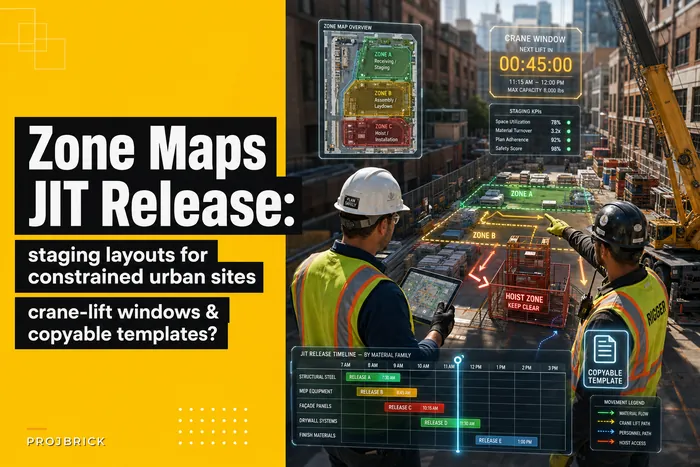
The receiving packet isn't paperwork for its own sake. It's the mechanism that keeps the factory's calendar and the site's calendar honest with each other. If you've read our breakdown on material staging layouts for constrained urban sites, the same zone-map and crane-window logic applies here — except modules are bigger, more fragile, and can't be restacked to make room.
A JIT receiving packet for each delivery should confirm:
-
Site readiness — the receiving location is clear, the crane is booked and inspected, the pick plan is approved
-
Sequence confirmation — this unit is the next one needed in the install order, not just the next one off the line
-
Access and route — the transport route is confirmed, permits in hand, delivery window matched to any street-closure or noise-ordinance limits
-
Receiving crew staged — someone with authority to inspect and accept is physically present
-
Weather check — for units with exposed connections or moisture-sensitive assemblies, the forecast is within tolerance for the unloading window
-
Storage fallback — if install can't happen immediately, a compliant protected storage location is identified before the truck leaves
That last point is where JIT programs quietly fail. Teams assume install-on-arrival and never define what happens when it slips — and it slips constantly, because a crane breakdown or a preceding-trade delay is a normal Tuesday. Without a storage fallback in the packet, a slipped install turns into modules parked in a mud lot with no protection plan.
The discipline is simple to state and hard to hold: the factory does not ship until the receiving packet is green. That means someone has to say no to the factory when they want to push a unit out early to smooth their own production. Saying no costs you a hard conversation. Saying yes costs you a module you can't install sitting somewhere it shouldn't be.
Storage and protection: the silent margin killer
Modules and panels are designed to be installed, not stored. The moment one sits in a yard, you're fighting moisture, UV, theft, and physical damage from other site activity. The costs are sneaky because they don't show up as a line item — they show up later as callbacks, mold remediation, and warped assemblies nobody can trace back to a rainy week in the storage yard.
Storage and protection rules need to be explicit and enforced with the same discipline as the acceptance checklist. A minimal storage governance standard covers:
| Risk | Rule | Enforcement check |
|---|---|---|
| Moisture / water intrusion | Units elevated off grade on dunnage, protection wrap intact, drainage away from storage pad | Weekly wrap-integrity walk, logged with photos |
| Ground bearing / settlement | Storage pad rated for point loads, no soft ground | Pad inspection before first unit placed |
| Sequence scrambling | Units stored in reverse install order (last-in, first-out) | Yard map matched to install sequence |
| Physical damage | Minimum spacing between units, exclusion zone from equipment traffic | Yard layout audit |
| Theft / tampering | Secured storage, unit IDs logged, seals on finished units | Daily unit count against manifest |
| Time-in-storage | Maximum days in storage before mandatory re-inspection | Age-tracking on every unit |
Every day in storage is a day of accumulating risk and zero progress. Storage time is pure carrying cost. The best prefab programs treat a growing storage yard the same way a good procurement lead treats a growing pile of long-lead material — as a warning sign, not a comfort. Our write-up on avoiding material-driven stoppages on high-rises makes the same point from the procurement side: inventory sitting still is money and risk sitting still.
The underlying problem is that storage feels passive. Nobody books a meeting about the yard. But that's exactly why it compounds — small protection failures and sequence scrambles accumulate quietly until you're doing field repairs on units that should have arrived ready to set.
Install gating: the last line of defense
The install gate is where you decide a module is actually going in the building. Everything upstream — factory acceptance, JIT packet, storage protection — feeds this decision. The gate exists to prevent the most expensive mistake in the whole chain: installing a unit that then has to come back out.
An install gate should require, at minimum:
-
Factory acceptance sign-off present and matched to this unit ID
-
Receiving inspection complete — no transit damage, protection intact
-
Preceding trades and structure signed off for this specific location
-
Rigging and pick plan approved for this lift
-
Crew staged and briefed on the connection sequence
-
Post-set inspection scheduled with a named inspector
The connection to your overall sequencing discipline matters here. Modular install doesn't remove the need for phase gating — it concentrates it. When you're setting whole rooms or wall assemblies in a single pick, a missed preceding-trade sign-off doesn't cause a small rework, it causes a set-and-remove. This is exactly the kind of phase discipline covered in our repeatable project-planning framework for multi-phase jobs — the gates are the same idea, just with much higher stakes per unit.
A set-and-remove isn't just a cost problem. It's a schedule problem, a crew morale problem, and depending on the unit type, potentially a structural problem. The install gate is cheap compared to what it prevents.
Running the governance across concurrent sites
Everything above is manageable on one site. The reason prefab programs fall apart is concurrency. Three or four sites pulling from one production line means the factory is optimizing for its own throughput, and each site's PM is fighting for their units to ship next. Without program-level governance, the loudest PM wins and the sequence gets scrambled for everyone.
Program-level governance means a single owner — usually a prefab program manager sitting above the individual site PMs — controls the release sequence off the production line based on install readiness across all sites, not by whoever complains hardest. This person holds the master install-order calendar and reconciles it against factory production capacity every week.
Below is a simplified view of how unit status flows from factory to install, and where the hold points live:
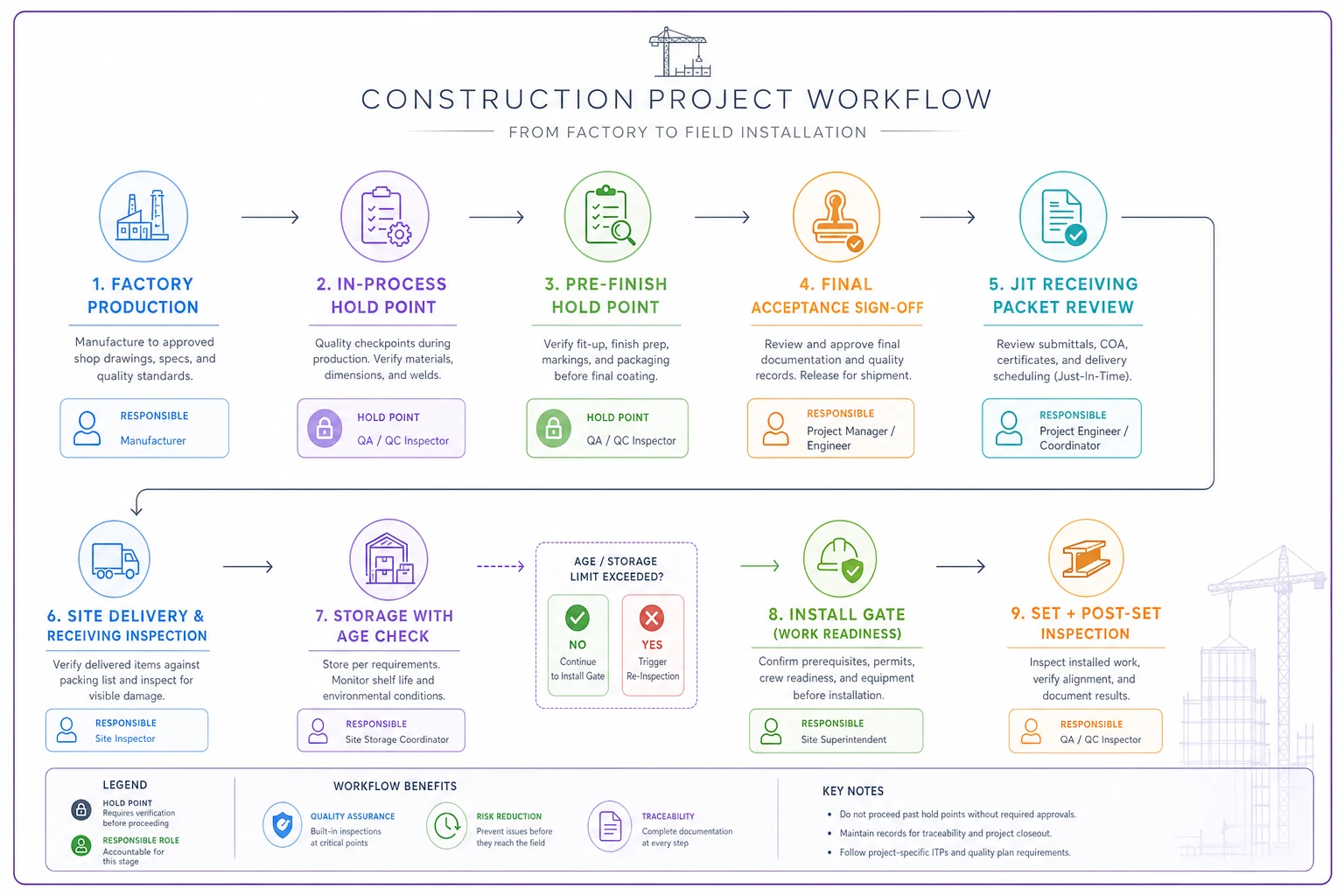
Each arrow is a handoff. Each hold point is a place where a named person on your team has authority to stop the unit from moving forward. That's the whole model.
The coordination cadence that tends to hold up:
-
Daily
Each site reports install completions and next-24-hour readiness. Factory reports units completing acceptance that day.
-
Twice weekly
Program manager reconciles factory production forecast against the combined install sequence across sites and reissues the release order.
-
Weekly
Full program review — storage yard ages, field-completion rates, acceptance rejection trends, upcoming crane windows across all sites.
-
Per delivery
JIT receiving packet review and go/no-go.
The single biggest coordination failure in concurrent prefab is information latency. A preceding-trade delay on Site B doesn't reach the factory in time, so a unit for Site B ships anyway, arrives to a site that isn't ready, and gets diverted to storage — while a unit Site A actually needed sits behind it in the production queue. That's a scheduling problem caused entirely by slow information flow. Centralizing everything into one shared program view — instead of five separate PM spreadsheets and a WhatsApp thread with the factory — quietly earns its keep. The tools matter less than the rule: one source of truth for unit status, install readiness, and release sequence, updated daily, that everyone reads from.
A real scenario
A mid-sized GC was running modular bathroom pods across three multifamily sites, pulling from one regional plant — roughly 40 pods a month across the program. Early on they ran it loosely: the factory shipped on its own schedule, site PMs coordinated by phone, and units that couldn't install went to whatever storage space was free.
The problems showed up about two months in. Storage was averaging 9–12 days per pod because deliveries kept outrunning install readiness. Around one in six pods had transit or storage damage requiring field repair — mostly moisture behind protection wrap that had torn and never got re-checked. On two occasions they set pods before the preceding plumbing rough-in was fully signed off, both of which came back out. The rework and carrying costs were eating the schedule savings that justified going modular in the first place.
The fix wasn't complicated, it was just governance. They put a single program manager over the release sequence, required a green receiving packet before any pod shipped, and enforced a hard storage protocol with a weekly wrap-integrity walk. They also capped storage age — any pod past 7 days triggered a mandatory re-inspection.
Over the next quarter, average storage time dropped to around 3–4 days, damage-requiring-repair fell to well under one in twenty, and the set-and-remove incidents stopped entirely. Nobody added headcount. They just stopped letting units move without the checks in place.
When strict gating is worth it — and when it's overhead
Heavy governance isn't free. Every gate is a potential stall point, and on a small, single-site modular job with a short production run, a full program-management layer is overhead you don't need. If you're setting a dozen units on one site with a crew that's on it every day, a lightweight acceptance checklist and a simple install gate are plenty. Twice-weekly reconciliation meetings on top of that is bureaucracy for its own sake.
The governance earns its cost when you hit concurrency, distance, or volume. Multiple sites drawing from one factory, a plant far enough away that field rework is genuinely expensive, or a production run long enough that sequence drift compounds — those are the conditions where a program manager and a hard receiving packet pay for themselves.
The honest test: if a scrambled sequence or a slipped delivery on one site would ripple into others, you need program-level governance. If it wouldn't, keep it light.
The teams that struggle most are the ones in the middle who run a multi-site program with single-site habits — treating each delivery as a local problem when it's actually a shared-resource scheduling decision. That gap between how the program is structured and how it's governed is where the schedule savings quietly leak away.
Modular and prefab construction is a genuinely better way to build under the right conditions — but the method doesn't manage itself. Quality control moves upstream to a factory you don't fully control, the logistics get tighter, and the coordination burden multiplies with every concurrent site sharing the production line. Governance is what holds all of that together: staged factory acceptance so defects get caught while they're cheap, receiving packets that keep the factory and site calendars honest, storage rules that stop carrying costs from eating your margin, and install gates that prevent the one mistake you can't afford.
Run those consistently across every site from a single shared view of unit status, and prefab delivers the schedule and quality it promised. Skip them, and you've simply traded on-site chaos for supply-chain chaos — usually at a higher price.
Ready to build smarter and faster?
Join 2,000+ construction teams using Projbrick to improve project visibility, reduce delays, and increase profitability.