

The problem with most foundation sampling plans is that they read fine in the spec book and fall apart the moment a 28‑day break comes back at 3,100 psi against a 4,000 psi design. Suddenly you've got three trades stacked behind that footing, a lab that won't answer the phone, and a superintendent asking whether he can keep pouring the next lift. Nobody documented what happens between "cylinder failed" and "structural signs off." That gap is where schedules die.
This packet is built for that gap. Not the theory of sampling — you already know ASTM C31, C39, the whole set fabrication routine. This is the operational layer on top: how many samples, when to core instead of accepting, how to keep the lab honest on turnaround, and how to sequence contingency pours so one bad break doesn't freeze the whole foundation. Everything here is meant to fit on a couple laminated pages in the field trailer.
Start with a sampling plan that matches pour risk, not a flat rule
Most specs give you a blanket rule — one set per 50 or 100 cubic yards, or one per pour, whichever is greater. That's a floor, not a plan. What separates crews that recover fast from crews that scramble is that they sample by risk, not by volume alone.
Here's the practical breakdown for foundations:
| Pour type | Sampling frequency | Extra cylinders | Why |
|---|---|---|---|
| Standard spread footings | 1 set / 100 CY or per pour | +2 field‑cured | Low consequence, easy to isolate |
| Mat / raft foundation | 1 set / 50 CY | +2 field, +1 for 7‑day | Continuous pour, hard to core later |
| Deep pile caps / heavily reinforced | 1 set / 50 CY per truck group | +2 field, +2 held | Congested rebar makes coring brutal |
| Cold or hot weather pours | 1 set / 50 CY | +2 field‑cured min | Temperature swings widen variance |
| First pour of a new mix/supplier | 1 set / truck for first 3 trucks | +2 held | You're validating the mix, not the pour |
The two numbers people consistently skip are field‑cured cylinders and held cylinders. Field‑cured sets tell you what the actual in‑place concrete is doing, which matters enormously when you're deciding whether to keep loading a slab. Held cylinders — extra sets you fabricate and don't break on the standard schedule — give you a 42‑ or 56‑day option so you're not forced into coring the second a 28‑day comes up short. A held set costs maybe $25–40 in lab fees. Coring a footing costs you a day and a diamond bit.
Fabricate held sets for the first three trucks of an unfamiliar mix so you don't lose the early validation opportunity.
One pattern worth flagging: crews under‑sample the first pour with a new supplier and over‑sample everything after. It should be the reverse. The first three trucks of an unfamiliar mix are where you catch batching problems, and that's exactly when a single per‑pour set hides the truck that was off.
The acceptance decision tree: when to accept, when to investigate, when to core
This is the part that needs to live on one page. When a break comes back, the field shouldn't be debating philosophy. ACI 318 gives you the two acceptance criteria most specs reference — no single test more than 500 psi below f′c, and the average of any three consecutive tests at or above f′c. The decision tree is how you route the result.
Keep your construction projects on schedule and budget.
Projbrick helps you plan, track, and manage every project phase with precision and ease.
- Real-time project tracking
- Resource & budget management
- Team collaboration tools
No credit card required
-
Break at or above f′c? Accept. Log it, move on. No action.
-
Break within 500 psi of f′c, and the 3‑test moving average holds? Conditionally accept. Flag it, notify structural as an FYI, keep watching the trend. No pour hold.
-
Single break more than 500 psi low, but a held/field set is available? Do NOT core yet. Pull the held cylinders or break the 7‑day field‑cured set for context first. This step alone kills half the unnecessary coring calls.
-
Break more than 500 psi low AND no held sample supports it? Now you're in investigation. Notify the structural engineer of record. Begin core planning in parallel — don't wait for their formal response to schedule the coring crew.
-
Two or more consecutive low breaks, or moving average below f′c? Full stop on dependent work. Structural review mandatory. Cores per ACI 318 (three cores, evaluated against 85% of f′c average, no single core below 75%).
The mistake is treating step 3 and step 4 as the same event. A single low cylinder is not a failed foundation — it's often a bad cylinder. Poor consolidation during fabrication, a cap that wasn't ground flat, a set left in the sun before pickup. Before you fire up a core drill, the field should be asking whether the sample failed or the concrete failed. Those are wildly different problems, and confusing them costs real money.
Managing lab turnaround so you're not waiting blind
The silent schedule killer isn't the low break. It's the four days you spend waiting to find out whether the break was low. Labs quote 24‑ to 48‑hour turnaround and then sit on results because nobody set expectations upfront.
-
Set the turnaround SLA in the testing contract, not the field. Written 24‑hour reporting on 7‑day and 28‑day breaks, with a named contact. If it's not in the agreement, "next week" is technically fine by them.
-
Require same‑day preliminary verbal on any break below f′c. You don't need the stamped report to start planning. You need to know a number is low today, not Thursday.
-
Track chain of custody with pickup timestamps. A cylinder that sat in a hot truck bed for six hours before reaching the curing tank is a fabrication problem you'll want documented before anyone blames the pour.
-
Batch your break schedule to the lab's run days. Some smaller labs only run the compression machine two or three days a week. Know that before you fabricate, or your "28‑day" break happens on day 31.
On a mid‑size mat pour, the difference between finding out about a low 7‑day break the same afternoon versus three days later was the difference between adjusting the next pour's mix and pouring the same suspect mix twice. The 7‑day break isn't an acceptance test, but it's your earliest warning, and labs treat it as low priority unless you tell them otherwise.
Contingency pour sequencing: keep the foundation moving around a hold
This is the discipline most teams lack. When a pour goes into investigation, they treat the whole foundation as frozen, when really only the work structurally dependent on that specific element needs to stop. Good sequencing isolates the problem pour and keeps independent work flowing.
Before the first pour, map your foundation into dependency islands — groups of elements where downstream work depends on a specific element reaching strength. A footing under Column Line 4 holds up framing on Line 4. It does not hold up the footing on Line 12. If you've sequenced with that separation in mind, a low break on Line 4 doesn't stop Line 12.
-
Identify the affected element and everything structurally downstream of it. That's your frozen zone.
-
Confirm what independent pours can proceed — different dependency islands, isolated footings, work that doesn't load the suspect element.
-
Reroute the crew and pump to the next available independent pour rather than standing them down. A standing crew on a foundation is $2k–$5k of idle labor a day depending on size.
-
Hold all backfill, form stripping, and load application on the frozen zone until the acceptance decision resolves.
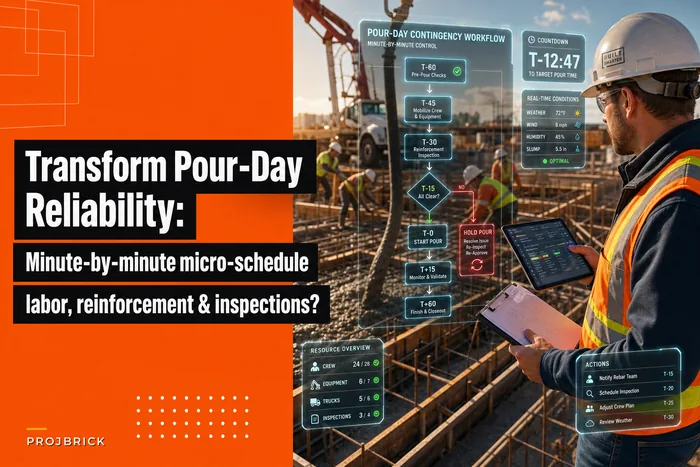
This sequencing logic is the same thing that keeps multi‑phase jobs from cascading — the ideas in this repeatable project‑planning framework for multi‑phase jobs apply directly to how you group foundation pours. And because contingency pours often collide with inspection and reinforcement timing, aligning them with a tight minute‑by‑minute pour‑day micro‑schedule helps make sure a rerouted pour doesn't create its own inspection gap.
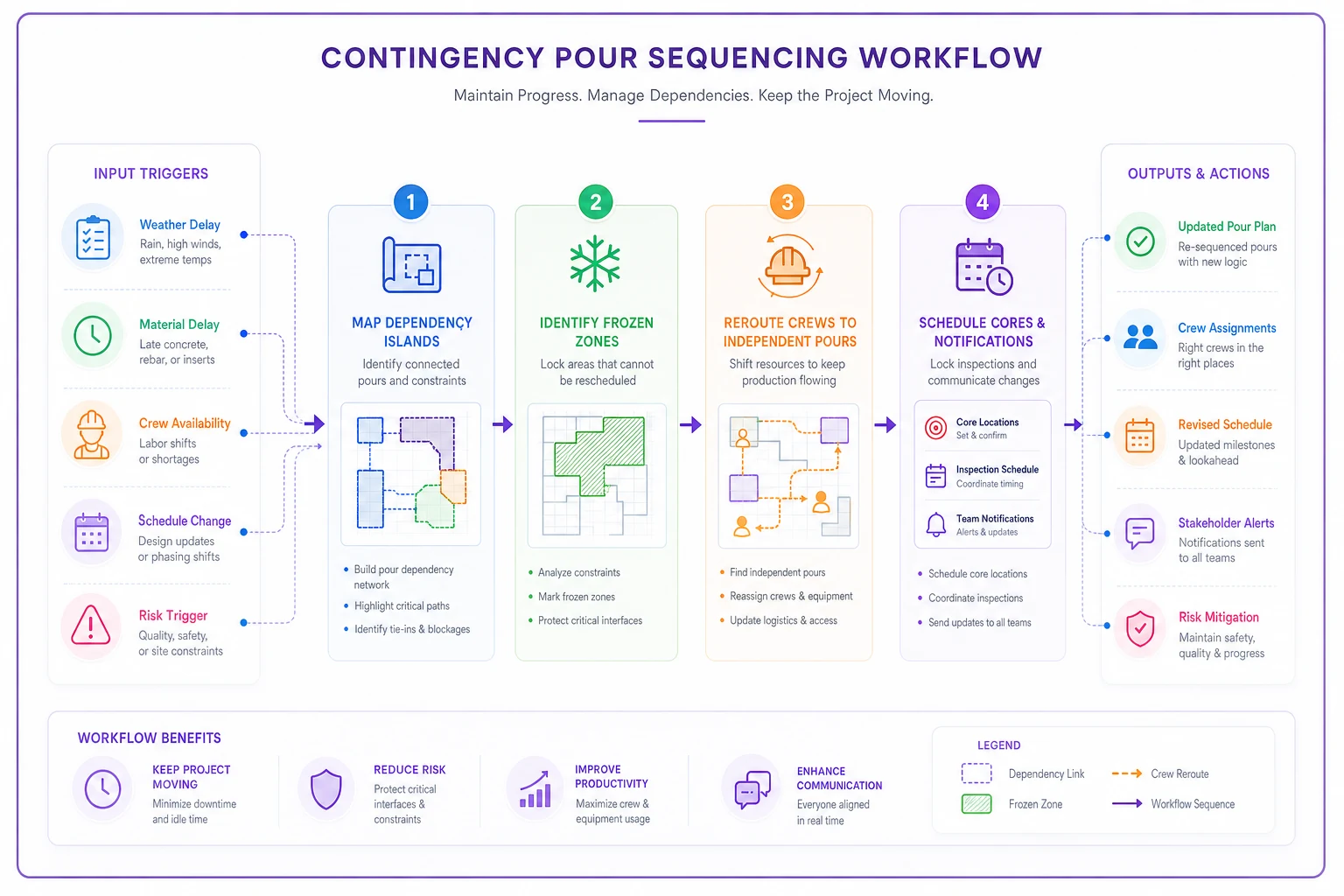
A quick visual of the contingency workflow.
A stakeholder notification matrix keyed to schedule continuation
The reason low breaks turn into week‑long stoppages is almost always communication lag, not concrete. The structural engineer finds out two days late. The owner hears about it from the inspector instead of the PM. The lab report circulates by the time the decision's already been made badly. A notification matrix fixes the sequence by tying who gets told to what the schedule can do next.
| Result trigger | Notify within | Who | Schedule status |
|---|---|---|---|
| Single break within 500 psi, avg holds | 24 hrs | SEOR (FYI), QA lead | Continue all work |
| Single break >500 psi low | Same day | SEOR, QA lead, super | Freeze dependent zone only |
| Held/field set contradicts low break | 24 hrs | SEOR, QA lead | Resume pending SEOR confirm |
| Two consecutive low / avg below f′c | Immediate | SEOR, PM, owner rep, inspector | Full hold on affected islands |
| Cores ordered | Same day | SEOR, owner rep, testing lab | Frozen zone until core results |
The point of keying it to schedule status is that everyone reading the notification instantly knows what it means for the job, not just that a number came back. "Break was low" causes panic. "Break was low, dependent zone frozen, Lines 8–12 continuing, cores planned for Thursday" is a plan. That distinction sounds small until you've watched an owner call three people in a row because nobody gave him a sentence that told him what happens next.
Where this tends to break down — and a quick fix
The failure mode is rarely the protocol itself. It's that sampling logs, break results, held‑cylinder tracking, and notification steps all live in different places — a field binder, someone's texts, a PDF the lab emailed, the super's memory. When a break comes back low, nobody can assemble the picture fast enough to make the acceptance call, so the whole thing defaults to "stop everything and wait."
Teams that recover fast keep this evidence together and time‑stamped — the same discipline behind good temporary works evidence packets and photo protocols. Whether that's a shared log, a simple dashboard, or operational software that flags a low break and routes the notification matrix automatically, the value isn't the tool — it's that the sampling plan, the results, and the decision tree stop living in separate silos. When a low cylinder can instantly show you the held sets available, the dependent pours, and who needs to be told, the acceptance decision takes minutes instead of days.
Real scenario: a low 28‑day on a pile cap
A commercial project pouring heavily reinforced pile caps got a 28‑day break at 3,350 psi against a 4,500 psi design — well past the 500 psi threshold. The old habit would've been an immediate full stop and a core‑drilling scramble through a cage so congested the drilling itself risked hitting rebar.
Because they'd fabricated two held sets per cap group, they broke the held cylinders first: those came back at 4,610 and 4,540 psi. The low break traced to a cylinder that had been capped unevenly — a fabrication defect, not a concrete defect. Field‑cured sets from the same cap confirmed in‑place strength was fine. No coring, no hold on downstream framing beyond a one‑day investigation window.
Rough math: coring three locations, lab evaluation, and the associated dependent‑work hold would've run somewhere in the $6k–$9k range plus two to three days of schedule. The held cylinders cost about $70 total to fabricate. That's the entire argument for held sets in one story.
When this level of rigor makes sense — and when it doesn't
This full packet is worth running on mat foundations, deep pile caps, heavily reinforced elements, and anything where the pour is continuous or coring later would be miserable. On those jobs, the cost of a held set and a notification matrix is trivial against the cost of a frozen foundation.
Where it's overkill: small residential footings, isolated low‑consequence pours, garden‑variety spread footings on a job with an established supplier and a clean break history. Fabricating held sets on every 20‑CY footing pour clutters your lab schedule and your budget without buying you real protection. Match the rigor to the consequence of being wrong.
The teams that get burned are the ones running the same thin sampling plan on a 900‑CY mat that they run on a backyard footing. Foundations don't fail on the pours you worried about. They fail on the ones you treated as routine.
Foundations don't fail on the pours you worried about. They fail on the ones you treated as routine.
Ready to build smarter and faster?
Join 2,000+ construction teams using Projbrick to improve project visibility, reduce delays, and increase profitability.