


Project closeout feels like running through quicksand while juggling flaming torches. You've substantially completed the build, trades are pulling off-site, but somehow you're still chasing commissioning reports six months later while the owner holds that final 5% payment hostage.
The numbers tell an ugly story. General contractors typically wait somewhere between 83 and 127 days after substantial completion to receive final payment. That's three to four months of carrying costs, stretched cash flow, and resources stuck managing paperwork instead of starting new projects. Meanwhile, subcontractors often wait even longer—sometimes pushing 180 days—creating a cascade of financial pressure down the construction food chain.
What makes this worse is that closeout chaos compounds across multiple projects. When you're running four or five jobs simultaneously, each with their own messy closeout process, you're essentially operating a document management company that happens to build things. Project managers spend more time tracking down O&M manuals than managing active construction.
Why traditional closeout turns into a black hole
The fundamental problem with construction project closeout isn't complexity—it's coordination. Every project involves the same basic components: punch lists, commissioning, warranties, as-builts, O&M documentation, lien waivers, and final accounting. But without a rigid system that enforces sequence and completeness, these pieces scatter across email threads, shared drives, and someone's desk drawer.
Think about what actually happens during a typical commercial project closeout. The MEP coordinator has commissioning data spread across three different testing contractors. The project engineer is tracking punch items on a spreadsheet nobody else can access. Accounting needs lien waivers from 23 different subs, but only 14 have submitted them because the other nine are waiting on closeout documentation from second-tier suppliers.
Meanwhile, the owner's facility team keeps asking for equipment manuals the mechanical contractor swears they submitted two months ago. The architect wants as-builts reflecting field changes nobody documented properly during construction. And somewhere in this mess, there's probably a $47,000 change order that never got fully executed because the backup documentation went missing.
This isn't a process problem you can fix with better project managers or more administrative staff. It's a systems failure that requires mandatory gates, automated tracking, and enforced timelines.
The mandatory closeout packet that eliminates ambiguity
A construction project closeout system starts with defining exactly what "complete" means—not in construction terms, but in documentation terms. This means creating a mandatory closeout packet structure that becomes non-negotiable from project kickoff.
Keep your construction projects on schedule and budget.
Projbrick helps you plan, track, and manage every project phase with precision and ease.
- Real-time project tracking
- Resource & budget management
- Team collaboration tools
No credit card required
Make the packet templates part of subcontractor contract attachments so expectations are clear from the start.
Commissioning Documentation
-
Individual equipment test reports
-
System integration testing
-
Balance reports (air and water)
-
Control sequence verification
-
Third-party commissioning agent signoff
As-Built Package
-
Architectural drawings with RFI incorporation
-
Structural modifications from field conditions
-
MEP routing changes with exact dimensions
-
Site plan adjustments
-
Civil underground actual locations
Operations and Maintenance
-
Equipment manuals indexed by space and system
-
Warranty documentation with start dates
-
Preventive maintenance schedules
-
Spare parts lists with supplier contacts
-
Training completion certificates
Administrative Closure
-
Final lien waivers from all tiers
-
Consent of surety (if bonded)
-
Final change order log
-
Stored materials releases
-
Subcontractor closeout affidavits
The critical piece here is making each category binary—either complete or incomplete. No partial credit. A commissioning report missing one pump test means the entire commissioning gate stays closed. This sounds harsh, but it's the only way to prevent the slow bleed of incomplete documentation that stretches closeout into infinity.
Commissioning gates that force sequential completion
Most contractors treat commissioning like a parallel process that happens alongside closeout. This creates the nightmare scenario where you're chasing commissioning reports months after substantial completion because nobody made them a prerequisite for other closeout activities.
Gate 1: Pre-Commissioning Requirements Before any systems testing begins, require complete installation verification. This includes torque documentation on critical connections, pressure test certificates for piping systems, and electrical megger testing. No testing starts until this gate passes.
Gate 2: Individual Equipment Testing Each piece of equipment gets tested in isolation with documented results. Fan motors run solo, pumps operate against closed valves, boilers fire without load. Every test generates a signed report that goes into the packet immediately—not "when we get around to scanning everything."
Gate 3: System Integration Testing Only after individual components pass can you test integrated systems. The chilled water plant runs as a complete system. The BAS demonstrates full sequence of operations. Emergency power systems prove automatic transfer under load.
Gate 4: Seasonal Testing Scheduling Some systems can't be fully tested until specific weather conditions exist. Your closeout system needs to track these requirements separately with scheduled return visits. A July substantial completion means heating systems won't get full-load testing until November. The system must account for this without holding up the entire closeout.
Gate 5: Owner Training Verification Training isn't complete until the owner's staff demonstrates competency. This means recording who attended, what they learned, and having them sign off that they can operate the systems. Skip this gate and you'll get calls two years later asking how to change filters.
Each gate blocks progress on subsequent activities. Subs can't submit final payment applications until their commissioning gates clear. That creates urgency around documentation that typically doesn't exist when everything floats freely.
Defect escrow mechanisms that protect cash flow
The traditional approach to punch lists creates a hostage situation. Owners hold massive retention amounts for minor defects, contractors can't get paid until every outlet cover is straight, and cash flow strangles while everyone argues about what constitutes "substantial" completion.
A defect escrow system separates minor punch items from major payment milestones. Here's the operational structure:
Set defect values based on actual correction cost, not arbitrary percentages. A missing door closer might require $200 to fix, so that's the escrow amount—not 5% of the entire door package. This requires detailed defect pricing during the punch walk, but it prevents owners from holding $100,000 for $3,000 worth of actual work.
-
Life safety items
24 hours
-
Operational defects
7 days
-
Aesthetic issues
30 days
-
Seasonal items
Scheduled resolution
The system automatically releases escrow amounts as defects clear. Fix the door closer, upload the verification photo, and that $200 releases immediately. No waiting for the entire punch list to clear before seeing any money.
For disputed items, implement a rapid resolution process. If the owner claims the paint doesn't match but you disagree, the system forces a decision within 72 hours. Either the owner accepts it, you agree to fix it, or it goes to predetermined third-party resolution. No more six-month arguments over subjective finish quality.
SLA timelines that create predictable closure
Service Level Agreements typically apply to ongoing services, but the same principle works for closeout activities. Every documentation requirement gets a specific timeline with automatic escalation when deadlines pass.
Your construction project closeout system should enforce these timelines:
Submittal deadlines from substantial completion:
-
Preliminary punch list
3 days
-
O&M manuals
14 days
-
As-builts
30 days
-
Warranty documentation
30 days
-
Final lien waivers
45 days
-
Commissioning reports
60 days
Review and response timelines:
-
Owner punch walk
Within 7 days of notification
-
Document review
5 business days maximum
-
Defect verification
48 hours from completion claim
-
Payment processing
10 days from approved submittal
When timelines slip, the system escalates automatically. Miss the O&M manual deadline by three days? The project executive gets notified. Miss it by seven days? It goes to company ownership. Miss it by fourteen days? The system can trigger contractual penalties or payment delays.
This sounds aggressive, but it's exactly what makes closeout predictable. Everyone knows when things are due and what happens if they're late. That alone changes behavior on most projects.
Accelerating financial closure through workflow automation
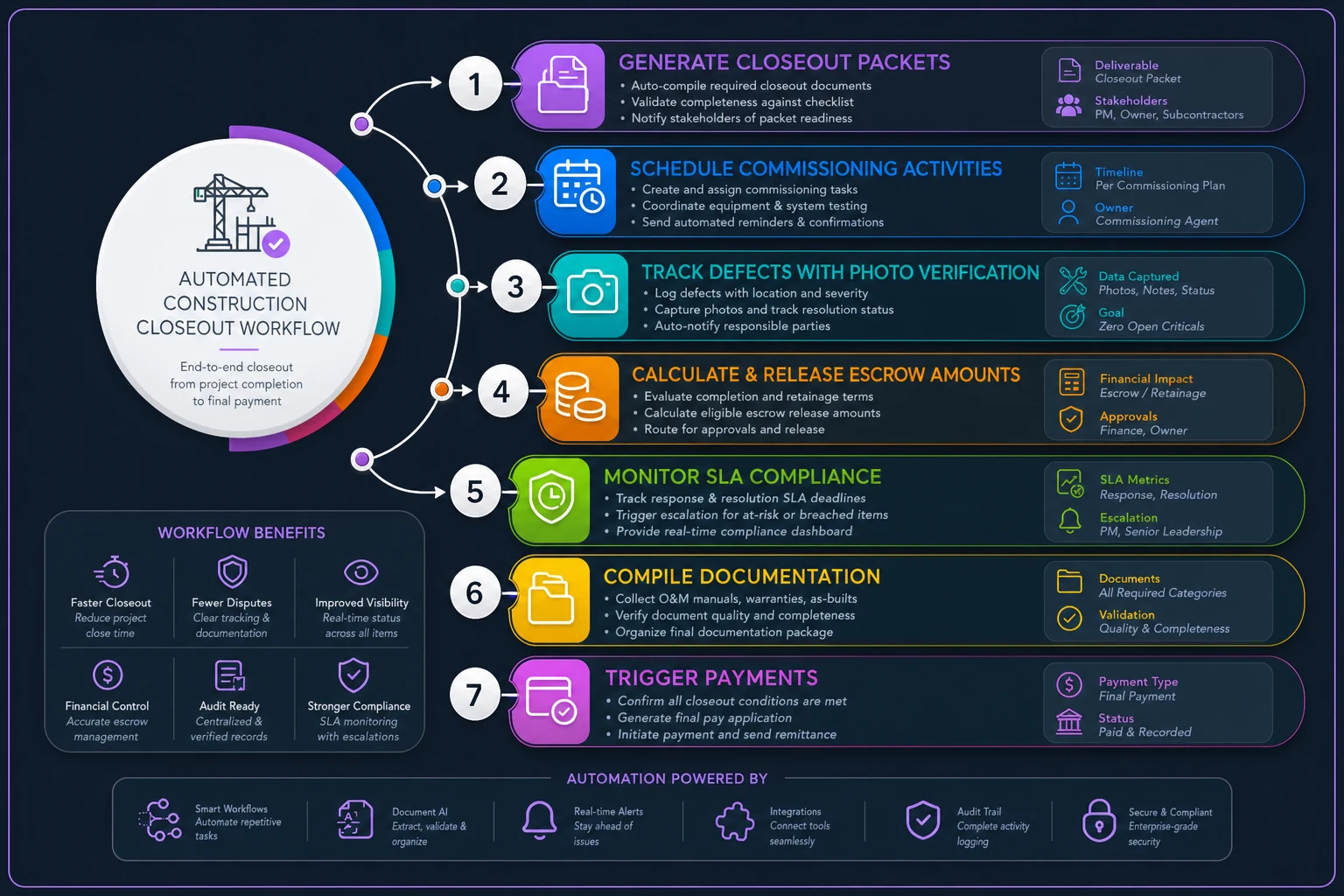
The final piece involves mapping these requirements to automated workflows that push documentation through without manual intervention. Instead of project managers sending reminder emails, the system drives the entire process.
When substantial completion hits, the system automatically:
-
Generates closeout packets for each subcontractor
-
Schedules commissioning activities based on system readiness
-
Tracks defect resolution with photo verification
-
Calculates escrow amounts and releases
-
Monitors SLA compliance with escalation triggers
-
Compiles documentation into owner-required formats
The automation extends to financial workflows too. As gates clear and escrow releases, the system automatically generates payment applications, processes lien waiver requirements, and triggers ACH transfers. No more waiting for accounting to "process the paperwork" when everything's already done.
Integration with accounting systems means payment applications generate automatically as gates clear. When the mechanical contractor completes their commissioning requirements, the system releases their retention without anyone touching a keyboard. Same goes for defect escrow—fix the item, upload the photo, get paid.
| Traditional Closeout | Systematic Closeout | Time Impact |
|---|---|---|
| Email chains for document collection | Automated packet generation | Saves 20-30 hours per project |
| Manual punch list tracking | Photo-verified defect clearing | Reduces resolution time by 60% |
| Undefined document requirements | Mandatory gate progression | Eliminates 75% of back-and-forth |
| Arbitrary payment holds | Cost-based defect escrow | Releases 85% of retention faster |
| Reactive deadline management | SLA-driven escalation | Cuts closeout duration by 40-50% |
A workflow diagram helps visualize the automation steps.
No more waiting for accounting to "process the paperwork" when everything's already done.
Real-world implementation on a mixed-use development
Consider what happened on a recent 240,000 square foot mixed-use project with retail, office, and residential components. The GC implemented a structured closeout system starting at 60% construction completion—not waiting until the end to think about documentation.
Each trade partner received closeout packet templates mapped to their scope. The mechanical contractor knew exactly which equipment needed commissioning reports, what format the O&M manuals required, and when as-builts were due. More importantly, they couldn't submit progress payments after 85% complete without showing closeout progress.
When substantial completion arrived, the results were immediate. Instead of the typical scramble, trades had already compiled around 70% of required documentation. Commissioning was scheduled and partially complete. The punch walk happened three days after substantial with pre-loaded defect categories and values.
The numbers tell the story. Previous projects with this owner averaged 118 days from substantial completion to final payment. This project closed in 67 days. The GC received 95% of retention within 45 days through the defect escrow system, with the remaining 5% clearing as minor items resolved.
Cash flow improved significantly. Instead of carrying roughly $1.2 million in retention for four months, they recovered most funds in six weeks. That freed up bonding capacity for new projects and eliminated the need for expensive working capital loans during closeout.
Technology infrastructure for closeout systemization
Building this system requires more than good intentions and spreadsheets. The infrastructure needs to handle document management, workflow automation, communication threading, and financial integration simultaneously.
Modern construction project closeout platforms use AI automation to reduce manual coordination. Document classification happens automatically—upload a commissioning report and the system identifies which equipment it covers, whether it's complete, and which gate it satisfies. Photo-based punch resolution uses image recognition to verify defect correction without manual review.
Automated workflows handle the repetitive tasks that bog down closeout. Missing documents get chased, submittal packages get compiled, lien waivers get cross-referenced against subcontractor lists, and discrepancies in as-built drawings get flagged. This frees project teams to handle actual exceptions rather than managing routine paperwork.
Earlier phases of construction require similar systematic approaches to prevent problems from cascading into closeout. When you maintain discipline throughout the project, closeout becomes a controlled process rather than a chaotic scramble.
Common failure points in systematic closeout
Even with a solid system, certain failure points consistently emerge. Understanding these helps you build preventive measures into your process.
Incomplete commissioning scope definition remains the biggest killer. Contracts often use vague language like "complete systems commissioning" without defining what that actually means. Your closeout system needs exhaustive commissioning matrices agreed upon before construction starts. Every valve, damper, sensor, and control point needs identification. Otherwise you'll argue about scope during closeout when everyone wants to go home.
Second-tier supplier documentation creates hidden delays. Your mechanical sub might be ready to close out, but they're waiting on warranty documentation from an equipment vendor who doesn't care about your timeline. The system needs to identify these dependencies early and create direct communication channels with critical suppliers.
Owner-furnished equipment falls into documentation gaps. The owner bought the kitchen equipment directly, but now you need startup and commissioning reports for certificate of occupancy. Unless your system specifically tracks owner-furnished items, they'll surface as surprises during final inspections.
Seasonal testing delays wreck closeout timelines if not properly managed. Just like concrete pours require specific conditions, certain commissioning tests need weather cooperation. Your system must separate these items from standard closeout requirements while maintaining owner confidence that testing will occur.
Change order documentation gaps appear when field changes didn't follow proper paperwork channels. The electrical contractor added three circuits based on a verbal directive, but now there's no paper trail for payment. Your closeout system needs to flag undocumented changes before they become payment disputes.
Measuring closeout system performance
You can't improve what you don't measure. A construction project closeout system needs clear metrics that show whether it's actually accelerating financial closure.
Track these key indicators:
-
Days from substantial completion to 95% payment
-
Average defect escrow hold percentage
-
Document rejection rate by category
-
SLA compliance percentage by trade
-
Commissioning gate cycle time
-
Owner response time to submittals
When patterns emerge, you adjust the system. If as-builts consistently get rejected, you need better templates or training. If certain trades always miss SLA timelines, you might need different partners or stronger contractual penalties.
The real proof comes from cash flow analysis. Calculate the carrying cost of delayed payments—interest on loans, extended general conditions, administrative burden. Then compare that to the same costs under your systematic approach. Most contractors find they save somewhere around 2-3% of project value just through faster closeout, which drops straight to the bottom line.
Building closeout discipline into company culture
The best construction project closeout system fails without organizational commitment. This isn't something you can delegate to project admins and forget about. It requires cultural change from executives to field engineers.
Start by making closeout metrics part of project manager compensation. If bonuses depend on closeout speed, not just substantial completion, behavior changes quickly. PMs stop treating documentation as someone else's problem and start demanding commissioning updates during regular coordination meetings.
Like avoiding material delays requires proactive planning, successful closeout requires thinking ahead throughout construction. Every RFI response should consider as-built implications. Every field change needs immediate documentation. Every trade partner meeting should include a closeout status update.
Pre-closeout reviews at 50% and 75% completion catch problems while there's still time to fix them. The mechanical contractor discovers they're missing fan curves? Better to know at 75% than during commissioning. The owner wants additional training videos? Better to plan that before trades demobilize. These reviews don't need to be long—an hour of focused attention at the right moment is worth ten hours of scrambling at the end.
Fast financial closure doesn't happen by accident. It requires a systematic approach with mandatory packets, commissioning gates, defect escrow, and enforced timelines. The construction industry loses billions annually to stretched closeout processes, but individual contractors can escape this trap through disciplined systems.
The path forward is straightforward: define requirements explicitly, create mandatory gates that force sequential completion, separate minor defects from major payments through escrow mechanisms, enforce SLA timelines with automatic escalation, and build technology infrastructure that drives the process without manual intervention.
Stop treating closeout as an afterthought that begins at substantial completion. When closeout planning starts at project kickoff, when systems enforce documentation discipline throughout construction, and when automation handles routine coordination, those painful 120-day closeout cycles compress to 60 days or less.
The contractors who master systematic closeout don't just get paid faster—they free up capital, bonding capacity, and human resources for new projects while competitors remain stuck chasing paperwork from last year's jobs. In an industry where cash is king and margins are thin, a proper construction project closeout system isn't just about efficiency. It's about survival and growth.
Ready to build smarter and faster?
Join 2,000+ construction teams using Projbrick to improve project visibility, reduce delays, and increase profitability.