



Ask any facilities team what they inherited from the last big capital project and you'll get some version of the same story: a folder named "FINALASBUILTSv3_REALFINAL" sitting on a shared drive, 4,000 PDFs with no naming logic, a BIM model that opens but has no data behind the geometry, and three O&M manuals referencing equipment tags that don't match anything on the physical asset. Nobody can find the warranty on the chiller. Nobody knows which valve serves which zone. The handover technically happened, and yet the owner has almost nothing they can operate against.
That gap — between "we delivered files" and "the owner can actually run the building" — is the real subject of the digital handover as-built BIM lifecycle. And it doesn't fail at the end. It fails in month two, when nobody decides how assets get named, and then everyone spends the last three weeks of the job trying to reverse-engineer a data standard that should have existed from day one.
This is a systems piece, not a tips list. The point is to show how metadata schema, asset tagging, acceptance packets, and gated checkpoints connect into one lifecycle — and where that lifecycle quietly breaks as project size and stakeholder count grow.
Why handover breaks even on well-run jobs
The uncomfortable pattern: projects with the tightest field execution are often the worst at handover. Not because the teams are careless, but because handover data gets treated as a deliverable instead of a byproduct of daily work.
When data collection happens at the end, you're asking people to recreate information that was true six months ago. Which submittal revision actually got installed? Was the substituted pump the one in the model or the one procured after the VE round? The commissioning agent tested something, but the tag on their report doesn't match the tag in the specs. Every one of those mismatches is a small archaeology project, and there are thousands of them.
-
No one owns the data standard early. The BIM manager owns geometry, procurement owns POs, the CxA owns test results, and nobody owns the connective tissue — the identifiers that make all three refer to the same physical thing.
-
Tagging happens three times, differently. The designer tags equipment one way, the sub tags it another way on shop drawings, and the field slaps an asset sticker with a third scheme. Reconciling those at closeout is brutal.
-
Acceptance is treated as a signature, not a verification. Somebody signs that the O&M package is "complete," but complete against what? There's rarely a checklist that maps each required attribute to a source of truth.
This is closely related to how model data leaks into the field in the first place — worth reading alongside this if you want the upstream half of the story. See the BIM-to-field coordination workflow with verification packets and escalation rules. Handover is essentially that same discipline, run in reverse and captured as a permanent record.
What actually breaks at scale
On a small tenant fit-out, sloppy handover is survivable. One person remembers where things are. On a 300,000 sq ft mixed-use building with 40+ subcontractors and a couple thousand tagged assets, the same sloppiness becomes unrecoverable.
Keep your construction projects on schedule and budget.
Projbrick helps you plan, track, and manage every project phase with precision and ease.
- Real-time project tracking
- Resource & budget management
- Team collaboration tools
No credit card required
Scale changes the failure mode in three specific ways.
Volume overwhelms manual reconciliation. Checking 80 pieces of equipment by hand is annoying. Checking 2,400 is impossible, so it doesn't happen — people spot-check, sign off, and hope. The errors that slip through aren't random; they cluster in the systems the owner cares most about, because those tend to have the most components.
Handoffs multiply mismatch points. Every additional sub brings another tagging dialect. Every phase gate is another chance for the "current" dataset to fork. By the time you're closing out phase 4, the phase-1 as-builts have been superseded twice and nobody flagged it.
The owner's downstream systems have opinions. A serious owner is loading your data into a CMMS or CAFM platform. That system expects specific fields, specific formats, specific relationships. If your metadata schema doesn't map cleanly to theirs, the "handover" becomes a six-month data cleansing project on their end — and your final retention sits hostage to it.
The teams that handle this well don't work harder at the end. They decide the shape of the data at the start and enforce it continuously. That mindset is the same one behind a solid field-to-office data strategy with a minimal schema and clear ownership rules — handover is just the terminal expression of whether that discipline existed throughout the job.
The metadata schema: decide it before you need it
The single highest-leverage decision in the entire lifecycle is the metadata schema, and it needs to be locked before major submittals start flowing. The schema is the contract that says: every asset we hand over will carry exactly these attributes, in exactly this format, traceable to exactly this source.
Keep it lean. A schema nobody can populate is worse than a smaller one everyone actually fills. Here's a workable core set for mechanical and electrical assets — the exact fields flex by discipline, but the discipline of having named fields doesn't.
| Field | Format / Rule | Source of truth | Required at |
|---|---|---|---|
| Asset Tag | LVL-SYS-TYPE-### (e.g., 03-HVAC-AHU-002) | Coordination model | Rough-in |
| Description | Free text, standardized nouns | Spec section | Submittal approval |
| Manufacturer | Controlled list | Approved submittal | Submittal approval |
| Model No. | Exact, as-installed | Field verification | Install complete |
| Serial No. | As-installed | Field capture (photo) | Install complete |
| Spec Section | CSI format | Specifications | Design |
| Warranty Start | Date | Substantial completion cert | Closeout |
| Warranty Duration | Months | Warranty document | Closeout |
| Location / Room | Room number per arch plan | As-built plan | Install complete |
| Served By / Serves | Related asset tag(s) | Commissioning record | Cx complete |
| O&M Doc Link | File reference | O&M package | Closeout |
Two things matter more than the specific fields. First, the "Required at" column — it forces data capture to happen when the information is fresh and verifiable, not reconstructed at the end. Serial numbers get captured at install because that's when someone is standing in front of the nameplate. Second, the "Served By / Serves" relationship — this is what turns a flat list of equipment into something an operator can actually navigate. When a tenant complains about a hot zone, that one field is the difference between finding the responsible VAV box in thirty seconds or thirty minutes.
One mistake worth calling out directly: teams often over-engineer the schema with 40 fields to be "comprehensive," then discover field crews can realistically populate maybe 12 of them. You end up with 28 columns of blanks that look like data but aren't. Start with what you'll actually enforce.
Asset-tagging rules that survive the field
The tag is the primary key for everything. If tagging is inconsistent, no amount of downstream verification saves you — because you can't join the records.
-
One tag, one physical asset, one scheme — from model to sticker. The tag in the coordination model is the tag on the physical label is the tag in the O&M index. No translation layers. If the sub uses their own internal numbering, they map it to the project tag before any acceptance step.
-
Tags are structured, not sequential-only. A tag like
03-HVAC-AHU-002tells you level, system, type, and instance at a glance. Pure sequential numbering (EQ-0447) carries no meaning and forces a lookup for every reference. -
Physical labels are durable and photographed. The as-installed serial capture and the tag verification happen in the same photo. That photo becomes evidence in the acceptance packet.
-
Tag assignment is gated. No asset enters the tracking register without a validated tag. This prevents the "we'll clean it up later" drift that never gets cleaned up.
The pattern that predicts trouble: when tagging responsibility is ambiguous between the GC and the subs, you get duplicate tags, skipped tags, and the same unit appearing twice under two different schemes. Assign it in writing, tie it to a submittal milestone, and check it at rough-in — not at the end.
Acceptance packets: making "complete" mean something
An acceptance packet is the bundle of evidence that proves a system is genuinely owner-ready — not just physically installed. The trick is defining, in advance, exactly what has to be in the packet for each system type, so "accepted" is a verifiable state and not a judgment call.
-
Asset register extract — every tag for the system, with all required metadata fields populated and validated against the schema.
-
As-installed verification photos — nameplate, tag label, and location for each major asset.
-
Approved submittal cross-reference — proof the installed model and manufacturer match the approved submittal, or documented approval of any substitution.
-
Commissioning results — functional test records tied to the correct asset tags.
-
O&M documentation — operation manuals, maintenance schedules, spare-parts lists, linked to each asset.
-
Warranty documents — with start dates keyed to substantial completion.
-
Training record — sign-off that the owner's team was trained on the system.
The verification step is where most closeouts are weak. It's not enough to have the documents; someone has to confirm they're internally consistent. A short verification table per packet does this cheaply:
| Check | Method | Pass criteria | Status |
|---|---|---|---|
| Tag consistency | Register vs. field photos | 100% match | ☐ |
| Submittal match | Register vs. approved submittals | Model/mfr match or approved sub | ☐ |
| Cx coverage | Cx report vs. register | Every commissionable asset tested | ☐ |
| O&M completeness | Register vs. O&M index | Every asset has linked docs | ☐ |
| Warranty capture | Register warranty fields | All populated, dates valid | ☐ |
| Schema compliance | Register vs. schema | No required field blank | ☐ |
Acceptance should fail loudly and specifically. "The HVAC packet is rejected because 14 assets have no serial number and 3 Cx records reference tags not in the register" is actionable. "The package feels incomplete" is not.
Gated handover checkpoints tied to closeout milestones
The reason handover data survives is that it's collected and verified at gates, not dumped at the finish line. Each gate ties to a milestone already on the schedule, so you're not inventing new events — you're attaching data requirements to things that were happening anyway.
-
Schema lock (early design/preconstruction) — metadata schema and tagging rules approved and issued to all trades. Nothing downstream is accepted against a different standard.
-
Rough-in tag validation — assets appear in the register with valid tags before they're concealed. Miss this and you're chasing buried equipment later.
-
Install verification — as-installed model, serial, and location captured. Photos filed against tags.
-
System-level acceptance — the acceptance packet for each system is submitted and passes its verification table before the system is considered handed over.
-
Pre-substantial-completion consolidation — all system packets aggregated, cross-system relationships verified, master register reconciled.
-
Final digital handover — validated dataset delivered in the owner's required format, with the as-built BIM model carrying the metadata, not just geometry.
Each gate needs a real consequence attached. The most effective lever is tying gate completion to payment milestones — a sub's retention or the associated pay application doesn't release until their acceptance packet passes verification.
Here's a simple workflow view of those gates.
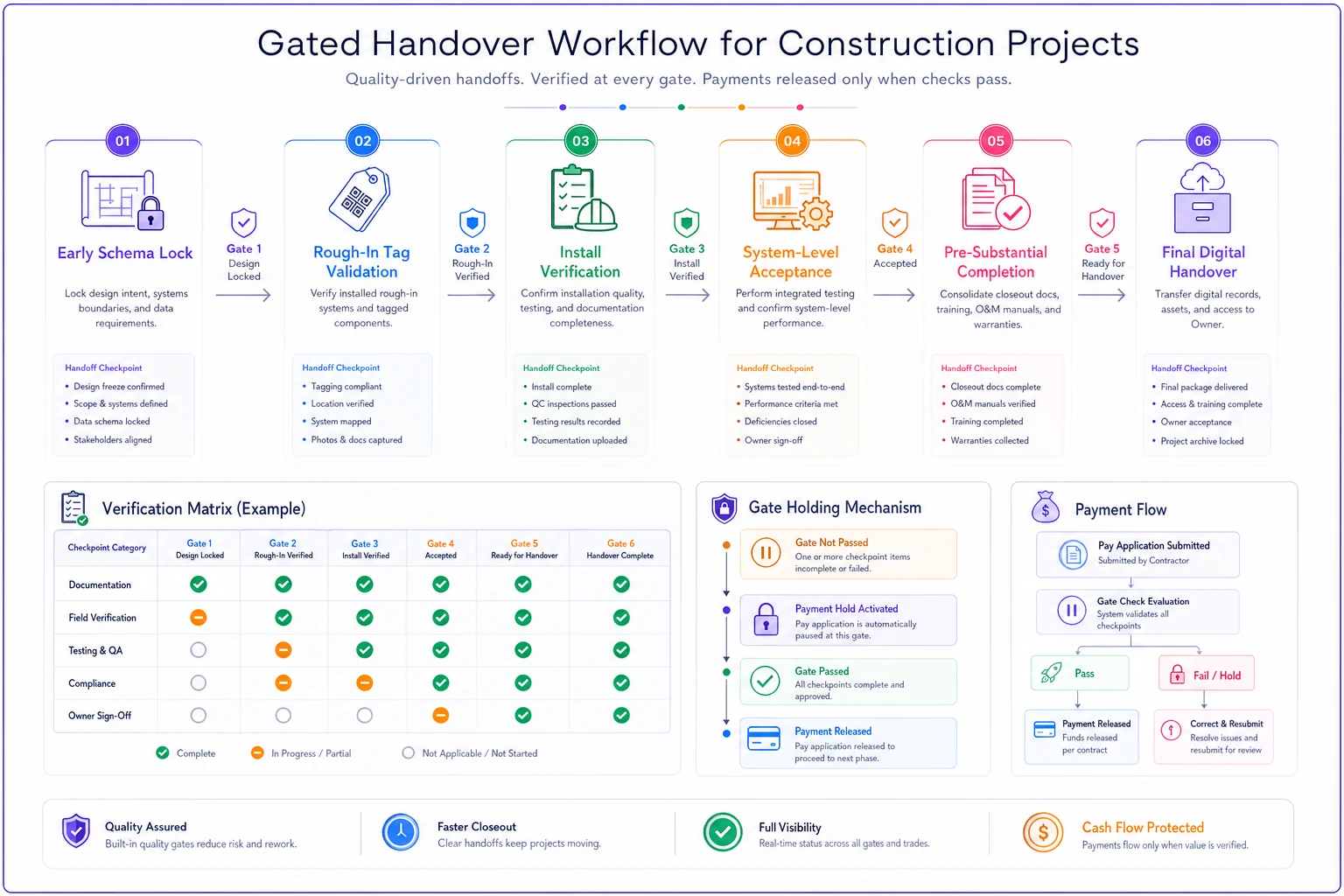
This is the same logic behind a structured closeout system with mandatory packets, commissioning gates and SLA timelines that actually speeds up final accounts instead of dragging them out — the data becomes a condition of getting paid, not an afterthought.
A real scenario: the register that saved a hospital fit-out
A regional contractor was closing out a roughly 60,000 sq ft hospital outpatient fit-out — heavy on mechanical and medical gas, around 380 tagged assets. Their normal process was end-loaded: collect everything in the last month.
On the previous comparable job, closeout had run about 11 weeks past substantial completion. The owner's CMMS team kept bouncing the data back — mismatched tags, missing serials, O&M docs referencing equipment that didn't exist under those names. Roughly $90k in retention sat frozen while both sides argued over what "complete" meant.
For the fit-out, they changed the approach. They locked a metadata schema and tag scheme before submittals, added tag validation at rough-in, and required a passing verification table for each system before that system was called done. It wasn't glamorous — mostly it meant the project engineer spent an hour or two a week keeping the register clean instead of a frantic month at the end.
The result wasn't magic, but it was real: closeout data was accepted by the owner in under three weeks, with only minor corrections. The medical gas and HVAC packets passed on first submission because serials and Cx records had been tied to tags all along. Retention released on a normal cycle. The project engineer's summary was blunt — "the difference was we never had to remember anything, because we wrote it down when it was true."
When this level of rigor makes sense — and when it doesn't
This full lifecycle is real overhead, and it's not always warranted.
It's worth it when:
-
The owner is loading data into a CMMS or CAFM and has explicit data requirements.
-
The asset count is high enough that manual reconciliation is unrealistic — roughly a few hundred tagged assets or more.
-
Retention is meaningful and closeout delays have cost you before.
-
You're doing repeat work for the same owner and want handover to be a differentiator.
It's overkill when:
-
Small, simple scope with a handful of assets and a non-technical owner who genuinely just wants a binder.
-
Very short-duration jobs where the setup cost exceeds the reconciliation cost.
Who should not attempt this cold: a team with no BIM discipline upstream and no one willing to own the schema. If tagging and model data are already chaos during construction, bolting on a handover process at the end won't fix it — you'll just document the chaos more formally. Fix the field-to-office data flow first. Handover discipline is downstream of that.
Where tooling actually helps
None of this requires exotic software, but reconciliation and gating are painful to run on spreadsheets once you're past a couple hundred assets.
The genuinely useful role for AI-assisted workflow platforms is in the tedious verification work — flagging register rows with blank required fields, catching tags that appear in a Cx report but not the master register, matching installed models against approved submittals, surfacing which system packets are failing which specific checks. That's the part humans do slowly and inconsistently at 2 a.m. before a deadline.
Pro-tip: Automate schema validation for the most error-prone fields (tags, serials, model numbers) so the gate only opens when those essentials are present.
Letting automation continuously validate the register against the schema — and letting a gate hold until the checks pass — is what keeps data clean throughout rather than in one heroic push at the end. The judgment stays with the team. The system just refuses to let a required field stay blank without someone noticing.
Pulling it together
A clean digital handover as-built BIM lifecycle isn't a document exercise you run at the end. It's a data discipline you decide at the start and enforce at gates you already have on the calendar.
Lock the schema early. Make the tag the primary key everywhere. Define acceptance as passing a specific verification table. Tie the gates to milestones with real consequences. None of that is complicated in concept — the hard part is the consistency, which is exactly why it breaks on projects where nobody owns it explicitly.
The projects that get this right don't have better closeout teams. They just refuse to let the last 10% become a rescue operation — because they captured the truth while it was still true, and made "complete" mean something you can actually check.
The projects that get this right don't have better closeout teams. They just refuse to let the last 10% become a rescue operation — because they captured the truth while it was still true, and made "complete" mean something you can actually check.
Ready to build smarter and faster?
Join 2,000+ construction teams using Projbrick to improve project visibility, reduce delays, and increase profitability.