



Most trade-acceptance disputes don't blow up at the moment a trade finishes. They blow up three phases later, when a drywall crew discovers that the MEP rough-in they built over was never properly accepted, and now nobody can agree who owns the rework. By then the original sub has demobilized, the pay-app has cleared, and the paper trail is a handful of inconsistent inspection notes scattered across four different people's phones.
That gap — between "the work looks done" and "the work is formally accepted into the record" — is where portfolios quietly lose money. Not in dramatic single events, but in the compounding drag of disputes that get resolved by whoever argues loudest instead of by a rule everyone agreed to in advance.
This is a governance problem, not a quality problem. The individual inspections might be fine. What's missing is the connective tissue: a shared catalogue of what "accepted" means per trade, a sampling discipline that scales with risk instead of inspecting everything equally, a phase-exit SLA that defines how fast acceptance decisions must happen, and an enforcement layer that makes the whole thing stick across projects that don't share the same superintendent.
Why trade acceptance falls apart the same way on almost every portfolio
The pattern is remarkably consistent. On a single project with one strong super, trade acceptance works because it lives in that person's head. They know which subs cut corners, which inspections matter, and what "good enough" looks like for each trade. The system is them.
Then the portfolio grows to six, eight, twelve concurrent jobs. The strong super can't be everywhere. Now you've got acceptance decisions being made by people with wildly different standards, no shared definition of what completeness means, and no way to compare whether Project C is accepting work to the same bar as Project A.
What you see across a lot of multi-project operations is that trade acceptance governance construction teams rely on is almost never written down in a usable form. There's a spec, sure. There's a QA plan. But the actual operational decision — is this trade finished enough that the next trade can build on it, and is the record clean enough that we'd defend the pay-app in a dispute? — that decision lives in tribal knowledge.
-
Inconsistent acceptance thresholds. One PM accepts framing at 95% punch-clear; another accepts at "looks fine, we'll catch it later." Neither is wrong on paper. Both can't be right across a portfolio.
-
Sampling that's either everything or nothing. Teams either try to inspect 100% (which they can't sustain, so it degrades) or they spot-check randomly with no logic behind the sample size.
-
No clock on acceptance decisions. A trade finishes Friday. The acceptance sign-off happens... eventually. Meanwhile the follow-on trade either waits or proceeds at risk.
-
Enforcement by personality. Whether a defect gets rejected depends on who's in the room, not on a written threshold.
The deeper issue is that acceptance sits at the junction of three things that usually have separate owners: quality, schedule, and cost. The QA team cares about defects. The scheduler cares about the follow-on trade starting. The commercial team cares about the pay-app. When those three don't share a single acceptance event, each optimizes their own piece and the whole thing fragments.
The trade-acceptance catalogue: the thing most portfolios are missing
Before you talk about sampling or SLAs, you need a catalogue. This is the single document — maintained at the PMO level, not the project level — that defines, per trade, what acceptance actually requires.
Keep your construction projects on schedule and budget.
Projbrick helps you plan, track, and manage every project phase with precision and ease.
- Real-time project tracking
- Resource & budget management
- Team collaboration tools
No credit card required
Think of it as the shared contract between every project in the portfolio. It answers, for each trade package:
-
What are the mandatory hold points that cannot be skipped?
-
What evidence constitutes acceptance (measurements, photos, test results, third-party sign-off)?
-
What's the acceptable defect threshold to pass versus hold versus reject?
-
Who has authority to accept, and who can override?
The reason this has to be a catalogue and not a per-project plan is consistency. When a sub works across three of your projects, they should hit the same bar on all three. When a dispute escalates to the portfolio level, the reviewer needs one definition of "accepted" to judge against. And when you're trying to compare sub performance across jobs — something you can't do if every project measures differently — the catalogue is what makes the data comparable.
A typical catalogue entry doesn't need to be elaborate. For interior framing it might specify: plumb and line tolerance, blocking verification at specified locations, photo evidence of fire-rated assemblies before close-in, and a punch threshold of no more than a handful of minor items per defined area. The point isn't the specific numbers — those come from your specs — it's that the numbers are written once and applied everywhere.
This connects directly to how you tie QA/QC to phase gates with sampling plans and defect-triage matrices. The catalogue is the per-trade detail layer underneath those phase gates. The gate says "this phase can't exit until acceptance is clean." The catalogue says what clean means for each trade inside that phase.
Sampling-size rules: inspect by risk, not by habit
A lot of PMOs either over-inspect themselves into exhaustion or under-inspect themselves into surprises. The fix is tiering your sampling by risk and by sub track record — not applying a flat rate to everything.
The logic is straightforward: not every trade carries the same consequence if a defect slips through. A cosmetic finish defect gets caught and fixed cheaply. A waterproofing defect under a slab doesn't get caught until there's water, and by then it's a six-figure problem. Sampling intensity should follow consequence and reversibility, not convenience.
A workable tiering looks like this:
| Risk tier | What belongs here | Sampling rate | If a defect is found |
|---|---|---|---|
| Critical / hidden | Waterproofing, structural connections, buried MEP, fire-rated assemblies | 100% of hold points, no sampling shortcuts | Full stop, reject, re-inspect after correction |
| High | Rough-in MEP, framing before close, exterior envelope | Sample ~30–50%, escalate to 100% if first sample fails | Hold the area, expand sample, conditional acceptance only with documented plan |
| Standard | Interior finishes, non-rated partitions, standard fit-out | Sample ~15–25%, adjust by sub history | Accept with punch list if under threshold |
| Low / cosmetic | Paint touch-up zones, accessory install | Spot-check ~5–10% | Punch and move on |
Track sample adjustments quantitatively — tie reduced sampling to a documented streak of clean inspections.
The second lever — and this is the one most teams ignore — is adjusting the sample rate based on the sub's acceptance history. A sub that's passed clean on their last several inspections earns a reduced sample. A sub that's been failing earns a tighter one. It's the same principle quality teams use in manufacturing: inspect more where you've been burned, less where you've earned trust. It rewards good subs with faster acceptance and concentrates inspection hours where the risk actually is.
One thing worth flagging: don't let a reduced sample rate turn into zero inspection. "Trusted sub, skip it entirely" is how the clean streak ends. Reduced means lighter, not absent.
The phase-exit SLA matrix: putting a clock on acceptance
Sampling tells you how much to inspect. The SLA matrix tells you how fast the decision must happen — because an acceptance decision that drifts is almost as damaging as a bad one. The follow-on trade is standing there.
A phase-exit SLA matrix assigns, for each acceptance event, a maximum turnaround from "trade reports complete" to "decision rendered." The decision has three possible outcomes: accept, conditionally accept (with a documented punch and deadline), or reject.
| Acceptance event | Decision SLA | Escalation if SLA missed |
|---|---|---|
| Critical hold point (buried/structural) | Within 24 hours, mandatory on-site | Auto-escalate to PMO quality lead |
| High-risk trade exit | Within 48 hours | Escalate to project director |
| Standard trade exit | Within 3 working days | Escalate to PM |
| Cosmetic / low-risk | Within 5 working days | Logged, no hard escalation |
The escalation column is what makes it real. An SLA with no consequence for missing it is just a suggestion. The matrix has to say what happens when the decision doesn't come in time — and it has to default to protecting the follow-on trade. In practice that often means: if the decision isn't rendered within the SLA, the follow-on trade either proceeds under a documented conditional acceptance or the delay gets logged against the acceptance owner, not the trade that finished on time.
That last point matters more than it sounds. Without it, a slow acceptance decision silently becomes the finishing sub's schedule problem — which is both unfair and corrosive to the relationship.
Decision thresholds: making accept/hold/reject a rule, not an argument
This is the enforcement core. For every trade in the catalogue, you need three explicit thresholds:
-
Accept threshold — defects below this are punch-listed and the trade is accepted. Work proceeds.
-
Hold threshold — defects in this band trigger conditional acceptance: the follow-on may proceed only with a documented correction plan and deadline, and the responsible sub stays on the hook.
-
Reject threshold — defects above this stop everything. No conditional acceptance. The trade re-presents after correction.
The value of writing these down is that it removes the person from the decision. When a super and a sub disagree about whether framing passes, the catalogue threshold settles it. Nobody's ego is in play. And when a dispute escalates, the PMO reviewer isn't re-litigating judgment calls — they're checking whether the documented threshold was applied correctly.
A realistic failure mode: teams define accept and reject but leave the hold band vague, so everything lands in a gray zone resolved by argument. Define the middle band carefully. That's where most disputes actually live.
When conditional acceptance makes sense — and when it's a trap
Conditional acceptance is a useful release valve. It keeps schedule moving when a defect is real but non-blocking. But it gets abused constantly, and the abuse always looks the same: the condition gets written, the follow-on trade proceeds, and the correction never happens because the open item falls off everyone's radar.
Conditional acceptance only works if every conditional carries a hard deadline, a named owner, and a verification step. If you can't track open conditionals to closure, don't use conditional acceptance — reject and make them fix it. A pile of unclosed conditionals at handover is one of the ugliest things to clean up, and it directly feeds into the final-accounts mess that a disciplined project closeout system with mandatory packets and commissioning gates is supposed to prevent. If conditionals leak, closeout inherits the leak.
How this actually works as a workflow across a portfolio
Walk the full loop, because the pieces only create value when they connect.
A trade reaches completion and the sub submits a completion notice with the evidence the catalogue requires for that trade — measurements, photos, test results. The sampling rule for that trade's risk tier (adjusted by the sub's recent history) determines what gets inspected. The inspector runs the sample, counts defects against the catalogue's thresholds, and renders one of three decisions inside the phase-exit SLA window.
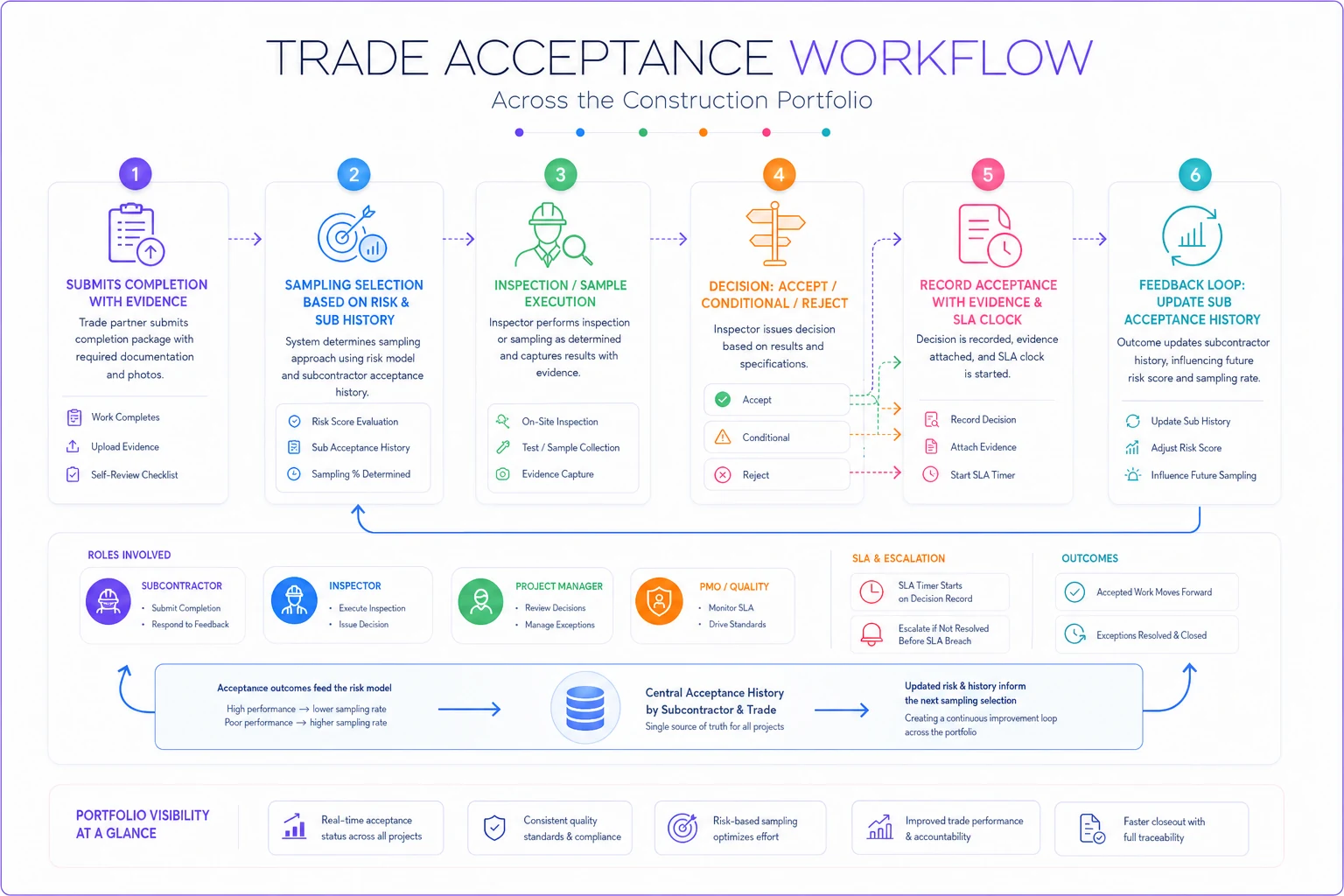
The diagram above shows the main actors, the decision points, and how the outcomes feed the sub history that adjusts future sampling.
If it's an accept, the acceptance event is recorded, the follow-on trade is cleared, and the pay-app line for that trade is now defensible because the acceptance record exists. If it's a conditional, the open items get logged with owners and deadlines, and the follow-on proceeds under documented risk. If it's a reject, the trade re-presents and the clock resets.
Every one of these events feeds the sub's rolling acceptance history, which feeds back into the next sampling rate. Clean subs get faster acceptance; problem subs get tighter scrutiny. Over a portfolio, this generates something most PMOs never have: comparable acceptance data across projects, so you can see that Project D's acceptance pass rate is drifting below the others before it becomes a quality incident.
The hard part across a portfolio isn't any single step — it's keeping this consistent when acceptance events live in different people's notebooks on different sites. This is the practical reason PMOs move trade acceptance onto a shared operational platform rather than running it on paper and spreadsheets. When the catalogue, sampling rules, SLA clocks, and acceptance records sit in one system, the governance largely enforces itself: SLA clocks run automatically, conditionals can't fall off the radar because they're tracked to closure, and sub-history adjustments happen from real data instead of memory. AI-assisted tooling helps most in the unglamorous parts — flagging acceptance events approaching their SLA deadline, surfacing conditionals going overdue, and spotting when one project's thresholds are quietly drifting from the catalogue. The decisions stay human; the system just makes sure nothing slips through the gap where acceptance usually breaks.
A real scenario: a mid-sized GC running nine concurrent fit-outs
A commercial fit-out contractor running nine jobs at once kept getting hit with the same problem: disputes over trade completeness that surfaced at pay-app time and again at closeout. On a couple of projects, follow-on trades had built over MEP rough-ins that were never formally accepted, and when leaks showed up, the rework fights dragged on for weeks because nobody could point to a clean acceptance record.
Their acceptance process was effectively personality-driven — solid on the two projects with experienced supers, loose everywhere else. No portfolio catalogue, no sampling logic, no clock on decisions.
They built a catalogue for their twelve most common trades, set four-tier sampling rules, and put a phase-exit SLA matrix with real escalation behind it. Nothing fancy. The biggest change was simply that every acceptance decision now produced a recorded event with evidence attached, judged against a written threshold.
Within a couple of quarters, it showed up where it mattered. Disputed pay-app lines dropped noticeably because the acceptance record existed to back each line. The "accepted over unaccepted work" surprises — the expensive kind — went from a recurring headache to rare. Closeout got meaningfully faster on the later jobs because there wasn't a backlog of unclosed conditionals to untangle. By their own rough estimate, the reduction in rework and dispute-resolution time was worth somewhere in the low-to-mid six figures across the portfolio over a year, most of it from problems that simply never happened.
The qualitative shift mattered too: subs started trusting the process more, because acceptance was predictable and the better performers got faster sign-offs instead of being held up by the same scrutiny as everyone else.
When this level of governance is worth it — and when it isn't
If you're running a single project with one reliable super, a full portfolio catalogue is overkill. The person is the system, and formalizing it adds overhead without much payoff. Build the discipline when you cross into multi-project territory and acceptance standards start diverging between sites.
It's also a bad fit if leadership won't back the enforcement layer. A catalogue and an SLA matrix that get overridden the moment a sub pushes back are worse than nothing — they create the appearance of governance while teaching everyone that the rules are optional. If the PMO can't hold the threshold under pressure, fix that first.
And if your projects are genuinely one-off and unlike each other — a bespoke restoration, a highly specialized industrial build — a standardized catalogue may fight the work instead of supporting it. Standardization pays off where there's repetition across the portfolio. Where every job is a snowflake, lean on strong per-project QA plans and tight phase gates instead.
Trade acceptance isn't really about inspection. It's about making sure that at every handoff between trades, there's a shared, defensible answer to "is this done, who said so, and would it hold up if someone disputed it." On a single project, one good person can hold that together. Across a portfolio, you need the catalogue, the risk-tiered sampling, the phase-exit SLA, and the decision thresholds working as one system — because the alternative is twelve projects each inventing their own standard and the PMO discovering the gaps only when the rework bills arrive.
The teams that get this right don't inspect more than everyone else. They inspect smarter, decide faster, and write it down once so it applies everywhere — because acceptance stops being a judgment call and becomes a rule the whole portfolio can stand behind.
Ready to build smarter and faster?
Join 2,000+ construction teams using Projbrick to improve project visibility, reduce delays, and increase profitability.