


Most contingency planning in construction stops at a risk register line item that reads something like "supplier delay — medium likelihood, high impact." Nobody argues with it. Nobody uses it either. When the shock actually lands — a port shutdown, a tier-2 supplier that quietly files for bankruptcy, a steel mill that goes dark — the project team improvises, burns three days figuring out who decides what, and ends up paying premium freight on top of an already-slipped schedule.
The gap isn't awareness. Everyone knows a disruption can happen. The gap is that supply chain contingency construction planning rarely gets built into something exercisable — scenario templates with pre-agreed trigger points, pooled-inventory rules across projects, and clear authority on who can pull which lever before the schedule bleeds out.
This is a systems piece. Not "ten tips to protect your supply chain," but how the whole machine behaves when a shock hits — where it coordinates well, where it jams, and what changes when you're running one project versus a portfolio of twelve.
Why the shock always costs more than the delay itself
The pattern repeats across almost every disrupted job: the direct delay is survivable, but the decision latency around it is what does the real damage.
A supplier outage on a curtain wall package might push delivery by five weeks. On paper, five weeks. But the actual cost cascade usually looks like this:
-
Three to four days lost just confirming the outage is real and not a logistics hiccup
-
A week of back-and-forth deciding whether to wait, re-source, or re-sequence
-
Trades already mobilized sitting idle or getting demobilized and re-mobilized
-
Expedited freight and spot-market premiums once someone finally commits to a plan
-
Downstream MEP and fit-out trades absorbing the ripple with no advance warning
By the time the dust settles, the five-week supplier problem has become an eleven-week project problem, and more than half of that was self-inflicted — not from the shock, but from the absence of a pre-decided response.
What separates teams that absorb shocks from teams that compound them is almost never luck or even inventory. It's whether the response was rehearsed. The same way you'd never run a fire evacuation for the first time during an actual fire, you shouldn't be working out your port-closure response while the containers are already stuck offshore.
The three systemic shocks worth templating
You can't template everything. But across construction portfolios, a handful of shock types account for the overwhelming majority of real disruption, and they behave differently enough that each needs its own playbook.
Keep your construction projects on schedule and budget.
Projbrick helps you plan, track, and manage every project phase with precision and ease.
- Real-time project tracking
- Resource & budget management
- Team collaboration tools
No credit card required
| Shock type | Early signal | Typical lead-time hit | Hardest coordination problem |
|---|---|---|---|
| Port / logistics closure | Carrier notices, customs backlog, freight rate spikes | 3–8 weeks on imported packages | Multiple projects competing for the same re-routed capacity |
| Tier-1 supplier outage | Missed order confirmations, quality drift, slow responses | 4–12 weeks depending on package | Re-qualifying an alternate without blowing the spec |
| Material-class shock (steel, resin, insulation) | Mill allocation notices, quote expiry shrinking | 2–10 weeks, often price before availability | Deciding whether to buy ahead across the whole portfolio |
The reason to separate these is that the right first move differs. A port closure is a routing and capacity problem — you may have the supplier, just not the path. A supplier outage is a sourcing and qualification problem. A material-class shock is a procurement-timing and capital problem that hits every active project at once.
Teams that lump them all into "supply chain risk" end up with a generic response that fits none of them. The ones who handle disruption cleanly have distinct playbooks that share a common governance spine — same escalation structure, different tactical content.
What a usable scenario template actually contains
A contingency playbook that sits in a binder is theater. A playbook that works has a small number of parts, and each part answers a question the team will actually ask at 7 a.m. on the day it breaks.
-
Trigger definition — the specific, observable signal that activates the playbook. Not "if there's a problem" but "if confirmed delivery slips more than 10 working days OR the supplier misses two consecutive order confirmations."
-
Confirmation step — who verifies the signal is real and how fast. This kills the three-day "is this actually happening" paralysis.
-
First 48-hour moves — the containment actions anyone can take immediately without waiting for a committee.
-
Decision fork — wait vs. re-source vs. re-sequence, with the criteria that push you down each branch.
-
Authority map — who can approve a spend threshold, a spec substitution, a re-sequence that touches the critical path.
-
Downstream notification list — which trades, which stakeholders, and what they need to know within hours, not weeks.
The confirmation step is the one most teams skip, and it's the one that pays off biggest. In real operations, a large share of "supplier outages" turn out to be a single late shipment or a miscommunicated date. If your playbook jumps straight to re-sourcing on every rumor, you'll burn relationships and money chasing ghosts. A tight confirmation gate — one named person, a 24-hour clock — separates real shocks from noise before the expensive machinery starts turning.
Pooled inventory: the lever portfolios have and single projects don't
This is where running a portfolio changes the game completely, and it's the part most contingency plans ignore because they're written project-by-project.
When you've got multiple active jobs, your real buffer isn't the safety stock on any one site — it's the shared position across all of them. A long-lead item staged for Project A that's eight weeks from needing it can cover an emergency on Project B that needs it next week, as long as someone has visibility and the authority to move it.
The problem is that visibility almost never exists. Each project manages its own procurement, its own staging yard, its own buffer. Material sitting three miles away on a sister project might as well be on another continent, because nobody's tracking it at the portfolio level and nobody has authority to reallocate it.
To make pooled inventory real, you need three rules agreed before a shock:
-
A shared register of long-lead and critical-path materials across all active projects, with quantities, locations, and the date each project actually needs them
-
Reallocation priority rules — when two projects want the same pooled unit, what decides? Usually it's critical-path proximity: the project that'll slip first gets it, and the donor project absorbs a controlled, documented delay
-
Replenishment accountability — whoever borrows triggers the reorder, and the cost lands in the right place so project managers aren't fighting over budget later
Put the reallocation priority rule as a single, visible field in the shared register so decisions can be executed without debate.
The decision rule matters more than it sounds. Without a pre-agreed priority, pooled inventory becomes a political fight between project managers, and the loudest one wins rather than the project with the most schedule risk. Portfolios where the pooling theoretically existed but never got used in a real crunch are more common than you'd think — because the first time two PMs both needed the same batch, there was no rule, and after that nobody trusted the system.
This connects directly to disciplined long-lead ordering. If your long-lead procurement schedule is already mapping which packages are vulnerable and when, extending that into a portfolio-wide pooled register is a much smaller step than building it from scratch during a shock.
Governance triggers: when a single project problem becomes a portfolio decision
There's a distinction that separates mature PMOs from reactive ones: knowing when a shock stops being a project-level event and becomes a portfolio intervention.
Most disruptions should be handled locally. A late order, a quality reject, a routine delay — the project team runs its playbook and moves on. But some shocks are systemic by nature. A steel allocation notice doesn't hit one job; it hits every job with structural steel still to procure. A port closure affects every imported package across the portfolio simultaneously.
The failure mode is that each project responds in isolation — each one independently scrambling to re-source, each one bidding against the other projects in its own company for scarce spot-market capacity. Portfolios have literally competed against themselves and driven up their own prices because three project managers all called the same alternate supplier in the same week.
Portfolio intervention triggers should be explicit and boring:
-
A shock affects two or more active projects in the same material class → escalate to portfolio-level procurement, consolidate the buy
-
A single project's mitigation requires capital or spend above threshold → portfolio sign-off, because it may be cheaper to re-sequence across projects than to pay premium on one
-
A shock threatens a milestone with external financial or contractual consequences → portfolio risk review, not just the project team
Centralizing isn't about bureaucracy. It's about leverage. One consolidated emergency order across five projects gets better pricing, better priority, and a coherent re-sequencing plan than five panicked individual ones. The governance trigger is what converts scattered project responses into a single coordinated move.
The exercised response flow — why you rehearse before it's real
A playbook you've never run is a hypothesis. The teams that handle shocks well treat their contingency plans like fire drills: they exercise them on a tabletop, deliberately, before a real event forces the test.
A tabletop exercise is simple to run and brutally revealing. You take a scenario — "the main port handling your facade and MEP imports closes for an indefinite period" — and walk the team through it in real time. Who gets the first call? Who confirms it's real? What's the 48-hour move? Who approves the re-source spend? Which downstream trades get notified, and by whom?
What surfaces almost every time:
-
The trigger is ambiguous — two people disagree on whether the scenario even activates the playbook
-
The authority map has a hole — nobody's sure who can approve the emergency spend when the usual approver is on leave
-
The notification list is stale — half the downstream trade contacts have changed
-
The pooled-inventory register is out of date, so the "buffer" everyone assumed existed doesn't
Finding these gaps in a two-hour tabletop costs you a morning. Finding them during a live shock costs you weeks. Run the exercise at least twice a year, and once more whenever the portfolio composition changes significantly.
A quick workflow: how a confirmed shock should move through the organization
Picture the flow for a supplier-outage scenario, start to finish.
Here’s a quick visual of that workflow.
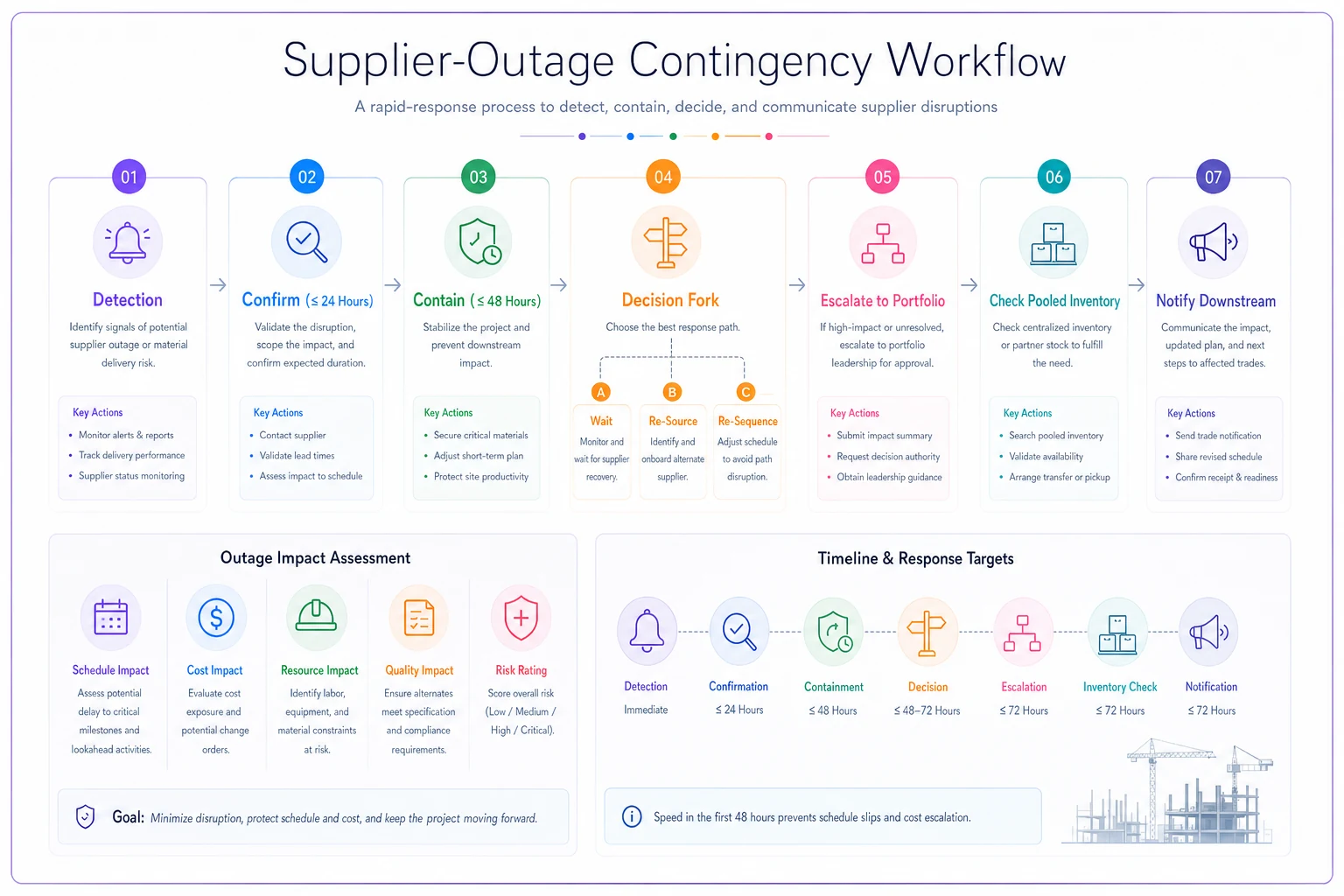
The project procurement lead notices two missed order confirmations and flags it. Within 24 hours, a named confirmation owner contacts the supplier directly and determines whether this is a genuine outage or a logistics blip. If it's real, the playbook activates: the 48-hour containment moves run — pause dependent sub orders, pull the pooled-inventory register to check for coverage, notify affected downstream trades. In parallel, the decision fork gets evaluated: how close is this to the critical path, is there a qualified alternate, what's the re-sequence cost. If the shock touches a second project or crosses the spend threshold, it escalates to portfolio procurement for a consolidated decision. Every step has an owner and a clock. Nothing waits on a meeting that hasn't been scheduled yet.
That flow is the whole point. The shock still happens — you can't prevent a port closing — but the decision latency that usually triples the cost gets stripped out, because the decisions were made in advance and the roles were assigned before the pressure hit.
Where tracking this breaks down — and where tooling earns its place
Running this on spreadsheets works for one or two projects. At portfolio scale it falls apart, and it falls apart in a predictable way: the pooled-inventory register is only as good as its last update, and nobody updates a spreadsheet during a crisis.
The coordination load is the real bottleneck. You need live visibility of critical materials across every active site, trigger conditions that flag automatically instead of waiting for someone to notice, and an escalation path that routes a confirmed shock to the right authority without a chain of forwarded emails. This is where a connected operational platform stops being a nice-to-have — not because software prevents shocks, but because it keeps the register current, watches the trigger conditions in the background, and makes sure a two-project material-class shock actually surfaces as a portfolio decision instead of three separate scrambles. The judgment stays human; the tracking and routing stop being the weak link.
The same logic applies to prefab and modular-heavy programs, where a factory outage is just another supplier shock with its own acceptance gates. If you're already running governed prefabrication programs with JIT delivery windows, folding those delivery triggers into the same contingency spine means one disruption doesn't require two separate response systems.
When this level of rigor makes sense — and when it's overkill
Full scenario templating, pooled inventory, and portfolio governance triggers are worth building when:
-
You run three or more concurrent projects sharing material classes or suppliers
-
A meaningful share of your packages are imported or single-sourced
-
Your milestones carry external financial consequences — liquidated damages, financing gates, tenant commitments
It's overkill when you're running a single small project with locally sourced materials and short lead times. There, a one-page response note and a good relationship with two alternate suppliers covers you.
And it's actively a bad idea to build an elaborate playbook nobody will exercise. A governance structure that exists only on paper creates false confidence — the team thinks it's covered, which is worse than knowing it isn't. If you won't run the tabletop drills, keep the plan simpler and honest.
A real scenario
A regional contractor running five concurrent commercial fit-outs got hit when a tier-1 glazing supplier went into administration mid-contract. Two of the five projects depended on that supplier for curtain wall packages.
Before this contractor had any shared process, an earlier version of this exact situation had played out badly: each project manager found out separately, both called the same two alternate glaziers, bid against each other, and the re-source dragged on for close to three weeks before anyone committed — pushing one project's facade milestone by roughly six weeks and triggering an awkward conversation with the client.
The second time around, with a confirmation gate and portfolio trigger in place, the outage got confirmed within two days, escalated immediately to portfolio procurement because it touched two projects, and handled as a single consolidated re-source. One negotiation, better pricing, and a deliberate re-sequence that let the less time-critical project absorb most of the slip. Net schedule impact landed closer to two to three weeks instead of six-plus, and the premium on the emergency order was noticeably lower because they were buying as one entity instead of two competing ones.
Same shock. Very different outcome. The difference wasn't a better supplier relationship or more inventory — it was a response that had been decided before the day it was needed.
The takeaway
Systemic supply-chain shocks aren't a risk you eliminate; they're a condition you operate inside of. The projects that get hurt aren't the ones that got unlucky — they're the ones that spent the first week deciding how to decide. Build the scenario templates, agree the pooled-inventory rules and the governance triggers while everyone's calm, and rehearse the response flow at least twice a year. When the port closes or the supplier goes dark, you want your team executing a plan, not inventing one under a clock that's already running against you.
Ready to build smarter and faster?
Join 2,000+ construction teams using Projbrick to improve project visibility, reduce delays, and increase profitability.