



Most pay-app rejections don't happen because the work wasn't done. They happen because the reviewer can't prove the work was done from the paperwork in front of them. The schedule of values says 60% complete on masonry, the daily report mentions "block work continued," and there are twelve photos — none labeled, dated, or tied to a location. So the reviewer does what any reasonable person does when they can't verify a claim against real money: they kick it back or trim the percentage.
That back-and-forth is expensive in a way that never shows up on a line item. A rejected pay-app doesn't just delay the draw. It resets the whole clock, forces your PM to re-pull field records that are now buried, and quietly trains the owner's rep to scrutinize everything you submit going forward.
The fix isn't more documentation. It's less, but structured. A minimal field evidence packet — a small, mandatory set of photos and measurements captured to a fixed protocol, plus an office-side cross-reference table that ties each claimed quantity back to procurement and daily reports — will do more for your approval cycle than any amount of extra narrative.
This is the field-side companion to a good desk review. If you've already built a fast pay-app verification checklist for your PMs, this is how you feed that checklist clean inputs so it actually runs fast.
The rejection pattern nobody tracks
Teams treat held pay-apps as one-offs. A reviewer asks a question, someone scrambles, they answer it, the draw eventually goes through. Nobody logs why it got held. So the same three or four gaps keep happening, month after month, on the same trades.
When you actually sort the reasons, they cluster tightly:
-
Quantity can't be verified — the SOV says X installed, but there's no measurement or count backing it.
-
Location is ambiguous — photos exist but nobody knows which floor, gridline, or unit they show.
-
Timing is unprovable — the claim covers work done in this billing period, but the evidence has no reliable date.
-
Stored materials aren't supported — you're billing for material on site, but there's no delivery ticket or count tied to the number.
None of these require better field work. They require the same field work captured in a way a stranger can verify in ninety seconds. That's the whole game.
On jobs where field crews photograph freely but without a protocol, the first pay-app of a new phase gets partially held somewhere between a third and half the time. On jobs with a fixed packet, it drops to the occasional real dispute — the kind where there's an actual disagreement about scope, not a documentation gap.
What "minimal mandatory" actually means
The instinct when approvals go bad is to over-document. Suddenly crews are told to photograph everything, and you drown the reviewer in 200 unlabeled images. That's worse. More photos with no structure means more time for the reviewer to hunt, and hunting is exactly what triggers the "let me just cut 5% to be safe" reflex.
Keep your construction projects on schedule and budget.
Projbrick helps you plan, track, and manage every project phase with precision and ease.
- Real-time project tracking
- Resource & budget management
- Team collaboration tools
No credit card required
Minimal mandatory means: for every line item you bill against this period, there is a fixed, small set of evidence — and it's the same set every time, so the reviewer learns your format and stops second-guessing.
For a typical trade line, the mandatory packet is four things:
-
One overview photo showing the work in context (you can tell it's the north elevation, third floor).
-
One or two detail photos showing the actual installed condition (the anchor, the weld, the finished face).
-
One measurement or count record — a tape shot, a marked-up plan, or a tally that supports the quantity claimed.
-
One reference tag linking that evidence to a location and a date.
That's it. Four elements, repeatable, per billable line. Not per photo — per line. If you're billing three lines this period, you assemble three small packets, not one giant folder.
Photo protocol: the rules that make a photo count
A photo only helps a reviewer if it answers what, where, and when on its own. Most field photos answer none of those. Here's the protocol that fixes it without slowing crews down.
Capture rules:
-
Shoot wide, then tight. The overview locates the work; the detail proves the condition. A tight shot of a perfect weld is useless if nobody can tell which weld it is.
-
Get a location marker in frame. A gridline sticker, a floor number chalked on the slab, a unit door number, a station marker. Something that makes the location undeniable without a caption.
-
Include a scale reference for anything measured. A tape, a folding rule, a marked story pole. If the photo backs a quantity, the scale needs to be visible.
-
Never rely on memory for the date. Use the device timestamp, and back it with a dated daily report reference in the packet. Reviewers distrust timestamps that can be changed — which is exactly why you pair them.
A pattern worth stealing: have crews shoot the same angle at the start and end of the billing period for progress trades. Same corner of the deck, same gridline. Two photos two weeks apart, same frame, tells a progress story no reviewer argues with. It's about as close to a time-lapse as a pay-app can carry.
The common mistake is thinking the photographer knows what they're looking at, so the photo doesn't need context. The reviewer isn't the photographer. Every photo has to survive being seen cold by someone who wasn't there.
Measurement protocol: turning "looks about done" into a defensible number
This is where pay-apps actually get trimmed. The reviewer believes the work happened; they just don't believe the percentage. "Looks like maybe 40%, you billed 55%." Without a measurement record, you lose that argument every time because you're arguing feel against feel.
-
If the estimate is by area (SF of drywall, SF of paint), record area — a marked-up floor plan with the completed zones shaded and dimensions noted.
-
If it's by count (fixtures, anchors, doors), record a tally against a plan, not a loose number.
-
If it's by length (pipe, conduit, curb), record run lengths against a location.
-
If it's by weight or volume delivered (rebar, concrete), tie the number to delivery tickets, not a visual estimate.
The point is alignment. A reviewer can reconcile a shaded plan against the SOV in seconds. They cannot reconcile "drywall about 55% done" against anything. This connects directly to how you're already tracking output — if your team runs daily crew productivity tracking, those production numbers should feed your measurement records so the pay-app quantity and the daily production log agree by default, instead of telling two separate stories.
One thing that trips people up: measure to the estimate's unit even when the field thinks in different terms. Crews think in "we hung the whole east wing." Estimators think in square feet. If your evidence speaks square feet, the review is fast. If it speaks "east wing," someone has to translate, and translation is where trimming happens.
The office cross-reference table: where field evidence meets the paperwork
This is the piece most teams skip, and it's the one that shortens approval cycles the most. The field packet proves the work exists. The cross-reference table proves the number is legitimate by tying it to two independent records the owner already trusts: procurement and daily reports.
The idea is a single row per billable line that a reviewer can scan without opening five documents.
| SOV Line | Qty Claimed This Period | Field Evidence Ref | Daily Report Ref | Procurement / Delivery Ref | Location |
|---|---|---|---|---|---|
| 03-200 Rebar install, L3 | 4.2 tons | PKT-L3-014 (tally + plan) | DR 07/14–07/22 | PO-118, tickets #4471, #4488 | Level 3, gridlines C–H |
| 09-250 Drywall hang, E wing | 3,900 SF | PKT-EW-021 (shaded plan) | DR 07/09–07/21 | PO-203 (board delivered 07/08) | Level 2, east wing |
| 08-110 Door frames set | 22 ea | PKT-DR-006 (count photos) | DR 07/16, 07/18 | PO-177, packing slip #92 | Level 2, units 201–214 |
Three things happen when a reviewer sees this:
-
The claimed quantity is corroborated by two other sources — the field packet and the procurement record. If you installed 4.2 tons of rebar, roughly that much rebar had better have been delivered. The delivery ticket makes the install number believable.
-
The daily report reference gives them the timing — they can confirm the work fell in this billing period without cross-examining a timestamp.
-
The location column removes the "where is this" question entirely.
A subtle but important detail: the procurement column catches your own errors before the reviewer does. If a line claims more installed than was ever delivered, that row won't reconcile — and you catch it during assembly instead of during a painful review call. That single check has quietly saved teams from over-billing corrections that would've torched their credibility for the rest of the job.
A workflow that doesn't add hours to the field day
The objection is always the same: "my crews don't have time for this." Fair. So it has to be light, and it has to happen during the work, not reconstructed at month end. Reconstruction at month end is where entire evenings disappear and where accuracy collapses.
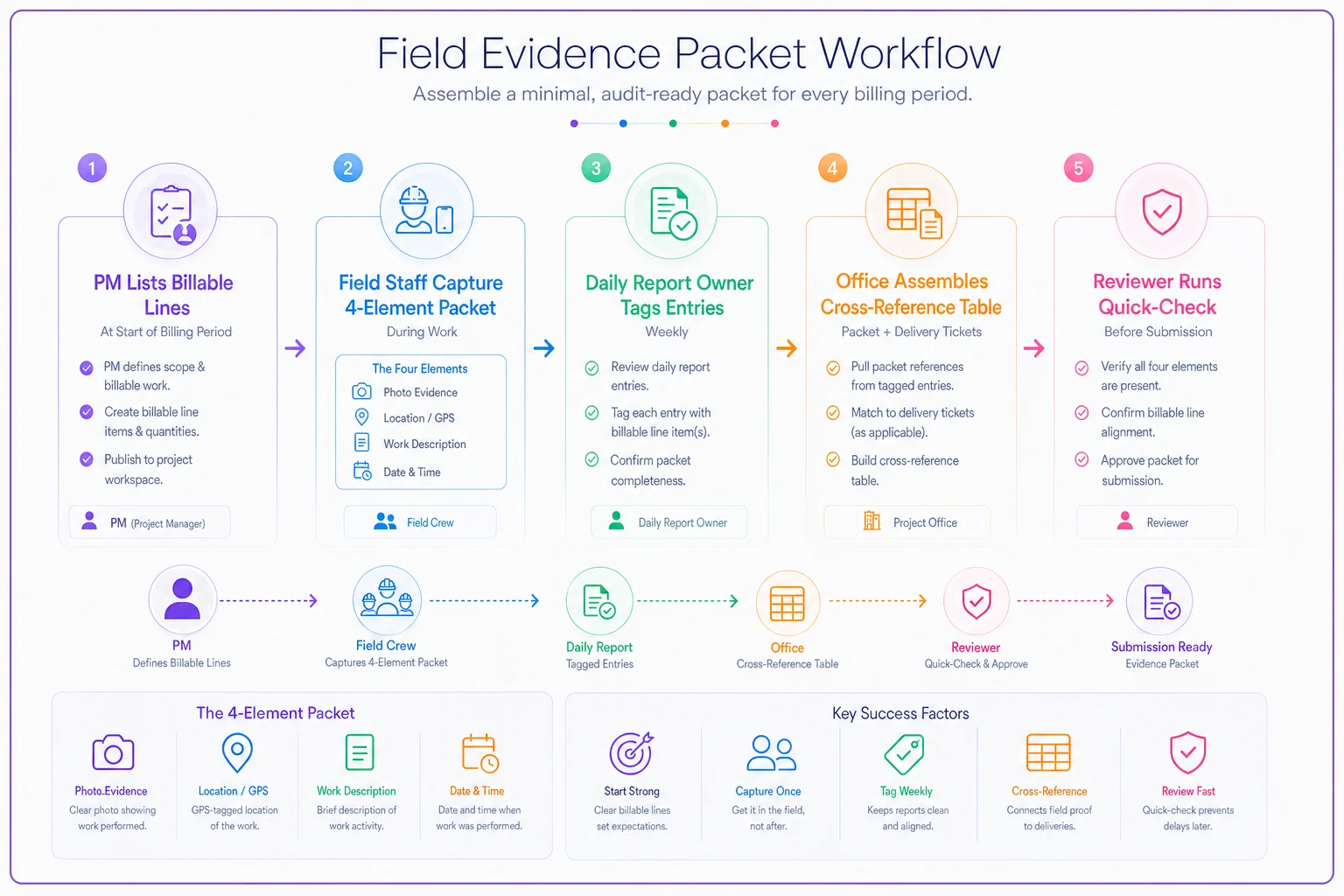
Visualizing the flow helps teams keep each step small and local.
-
At the start of a billing period, the PM lists the lines that will be billed. That's the target — crews only need evidence for those lines, not everything.
-
During the period, field staff capture the four-element packet as they finish measurable chunks — not a special trip, just a shot and a tally at natural stopping points.
-
Weekly, whoever owns the daily report tags which entries correspond to which billing lines. This is the link that makes the cross-reference table trivial later.
-
At submission, the office fills the cross-reference table by pulling packet refs, daily report refs, and delivery tickets. Because the tagging already happened, this is assembly, not investigation.
-
Before submitting, run the reviewer quick-check on your own packet (below). If it fails your own check, it'll fail theirs.
The reason month-end reconstruction fails is that memory decays fast on an active site. A tally taken the day the rebar went in is accurate. The same tally reconstructed three weeks later from photos is a guess wearing a number's clothing.
Teams running structured field data — where photos, quantities, and daily logs live in one place instead of scattered across phones, texts, and a shared drive — assemble these packets in a fraction of the time, mostly because the cross-referencing is already done by the time the pay-app is due. The tooling matters less than the habit, but the habit is a lot easier to keep when the records aren't fragmented across six apps.
The reviewer quick-check guide
Give this to whoever assembles the pay-app and whoever reviews it internally. When both sides use the same checklist, cycles collapse because you stop discovering problems live on a call.
Run every billable line against this before it leaves your office:
-
Quantity check Does a measurement or count record back the claimed number, in the same unit as the estimate?
-
Location check Can I tell exactly where this work is from the evidence alone, with no verbal explanation?
-
Timing check Is there a dated daily report entry that puts this work inside the billing period?
-
Corroboration check Does procurement/delivery support the quantity installed? (Can't install more than arrived.)
-
Stored materials check If billing for stored material, is there a delivery ticket and a count — and is it protected/insured per the contract?
-
Consistency check Does the field quantity match the daily production log? If they disagree, fix it now.
-
Cold-read check Would a stranger approve this row in under two minutes without calling me?
That last one is the real test. If any row needs a phone call to explain, it's not ready. Every row that needs explaining is a row that gets held.
A real scenario
A mid-sized interiors contractor doing multi-floor office fit-outs was getting partial holds on nearly every progress pay-app — usually a 5–10% trim on drywall and ceiling lines, plus a recurring fight over stored materials. Draws were landing two to three weeks late most cycles, and the PM was spending close to two days a month digging through photos and texts to answer the owner's rep.
The problem wasn't the work. It was that their evidence was a folder of 150+ unlabeled photos and daily reports that said things like "ceiling grid ongoing." Nothing tied a number to a place to a date.
They put in the minimal packet — four elements per billable line — plus the cross-reference table with a procurement column. Nothing fancy on the field side; crews shot a shaded plan and a couple of context photos when they finished a zone. The daily report owner started tagging entries to billing lines each Friday.
Within about two billing cycles, the partial holds mostly stopped. The stored-materials fight disappeared once every stored line carried a delivery ticket and a count in the table. Approval time dropped from that two-to-three-week drag to roughly a week, and the PM's month-end assembly went from around two days to a few hours because the cross-referencing was already done. Not a revolution — just the same work, finally provable.
When this is worth it — and when it isn't
This packet earns its keep on progress-billed work with quantity-based lines, disputed or trimmed pay-apps, owners' reps who scrutinize draws, and any job where stored materials are a recurring fight. If your holds cluster around "can't verify the quantity," this is the direct fix.
It's overkill on small lump-sum jobs with a couple of milestones and a trusting owner, where a handful of photos and an invoice have always cleared fine. Don't build a cross-reference table for a two-draw project. And it won't save you if the underlying problem is a genuine scope dispute — no amount of clean evidence resolves a disagreement about what was in the contract. That's a different conversation.
The teams who get the most out of it are the ones bleeding time on the same recurring holds every month. If you can't name why your last three pay-apps got held, start by logging the reasons for one cycle. The clusters will tell you exactly which lines need the packet first — and you probably won't need it on all of them.
The takeaway
Faster pay-app approvals aren't about writing more or arguing better. They're about handing the reviewer a claim they can verify without leaving their desk. A small, fixed field packet answers what, where, and when for every billable line. The cross-reference table proves the number against procurement and daily reports the owner already trusts. Together they turn a review from an investigation into a scan — and a scan gets approved.
Start narrow. Pick the two or three trades that keep getting trimmed, build the packet for those lines only, and add the cross-reference table. Get one clean cycle under your belt, then expand to the trades that need it. The point isn't perfect documentation on everything. It's provable documentation on the lines where money actually gets held up.
Faster pay-app approvals aren't about writing more or arguing better. They're about handing the reviewer a claim they can verify without leaving their desk. A small, fixed field packet answers what, where, and when for every billable line. The cross-reference table proves the number against procurement and daily reports the owner already trusts. Together they turn a review from an investigation into a scan — and a scan gets approved.
Start narrow. Pick the two or three trades that keep getting trimmed, build the packet for those lines only, and add the cross-reference table. Get one clean cycle under your belt, then expand to the trades that need it. The point isn't perfect documentation on everything. It's provable documentation on the lines where money actually gets held up.
Ready to build smarter and faster?
Join 2,000+ construction teams using Projbrick to improve project visibility, reduce delays, and increase profitability.