


The fine itself is rarely the worst part. When a city inspector shuts down a night pour at 1:40 AM because a resident two buildings over called in a complaint, you lose the pour window, the ready‑mix trucks are stuck idling, the pump crew bills you for standby, and you've got an inspector who now remembers your project by name. That one call can cost more than the entire night's work was worth.
Most teams treat night‑work compliance like a one‑time permit box to tick. Then they wonder why they keep getting caught flat‑footed when a neighbor escalates, or when a sound reading drifts over the limit and nobody on site knows what number actually triggers a shutdown. The gap is almost never the permit. It's the daily operating discipline that sits underneath it.
This is a packet you can run every single night — the stuff you hand to the night super before the crew shows up. The goal of a solid urban night work noise curfew protocol isn't to memorize municipal code. It's to make sure the person standing on site at 2 AM knows exactly what to check, who to call, what reading forces a stop, and how to document everything so a complaint doesn't become a violation.
Where night‑work violations actually come from
Most complaints that turn into fines don't start at the loudest moment of the night. They start in the quiet handoffs nobody owns.
A typical sequence: the permit allows night work from 10 PM to 6 AM with a noise variance. The day crew leaves a generator running because the night crew needs it. Nobody repositioned it, so now it's pointed straight at a residential window instead of the street. A light‑duty task that was supposed to be "quiet work only" slips into impact drilling because a trade got behind during the day. A resident who was never notified hears it, can't sleep, and calls the non‑emergency line. By the time the inspector arrives, the reading is high, there's no mitigation in place, and — critically — there's no paperwork showing the crew did anything to prevent it.
The pattern underneath almost every one of these: the site had a permit but no operating rules. A permit tells you that you're allowed to be there. It doesn't tell the night super what to do when a specific sound level is crossed, which neighbors were owed a heads‑up, or when to pull the plug before the city does it for you.
The other recurring failure is memory. The super who ran last Tuesday's night shift knew the gravel driveway neighbor was sensitive. He's off tonight. His replacement doesn't know, repeats the same mistake, and the complaint count ticks up. Repeat complaints are what get variances revoked, not isolated ones.
The daily night‑work packet, piece by piece
Think of the packet as five layers. Each one covers a different failure mode. Keep it short enough that a night super will actually read it standing up.
Keep your construction projects on schedule and budget.
Projbrick helps you plan, track, and manage every project phase with precision and ease.
- Real-time project tracking
- Resource & budget management
- Team collaboration tools
No credit card required
1. The pre‑shift permit and conditions checklist
This is the non‑negotiable gate before any noise starts. The point isn't to re‑verify that you have a permit — you obviously do. It's to confirm that tonight's planned work actually fits inside the permit's conditions. Those are two different things, and the gap between them is where crews get burned.
-
Permit and noise variance physically on site (printed copy, not "it's in the trailer somewhere")
-
Tonight's scope confirmed against permitted activity types — impact work, pours, deliveries, hoisting all explicitly allowed for the hours planned
-
Permitted hours confirmed, including any stricter weekend or holiday cutoff
-
Equipment positions checked against last approved site layout — generators, compressors and pumps pointed away from the nearest residential facades
-
Noise barriers / acoustic blankets in place and intact before the first noisy task
-
Lighting aimed down and inward so you don't trade a noise complaint for a light‑trespass one
-
Delivery and truck routing reviewed — no reversing beepers under windows at 11 PM
-
Name and phone number of tonight's responsible person posted at the site entrance
A quiet but important detail: the equipment‑position check connects directly to how you laid out the yard in the first place. If your staging plan crammed the compressor into the only corner that faces apartments, no checklist will save you. Getting the physical layout right up front — the way you'd plan material staging and crane‑lift windows on a constrained urban site — removes half the noise problem before the first shift even starts.
2. Neighbor notification templates
The single highest‑leverage thing you can do to prevent a complaint is tell people before they're surprised. A resident who got a flyer and a phone number will usually wait and call you. A resident who got nothing calls the city.
A. The advance notice (delivered 3–5 days before noisy night work):
> Dear neighbor, > [Company] is performing permitted overnight construction at [address] on the nights of [dates], between [hours], under City Permit #[number] and Noise Variance #[number]. > You may notice increased noise during [specific activity — e.g., a concrete pour / foundation work]. We've scheduled the loudest tasks for [window] and will keep the rest of the night to quieter work. > If you have concerns during the work, please call our on‑site night supervisor directly at [24‑hr number] before contacting the city — we can usually address issues within minutes. > Thank you for your patience.
B. The night‑of door hanger / quick reminder — same core info, one paragraph, big phone number.
C. The complaint‑response acknowledgment — a short template logged every time someone calls, capturing time, address, concern, and what you did. This one matters most, because a documented, responded‑to complaint is evidence you were managing the site. An ignored one is evidence you weren't.
The mistake teams make here is notifying "the block" generically. Map the actual receptors — the specific windows, balconies, and ground‑floor bedrooms within earshot of your noisiest equipment — and notify those units directly. Ten targeted door hangers beat two hundred generic ones taped to a lamppost.
3. Noise‑monitoring thresholds
You need numbers the crew can act on without calling an acoustician. Your real limits come from your variance, so fill these in from the actual permit — but the structure below is what turns a raw decibel reading into a decision.
| Level | Reading at nearest receptor | What it means | Action |
|---|---|---|---|
| Green | At or below permitted limit | Normal operation | Continue, log hourly readings |
| Amber | Within ~3 dB of the limit | Drifting toward violation | Identify loudest source, deploy mitigation, increase readings to every 15 min |
| Red | At the permitted limit | Violation risk imminent | Stop the offending task, apply mitigation before resuming |
| Hard stop | Over the limit, or 2+ complaints on same activity | Shutdown condition | Stop noisy work, notify responsible person, document everything |
Two things that trip people up. First, where you measure matters as much as the number — readings should be taken at the nearest affected property line or facade, not next to the machine. Second, a short, cheap handheld meter logged hourly is worth far more than an expensive one nobody turns on. The value is in the record, not the precision. When the inspector asks "were you monitoring?", a time‑stamped log is the difference between a warning and a citation.
4. The mitigation playbook
When you hit amber, the crew shouldn't be improvising. Give them a ranked list tied to the usual offenders.
-
Reposition the source — rotate or shield the generator/compressor so the hard surface faces away from receptors. Fastest fix, costs nothing.
-
Deploy acoustic barriers — move temporary blankets or panels between the source and the nearest facade. Have spares staged, not stored off‑site.
-
Swap the task — if impact drilling is the problem, pull it forward in the night or switch to a quieter sequenced task and recover the loud work before the quieter cutoff.
-
Throttle equipment — run fewer units simultaneously, lower pump rates, stagger truck arrivals so beepers and engines don't stack.
-
Enclose the point source — temporary enclosure for a stationary generator or saw station on multi‑night runs.
-
Pause and reassess — if nothing drops the reading below red, you're already at a stop‑work trigger.
The recurring mistake is treating mitigation as something to buy after the first complaint. On a multi‑night run, the barriers and spare blankets should be on site night one. Reactive procurement at midnight doesn't exist.
Stage spare acoustic blankets and at least one extra handheld meter on night one for multi‑night runs so mitigation isn't delayed by procurement.
5. Stop‑work triggers
These need to be black‑and‑white so a night super never has to guess, and never has to wake up the PM to ask permission to do the obvious thing. Any one of these stops the noisy activity immediately:
-
Reading exceeds the permitted limit at the receptor and mitigation hasn't brought it back within one reading cycle
-
Two or more verified complaints on the same activity in one night
-
A city inspector or officer directs a stop
-
Work drifts outside permitted hours or into a non‑permitted activity type
-
A required noise barrier fails or is removed and can't be immediately restored
Give the night super explicit authority to stop. The single most expensive pattern is a super who saw the reading climb but didn't act because he wasn't sure he was allowed to halt the trade. Write it down: stopping noisy work is always the correct call, and never a disciplinary one.
A realistic walkthrough: the Tuesday pour
Here's how the packet plays out on an actual night.
A mid‑size GC had a three‑night foundation sequence on an infill lot wedged between a residential mid‑rise and a quiet side street. First night, no packet. The pump sat on the residential side because that's where there was room, readings were never taken, and no one had notified the mid‑rise. Three complaints came in before midnight, an inspector shut it down around 1 AM, and they ate standby on the pump and two ready‑mix trucks plus a wasted night of crew time — somewhere in the $6k–$9k range once you count the lost window and the reschedule scramble.
Second and third nights they ran the packet. The pump moved to the side‑street corner behind two acoustic panels. Door hangers went to the eleven units actually facing the site, with the night super's cell number on them. Readings were logged hourly, drifted into amber once during the loudest hour, and a barrier reposition plus throttling the pump pulled it back. One resident called — the super answered, explained the pour would be done by 1:30, and the resident didn't escalate. Both nights finished on schedule, zero violations, and the complaint got logged as responded‑to rather than ignored.
Nothing exotic happened. The difference was that the person on site at 1 AM had a sheet telling him exactly what to check, what number to watch, and what to do when it moved.
When a formal packet is overkill — and when it's non‑negotiable
A full nightly packet makes sense when you're running recurring night work near residential receptors, operating under a noise variance, or on a project where repeat complaints could get your variance pulled. In those cases the paperwork is the asset — it protects the variance that makes the whole schedule possible.
It's overkill for a one‑off, genuinely quiet night task well away from any homes — a single hoist in an industrial zone where there's nobody to disturb. Don't manufacture process for its own sake.
Who should not skip it: anyone doing impact work, pours, or deliveries within earshot of homes under a variance. That's precisely the setup where one bad night costs you the next twenty.
Making the packet actually get used
A packet that lives in a binder is worthless. The reason these controls fail isn't that teams don't know them — it's that the knowledge sits with whoever happens to be on shift, and it evaporates when that person rotates off.
The fix is to run the packet the same way you'd run any field evidence process: short, repeatable, and logged in one place everyone can see. Readings, complaint responses, and the pre‑shift checklist should land in the same system you already use for field documentation, so the next night's super inherits last night's knowledge instead of relearning it the hard way. Same discipline as a good temporary‑works inspection routine with quick evidence packets and a photo protocol — the point is a time‑stamped record that proves you were managing the risk, not reacting to it.
Here's a simple workflow illustration of the nightly packet handoff and logging steps.
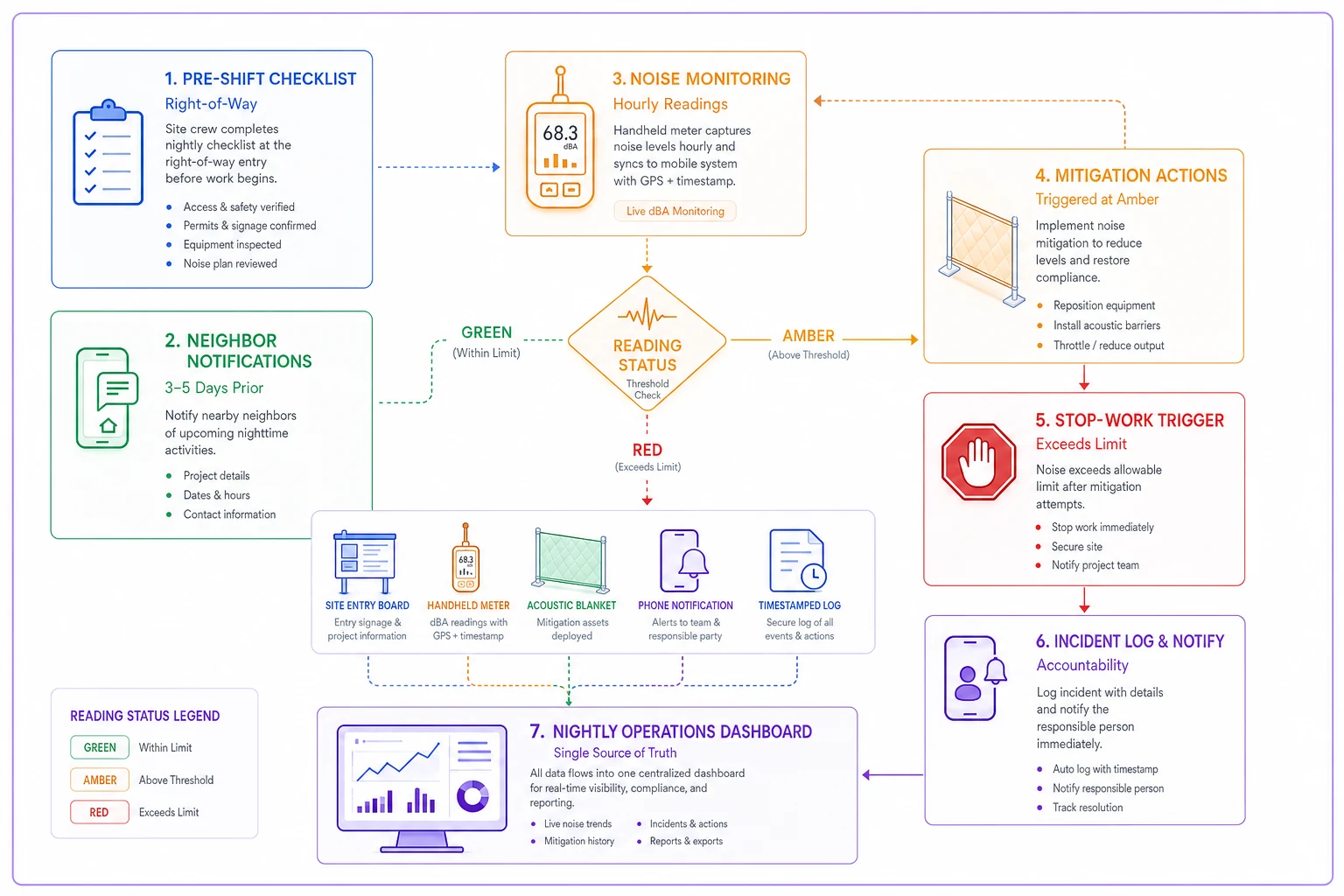
Where lightweight automation earns its keep is in the handoffs. Pre‑scheduled neighbor notifications that fire a few days before each noisy night, hourly reading reminders pushed to the night super's phone, complaint logs that time‑stamp themselves and roll up into one view — those remove exactly the gaps where violations slip through. Not because the tech is clever, but because it stops compliance from depending on whether one tired person remembered one step at 2 AM.
The real takeaway
Night‑work fines aren't a noise problem. They're a handoff problem dressed up as a noise problem. The crew that gets cited usually could have stayed under the limit — they just didn't have a clear number to watch, a neighbor already warned, or the authority to stop before the inspector arrived.
Build the packet once, fill in your variance's actual limits, and run it every night without exception. The nights it feels unnecessary are the nights it's quietly working.
Night‑work fines aren't a noise problem. They're a handoff problem dressed up as a noise problem. The crew that gets cited usually could have stayed under the limit — they just didn't have a clear number to watch, a neighbor already warned, or the authority to stop before the inspector arrived.
Build the packet once, fill in your variance's actual limits, and run it every night without exception. The nights it feels unnecessary are the nights it's quietly working.
Ready to build smarter and faster?
Join 2,000+ construction teams using Projbrick to improve project visibility, reduce delays, and increase profitability.