

Nobody logs "submittal rejections" as a schedule risk until the pattern is impossible to ignore. On a mid‑rise job, a single rejected steel shop drawing comes back three weeks later, the fabricator re‑queues the package, and suddenly a sequence that looked comfortable on the Gantt has zero float left. The rejection itself took the architect four minutes to type. The recovery took a month.
That gap — between how trivial a rejection looks and how expensive it actually is — is the core problem with submittal RFI governance in construction. Most teams treat submittals and RFIs as paperwork to push through, not as a controlled process with entry requirements and response deadlines. The back‑and‑forth multiplies, and the schedule absorbs it silently.
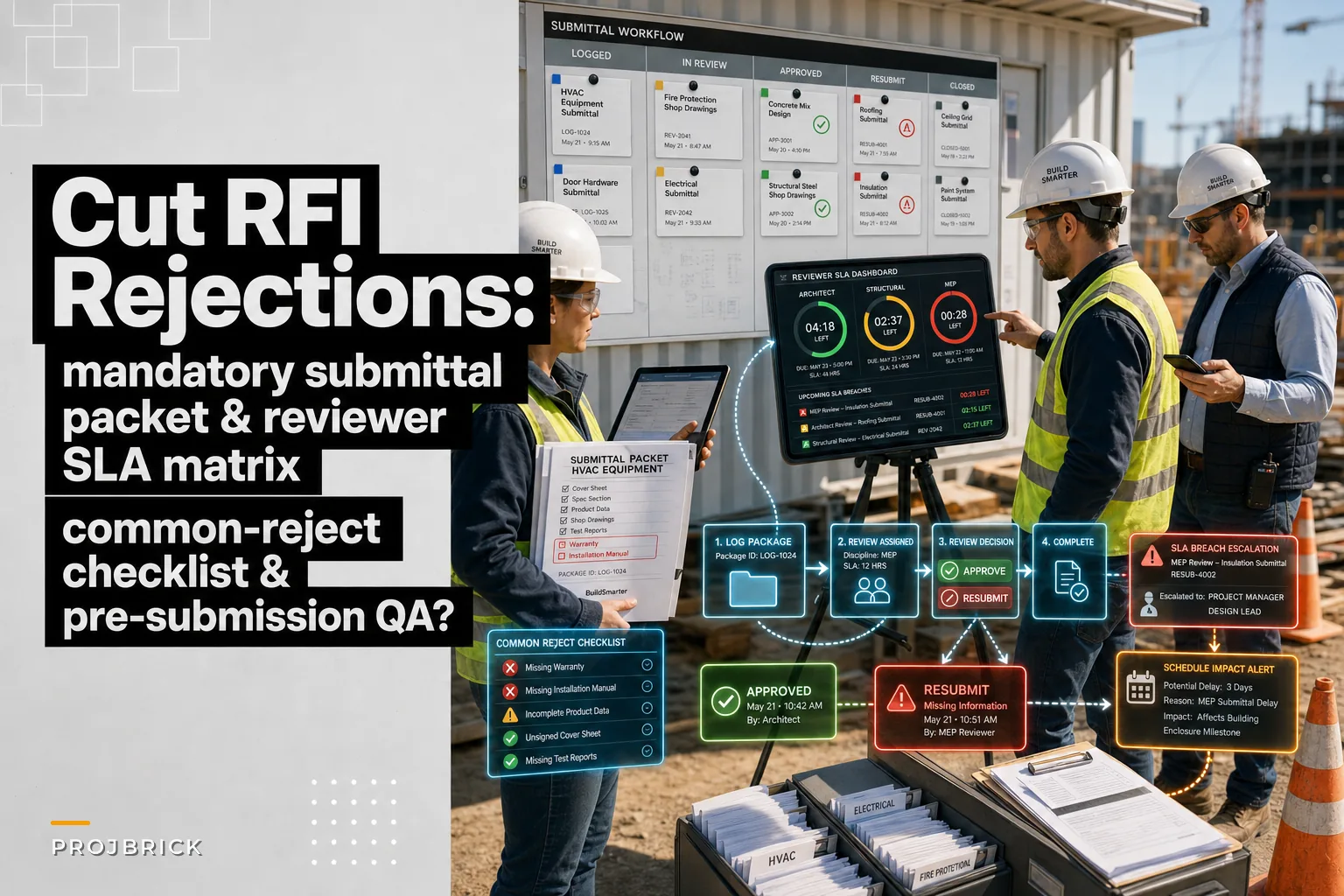
This post covers three pieces of a system to stop that: a mandatory pre‑submission packet so nothing incomplete enters the log, a reviewer SLA matrix so responses don't drift, and a common‑reject checklist so your team QA's the exact things that get kicked back.
Why rejections cluster where they do
Rejections aren't random. Sort through a few hundred of them and the same handful of causes keep appearing — and almost none are about engineering judgment. They're about incomplete packages, mislabeled files, or missing context the reviewer needs to say yes.
The pattern plays out like this: a sub emails a PDF, the project engineer forwards it into the log without opening it carefully, and the reviewer gets a shop drawing with no transmittal, no spec section reference, and a title block reading "Rev 0" even though it's the third version. They can't tell what changed, can't tie it to a spec, and have no coordination markups showing it clears the adjacent trade. So they reject — not because the work is wrong, but because they can't responsibly approve what they can't verify.
What makes it worse is volume. On a job running 400–600 submittals, even a 25–30% rejection rate means 100+ packages going around twice. Each round trip is a transmittal, a review cycle, a re‑submission, and usually a few reminder emails. The reviewer's clock and your fabrication lead time keep running the whole time.
The fix isn't "review more carefully." It's not letting an incomplete package into the log in the first place.
The mandatory pre‑submission packet
The entry gate is a required-fields packet that changes by submittal type. If the fields aren't filled, the package doesn't get a log number. No log number, no reviewer time wasted.
Keep your construction projects on schedule and budget.
Projbrick helps you plan, track, and manage every project phase with precision and ease.
- Real-time project tracking
- Resource & budget management
- Team collaboration tools
No credit card required
Different submittal types need different things. A product data sheet doesn't need coordination markups the way an MEP shop drawing does. Forcing one universal form just leads people to skip fields or paste "N/A" everywhere, which defeats the whole point.
Required fields by submittal type
| Submittal type | Must‑have fields before logging |
|---|---|
| Product data | Spec section reference, manufacturer + model, compliance statement against spec, any deviations flagged explicitly |
| Shop drawings (steel/rebar/precast) | Revision history with change clouds, dimensional ties to contract drawings, connection references, fabricator QA stamp |
| MEP coordination drawings | Trade sign‑offs for adjacent systems, clash check reference, ceiling/plenum elevation confirmation, access/clearance callouts |
| Samples / mock‑ups | Spec section, physical sample ID, location of installed mock‑up, acceptance criteria stated |
| Mix designs / test reports | Spec reference, lab credentials, test dates, pass/fail against spec thresholds |
| O&M / closeout submittals | Warranty terms, model/serial capture, as‑installed confirmation, link to commissioning record |
What actually makes this work: one person owns the gate. Usually the project engineer or document controller. They don't review technical content — they verify the fields exist. That separation matters, because the moment the gatekeeper starts making engineering calls, the gate slows down and people start routing around it.
The deviations field deserves special mention. Most rejections on product data happen because a sub quietly submits an "or‑equal" without flagging it, and the reviewer feels ambushed. Forcing an explicit deviation statement — even just "no deviations" — turns a hidden surprise into a clear yes/no question. Reviewers approve clear questions far faster than ambiguous ones.
The reviewer SLA matrix
Half the back‑and‑forth isn't about rejections at all — it's about silence. A submittal sits in someone's inbox for 18 days because nobody agreed on how long "review" is supposed to take, and there's no trigger when it drifts.
A reviewer SLA matrix sets response windows by submittal type and criticality, and names who escalates when a window is blown. It only works if the clock starts automatically when the package is logged, and if a missed SLA produces an actual nudge rather than a quiet overdue flag nobody looks at.
A workable SLA matrix
| Submittal type | Criticality | Review SLA (business days) | Escalation at |
|---|---|---|---|
| Long‑lead fabrication (steel, curtain wall) | Critical path | 7 | Day 8 → PM + design lead |
| MEP coordination drawings | High | 10 | Day 11 → PM |
| Standard product data | Medium | 14 | Day 15 → PE |
| Samples / mock‑ups | Medium | 10 | Day 11 → PE |
| Closeout / O&M | Low | 21 | Day 22 → document control |
Two things teams consistently get wrong. First, they set one SLA for everything — which means the curtain‑wall package driving your enclosure date gets the same 14 days as a paint color chip. Tie the SLA to schedule impact, not convenience.
Second, they forget to budget the sub's resubmission time inside the fabrication lead time. If your steel needs a 7‑day review and you've only allowed for one review cycle before fab release, a single rejection blows the date. Build in at least one expected re‑review for critical‑path items, or you're planning for a world where nothing ever gets kicked back — which isn't the world you're actually working in.
Here's a short visual to show the flow from logging a package to SLA timer, reviewer action, and escalation.
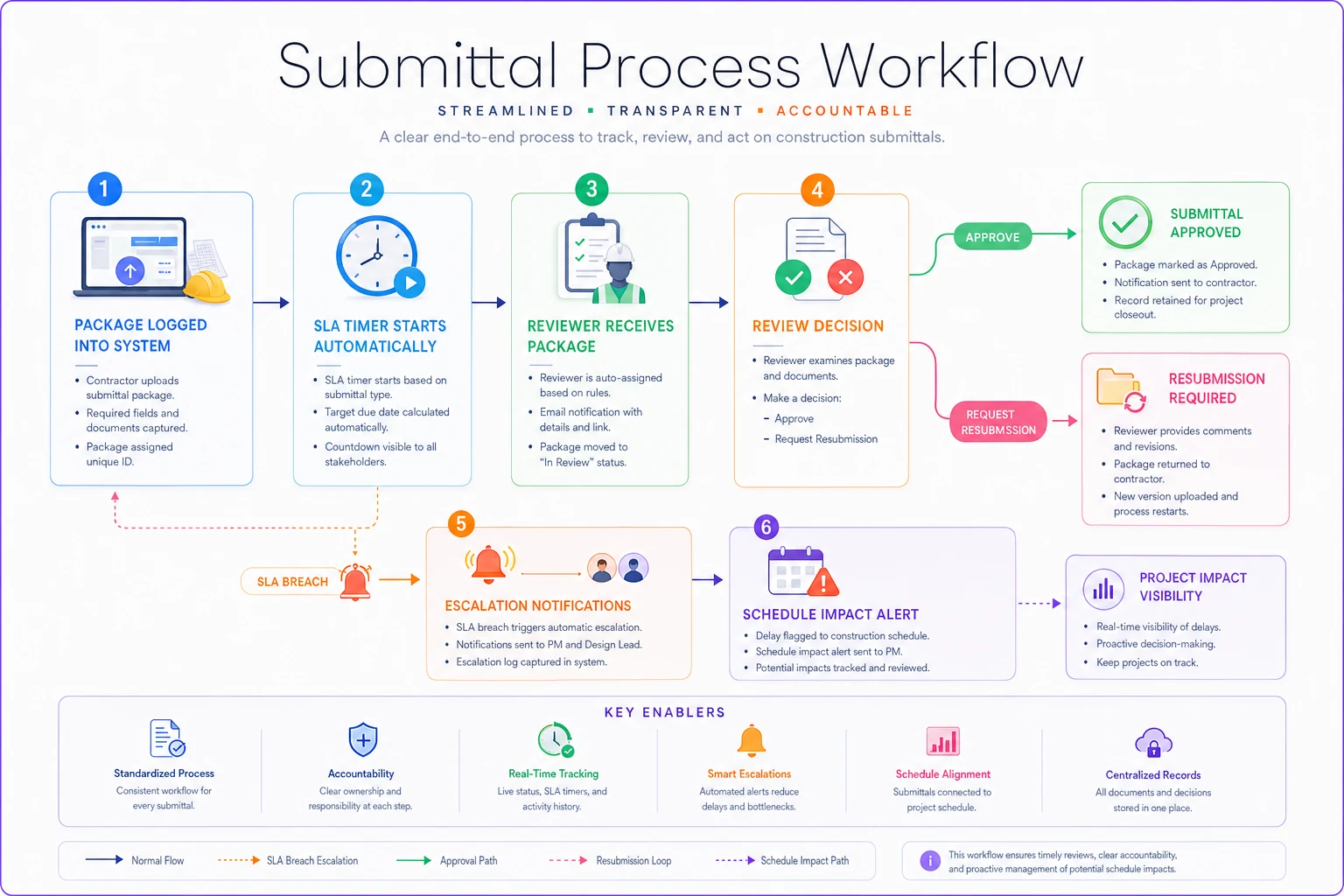
When an SLA breach lands on a critical‑path item, it stops being a document problem and becomes a schedule problem. That's the handoff point into your critical-path escalation protocol — the same 48/24/8‑hour trigger logic applies once a blown review window threatens a sequence start date.
The common‑reject checklist
This is the piece that pays for itself fastest. Before anything goes into the log, the submitting team runs a short QA pass against the exact causes reviewers reject for. Not a generic "is this good" pass — a specific pre‑empt of known failure modes.
Across most jobs, rejection causes cluster into a predictable handful:
-
No spec section reference — reviewer can't tie the submittal to what they're checking against
-
Missing or wrong revision tracking — no change clouds, so the reviewer re‑reviews the whole thing or rejects on principle
-
Unflagged deviations / or‑equals — a substitution buried in the data sheet with no call‑out
-
No coordination sign‑off — MEP drawing submitted without the adjacent trade's clearance
-
Stale title block info — rev number, date, or drawing number doesn't match the transmittal
-
Incomplete package — one sheet of a multi‑sheet set, or product data missing a referenced appendix
-
Dimensional ties missing — shop drawing that doesn't reference back to contract drawing dimensions
-
Wrong reviewer routing — sent to the architect when the structural engineer needed it first
The pre‑submission QA pass, in order
-
Confirm the spec section is referenced and matches the submittal content
-
Check the revision history — clouds present, rev number correct, change log current
-
Scan for deviations; if any exist, confirm they're explicitly flagged, not buried
-
Verify coordination sign‑offs for any trade‑adjacent package
-
Match title block details against the transmittal (number, rev, date)
-
Confirm the package is complete — all referenced sheets and appendices attached
-
Check routing — is this going to the right reviewer in the right order?
-
Only then, assign the log number
The part most teams miss: the checklist should be run by the sub before they transmit, not just by your PE after they receive it. Push the QA pass upstream to the party creating the package and you kill most rejections before they ever reach your inbox. Publish the checklist to your subs as a submission condition. The ones who follow it get faster approvals, which becomes a real incentive once they feel the difference.
A real scenario
A regional GC running a four‑story medical office fit‑out was drowning in submittal churn. Around 480 submittals on the job, rejection rate sitting near 30%. Reviews were drifting past 20 days on items nobody had flagged as urgent, and two long‑lead packages — the rooftop units and the curtain wall — had each gone around twice, eating into the enclosure sequence.
They put the three‑part system in mid‑project. Mandatory packet with type‑specific fields, SLA matrix tied to criticality, common‑reject checklist pushed out to major subs as a submission requirement.
Over the following couple of months, first‑pass approval climbed into the mid‑80s percent range. The rejections that still happened were real technical disagreements, not missing fields — which is exactly what you want, because those are the ones worth a reviewer's time. Average turnaround on critical‑path items tightened to within the 7‑day window because SLA breaches now generated an actual escalation instead of a silent overdue flag. The enclosure sequence, which had been bleeding float, stabilized.
Nobody worked harder. The packages just stopped entering the system broken.
When this is worth the overhead — and when it isn't
This system has real setup cost. Building type‑specific fields, agreeing SLAs with your design team, publishing the checklist to subs — that's a few days of coordination up front.
It's clearly worth it when: you're running more than a couple hundred submittals, you have long‑lead fabrication on the critical path, or your rejection rate is already above roughly 20%. At that scale the back‑and‑forth is a schedule risk whether you're tracking it or not.
It's probably overkill when: you're on a small job with 40–50 submittals and a single reviewer who turns things around in a few days anyway. Forcing a formal gate there just adds friction to a process that already works.
Who should not run the full matrix: teams without a dedicated document controller or project engineer to own the gate. If the gatekeeper role gets handed to whoever's free that week, the standard erodes within a month and you're back to logging broken packages — now with extra forms attached.
Where this ties into the rest of the controls
Submittal governance doesn't live alone. The same closeout and O&M submittals you're gating here feed straight into commissioning — which is why the field evidence and sign‑off discipline matters. The handoff into a structured MEP commissioning checklist is cleaner when your closeout submittals arrived complete the first time instead of getting reconstructed at the end of the job.
The takeaway is narrow on purpose. You don't need a bigger review team or stricter reviewers. You need an entry gate that rejects incomplete packages before they consume anyone's time, a response clock that actually triggers when it drifts, and a short QA pass aimed at the specific reasons things get kicked back. Put those three in place and the back‑and‑forth quietly eating your float mostly stops on its own.
The takeaway is narrow on purpose. You don't need a bigger review team or stricter reviewers. You need an entry gate that rejects incomplete packages before they consume anyone's time, a response clock that actually triggers when it drifts, and a short QA pass aimed at the specific reasons things get kicked back. Put those three in place and the back‑and‑forth quietly eating your float mostly stops on its own.
Ready to build smarter and faster?
Join 2,000+ construction teams using Projbrick to improve project visibility, reduce delays, and increase profitability.