


Most procurement failures on big programs don't start as procurement failures. They start as a single-project habit that quietly scaled. A PM sole-sources a switchgear package because they trust the rep, the lead time holds for two jobs, and then the same vendor becomes the default across eleven projects running at once. Nobody decided that. It just accumulated. And when that vendor's plant goes down or their order book backs up to 42 weeks, the entire portfolio feels it at the same moment.
That concentration problem is the real shape of supplier risk governance in construction. At the project level you're managing deliveries. At the portfolio level you're managing exposure — how many of your critical paths depend on the same factory, the same port, the same raw-material index, the same two fabricators who happen to be the only ones certified for your spec. The tools that work for one job stop working once you're coordinating across a program, and most teams don't notice until a shock exposes it.
This article is about the governance layer that sits above individual purchasing decisions: how to tier suppliers by actual risk, how to build contract decision trees that tell you when to single-source versus diversify, and how to hold hedging and contingency rules that survive a long-lead disruption instead of collapsing into panic buying.
Why single-project procurement instincts break at portfolio scale
The instinct that serves you well on one project — build a relationship, consolidate spend with one reliable supplier, negotiate volume pricing — is exactly what creates fragility across many.
On a single job, concentration is efficient. You get better pricing, cleaner coordination, one throat to choke. But run that logic across a portfolio and you've accidentally built a system where a handful of vendors sit on multiple critical paths simultaneously. The efficiency is real. The hidden correlation is also real, and it's invisible until everything moves in the same direction at once.
A pattern that shows up repeatedly: a contractor has, say, nine active projects. Procurement is managed project-by-project, each PM running their own vendor list. On paper there's diversity — lots of different POs, lots of different names. But when someone finally maps spend against shared dependencies, they find that three of the nine projects depend on the same curtain-wall fabricator, with all three enclosure milestones landing in the same quarter. No single PM did anything wrong. The exposure emerged from the sum of reasonable local decisions.
-
Correlated lead-time risk. When one supplier slips, multiple schedules slip together, and your float disappears across the portfolio at once instead of one project at a time.
-
Loss of negotiating memory. Each project renegotiates terms from scratch. Nobody's tracking that you're the vendor's biggest aggregate customer and should be pricing and prioritizing accordingly.
-
No early-warning aggregation. A delay signal on Project A never reaches Project F, even though they share the same long-lead item and the same root cause.
-
Panic substitution. When a shock hits, teams scramble for alternates with no pre-qualified backup, so they pay spot premiums and accept whatever spec the substitute offers.
The fix isn't to ban concentration. Sometimes concentration is the right call. The fix is making it a decision instead of an accident — which means you need a framework that forces the question before the commitment.
A supplier-tier framework built around exposure, not spend
Most supplier classification systems rank vendors by annual spend. That's a finance view, and it's nearly useless for risk. A $40k custom-fabricated item sitting on four critical paths is more dangerous than a $900k commodity order you can resource in a week from six suppliers.
Keep your construction projects on schedule and budget.
Projbrick helps you plan, track, and manage every project phase with precision and ease.
- Real-time project tracking
- Resource & budget management
- Team collaboration tools
No credit card required
Tier your suppliers by the damage their failure would cause, not by how much you pay them. Three variables matter most: criticality (does failure stop work?), substitutability (how fast and how painfully can you replace them?), and concentration (how many projects depend on them at once?).
| Tier | Profile | Governance requirement |
|---|---|---|
| Tier 1 — Strategic / high-exposure | Long-lead, specialized, few alternates, sits on multiple critical paths | Portfolio-level ownership, dual-source plan, quarterly financial health check, contract with priority-allocation and delay clauses |
| Tier 2 — Important / moderate exposure | Meaningful lead time, some alternates exist but with switching cost | Named backup pre-qualified, lead-time monitoring, scorecard reviewed each phase gate |
| Tier 3 — Commodity / low exposure | Short lead time, many suppliers, easily substituted | Project-level management, standard terms, light monitoring |
The important move is that tiering happens at the portfolio level and gets reviewed on a rhythm, not set once and forgotten. A supplier can be Tier 3 when you have two active jobs and climb to Tier 1 when you have ten, purely because concentration changed. In real operations, the vendors that hurt you most are often the ones that drifted into Tier 1 without anyone reclassifying them.
A practical reclassification trigger: any supplier whose aggregate exposure crosses more than two concurrent critical paths gets automatically bumped up a tier for review. That single rule catches most of the accidental concentration before it becomes a crisis.
Contract decision trees: when to single-source, dual-source, or hold inventory
Once suppliers are tiered, the next governance question is how you contract with them. Decision trees beat policy manuals here, because the right answer genuinely changes with the item.
-
Is the item on a critical path, and is the lead time longer than your available float? If no, standard project-level procurement is fine — don't over-engineer commodity buys. If yes, continue.
-
Does a qualified alternate supplier exist with comparable spec and certification? If no, you're structurally single-sourced, so the contract must do the work that competition can't — priority allocation, firm lead-time commitments, liquidated damages or expedite rights. If yes, continue.
-
Is the switching cost (re-qualification, re-design, re-submittal) low enough to execute inside your float window? If yes, dual-source and split the award to keep both suppliers warm. If no, treat it as functionally single-sourced even though alternates "exist" on paper.
-
Is the item price-volatile against a tradeable index (steel, copper, aluminum, fuel)? If yes, layer a hedging decision on top — fixed-price, indexed with caps, or buffer inventory. If no, lock a firm price and move on.
-
Does holding buffer inventory cost less than the expected delay cost? If yes, and storage is feasible, pre-purchase and stage. If no, rely on contractual lead-time protection instead.
This logic connects directly to how you sequence long-lead items in the first place — the scheduling side of this is covered in our breakdown of building a long-lead procurement schedule that prevents material-driven stoppages on high-rises. The decision tree tells you how to contract; the schedule tells you when the commitment has to land.
One mistake worth calling out: teams often dual-source to feel safe, then split the award so thin that neither supplier treats them as a priority customer. Splitting 50/50 across two fabricators who each have bigger clients means you're second in line at both when capacity tightens. Sometimes a 70/30 split — enough to keep the backup qualified and warm, but concentrated enough to matter to the primary — protects you better than a clean even split.
Portfolio hedging rules for price and availability shocks
Hedging in construction isn't just a finance exercise with futures contracts. Most of your practical hedging is operational: where you hold buffer, how you structure price terms, and how much flexibility you build into specs so you can substitute.
Price hedging. For index-linked materials, decide per package whether you fix, index-with-cap, or float. Fixing everything feels safe but you pay a premium for certainty and lose upside if prices fall. The portfolio approach is to fix the volatile, critical-path packages where a price swing would blow a project's margin, and let low-exposure commodity items float. Indexed contracts with a cap-and-collar give you a middle path — you share some volatility but bound the downside.
Inventory hedging. Pre-purchasing and staging buffer stock for Tier 1 items trades carrying cost for schedule certainty. This only makes sense when expected delay cost clearly exceeds storage, financing, and obsolescence risk. For fast-moving commodities, buffer is cheap insurance. For spec-specific custom items that might change under a design revision, buffer can turn into expensive scrap.
Spec flexibility hedging. The most underused hedge. If your specification allows two manufacturers' products instead of one named model, you've created a substitution option for free. Fighting for approved-equal language during design is a procurement hedge disguised as a spec review. Teams that lock single-manufacturer specs early lose this option permanently.
Fight for approved-equal language during design reviews — it's a low-cost hedge that preserves substitution options.
A hedging rule only works if it's written down with a trigger. "Hold three months of buffer on structural steel" is a policy. "If the steel index rises more than X% quarter-over-quarter or mill lead times exceed Y weeks, convert the next two projects' steel buys to fixed-price and pre-order rebar" is a hedging rule. The difference is that one tells you when to act.
Contingency playbooks: a worked example of a long-lead shock
Policies and tiers are worthless in the first 48 hours of a real shock unless someone has already decided who does what. This is where a contingency playbook earns its keep.
Consider a realistic scenario. A mid-sized contractor is running a portfolio with roughly $180M in active work across eight projects. Their primary electrical switchgear supplier — a Tier 1 vendor sitting on four of those projects — notifies them that lead times have jumped from about 20 weeks to somewhere north of 50 weeks following a transformer-component shortage. Three of the four affected projects have energization milestones inside the next year. Float on those milestones is thin, maybe two to four weeks each.
Without a playbook, what happens is predictable: each PM finds out separately, each starts calling alternates independently, and the portfolio ends up competing against itself for the same scarce backup capacity while paying escalating expedite fees.
-
Aggregate the exposure first (day 1–2). Pull every project touching that supplier into one view. Confirm which milestones actually have thin float versus which have cushion. In this case, two projects are genuinely exposed; one has enough float to absorb the slip without intervention.
-
Rank who gets the scarce resource (day 2–3). Decide at portfolio level which project's needs take priority — usually driven by liquidated-damages exposure, owner relationship, or downstream trade dependencies. This prevents PMs from bidding against each other.
-
Activate pre-qualified alternates (week 1). Because the backup fabricator was kept warm under the Tier 1 governance rule, re-qualification is days, not months. Submit the approved-equal substitution the spec flexibility allowed.
-
Re-sequence around the constraint (week 1–2). Pull forward work that doesn't depend on switchgear; delay what does. Protect the most schedule-sensitive project by diverting the earliest available units to it.
-
Re-cut contracts (week 2–4). Lock firm lead times with the alternate, add priority-allocation language, and renegotiate the primary supplier's remaining orders with delay protection.
In a situation like this, the teams with a rehearsed playbook typically recover one or two of the exposed milestones outright and limit the damage on the rest to a manageable slip. The teams without one usually eat the full 30-week delay on at least one project plus a six-figure expedite bill — because by the time they organized a response, the alternate capacity was gone too.
The playbook didn't create new options. It made sure the options the governance framework had already built were actually usable under pressure.
Diversification decisions: when it helps and when it just adds cost
Diversification sounds like obvious good practice, but blanket diversification is a real cost, and some teams over-correct after a bad shock and diversify everything.
When diversification clearly makes sense:
-
The item sits on multiple critical paths across the portfolio
-
Lead times are long and alternates take time to qualify
-
The supplier's financial health or capacity is uncertain
-
The material is exposed to a volatile index or geopolitical supply risk
When diversification is a bad idea:
-
Commodity items with deep, fast markets — you're adding admin overhead to manage risk that barely exists
-
Highly spec-specific items where qualifying a second source costs more than the delay risk it hedges
-
Early-stage or low-volume programs where you can't give any supplier enough volume to stay a priority customer
-
Cases where splitting award destroys the volume pricing and relationship leverage that were actually protecting you
Who should probably not diversify aggressively: smaller contractors with limited concurrent work. If you only have two or three active projects, your total volume is already modest, and spreading it across more suppliers can leave you as nobody's priority. For those teams, the better hedge is deep relationships with one or two primaries plus a named, pre-qualified backup you activate only when needed — not a permanently split book.
The judgment call is almost always about volume leverage versus correlated risk. Diversification reduces correlation but dilutes leverage. The right balance shifts as the portfolio grows, which is exactly why this has to be revisited regularly rather than decided once and left alone.
Making the governance layer actually run
The hardest part of supplier risk governance in construction isn't designing the framework — it's keeping it current across many moving projects. Tiering drifts. Backups go stale. A supplier's financial health changes. A new project quietly adds a fourth critical path to a vendor that was fine at three.
This is where portfolio-level visibility matters more than any single document. When procurement, schedule, and supplier data live in separate project silos, nobody can see the cross-project concentration until it bites. The practical answer is a shared system of record where supplier exposure, lead-time status, and contract terms are visible across the whole portfolio — so a lead-time alert on one project automatically flags every other project exposed to the same vendor. Modern construction management platforms increasingly use automation to surface those correlations: flagging when a supplier crosses a concurrency threshold, tracking lead-time drift against baselines, and triggering a reclassification review before a shock does it for you. The point isn't the technology for its own sake — it's that the review rhythm the framework depends on only survives if the data gathering is automatic rather than a manual quarterly scramble.
For programs running factory-built components, this governance layer connects tightly to production and delivery control — the checkpoints and JIT windows covered in our guide to governing modular prefabrication programs are essentially supplier-risk governance applied at the factory floor. Same logic, different vantage point.
Here's a simple workflow that shows how alerts travel from project-level data into portfolio decisions.
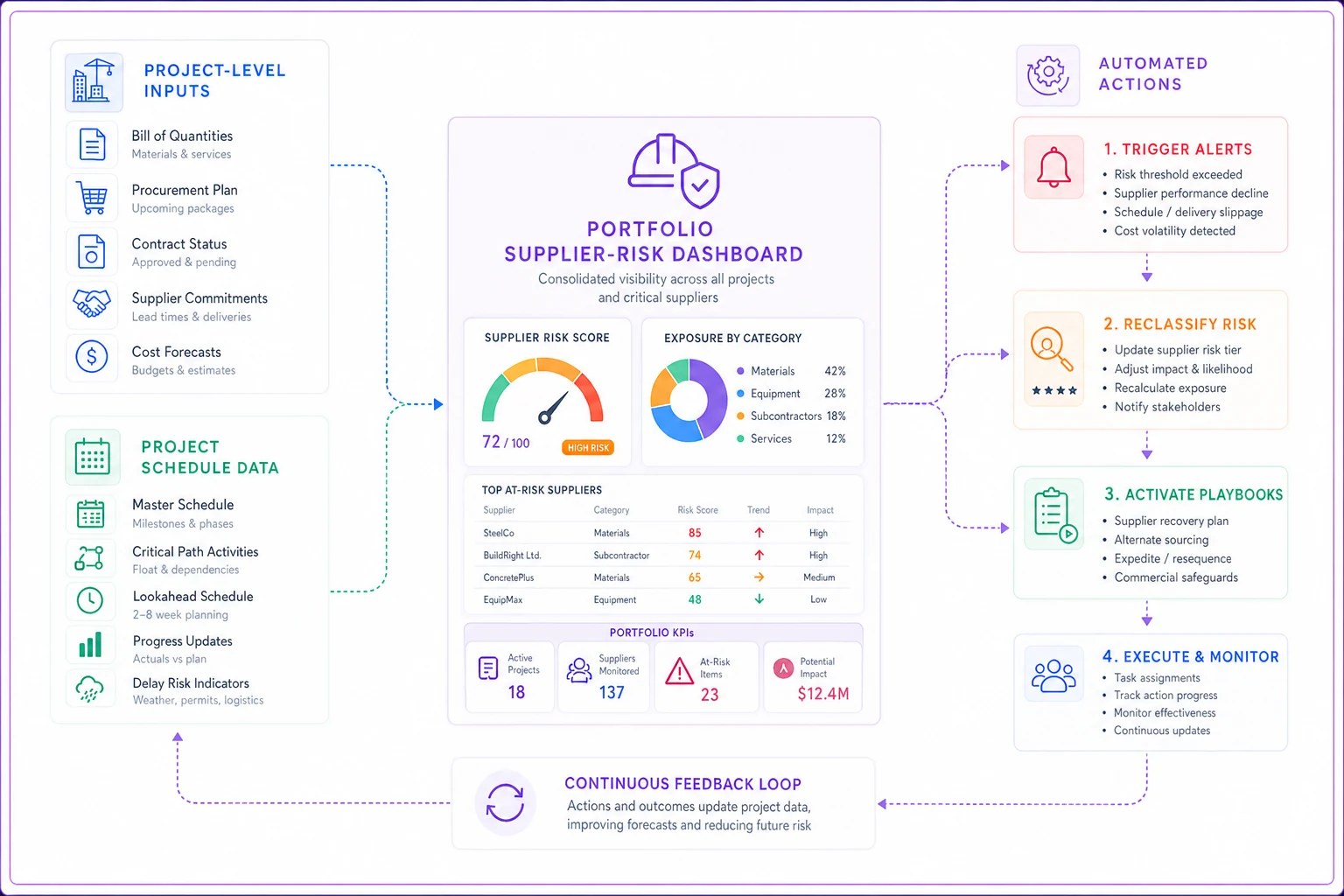
The visualization maps data sources to actions so teams can see who owns each trigger and what the immediate response should be.
The governance layer is not about buying another tool — it's about wiring existing data into a rhythm of reviews and automatic alerts so the portfolio doesn't rediscover concentration only after it costs you.
Bringing it together
The shift from project procurement to portfolio supplier-risk governance is really a shift in what you're measuring. On one job you measure deliveries against a schedule. Across a portfolio you measure exposure — correlated dependencies, concentration on single vendors, the gap between the backups you think you have and the backups that are actually warm and qualified.
The framework holds together when three things stay connected: tiering by exposure rather than spend, contract decision trees that force the single-source-versus-diversify question before you commit, and hedging and contingency rules written with real triggers so they fire under pressure instead of dissolving into improvisation. Each piece is simple on its own. The value is in the connections — and in reviewing them on a rhythm as the portfolio grows and the exposure map quietly rearranges itself underneath you.
Get that governance layer right and the next long-lead shock becomes a managed event with a sequenced response, not a scramble. That's the whole difference between a portfolio that absorbs disruption and one that amplifies it.
Get that governance layer right and the next long-lead shock becomes a managed event with a sequenced response, not a scramble. That's the whole difference between a portfolio that absorbs disruption and one that amplifies it.
Ready to build smarter and faster?
Join 2,000+ construction teams using Projbrick to improve project visibility, reduce delays, and increase profitability.