



Most PMOs in construction treat continuous improvement like a compliance ritual. Someone runs a lessons-learned session at closeout, fills in a spreadsheet nobody opens again, and the exact same defect shows up on the next job. Snagging lists balloon, rework budgets get quietly padded, and the "improvement" folder becomes a graveyard of good intentions.
The problem isn't a lack of data. Most firms are drowning in defect records — punch lists, NCRs, QA fail reports, warranty callbacks. What's missing is a governance loop that turns that noise into changes that stick: revised training, tightened procurement specs, updated contract clauses, each with a named owner and a number attached. That's what separates a real continuous improvement PMO in construction from a team that just documents its mistakes.
This is a systems piece. Not a list of QC tips. The whole point is showing how defect data should flow through a quarterly cadence, get triaged by root cause, feed decisions across three different departments, and then get checked to confirm the fix actually worked.
Why defect-reduction programs fail even when everyone tries
The usual failure isn't laziness. It's that the feedback loop is broken in a few predictable places.
Defect data lives in silos. The site team logs snags one way. QA logs NCRs another way. The commercial team tracks warranty costs in a completely separate system. Nobody reconciles them, so the same underlying problem — say, a subcontractor consistently installing the wrong sealant — shows up as three unrelated line items instead of one clear pattern.
Lessons-learned also tends to happen too late. If you only review defects at closeout, you're capturing insight 14 to 20 months after the decisions that caused them. The estimator who wrote the vague spec has moved on. The procurement lead who accepted the cheaper substitute doesn't hear about the failure until the warranty claim lands. Feedback that arrives after everyone involved has scattered isn't really feedback — it's an autopsy.
Third, and this is the one that actually kills programs: there's no line connecting a defect to a decision that changes. A team identifies that 30% of finishes defects trace back to one flooring sub. Everyone nods. Then procurement re-appoints the same sub on the next job because they came in cheapest and nobody flagged them in the prequal system. The insight existed. The governance to act on it didn't.
What breaks at scale is coordination, not analysis. A single project manager running one job can hold defect patterns in their head. Run six concurrent projects across two regions and that informal memory evaporates. Patterns that are obvious across the portfolio stay invisible because no single person sees all six punch lists at once.
The quarterly cadence: why 90 days is the right rhythm
Annual reviews are too slow — you lose a whole year of repeated defects before anything changes. Weekly reviews are too granular — you end up reacting to noise before any real pattern has formed. Quarterly hits the sweet spot because it gives you enough volume to see genuine trends while still being fast enough to change a spec or update a training module before the next project starts.
Keep your construction projects on schedule and budget.
Projbrick helps you plan, track, and manage every project phase with precision and ease.
- Real-time project tracking
- Resource & budget management
- Team collaboration tools
No credit card required
The cadence works when it's structured, not just a standing meeting. A useful quarterly review does four things in order:
-
Consolidate every defect record from the quarter across all live projects into one dataset — NCRs, punch items, QA fails, warranty callbacks, and near-miss quality issues.
-
Categorize each defect by root-cause type (more on the triage matrix below), not by symptom.
-
Rank the categories by combined frequency and cost, so you're spending attention on the defects that actually hurt.
-
Assign each top category to a corrective pathway — training, procurement, or contract — with a named owner and a target for the next quarter.
The mistake most firms make is stopping after step two. They categorize beautifully and then never rank or assign. Categorization feels like progress but changes nothing.
One practical note: keep the quarterly review small. Six to eight people max — a PMO lead, senior QA, a commercial rep, a procurement lead, and one or two experienced site managers. Large review committees dilute accountability. When everyone owns the improvement, nobody does.
Visualize this as a simple workflow.
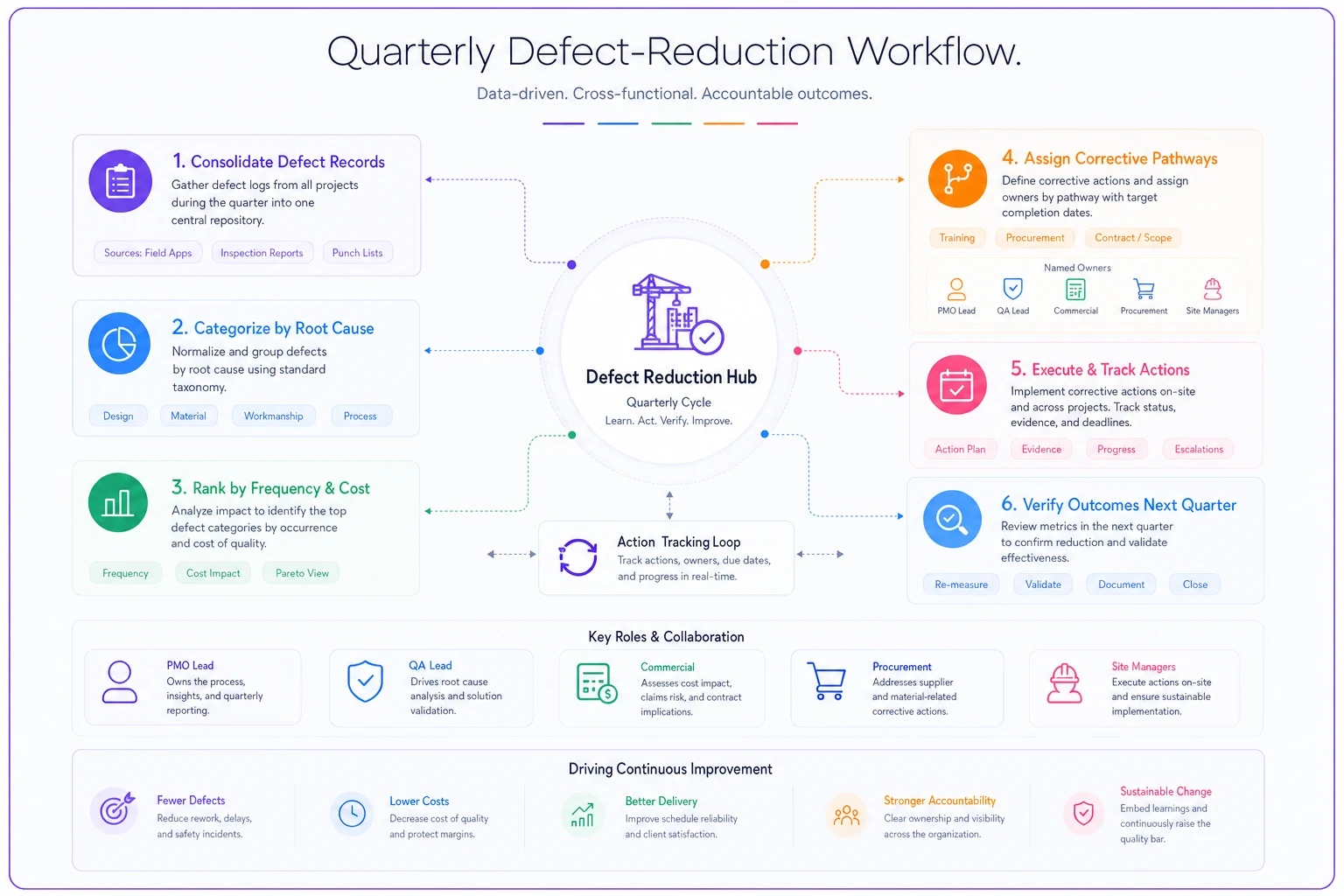
Visualized, the flow helps people see where data needs to move and who must act each quarter.
The root-cause triage matrix
Symptom-based sorting is what kills most defect programs. "Cracked tile," "leaking joint," and "misaligned door" are symptoms. They tell you nothing about what to change. Triage by root cause instead, and defects collapse into a much smaller set of actionable buckets.
| Root-cause category | Typical signal | Corrective pathway | Accountable owner |
|---|---|---|---|
| Skill / workmanship gap | Same defect across different subs, same trade | Training / toolbox revision | QA lead |
| Design ambiguity | Defect clusters around a detail or spec section | Design-handoff feedback | Design manager |
| Material / product failure | Defect tied to a specific product or supplier | Procurement spec change | Procurement lead |
| Subcontractor performance | Defects concentrated in one sub across projects | Prequal + contract terms | Commercial lead |
| Sequencing / coordination | Defects at trade interfaces | Planning / lookahead revision | Planning lead |
| Process gap | No standard existed to prevent it | Procedure / checklist update | PMO lead |
The value of forcing every defect into one of these buckets is that it automatically points to who fixes it. A workmanship gap is a training problem. A product that keeps failing is a procurement problem. A sub that keeps underperforming is a contract-and-prequal problem. Without this mapping, everything defaults to "the site team needs to be more careful," which isn't a corrective action — it's a complaint.
A pattern worth watching: when a defect could plausibly fit two categories, teams tend to pick the one that blames someone outside the room. Design managers call it workmanship; site teams call it design ambiguity. A simple tiebreaker helps — if the same defect appears across multiple independent subs, it's a design or process problem, not a workmanship one. That one rule removes a surprising amount of unproductive finger-pointing.
This triage discipline pairs directly with a phase-gate QA approach. If you're already using something like the system described in tying QA/QC to phase gates, the triage matrix becomes the analysis layer that sits on top of the sampling and phase-exit data you're already collecting.
Feeding the three downstream systems
This is where continuous improvement earns its name. Triage output isn't a report — it's an input into three operational systems that most PMOs run in isolation.
Training. Workmanship and process-gap defects should generate specific, targeted training — not generic "quality awareness" sessions. If the matrix shows 40% of your quarter's plastering defects come from improper mixing across three different crews, the corrective action is a five-minute toolbox card and a supervisor sign-off, not an afternoon seminar. Narrow training sticks. Broad training gets forgotten by the drive back to site.
Procurement. Material-failure and product-related defects feed directly into spec revisions and approved-vendor lists. The workflow looks like this: triage flags a recurring sealant failure → procurement traces it to a substituted product accepted for cost reasons → the spec is tightened to remove the substitution option → the change is logged against next quarter's baseline. The critical move is that procurement can't quietly re-accept the failed product because the change is now governed, not just remembered.
Contract changes. Subcontractor-performance defects feed prequalification scoring and contract terms. If one sub generated a disproportionate share of your defects and warranty callbacks, that data should hit their scorecard before they're invited to the next bid. This is exactly why defect governance and subcontractor lifecycle governance belong in the same conversation — a scorecard that isn't fed by real defect data is just a form.
The connective tissue between all three is action-tracking. Every corrective action gets an owner, a due date, a target metric, and a verification check in the following quarter. Without the verification loop, "we sent an email about it" becomes the de facto definition of improvement.
Action-tracking governance: making changes stick
A corrective action that isn't tracked to closure is a wish. The governance layer is what converts triage findings into measurable change, and it needs to be almost boringly simple to survive real project pressure.
A workable action-tracking checklist for each corrective action coming out of the quarterly review:
-
Defect category it addresses (from the triage matrix)
-
Named owner — a person, not a department
-
Specific change — what document, spec, training, or clause actually gets modified
-
Baseline number — current defect frequency or cost for this category
-
Target — what the next quarter should show
-
Due date — usually before the next review
-
Verification method — how you'll confirm it worked next quarter
Treat the verification field as mandatory evidence — don't accept "we emailed them" as closure.
The verification field is the one everyone skips and the one that matters most. If last quarter you flagged a flooring sub and tightened their contract terms, this quarter's review must explicitly check whether their defect rate dropped. If it didn't, the action failed and gets escalated — you don't just close it and move on.
At small scale, a shared spreadsheet handles this fine. The trouble starts around four to six concurrent projects, where defect volume across sites makes manual consolidation genuinely painful. AI-assisted operational platforms start to earn their keep here — not by making decisions, but by pulling defect records from multiple project systems, flagging when the same pattern appears across jobs that no single PM would have connected, and reducing the cross-project reconciliation work that usually causes the whole cadence to quietly collapse by Q3. The judgment stays human; the tedious data plumbing gets automated.
A real scenario: mid-size fit-out contractor
A regional fit-out contractor running around 9 to 12 concurrent projects had a persistent finishes rework problem. Punch lists were consistently long, and warranty callbacks in year one were eroding margins on completed jobs. Nobody could say exactly how much — the costs were scattered across individual project accounts.
They started a quarterly triage. First quarter, the consolidated data was ugly but clarifying: roughly 35% of their defects traced to just two categories — a specific door-hardware product that kept failing, and grout workmanship across several plastering crews. Both had been showing up for over a year, treated as unrelated one-offs on each project.
The corrective actions were unglamorous. Procurement removed the failing hardware from the approved list and specified an alternative. QA produced a two-page grout-mixing standard with a supervisor sign-off gate. Both got owners and targets.
By the third quarterly review, finishes-related punch items in those two categories had dropped by somewhere around 40–50%, and the door-hardware warranty callbacks essentially stopped. The number that got leadership's attention wasn't the defect count — it was the reduction in rework labour, estimated at roughly $60k–$80k across the portfolio over the following year. The program paid for itself on two categories alone, and they hadn't even worked through the rest of the matrix yet.
The lesson wasn't that they found brilliant new fixes. The fixes were obvious once the pattern was visible. The lesson was that the governance — consolidation, triage, ownership, verification — made two long-standing problems visible and forced someone to own them.
When this actually makes sense
A full quarterly triage-and-governance loop is worth running when you have multiple concurrent projects and defects repeating across them. The whole value comes from seeing portfolio-level patterns and closing the loop back into procurement and contracts. If you can already see all your patterns clearly without a formal cadence, you probably don't have enough volume to justify the overhead.
It also makes sense when rework costs are meaningful but invisible — scattered across project accounts where nobody owns the total. The consolidation step alone often surfaces costs leadership didn't know they were carrying.
When it's overkill
A single-project contractor, or a firm running one job at a time, doesn't need quarterly governance. The PM already holds the patterns in their head and can adjust on the fly. Adding formal cadence there just creates meetings.
It's also a bad fit if leadership won't act on the findings. The fastest way to kill a defect-reduction program is to run a solid triage, identify a poorly performing sub or a bad product, and then re-appoint or re-buy anyway because of price. Once site teams see the governance has no teeth, they stop feeding it honest data — and then you're worse off than before, because the defect records are now politically filtered.
Who should not run this yet
If your defect data is genuinely unreliable — inconsistent logging, missing NCRs, punch lists that don't get closed out — fix your capture layer first. Triage on bad data produces confident, wrong conclusions.
Get consistent defect logging working across projects before you build the governance loop on top of it. Otherwise you'll spend the quarterly review arguing about whether the numbers are even real, instead of deciding what to change.
Bringing it together
The reason defects repeat isn't that firms don't learn. It's that learning never gets converted into a governed decision with an owner and a number attached. A continuous improvement PMO in construction works when four things connect: a quarterly cadence that consolidates defect data fast enough to matter, a root-cause triage matrix that points every defect at the right corrective pathway, three downstream systems — training, procurement, contracts — that actually consume those findings, and action-tracking that verifies the fix worked instead of assuming it did.
Get those four moving in a loop and defect reduction stops being an annual ritual and becomes a background process that quietly compounds. The firms that pull ahead aren't the ones with the cleverest fixes. They're the ones whose systems make sure the same mistake doesn't get paid for twice.
The reason defects repeat isn't that firms don't learn. It's that learning never gets converted into a governed decision with an owner and a number attached. A continuous improvement PMO in construction works when four things connect: a quarterly cadence that consolidates defect data fast enough to matter, a root-cause triage matrix that points every defect at the right corrective pathway, three downstream systems — training, procurement, contracts — that actually consume those findings, and action-tracking that verifies the fix worked instead of assuming it did.
Ready to build smarter and faster?
Join 2,000+ construction teams using Projbrick to improve project visibility, reduce delays, and increase profitability.