


Most digital twin problems on a construction project don't show up during construction. They show up eighteen months after handover, when a facilities manager clicks on a chiller in the model, finds a serial number that was superseded during commissioning, and realizes nobody has touched the file since the ribbon got cut. At that point the twin isn't an asset. It's a liability that everyone paid for and nobody governs.
The reason this keeps happening isn't technical. The modeling tools are fine. The problem is that almost nobody writes down, in enforceable terms, who authored what, who has to update it and by when, how accurate it's contractually required to be, and what the owner does when the twin disagrees with the field. You end up with a beautiful model and zero governance wrapped around it. This post is about building that governance — the contractual and operational scaffolding that decides whether a twin stays useful for its whole life or quietly dies in a shared drive.
The core failure: twins get built, not governed
There's a pattern worth naming. A twin gets treated as a deliverable — a thing you make once and hand over — instead of a system that needs authorship rules, update cadence, and dispute mechanisms for its entire operational life.
That framing causes predictable damage. When a twin is a deliverable, everyone optimizes for the handover date. The model looks perfect on day one. But an operational twin is only worth anything if it stays synchronized with reality, and reality changes constantly: valves get replaced, a controls contractor swaps a sensor, a tenant fit-out moves a wall. Without governance, every one of those changes becomes silent drift between the model and the building.
The twin degrades fastest in the first six months after occupancy — exactly when the owner's team is least equipped to maintain it and the construction team has already demobilized. The commissioning-era changes never make it back in. By the time anyone notices, the twin is 15–20% wrong on asset data, which is enough for maintenance teams to stop trusting it entirely. And once trust breaks, adoption never recovers.
Why authorship rules are the foundation
Before you can hold anyone to an accuracy standard, you have to know who is responsible for each part of the model. This sounds obvious and it's almost never done properly.
Keep your construction projects on schedule and budget.
Projbrick helps you plan, track, and manage every project phase with precision and ease.
- Real-time project tracking
- Resource & budget management
- Team collaboration tools
No credit card required
A twin is authored by a lot of hands. Design consultants build the geometry. Subcontractors enrich it with product data. Commissioning agents attach test results and warranties. During O&M, the facilities team edits it continuously. If you don't assign authorship per data domain, you get a model where nobody knows whether a given attribute is authoritative or a leftover placeholder from the design phase.
Authorship rules should answer three things for every data domain:
-
Who is the author of record (the party allowed to change it)
-
Who is a contributor (can propose changes, can't commit them)
-
Who is the verifier (signs off that the change matches reality)
A typical breakdown looks like this:
| Data domain | Author of record | Verifier | Update trigger |
|---|---|---|---|
| Geometry / spatial | Design lead → then owner BIM manager | QA reviewer | Design change, as-built survey |
| Asset attributes (make/model/serial) | Installing subcontractor | Commissioning agent | Procurement substitution, install |
| Commissioning & test data | Cx agent | Owner acceptance rep | Test completion |
| Warranty & O&M docs | GC / handover team | FM lead | Equipment acceptance |
| Operational edits post-handover | Owner FM team | Owner BIM manager | Any physical change |
The insight most teams miss: authorship has to transfer at defined points. The design lead can't stay author-of-record for geometry forever — that responsibility moves to the owner's BIM manager at handover. If you never define the transfer, you get a gap where the design team assumes they're done and the owner assumes someone else is watching. Nothing gets updated in that gap, and that gap is where twins die.
Update windows: the cadence that keeps a twin alive
An accuracy requirement without an update window is meaningless. "The model must be accurate" is unenforceable. "Asset substitutions must be reflected in the twin within 5 business days of the RFI approval" is something you can actually hold a subcontractor to.
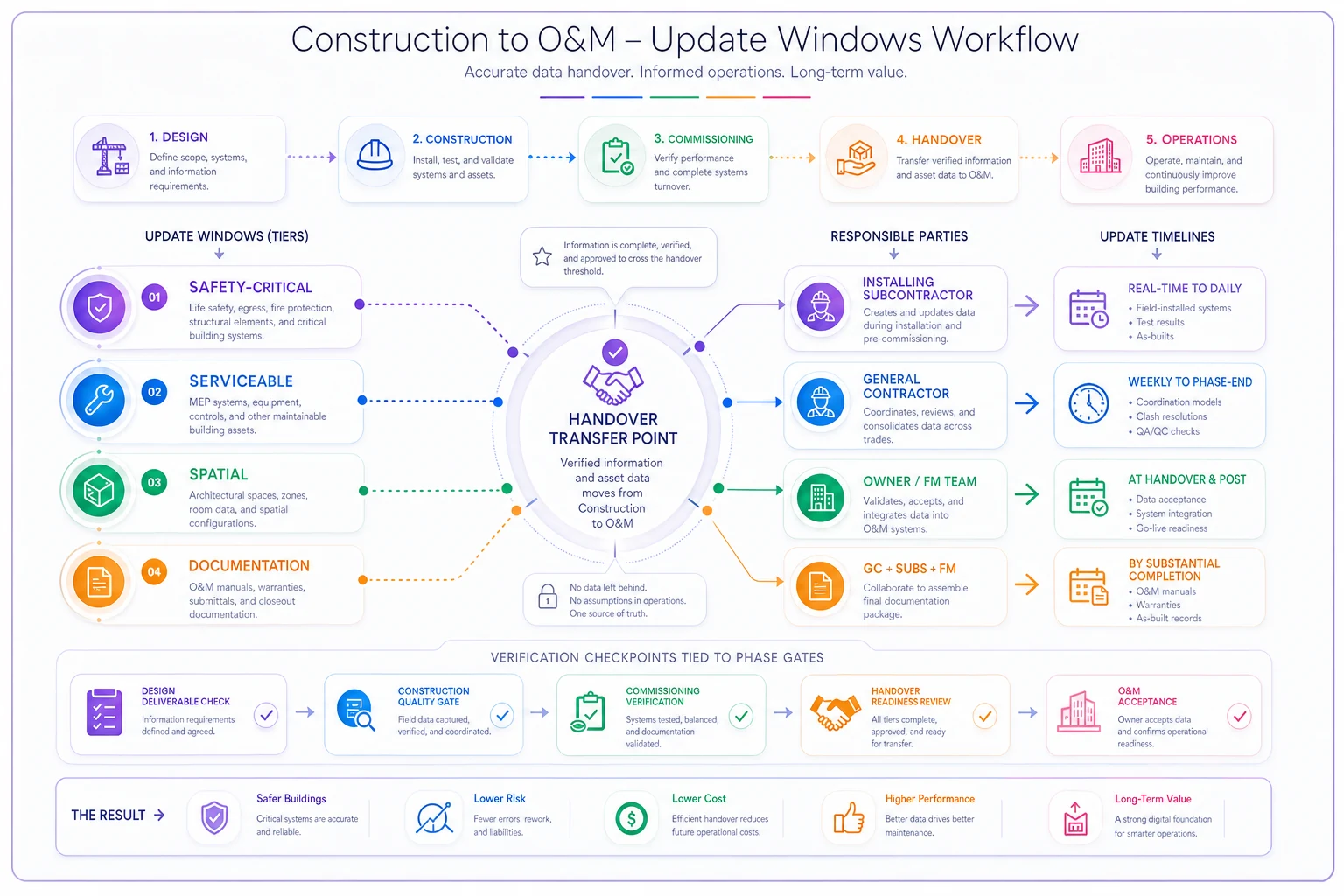
Update windows should be tiered by how fast the change affects operations. Not everything needs same-day turnaround, and pretending it does just guarantees everyone ignores the SLA.
-
Safety-critical / operational changes (fire systems, life safety, main electrical) — updated within 2 business days of field change
-
Serviceable asset changes (equipment swaps, valve replacements, control points) — within 5–10 business days
-
Spatial / non-critical geometry (partition moves in non-critical zones) — batched monthly
-
Documentation attachments (revised O&M manuals, updated warranties) — within 15 business days of receipt
The pattern to watch for: teams write aggressive update windows during construction and then have no mechanism to enforce them during O&M, because the enforcing party (the GC) is gone. The fix is to bake the operational-phase update windows into the owner's own FM processes and into any facilities management contract — not just the construction contract. The construction contract governs the twin until handover. Something else has to govern it after, or the whole thing lapses on day one of occupancy.
A simple workflow of update windows and responsible parties helps teams visualize who acts when.
If your handover already runs on metadata standards and gated acceptance, the update-window governance has something to attach to. The work we've described around a pragmatic digital-handover lifecycle with asset tags and gated acceptance is essentially the on-ramp for twin governance — without those gates and tags, you have nothing to write an SLA against.
Accuracy SLAs that mean something in the field
Most twin contracts fall apart here. They specify accuracy in modeling terms — LOD 400, LOD 500 — but never translate that into field readiness, meaning whether a technician standing in a mechanical room can actually rely on the twin to do their job.
An accuracy SLA needs to be expressed against real O&M usefulness, not modeling maturity. Two ways to define it that actually work:
Attribute completeness against a required schedule. For a defined list of critical assets, X% of required attributes must be present and verified. You pick the percentage per asset class — 100% for life-safety equipment, maybe 95% for serviceable mechanical, lower for cosmetic elements.
Field-verification sampling. At acceptance and at defined intervals afterward, a sample of assets gets physically checked against the twin. If the mismatch rate exceeds the threshold (say, more than 5% of sampled assets have wrong or missing critical attributes), the twin fails acceptance and the responsible author has to remediate within a cure window.
"For the 340 critical mechanical and electrical assets listed in Schedule C, 100% of safety-critical attributes and 95% of serviceable attributes must be present and field-verified. A random sample of 10% will be physically inspected at acceptance; a mismatch rate above 5% triggers rejection and a 15-business-day cure period."
That's enforceable. "The BIM shall be delivered at LOD 500" is not — it tells the owner nothing about whether the twin actually works.
Verification checkpoints: don't leave truth to the end
The biggest mistake is treating verification as a one-time gate at handover. By handover, the people who know the ground truth for early-phase installs are long gone, and reconstructing what actually got installed in a shaft that's now closed up is expensive or impossible.
Verification has to happen continuously, tied to the same phase gates you already run for QA. The checkpoints that matter:
-
At installation — installer confirms as-installed attributes before the work is covered or concealed
-
At commissioning — Cx agent verifies test data attaches to the correct asset in the model
-
At phase exit — a twin-accuracy check becomes part of the phase gate, not a separate exercise
-
At acceptance — the formal sampling described above
-
Recurring in O&M — periodic sampling (quarterly or on a maintenance rhythm) so drift gets caught early
Schedule verification checks to align with existing QA phase gates so they add minimal overhead and catch issues while the responsible parties are still on site.
Catching a mismatch when the person who caused it is still on site is dramatically cheaper than catching it later. The logic behind stopping model issues before they reach the field with verification packets and escalation rules applies just as much to twin data as it does to clash detection — the earlier the checkpoint, the cheaper the fix.
Dispute flows: what happens when the twin and the field disagree
Eventually the twin will say one thing and the building will say another. Somebody replaced a pump and didn't update the model. A technician pulls up the twin, finds the wrong part number, orders the wrong seal kit, and loses a day. Without a defined dispute flow, that discrepancy just erodes trust and nobody fixes the root cause.
A dispute flow needs to define, in advance:
-
How a discrepancy gets logged — ideally the technician who finds it can flag it in seconds, from the field, against the specific asset
-
Who triages it — the verifier for that data domain assesses whether the field or the model is correct
-
Who bears the cost of correction — depends on when the error was introduced and who was author-of-record at the time
-
The cure window — how fast the correction has to land, tied to the same tiering as update windows
-
Escalation — what happens if the responsible party disputes ownership of the error
The ownership-of-cost question is the one that causes fights, and it's why authorship history matters so much. If the twin was wrong because a subcontractor made a substitution during construction and never reported it, that's a construction-phase defect under the GC's obligations. If it's wrong because the owner's FM team replaced a unit and didn't update the model, that's an operational lapse. You can only assign cost correctly if you can trace who was author-of-record when the error entered — which loops right back to why authorship rules are the foundation of everything else.
A real scenario
A mid-size commercial developer delivered a five-story office building with a full digital twin — geometry, asset data, the works. The construction contract required LOD 500 and everyone signed off at handover. Looked great.
Fourteen months in, the FM team ran a spot check because a work order kept pulling wrong equipment data. Out of roughly 60 assets they physically checked, around 11 had wrong serial numbers, superseded model numbers, or missing warranty attachments — most from commissioning-era substitutions that never got fed back into the twin. That's an 18% mismatch rate on a sample, which meant the whole thing was untrustworthy. Their maintenance team had already quietly stopped using it and gone back to spreadsheets and paper manuals. The twin had cost somewhere in the range of $40k–$55k to build and was delivering close to zero operational value.
On the next building, the same developer changed the contract. They added authorship rules per data domain, a 5-day update window for asset substitutions during construction, an accuracy SLA defined by attribute completeness on a roughly 300-asset critical list, sampling at acceptance, and quarterly verification baked into the FM contract. The construction cost of the twin barely moved. But at the twelve-month check, the mismatch rate on sampling was under 3%, and the maintenance team was actually using it to plan service calls. The difference wasn't the model. It was the governance wrapped around it.
When this level of governance makes sense — and when it doesn't
Not every project needs a fully instrumented twin with SLAs and dispute flows. The governance overhead has to be proportional to how much the owner will actually operate the asset.
When it makes sense:
-
Owner-operators keeping the building for the long term
-
Complex assets with a lot of serviceable equipment (hospitals, labs, data centers, large commercial)
-
Portfolios where a repeatable twin standard pays off across many buildings
When it's a bad idea:
-
Speculative developments being sold immediately, where the buyer's FM approach is unknown
-
Simple buildings with minimal MEP where a good asset register beats a twin
-
Projects where the owner has no FM capability to maintain the twin post-handover — in that case the update-window obligations have nobody to land on, and you're building governance that will lapse anyway
Who should not do this: owners without a defined plan for who maintains the twin after handover. If there's no author-of-record for the operational phase, you're paying for a twin that's guaranteed to drift. Fix the FM ownership question first, then build the twin.
Tying it together
Good digital twin governance construction teams don't treat the twin as a finished object. They treat it as a system with named authors, enforceable update windows, accuracy standards defined in field-readiness terms, continuous verification tied to phase gates, and a dispute flow that assigns correction cost based on who owned the data when it broke.
The contract is where this lives or dies. Authorship rules, update-window SLAs, and O&M acceptance criteria have to be written into both the construction contract and whatever governs the operational phase — because the twin's whole life spans both, and the handoff between them is exactly where governance usually falls through. Get the boring parts right, and the twin stays useful for its whole life. Skip them, and you've paid for a very expensive picture that stops matching the building the day the doors open.
Get the boring parts right, and the twin stays useful for its whole life. Skip them, and you've paid for a very expensive picture that stops matching the building the day the doors open.
Ready to build smarter and faster?
Join 2,000+ construction teams using Projbrick to improve project visibility, reduce delays, and increase profitability.