


Substantial completion gets signed. The ribbon gets cut. Everybody moves to the next job. And then, about four months later, a rooftop unit throws a fault code, the facilities guy pulls out a binder nobody updated, calls a warranty number that rings to a disconnected line, and the whole thing lands back on your desk — except now the sub who installed it has demobilized and the manufacturer wants a commissioning report you never collected.
That's the actual failure mode of handover. Not the punch list. The punch list gets attention because it's visible. What gets skipped is the operational apparatus the owner needs to run the building for the next 10 to 25 years. When that apparatus is missing or half-baked, the gap doesn't show up on your closeout — it shows up as callbacks, warranty disputes, and a reputation problem that follows you into the next bid.
Good handover to operations governance in construction isn't a document dump. It's a system that makes the building operable, keeps warranties enforceable, and creates a clear line of accountability for anything that goes wrong after you've left. Most teams treat it as a paperwork exercise. The ones who treat it as a governance problem stop bleeding margin on post-handover chaos.
What actually breaks after handover
The trouble isn't that teams forget handover exists. It's that handover gets treated as a single event instead of a lifecycle. Everything gets crammed into a two-week window at the end, when the field team is exhausted, the subs are already on other jobs, and nobody has the bandwidth to chase a missing warranty certificate for a $40k chiller.
-
Warranties start counting from the wrong date. Equipment gets energized during commissioning, months before the owner takes over. Nobody documents the actual start date, so when a failure happens 13 months later, there's an argument about whether it's inside coverage.
-
The owner-ready package is built to satisfy the contract, not the operator. It's a compliance artifact — a stack of PDFs that checks a box in the specs but that no facilities manager can actually use to troubleshoot a unit at 2am.
-
Accountability evaporates at the boundary. Once the owner accepts the building, there's no clear rule for who owns a defect. Is it a warranty claim? A latent defect? A maintenance issue? Nobody defined the categories, so every issue becomes a negotiation.
-
No SLA on accept/reject. The owner sits on the handover package for six weeks, then rejects half of it, and now you're re-mobilizing to fix documentation gaps while retention sits frozen.
The through-line is coordination. Handover touches procurement (who bought the equipment), the field (who installed and started it), the subs (who hold the warranties), the owner's operations team (who inherits everything), and finance (who's holding retention hostage). When those groups don't share a single record, the seams tear.
The warranty lifecycle nobody manages
Warranties aren't a document. They're a timeline with triggers, and almost nobody manages them as one.
Keep your construction projects on schedule and budget.
Projbrick helps you plan, track, and manage every project phase with precision and ease.
- Real-time project tracking
- Resource & budget management
- Team collaboration tools
No credit card required
-
Procurement — the warranty terms are negotiated (or, more often, accepted blindly from the sub's proposal).
-
Installation — the physical asset goes in, but often before the warranty registration requirements are met.
-
Commissioning/energization — this is frequently the real warranty start, and it's rarely recorded cleanly.
-
Owner acceptance — the contractual warranty period the owner cares about begins, sometimes on a different date entirely.
-
Active coverage — the window where claims are enforceable, assuming you can prove the start date and maintenance conditions.
-
Expiration approach — the last chance to run everything hard, find latent defects, and file claims before coverage lapses.
Here's the part that costs money: many warranties are conditional. They require documented maintenance intervals, approved parts, factory-authorized service, or registration within 30–60 days of startup. If the owner isn't handed a clear list of those conditions — and if nobody registered the equipment in the first place — the coverage is functionally void even though it looks active on paper.
A typical example looks like this: a mid-size commercial fit-out hands over roughly 40 pieces of tracked equipment. Six months later, three units fail. Two claims get honored. The third gets denied because the sub never registered the unit and the maintenance log required by the manufacturer doesn't exist. That's a $12k–$18k repair the owner eats, and guess who they blame.
Managing the warranty as a lifecycle means every asset carries its own start date, expiration date, conditions, registration status, and claim history — and someone gets an alert before, not after, the important dates pass.
Here's a simple diagram of the warranty lifecycle.
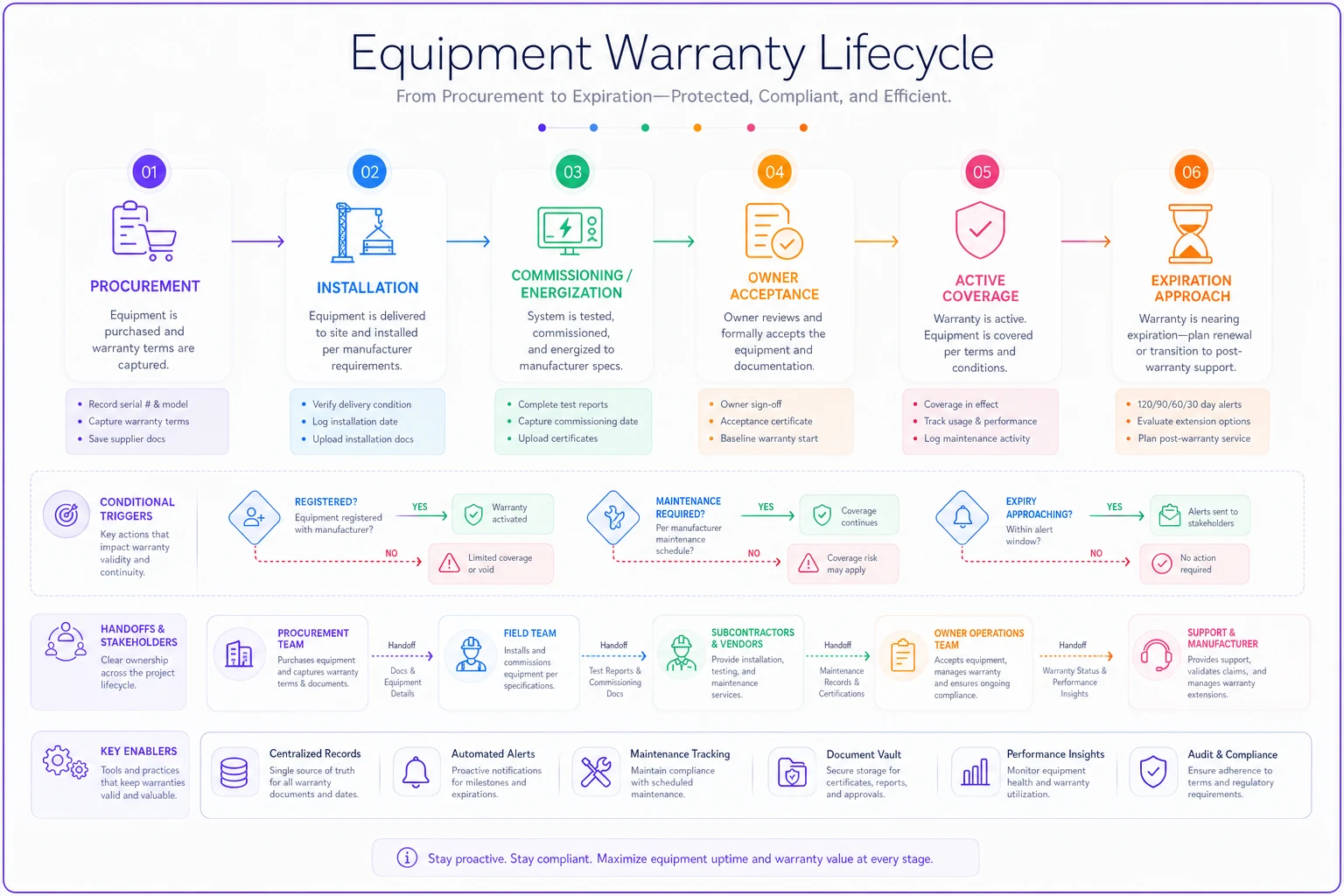
Capture energization dates and registration status in the asset record at commissioning to avoid warranty disputes.
A typical example looks like this: a mid-size commercial fit-out hands over roughly 40 pieces of tracked equipment. Six months later, three units fail. Two claims get honored. The third gets denied because the sub never registered the unit and the maintenance log required by the manufacturer doesn't exist. That's a $12k–$18k repair the owner eats, and guess who they blame.
The minimal owner-ready package (and why "minimal" is the point)
Owners don't fail because they got too little paper. They fail because they got too much of the wrong paper. A 4,000-page O&M binder with no index is worse than useless — it's a way to hide the three documents that actually matter.
The goal is a minimal, operable package: the smallest set of artifacts that lets a facilities manager run, maintain, and claim against every major asset without calling you. This connects directly to the discipline in a pragmatic digital-handover lifecycle built on metadata, asset tags and gated acceptance — because a package is only "operable" if every asset is tagged and every document maps to that tag.
-
Asset identity — tag number, location, make/model/serial, the drawing it lives on.
-
Warranty record — start date, duration, expiration, conditions, and the actual contact who honors it (not a general 1-800 line).
-
Maintenance requirements — intervals and tasks required to keep the warranty valid, not just recommended service.
-
Commissioning evidence — the startup report, test results, and settings, so the operator knows what "normal" looks like.
-
Spare parts and consumables — what's needed, part numbers, lead times.
-
Responsible party — who installed it, who to call for warranty, who to call for out-of-warranty service.
Notice what's not on that list: every submittal, every catalog cut sheet for every screw, every generic manufacturer brochure. Those can live in an archive. The operable package is the working layer on top.
What separates a compliance package from an operable one
| Dimension | Compliance package | Operable package |
|---|---|---|
| Organized by | Spec section / contract | Asset and location |
| Warranty info | Buried in submittals | One record per asset, with dates and conditions |
| Findability | PDF search, if you're lucky | Tag → document, direct |
| Maintenance | "See manufacturer's manual" | Explicit tasks tied to warranty validity |
| Start dates | Assumed, undocumented | Recorded per asset |
| Who owns a defect | Undefined | Categorized and assigned |
| Owner's first bad experience | 3 months in | Rare |
The right column takes more discipline during the project. It also stops the callbacks that quietly eat your next quarter.
Accept/reject SLAs: putting a clock on the boundary
The most underrated part of handover governance is the accept/reject SLA — the rule that says how long the owner has to review a package, what a valid rejection looks like, and what happens when the clock runs out.
Without this, handover becomes an open-ended negotiation. The owner drips objections over months, retention stays frozen, and you can't demobilize your closeout resources. With it, both sides know the rules.
-
Submission → acknowledgment
5 business days.
The owner confirms receipt and that the package is complete enough to review (not a substantive review — just a completeness check). -
Review → accept/reject
15 business days per package.
A rejection must be specific — cite the asset, the missing or deficient artifact, and the standard it fails. -
Vague rejections are invalid. "This isn't good enough" doesn't stop the clock. A rejection has to be actionable or it's treated as acceptance.
-
Re-submission → re-review
7 business days,
and only the previously rejected items are back in scope. You don't reopen accepted items. -
Deemed acceptance. If the owner blows the review window without a valid rejection, the package is accepted and the associated retention releases.
This is the same discipline that makes a fast closeout possible — the same logic behind a project closeout system that speeds final accounts with mandatory packets, commissioning gates and SLA timelines. Handover SLAs and closeout SLAs are really the same nervous system; they just govern different artifacts.
One thing worth flagging: these SLAs only work if they're in the contract and the package is genuinely reviewable. If you hand over a mess and try to enforce a 15-day clock, you'll lose that fight — reasonably. The clock is a privilege you earn by handing over something clean.
Post-handover accountability: defining who owns a problem before there's a problem
The single biggest source of post-handover friction is that nobody defined the categories of "something went wrong." So every issue becomes a fight about classification.
-
Warranty claim — covered defect, manufacturer or installing sub responds, cost is theirs. Needs proof of valid coverage.
-
Latent defect / contractor liability — workmanship or design issue inside the defects liability period. You own it.
-
Owner-caused / operational — misuse, missed maintenance, or a change the operator made. Owner owns it.
-
Out of scope / betterment — the operator wants something the contract never covered. Chargeable.
The accountability artifact that matters most here is a defect log with pre-assigned routing — a live record where every reported issue gets categorized, assigned, timestamped, and tracked to resolution. Without it, you're relitigating the same argument every time a light flickers.
This is where a lot of teams discover their records were never good enough. When the owner claims a rooftop unit is a workmanship defect and the sub claims it's a maintenance failure, the only thing that settles it is documentation: the commissioning report, the warranty conditions, and the maintenance log. If those live in three different inboxes, you lose by default.
Keeping those artifacts in one connected system — where the asset tag, warranty terms, commissioning evidence, and issue history all sit against the same record — is what turns "he said, she said" into a five-minute lookup. This is exactly the kind of coordination problem that AI-assisted operational platforms handle well: flagging warranties approaching expiration, spotting equipment that was energized months before acceptance, and surfacing assets missing required registration before the owner ever notices. The point isn't the technology — it's that the accountability boundary holds because the record holds.
A real scenario
A regional GC doing commercial tenant fit-outs — usually $2M–$5M jobs — kept getting pulled back onto completed projects. Post-handover callbacks were running around 15–20 per project in the first six months, and a chunk of them were warranty disputes that should never have been disputes: units that failed inside coverage but got denied because registration or commissioning documentation was missing.
They weren't disorganized in the field. Their problem was purely governance at the boundary. So they changed three things: every tracked asset got a single warranty record with a documented start date and registration status before energization; the owner-ready package was rebuilt around assets instead of spec sections; and they wrote accept/reject SLAs into their handover process with a defect taxonomy attached.
The next few projects, callbacks dropped to roughly 5–8 in the first six months, and — more importantly — the warranty denials mostly disappeared because the coverage was actually enforceable. Retention started releasing weeks earlier because the owner couldn't stall behind vague objections anymore. The PM's estimate was that the change freed up something like 30–40 hours per project that used to get burned chasing old jobs. Not a revolution. Just a boundary that finally held.
When this level of rigor makes sense — and when it doesn't
Not every project needs a full warranty-lifecycle apparatus. Judgment matters.
This makes sense when:
-
The owner is a long-term operator (institutional, healthcare, education, industrial) who will run the building for decades.
-
There's significant equipment with conditional warranties — MEP-heavy fit-outs, hospitals, data centers.
-
You do repeat work for the same owner and reputation compounds.
-
Retention values are large enough that a stalled acceptance genuinely hurts cashflow.
This is overkill when:
-
It's a small, low-equipment scope where a lean package covers everything.
-
The owner is a developer flipping the asset immediately and doesn't care about long-term operability.
-
You'll never work with this client again and the warranty exposure is minimal.
Who should NOT bolt this on last-minute: any team trying to build the warranty record at handover instead of throughout the project. The start dates, registration deadlines, and commissioning evidence all get created months earlier. If you're assembling them at the end, you've already lost the data — you're reconstructing history, and reconstruction is where the gaps and disputes come from.
The mindset shift
Teams that struggle with handover treat it as the end of the job. Teams that do it well treat it as the beginning of the owner's job — and design the whole thing backward from "can the facilities manager operate and defend this building without calling me?"
That reframe changes what you collect, when you collect it, and how you hand it over. Warranty dates get captured at energization, not reconstructed later. The package is built for the operator, not the spec book. Accept/reject rules put a clock on the boundary so accountability doesn't drift into an endless negotiation. And every post-handover issue has a pre-assigned owner before it ever occurs.
Handover isn't paperwork. It's the last coordination problem of the project — and the first one of the building's life. Govern it like a system, and the callbacks that quietly eat your next job mostly stop showing up.
Ready to build smarter and faster?
Join 2,000+ construction teams using Projbrick to improve project visibility, reduce delays, and increase profitability.