


The handoff from design to construction is where most projects quietly start bleeding. Not through one dramatic event, but through a slow accumulation of small changes that each seem reasonable in isolation. A dimension gets tweaked after IFC. A duct route shifts to solve a clash nobody flagged in coordination. An architect submits a "minor" revision two days before the slab pour. None of these feel like a crisis on their own, and that's exactly the problem. By the time you add them up across a job, you've absorbed weeks of rework that never showed up as a line item anyone could point to.
What separates teams that hold their handoff together from teams that don't isn't discipline in the abstract. It's whether they've built design to construction handoff governance that can actually say no — and, just as important, can say yes fast when yes is the right call. Most governance systems are good at one and terrible at the other. They either freeze everything and become the reason field teams start working off marked-up PDFs, or they wave changes through and wonder why the model no longer matches what's in the ground.
The real failure isn't change — it's change without a lane
Change is normal. On any decent-sized project you're going to get design evolution well past the point where the field expects stable information. The failure mode isn't the existence of changes. It's that most projects have no defined pathway for them, so every change gets handled the same way: informally, urgently, and outside any record that ties it back to cost and schedule.
The pattern shows up again and again. A field engineer spots a conflict, calls the designer directly, gets a verbal "yeah, just move it," and proceeds. Three weeks later the as-built doesn't match the model, the next trade coordinated off the old model, and now two crews are undoing each other's work. Nobody logged the change because it never felt like a change — it felt like solving a problem on site.
When you trace these back, they almost always share the same root: no agreed distinction between what's frozen and what's still open, and no fast, legitimate route to modify frozen information. So people invented their own routes. Governance that exists on paper but has no enforceable teeth just trains everyone to work around it.
What breaks as the project scales
On a small job with one or two active trades, informal handoff works because coordination happens by proximity. Everyone's in the same trailer. The moment you scale — multiple concurrent packages, staggered design releases, subs coordinating off federated models — the informal system collapses in specific, predictable places.
Keep your construction projects on schedule and budget.
Projbrick helps you plan, track, and manage every project phase with precision and ease.
- Real-time project tracking
- Resource & budget management
- Team collaboration tools
No credit card required
-
Version drift. Different trades are building off different snapshots because there's no single freeze reference everyone acknowledges.
-
Silent scope creep. Small changes never get evaluated for downstream impact, so their cost lands somewhere later as "unexplained rework."
-
Evaluation bottlenecks. Once you introduce a change process, it becomes the slowest thing on the job. Requests pile up waiting for a designer, a PM, and a cost check that never happen in the same week.
-
Trust erosion. Field teams stop trusting the model because it's been quietly wrong before, so they revert to their own markups — which guarantees the next round of mismatch.
The insight most teams miss: the bottleneck isn't the freeze, it's the evaluation. Freezing information is easy. Getting a legitimate change evaluated and re-released fast enough that people don't route around the system — that's the hard part, and it's where governance either earns its keep or becomes theater.
The four pieces that make a handoff actually enforceable
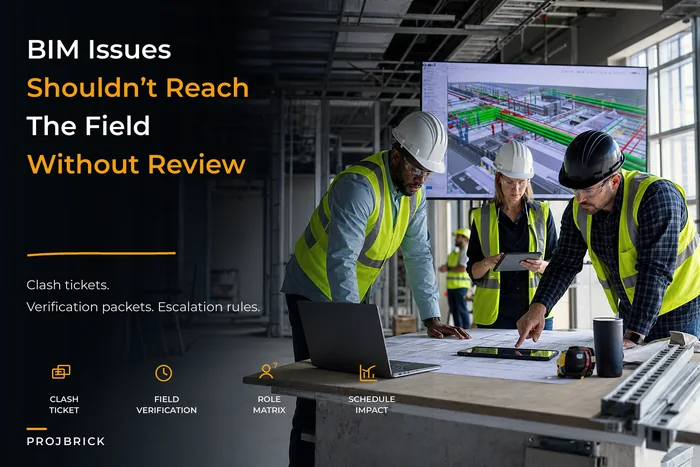
A handoff governance system that holds up under scale has four components that work together. Miss one and the other three degrade. This connects closely to how you manage information at the model level — the BIM-to-field coordination workflow with verification packets and escalation rules handles the technical release mechanics; what we're describing here is the governance wrapper that decides when those releases can and can't happen.
The four pieces below are the practical governance controls that decide what's frozen, how exceptions get evaluated, and who has the authority to make quick calls without turning the process into a bottleneck.
1. A handoff checklist that gates the freeze
The handoff checklist isn't a formality — it's the gate that determines whether design information is even allowed to enter the construction domain. Before anything gets frozen for field use, it should clear a defined set of conditions. Not a 90-item bureaucratic monster, but a tight list that catches the things that actually cause rework.
-
Clash detection run and open clashes either resolved or explicitly flagged with a workaround note
-
Design assumptions (loads, tolerances, sequencing constraints) documented, not implied
-
Interfaces between packages identified and owner assigned for each
-
Long-lead items confirmed against the frozen design so a later change doesn't strand procurement
-
RFIs affecting the package closed or dispositioned — no "we'll sort that during construction"
-
Constructability review sign-off from someone who's actually built this before
-
Version/reference stamp applied so everyone knows exactly what snapshot they're building from
The point of the checklist is that a freeze isn't a date on a calendar — it's a state the information has to reach. Skipping the checklist to hit a freeze date just means you froze the wrong thing, and you'll pay for it in change requests.
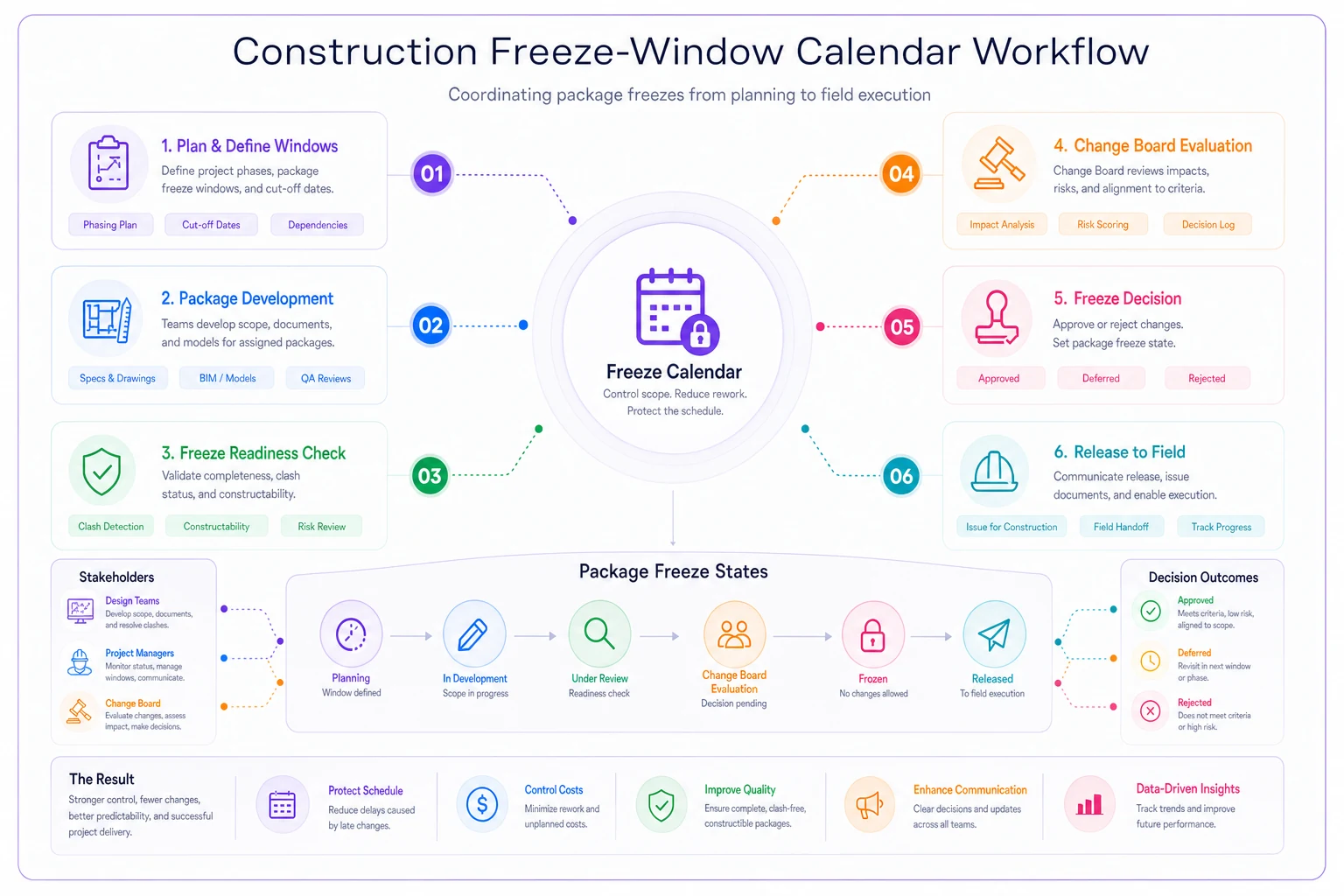
2. A freeze-window calendar everyone can see
A freeze window is a defined period where specified design information cannot change without going through the formal evaluation lane. The mistake most teams make is treating "freeze" as a single global event. It isn't. Different packages freeze at different times based on when the field needs them, and the calendar has to reflect that.
The freeze-window calendar maps each package to its freeze date, its "hard freeze" date (after which even evaluated changes are painful), and its release-to-field date. When it's visible to everyone — designers, PMs, subs — it changes behavior. Designers stop lobbing in late revisions because they can see the wall they'd be hitting. Field teams know exactly which information is stable enough to build off and which is still open.
| Freeze state | What it means | Who can change it | Evaluation required? |
|---|---|---|---|
| Open | Design still evolving | Design team freely | No |
| Soft freeze | Field prepping, not yet building | Design + PM sign-off | Fast-track evaluation |
| Hard freeze | Field building off it | Change board only | Full evaluation + cost/schedule check |
| Locked | Constructed / poured | Formal change order only | Full impact analysis |
The value here isn't the table itself — it's that everyone shares one definition of "how frozen is this?" Most disputes at handoff come from two people using the word "frozen" to mean completely different things.
A visual workflow helps make the freeze stages and decision lanes clear.
When it's visible to everyone — designers, PMs, subs — it changes behavior. Designers stop lobbing in late revisions because they can see the wall they'd be hitting. Field teams know exactly which information is stable enough to build off and which is still open.
3. Change-evaluation SLAs so the freeze doesn't strangle the job
This is the piece that keeps the whole system from becoming a bottleneck. If a legitimate change to frozen information takes two weeks to evaluate, people will route around it every single time. The freeze only holds if the exception pathway is fast enough to use honestly.
That means committing to evaluation SLAs by change severity. A minor change that doesn't touch cost or schedule shouldn't wait in the same queue as a change that moves the critical path. A rough tiering that works in practice:
-
Class A (field-blocking) Crew is stopped or about to be. Evaluation and disposition within 8–24 hours. Small standing review authority that can act without a full board meeting.
-
Class B (near-term, non-blocking) Affects work in the next one to two weeks. Evaluated within 2–3 working days including a quick cost/schedule check.
-
Class C (design refinement) No field impact yet. Batched into the regular governance cycle, evaluated within the week.
The tiering matters because the most common governance failure is treating all changes as equally urgent, which means the genuinely urgent ones wait behind the trivial ones. When a field-blocking clash sits in the same queue as a finish-schedule tweak, the site team stops using the queue entirely.
Prioritize Class A decisions with a standing approver to reliably hit the 8–24 hour SLA.
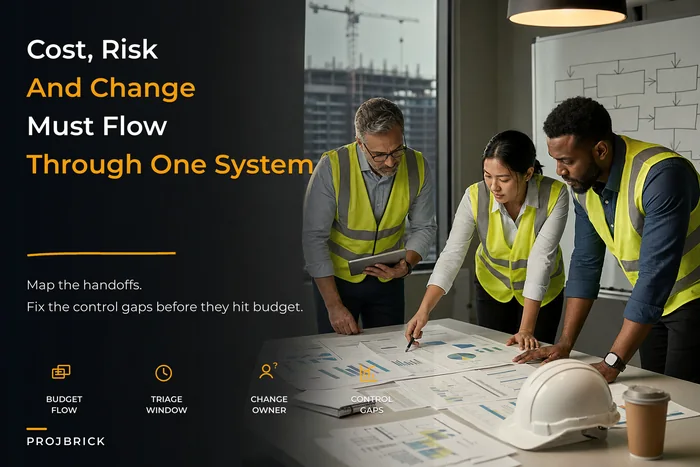
The cost side of every evaluation needs to connect to your broader controls, not sit in a separate spreadsheet. The way change requests tie into cost and risk workflows is the difference between catching budget impact early and discovering it at final accounts — the mechanics of that linkage are covered in mapping cost, risk and change workflows to stop budget surprises.
4. A governance meeting with an agenda that drives decisions
The weekly (or twice-weekly) governance meeting is where the frozen-vs-open boundary gets actively managed. The failure mode is a meeting that turns into a status readout — everyone reports, nobody decides. A governance meeting that works runs on a decision-forcing agenda:
-
Open change queue by class — every Class A and B item gets a disposition in the meeting, not "we'll circle back"
-
Upcoming freezes in the next 2–3 weeks — anything not on track to clear the handoff checklist gets flagged now
-
Freeze-window conflicts — packages whose freeze dates are colliding with unresolved dependencies
-
SLA breaches — any evaluation that missed its window, and why (this is your early warning that the system is clogging)
-
Emergency releases since last meeting — reviewed after the fact so hotfixes don't quietly become the norm
The agenda's real job is to make decisions unavoidable. If an item can't be decided, the meeting names the specific person and the specific date by which it will be. Ambiguity is what kills handoff governance, and a well-run agenda is mostly a machine for eliminating it.
A real scenario: mid-rise mixed-use, roughly $40M
A regional contractor running a mid-rise mixed-use build — around $40M, structure plus fit-out — was getting hammered by change churn at the MEP handoff. Design releases were happening on a rolling basis, but there was no shared understanding of what was actually frozen. Subs were coordinating off whatever model version they'd last downloaded.
The concrete symptom: they logged something like 60–70 informal changes over a two-month stretch that never went through any evaluation. When they finally traced the rework cost, it came to roughly $180k–$220k — mostly duct and pipe rerouting where trades had built off mismatched information, plus a couple of partial demo-and-redo events on hangers.
What they changed wasn't dramatic. They put up a freeze-window calendar tied to package release dates, introduced a three-class change SLA, and ran a 45-minute governance meeting twice a week with a strict decision agenda. The first month was rough — the queue exposed how many undocumented changes had been flowing through. By the second month, field-blocking changes were getting evaluated inside a day, and the informal side-channel changes dropped off sharply because the legitimate route was finally faster than the workaround.
Over the following quarter, documented rework attributable to handoff mismatch fell by more than half. Not zero — you never get to zero — but the changes that did happen were evaluated, priced, and reflected in the model before the next trade built off it. The less visible win was that the field started trusting the model again, which meant they stopped keeping shadow markups.
When enforceable freeze governance makes sense — and when it doesn't
This level of structure isn't free. It costs meeting time, evaluation capacity, and the discipline to actually hold the line. So it's worth being honest about where it pays off.
It makes sense when:
-
You have multiple concurrent packages or trades coordinating off shared models
-
Design is releasing on a rolling schedule rather than one clean IFC event
-
You've been surprised by rework cost at final accounts before
-
Long-lead procurement is committed against design that's still moving
It's overkill when:
-
You're running a small, single-trade job where coordination happens by proximity
-
Design is genuinely complete and stable before construction starts (rare, but it happens)
-
The team is small enough that a freeze conversation is a two-minute hallway chat
One group that should be careful: teams that adopt the freeze windows but skip the evaluation SLAs. That's the worst of both worlds — you've built a wall with no gate, so everyone climbs over it. If you can't commit to fast evaluation, don't lock down the freeze, because you'll just push all the change activity into the untracked shadow process you were trying to eliminate.
The system view: freeze and speed are the same problem
The instinct is to treat freezing and change speed as opposing forces — the more you freeze, the slower you get. In a well-designed handoff governance system, they're actually the same lever. A credible freeze is only credible because there's a fast, legitimate way to unfreeze when it's genuinely needed. Remove the speed and the freeze loses authority. Remove the freeze and there's nothing for the speed to protect.
Where this gets easier in practice is when the freeze state, the change queue, and the cost/schedule impact all live in one connected system rather than scattered across email threads, a version-control tool, and someone's spreadsheet. When a change request automatically carries its severity class, its SLA clock, and its link to the affected package and budget line, the governance meeting stops being an archaeology session and starts being an actual decision meeting. That's less about any specific tool and more about a basic principle: the information the governance meeting needs to make a call should already be assembled before anyone walks in the room.
Change churn at the design-to-construction boundary isn't caused by too many changes. It's caused by changes moving faster than the system that's supposed to evaluate them. Build a handoff governance system where the freeze is enforceable and the evaluation is fast, and the churn drops on its own — not because you stopped changes, but because you finally gave them a lane.
Change churn at the design-to-construction boundary isn't caused by too many changes. It's caused by changes moving faster than the system that's supposed to evaluate them. Build a handoff governance system where the freeze is enforceable and the evaluation is fast, and the churn drops on its own — not because you stopped changes, but because you finally gave them a lane.
Ready to build smarter and faster?
Join 2,000+ construction teams using Projbrick to improve project visibility, reduce delays, and increase profitability.