

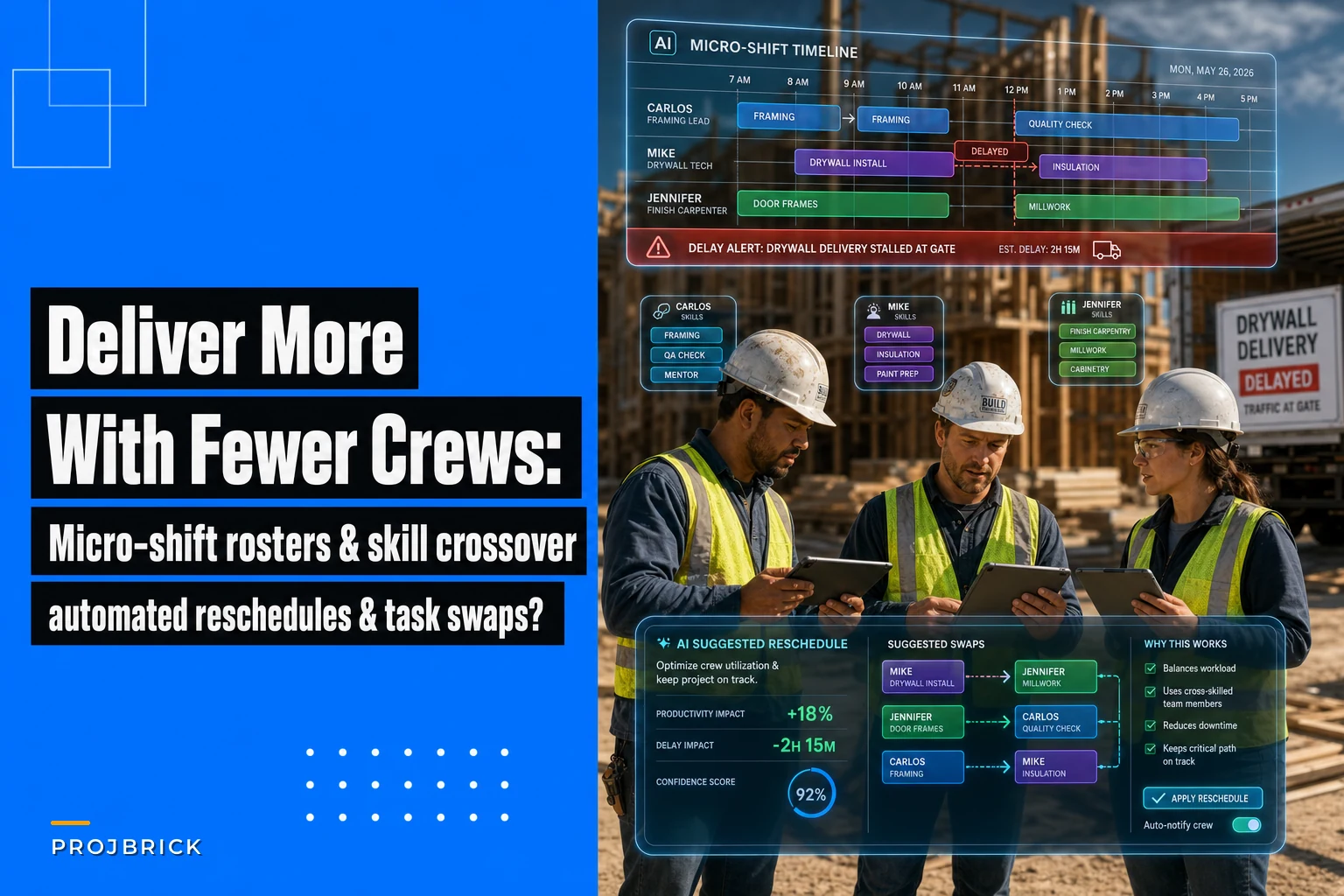

Your framing contractor just called out sick. The electrician who can also pull wire and set boxes is already booked on another site. Meanwhile, you've got a drywall guy sitting idle because his usual task isn't ready yet—but he could be helping with basic trim work if anyone had planned for it.
This is construction scheduling right now. Finding skilled trades is harder than it's been in a long time, and keeping specialized crews busy usually means accepting lower margins or constant schedule conflicts. But there's another way to approach this that most PMs don't think about: building small, cross-trained teams that can handle multiple trades in sequence.
The traditional crew model breaks when headcount drops
Standard construction scheduling assumes dedicated crews for each trade. Framers frame. Electricians wire. Plumbers plumb. Each crew shows up, does their thing, then clears out while the next trade takes over.
That worked when labor was plentiful. You could have five framers who only framed, three electricians who only did electrical, and so on. But when you're down to skeleton crews—maybe two framers total, one electrician splitting time across three projects—this model creates massive inefficiencies.
What actually happens: your two-person framing crew finishes a section Tuesday afternoon. Electrical rough-in can't start until Thursday because your electrician is tied up elsewhere. Dead time on site. Your framers are either sitting around or you're sending them home early.
The math gets worse when you factor in mobilization costs. Bringing a specialized crew to site for half a day costs nearly as much as a full day once you count travel, setup, and coordination overhead. Small tasks that used to get bundled into larger crew days become expensive standalone mobilizations.
Skill matrices reveal hidden capacity
Most PMs miss this: a lot of your trades already have overlapping skills, they just don't advertise them. Your experienced framer probably knows basic electrical rough-in from years of working alongside electricians. Your finish carpenter can handle simple drywall patches. Your plumber's apprentice spent two years doing residential HVAC.
Keep your construction projects on schedule and budget.
Projbrick helps you plan, track, and manage every project phase with precision and ease.
- Real-time project tracking
- Resource & budget management
- Team collaboration tools
No credit card required
Creating a skill-crossover matrix changes how you schedule. Instead of thinking "I need an electrician Wednesday," you start thinking "I need someone who can pull wire and set boxes Wednesday—who's qualified?"
Start by mapping what each crew member can actually do, not just their primary trade. Rate skills on three levels:
Primary (P): Can work independently, troubleshoot problems, train others Secondary (S): Can handle routine tasks with minimal supervision Basic (B): Can assist or handle simple repetitive tasks
A real skill matrix from a 12-person operation might look like:
| Worker | Primary Trade | Framing | Electrical | Plumbing | Drywall | Finish | HVAC |
|---|---|---|---|---|---|---|---|
| Carlos | Framing | P | B | - | S | B | - |
| Mike | Electrical | B | P | B | - | - | S |
| Jennifer | Plumbing | - | B | P | - | - | B |
| David | Drywall | S | - | - | P | S | - |
| Ana | Finish | S | - | - | B | P | - |
| Robert | Framing | P | S | - | B | B | - |
Suddenly Carlos isn't just a framer—he's someone who can cover drywall when framing is slow. Mike can rough in basic HVAC ductwork between electrical tasks. That flexibility completely changes your scheduling options.
Micro-shifts maximize cross-trained crews
Traditional scheduling blocks out full days or half-days per trade. With small cross-trained crews, you shift to micro-scheduling: 2-3 hour task blocks that match actual work requirements.
Instead of scheduling "Electrical - Thursday," you break it down:
-
Pull wire to kitchen/dining (3 hours, needs Electrical-P or S)
-
Set outlet boxes in bedrooms (2 hours, needs Electrical-S or B)
-
Install bathroom vent fans (1.5 hours, needs Electrical-S plus HVAC-B)
Now you can slot Mike for the complex kitchen wiring in the morning, then move Carlos (Framing-P, Electrical-B) to bedroom outlets after lunch. Mike shifts to bathroom vents with Jennifer assisting on the HVAC side. What would normally stretch across 1.5 days gets compressed into one day.
Pack tasks that use the same toolset consecutively to minimize tool switches during micro-shifts.
The key is matching task complexity to skill level. You don't need a master electrician pulling Romex through studs—someone with basic electrical skills can handle that while your licensed electrician focuses on panel work or complex runs.
Task bundling rules prevent quality problems
Cross-training only works if you set clear bundling rules. Not every task combination makes sense, and some create more headaches than they solve.
Effective bundling follows three rules:
-
Sequential logic Tasks should naturally follow each other. Framing into drywall makes sense. Electrical into painting doesn't.
-
Skill overlap The person doing both tasks needs to be competent in both, not stretching into unfamiliar territory.
-
Inspection alignment Don't bundle tasks that fall under different inspection stages. Rough electrical and insulation might seem logical, but if electrical needs inspection first, bundling them creates delays.
Good bundles that actually work:
-
Framing + blocking for fixtures
-
Electrical rough + low-voltage wiring
-
Plumbing rough + HVAC drain lines
-
Drywall hanging + basic taping
-
Trim carpentry + cabinet adjustment
Bad bundles that create problems:
-
Rough plumbing + finish plumbing (different inspection stages)
-
Electrical rough + drywall (can't inspect covered wires)
-
Framing + roofing (completely different skill sets)
-
Tile work + grouting (needs cure time between)
Cross-training only works if you set clear bundling rules. Not every task combination makes sense, and some create more headaches than they solve.
Two-week scheduling example: 3-bedroom renovation
Here's how this works on a real project—a 3-bedroom house renovation with limited crew availability. Traditional approach would call for 6-8 different crews. We'll do it with 4 people.
Available crew:
-
Carlos
Framing-P, Drywall-S, Finish-B
-
Mike
Electrical-P, HVAC-S, Plumbing-B
-
Jennifer
Plumbing-P, HVAC-B
-
Ana
Finish-P, Drywall-S, Framing-B
Week 1 Schedule:
Monday:
-
Morning
Carlos + Ana do framing repairs (Carlos leads, Ana assists)
-
Afternoon
Carlos continues framing, Ana starts drywall prep
Tuesday:
-
Morning
Mike runs main electrical lines (solo)
-
Afternoon
Mike + Jennifer do plumbing rough-in (Jennifer leads, Mike assists)
Wednesday:
-
Morning
Carlos frames bathroom walls while Mike sets electrical boxes
-
Afternoon
Jennifer runs water lines, Ana helps Carlos with blocking
Thursday:
-
Morning
Mike completes electrical rough, Jennifer finishes plumbing
-
Afternoon
Carlos + Ana start drywall hanging (both S-level)
Friday:
-
Morning
Inspection prep—Mike checks electrical, Jennifer checks plumbing
-
Afternoon
Carlos + Ana continue drywall, Mike starts HVAC rough
Week 2 Schedule:
Monday:
-
Morning
Carlos finishes drywall hanging, Ana begins taping
-
Afternoon
Mike completes HVAC, Jennifer assists with drain lines
Tuesday:
-
Morning
Ana leads finish carpentry, Carlos assists
-
Afternoon
Mike pulls final electrical, Jennifer tests plumbing
Wednesday:
-
Morning
Carlos + Ana handle trim work
-
Afternoon
Mike installs outlets/switches, Jennifer sets fixtures
Thursday:
-
Morning
Ana continues trim, Carlos patches drywall issues
-
Afternoon
Final mechanical installations (Mike + Jennifer)
Friday:
-
Morning
Punch list items (all hands)
-
Afternoon
Final inspection prep
Traditionally, this would need at least 6 separate crews making multiple trips. Instead, 4 cross-trained people handled everything with almost no dead time between trades.
Common bottlenecks in multi-trade scheduling
Even with a solid skill matrix, certain things will still mess up your flow:
Tool conflicts: When Carlos switches from framing to drywall, he needs different tools. If those tools are locked in someone's truck or stored off-site, you lose 30-45 minutes to tool switches. Staged tool zones for each trade area solve this.
Material timing: Cross-trained crews can pivot quickly, but materials can't. If drywall shows up late, Carlos can't switch over as planned. Build 24-hour material buffers for each trade transition.
Code knowledge gaps: Someone might have the physical skills for basic electrical work but not know local code requirements. This creates inspection failures. Document what a Secondary-skill person can legally do without creating problems.
Quality standards: A framer doing drywall might meet functional requirements but not aesthetic ones. Define minimum acceptable quality per skill level—Basic might be fine for garage drywall but not a living room.
Tracking productivity across mixed crews
Multi-trade scheduling makes productivity tracking more complex. When Carlos spends the morning on framing and the afternoon on drywall, how do you measure his output?
Traditional metrics assume single-trade focus. "Framer produces 200 square feet per day" doesn't hold when that framer only frames for 3 hours. You need task-based productivity metrics:
-
Framing
35 sq ft per hour
-
Electrical rough
8 outlets per hour
-
Drywall hanging
3 sheets per hour
-
Basic trim
20 linear feet per hour
Track actual time per task, not daily averages. Carlos might hit 40 sq ft/hour on framing because he's fresh in the morning, but only 2.5 sheets/hour on drywall after lunch. That granular data helps you optimize future schedules.
It also tells you which cross-training combinations actually hold up. Maybe Mike's HVAC work is solid when he has full days on it, but his output tanks when he's bouncing between electrical and HVAC multiple times in one day. Or Jennifer's plumbing speed drops when she's also managing helpers from other trades.
Building versus buying cross-trained teams
Two paths here: develop existing people or hire for multiple skills.
Developing existing crews usually works better. Your framers already understand construction sequencing. Teaching them basic drywall or simple electrical rough-in takes weeks, not months. And they're already wired into your team's communication patterns.
Start with adjacent skills. Framers learn drywall faster than plumbing. Electricians pick up low-voltage and HVAC electrical quickly. Plumbers understand HVAC piping and drain systems. Don't try to teach a carpenter complex electrical—focus on logical skill extensions.
Incentives matter. If Carlos gets paid the same whether he frames all day or helps with drywall, he has no reason to learn new skills. Consider skill-based pay bumps: $2/hour extra for each Secondary skill, $4/hour for additional Primary skills. That might add roughly $3,000-3,500 per person annually, but you save significantly more in reduced mobilizations and schedule compression.
When hiring, look past the primary trade. An electrician who mentions doing residential plumbing for two years is extremely useful. The framer who helped run his uncle's drywall business? Perfect. These people might cost slightly more upfront but can eliminate entire crew mobilizations.
Resistance points and solutions
Trades push back on cross-training for pretty predictable reasons:
"That's not my job" — Trade boundaries run deep. Frame it as skill expansion, not job mixing. They're becoming more valuable, not doing someone else's work.
"I don't get paid for that" — Fair point. Skill-based pay increases address this directly.
"What about liability?" — Workers worry about mistakes outside their expertise. Clear task boundaries by skill level help here. Basic-level work shouldn't include anything requiring licenses or creating liability.
"The union won't allow it" — Sometimes true, but often overstated. Many unions allow members to work outside their trade for the same employer. Check the actual rules, not assumptions.
Getting buy-in means showing crews what's in it for them—steady work when their primary trade is slow, skill development that makes them more marketable, and less repetitive strain from doing the same physical motion every day.
Software coordination for complex sequencing
Paper schedules can't handle the complexity of multi-trade micro-shifts. When Carlos moves from framing to drywall at 1 PM, Mike switches from electrical to HVAC at 2:30 PM, and Jennifer needs to coordinate both for a plumbing task at 3 PM—you need something more dynamic.
AI-powered scheduling platforms can optimize these patterns automatically. The system tracks each person's skills, current task progress, and upcoming requirements, then suggests optimal task sequences. When the drywall delivery pushes to 2 PM, the system reshuffles—maybe Carlos extends framing, or pivots to help Mike with electrical rough-in.
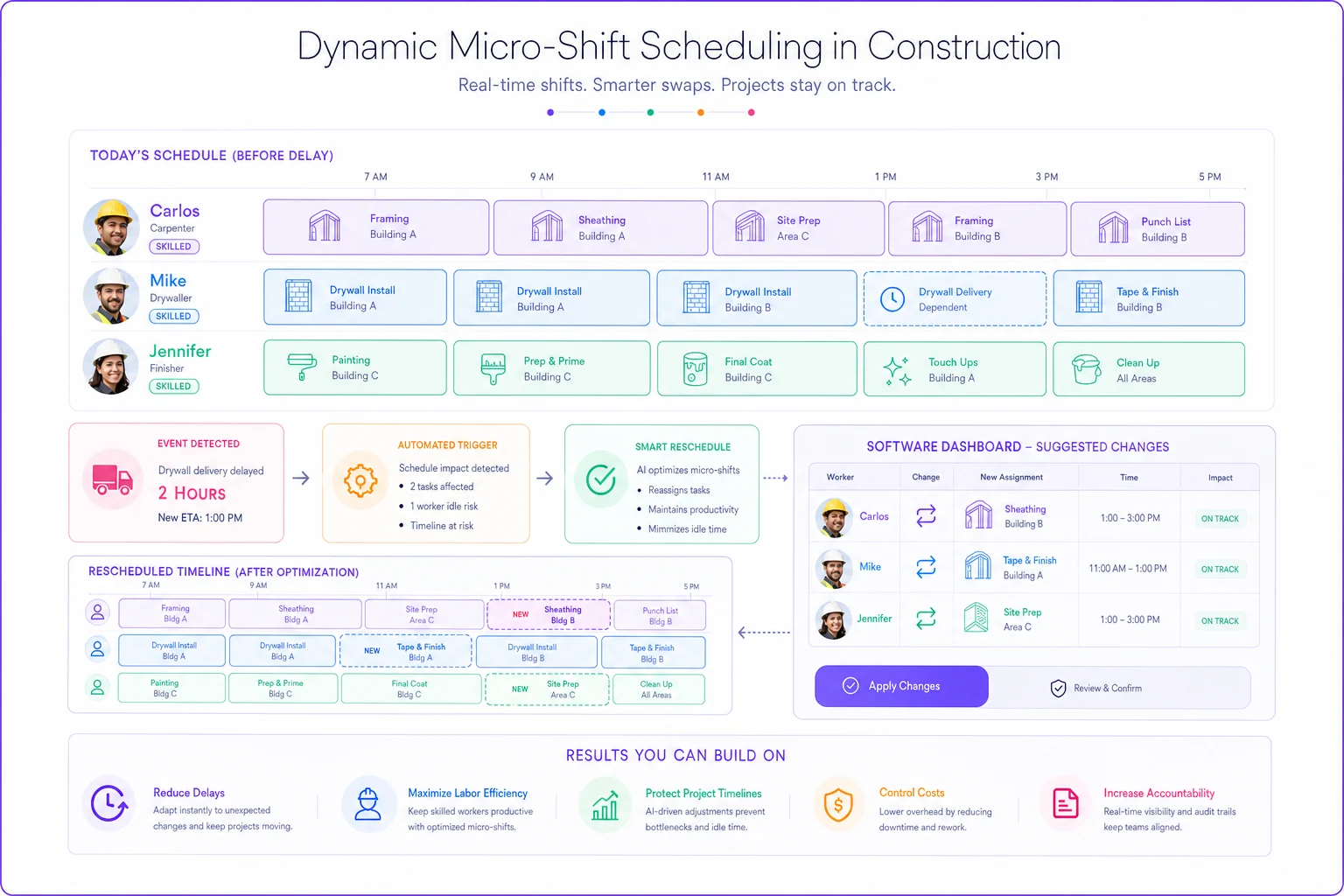
The real value over time is pattern recognition. After a few weeks, the system picks up that Carlos works faster on framing before lunch, Mike's output slows after back-to-back HVAC and electrical days, and Jennifer's productivity improves when she's leading rather than assisting. That kind of data makes future scheduling smarter without you having to track it manually.
Communication becomes critical when people are switching tasks throughout the day. Your crew needs to know not just what they're doing now, but what's coming this afternoon and tomorrow morning. Modern operational platforms push schedule updates to phones, track task completion in real time, and flag when sequences change—so nobody shows up to a task that isn't ready for them.
When small-crew multi-trade doesn't work
This approach has real limits. Some situations still need traditional specialized crews:
High-specification work: Custom millwork, structural steel, complex mechanical systems—these need specialists, not generalists with secondary skills.
Large-scale projects: When you're framing 10,000+ square feet, you need dedicated framing crews for speed. Multi-trade scheduling fits better on projects under roughly 5,000 square feet.
Time-critical paths: Racing weather or a hard deadline? Specialized crews move faster than cross-trained teams task-switching throughout the day.
Licensed work: Many tasks legally require licensed tradespeople. A cross-trained framer can't make final electrical connections regardless of skill level.
Union projects: Strong union rules may prohibit cross-trade work. Know your constraints before planning around multi-trade scheduling.
The sweet spot: renovation projects, small commercial buildouts, residential remodels, and maintenance work where schedule flexibility matters more than raw speed.
Phase-based implementation
Don't try to convert your whole operation overnight. Start with one project or one crew and expand from there.
Phase 1: Skills assessment (Week 1-2)
-
Map current crew skills beyond primary trades
-
Identify natural cross-training opportunities
-
Find willing early adopters
Phase 2: Pilot project (Week 3-6)
-
Choose a small, low-risk project
-
Schedule 2-3 people with overlapping skills
-
Track productivity carefully
-
Document what works and what doesn't
Phase 3: Training expansion (Week 7-10)
-
Based on pilot results, identify high-value skill combinations
-
Start formal cross-training for willing workers
-
Implement skill-based pay adjustments
Phase 4: Full implementation (Week 11+)
-
Roll out to larger projects
-
Build scheduling templates for common project types
-
Develop material and tool staging systems
-
Integrate software for complex coordination
For multi-phase projects, introduce multi-trade scheduling in later phases first. Early phases often need specialized speed, while later phases benefit more from flexibility.
ROI calculation for managers
Traditional approach for a 3-bedroom renovation:
-
6 specialized crews × 4 mobilizations each = 24 mobilizations
-
Average mobilization cost
~$200 (travel, setup, coordination)
-
Total mobilization
$4,800
-
Dead time between trades
~8 days × $500 lost productivity = $4,000
-
Schedule duration
4 weeks
Multi-trade approach:
-
4 cross-trained people, continuous presence = 4 mobilizations
-
Mobilization cost
$800
-
Dead time
near zero
-
Skill premiums
4 people × $3/hour × 2 weeks = ~$960
-
Schedule duration
2 weeks
Net savings: roughly $7,000 per project, plus you finish two weeks earlier—which means more projects in the calendar year.
The bigger win is reliability. When your electrical sub no-shows, traditional scheduling stops cold. With cross-trained crews, Mike covers critical electrical while Carlos handles the HVAC work Mike had planned. You keep moving even when people call out.
Small-crew multi-trade scheduling isn't about making everyone a generalist. It's about recognizing the skills your people already have and building around them intelligently.
The construction labor shortage isn't going anywhere. Projects aren't getting simpler. Client timelines aren't getting longer. Traditional crew scheduling assumes resources that most operations just don't have anymore. But with solid skill mapping, micro-shift scheduling, and clear task bundling rules, you can deliver complex projects with a fraction of the headcount.
Start small—map one crew's secondary skills, run one pilot project, track what happens. Once you see a 3-person cross-trained team outperform a traditional 6-person rotation, the old model stops making sense.
The trades that adapt will keep busy. The ones that don't will keep scrambling for bodies and wondering why margins keep shrinking.
Ready to build smarter and faster?
Join 2,000+ construction teams using Projbrick to improve project visibility, reduce delays, and increase profitability.