


The call comes in at 6:40 AM. Your pour got moved up, a sister project just freed up eight guys, and now you've got a truck of pooled labour showing up at the gate who've never set foot on your site. By 7:15 they're standing around your foreman looking for direction, and by 8:00 half of them are doing the wrong task or waiting to be told what the wrong task even is.
That gap — between bodies arriving and bodies producing — is where a day-of surge quietly eats your budget. Most PMs treat surge labour like it's just regular crew, but more of it. It isn't. A day-of labor surge roster in construction is its own workflow with its own failure modes, and if you don't have a repeatable playbook for it, you're paying full rate for people who spend their first three hours being useless through no fault of their own.
This post is about closing that gap. Not general staffing strategy — specifically the mechanics of getting pooled workers you've never met safe, oriented, task-assigned, and monitored on the same day they show up.
Why same-day pooled labour underperforms (and it's rarely the workers)
The instinct is to blame the pooled guys. "They don't care, they're not ours, they're just here for the day." Sometimes that's true. But when you actually watch a surge morning fall apart, the failures are almost always upstream of the worker.
-
Nobody decided before they arrived who does what, so assignment happens live at the gate — the slowest, most chaotic possible moment.
-
Safety orientation gets compressed into a rushed 4-minute walk-and-talk because the pour's already behind, meaning half the crew doesn't actually know where the exclusion zones are.
-
The foreman becomes the single bottleneck. Every question, every task handoff, every "where do I put this" routes through one guy who's also trying to run the actual work.
-
Nobody verifies competency before handing over a task. You assume the pooled finisher can finish, and you find out he can't when the slab's already floated wrong.
The productivity loss isn't spread evenly across the day — it's front-loaded. The first two to three hours of a surge day are where most of the waste happens. Get those hours right and the rest of the day mostly runs itself.
The core idea: pre-stage everything you can before they arrive
Most of a surge workflow can be prepared before the workers exist on your site. You know a surge is coming — usually at least the night before or a few hours out. That window is when the roster gets built, the packets get printed, and the assignments get locked. Not at 7 AM with twelve people watching your foreman scroll his phone.
Keep your construction projects on schedule and budget.
Projbrick helps you plan, track, and manage every project phase with precision and ease.
- Real-time project tracking
- Resource & budget management
- Team collaboration tools
No credit card required
Think of it in three tracks running in parallel:
-
Roster prioritization — deciding who does what before you see faces.
-
Expedited safety and onboarding — the minimum viable packet that's actually legally sufficient and actually understood.
-
Micro-training quick-checks and QA monitoring — verifying competency fast and catching drift early.
Think of it in three tracks running in parallel:
Track 1: Surge roster prioritization
The mistake most crews make is treating a surge roster as a headcount problem ("we need 8 more") rather than a task-slot map. Headcount tells you nothing about whether the work actually gets done.
Build the roster as a list of slots, ranked by risk and skill dependency, then fill slots to skill. When the labour pool gives you names, you match names to slots based on whatever verified skill data you have — certs, prior site history, self-reported trade with a quick-check attached.
| Slot priority | Task type | Who fills it | Risk if mismatched |
|---|---|---|---|
| P1 – Critical | Skilled trade on critical path (finishing, rebar tying, welding) | Only verified/experienced pooled workers | Rework, structural QA failure |
| P2 – Supervised skilled | Skilled task under direct foreman line-of-sight | Mid-skill, needs a quick-check | Slowdown, moderate rework |
| P3 – General support | Material moving, cleanup, staging, spotting | Anyone cleared on safety | Low — mostly just coordination |
| P4 – Buffer/flex | Unassigned, held for reassignment | Whoever's left | None if managed |
The logic is defensive: protect your critical-path slots by only filling them with verified people, and absorb uncertainty into the low-risk slots where a mismatch costs you almost nothing. A pooled worker who overstated his finishing experience does far less damage stacking rebar than floating your P1 slab.
Surge rostering shares a lot of DNA with running lean crews generally. If you're regularly building rosters around skill flexibility, the small-crew multi-trade scheduling approach with skill-crossover rosters covers the day-to-day version of this. The surge playbook is basically its emergency cousin.
Keep a "known pool" list. Track which pooled workers actually performed after each surge. Tag names: solid, avoid, verify-again. Six months of this and your P1 slots fill themselves because you know exactly who to request from the agency.
Track 2: The expedited safety and onboarding packet
Here's the tension: safety orientation cannot be skipped, but a full standard induction can eat 45–90 minutes per person and you don't have that time. The answer isn't to cut safety — it's to pre-build a packet that delivers the legally required and operationally critical pieces fast, without the filler that belongs in a full onboarding.
The expedited packet has two parts: what they must know before touching anything and what they sign to confirm they know it.
-
Site-specific hazard map — one page, marked exclusion zones, crane swing radius, live edges, today's specific hot spots (the pour zone, the open shaft).
-
Emergency layout — muster point, nearest exit, first-aid location, who the safety lead is by name and hi-vis color.
-
Today's specific risks — not generic PPE reminders, but "we are pouring on level 3, the pump line runs here, do not cross this tape."
-
PPE confirmation — verified visually at the gate, not assumed.
-
Signed acknowledgment — short, specific, defensible.
The packet should be 80% pre-built and 20% customized each morning. The site map, emergency layout, and standard rules never change. Only "today's specific risks" gets swapped. That means your morning prep is filling in one section, not building a document from scratch.
The onboarding half — the non-safety orientation — should be brutally minimal for day-of workers. They don't need the company history or a full org chart. They need: who's your point person, where's the toilet and water, where do you take breaks, how do you report a problem, and where's your assigned zone. Five things. Print it on the back of the safety packet.
Sites that build the packet around the pour or task rather than around the company get people productive faster, because everything the worker reads is immediately relevant to what they'll do in twenty minutes. Generic inductions get skimmed. Task-specific ones actually get read.
Track 3: Micro-training quick-checks and QA monitoring
This is the part almost everyone skips, and it's the difference between a surge day that works and one that generates a punch list.
-
Assign to a slot based on stated skill.
-
Before real work starts, foreman or lead runs the 60-second demonstration relevant to that slot.
-
Pass → they proceed on the P1/P2 task.
-
Struggle → immediately reassign down to P3 support, no drama, no lost time arguing.
-
Log the result against their name for your known-pool list.
The reassignment step matters most. The whole point of the P-slot structure is that a failed quick-check has a landing spot. You're never stuck choosing between "let this guy do it anyway" and "send him home." You slide him to support and pull your buffer person up.
QA monitoring during the day should be lightweight and frequent, not heavy and end-of-day. For surge crews specifically, run short check-ins — a look at each P1/P2 workface roughly every 90 minutes to two hours. You're catching drift while it's one bad connection instead of forty. This ties directly into how you're measuring output day to day; if you've built any kind of daily crew productivity tracking that turns field reports into forecasts, surge workers should get flagged separately in that data so you can actually see whether pooled labour is pulling its weight or quietly dragging.
A real scenario: the moved-up deck pour
A mid-size GC running a five-story residential job had a level-3 deck pour bumped forward two days when the ready-mix schedule opened up. They got 9 pooled workers from an agency with about 4 hours' notice — no history with any of them.
First instinct was the usual: gate them, walk them, throw them at the pour. Instead the super pre-built the roster the night before as slots, not headcount. Three P1 finishing slots, two P2 supervised, four general support. The safety packet was already 90% done — he filled in the pour-zone hazard section that morning and ran everyone through it in about 12 minutes as a group at the gate.
Quick-checks caught two of the "experienced finishers" who clearly weren't. Both got moved to support before the concrete showed up. The two remaining verified finishers plus the crew's own guys handled the float.
The pour ran on the moved-up schedule with no rework flagged on the finish. Their previous surge — where a mis-assigned finisher caused a section that had to be ground and patched — cost roughly a day and somewhere in the low thousands. The difference this time was basically the quick-check step and the pre-built roster. Nothing exotic. Just decisions made before the workers arrived instead of after.
When this playbook makes sense — and when it doesn't
Use the full playbook when:
-
You're bringing in 5+ pooled workers you don't know.
-
The surge lands on a critical-path task (pours, closures, inspections).
-
The risk of a competency mismatch is high (structural, safety-critical trades).
Scale it down when:
-
You're adding 1–2 people to an existing crew — the crew absorbs them naturally, you don't need slot-mapping.
-
The work is entirely low-risk general labour — cleanup, material moves. Safety packet still mandatory, but skip the elaborate roster.
Who should not lean on this at all: if you're pulling day-of surges frequently to cover the same recurring gap, this playbook is a bandage on a forecasting problem. Chronic same-day scrambling usually means the resource plan is wrong upstream. Fix the plan; don't get good at emergencies you shouldn't be having.
Making the prep repeatable
The reason most crews never run a clean surge is that the prep lives in one person's head. The super knows what to do — but he's doing it from memory at 6 AM under pressure, so half the steps get dropped.
The fix is simple: templatize it. The slot-based roster, the 90%-built safety packet, the quick-check scripts per trade, the known-pool list — these should be standing documents, not fresh work each time. Whether that lives in a shared folder, your project management platform, or a lightweight workflow tool matters less than the fact that it exists outside someone's head and gets pulled up automatically when a surge triggers. Teams that keep this stuff in a central system — where the roster, packets, and worker history are all linked — stop reinventing the process every scramble. The morning becomes "open the template, fill the one changing section, go" instead of "rebuild everything under pressure."
Templatize the quick-check script for each trade so leads can run them from memory in under a minute.
Open the template, fill the one changing section, go.
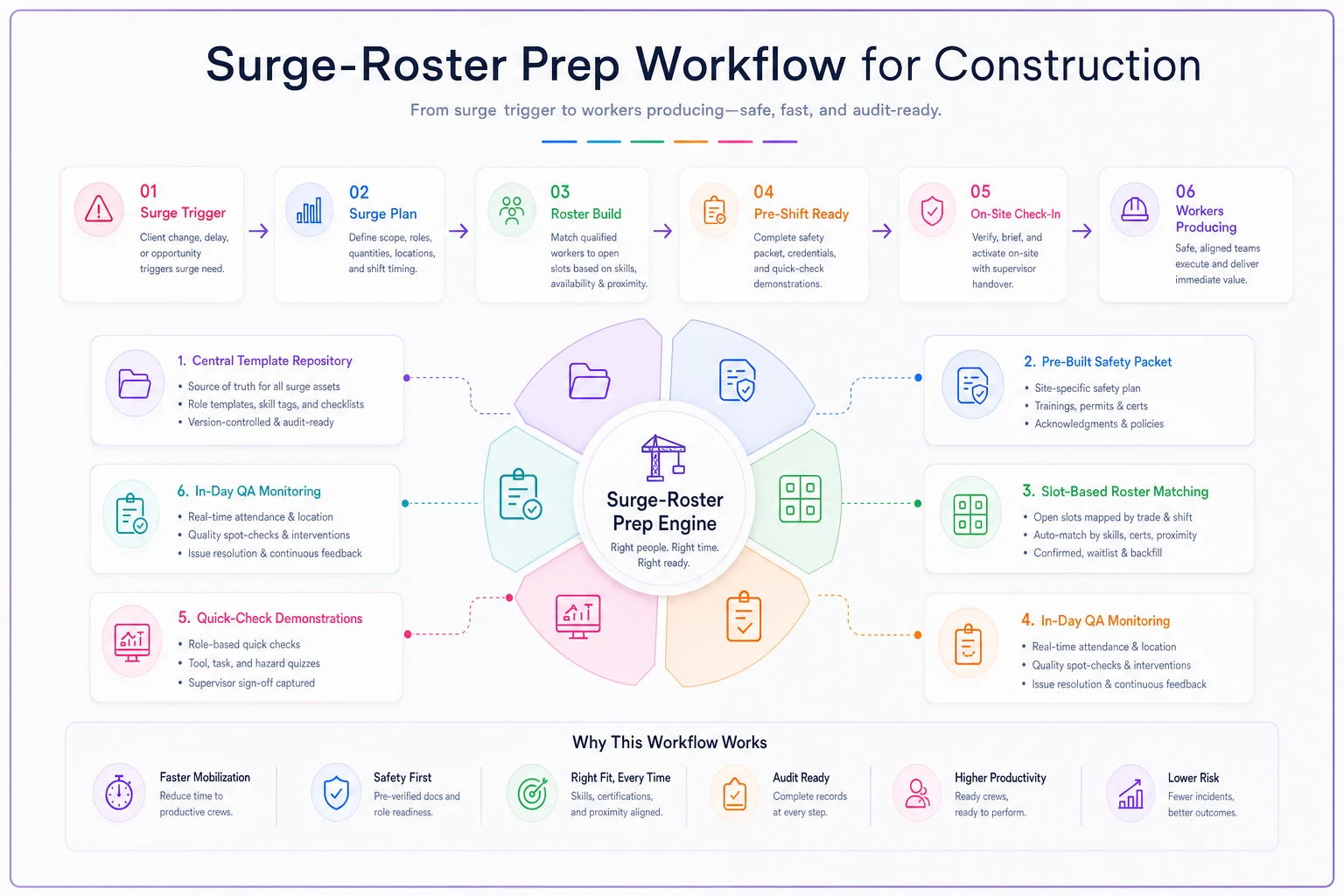
A simple visual like this makes the workflow easy to follow under pressure.
The workers you get on a surge day are rarely the problem. The problem is asking eight strangers to become a productive crew through a process that got designed live, at the gate, while the concrete truck idles. Move the decisions earlier, protect your critical slots, verify before you trust, and check in often enough to catch drift while it's still small. Do that consistently and same-day pooled labour stops being a gamble and starts being just another Tuesday.
The workers you get on a surge day are rarely the problem. The problem is asking eight strangers to become a productive crew through a process that got designed live, at the gate, while the concrete truck idles. Move the decisions earlier, protect your critical slots, verify before you trust, and check in often enough to catch drift while it's still small. Do that consistently and same-day pooled labour stops being a gamble and starts being just another Tuesday.
Ready to build smarter and faster?
Join 2,000+ construction teams using Projbrick to improve project visibility, reduce delays, and increase profitability.