
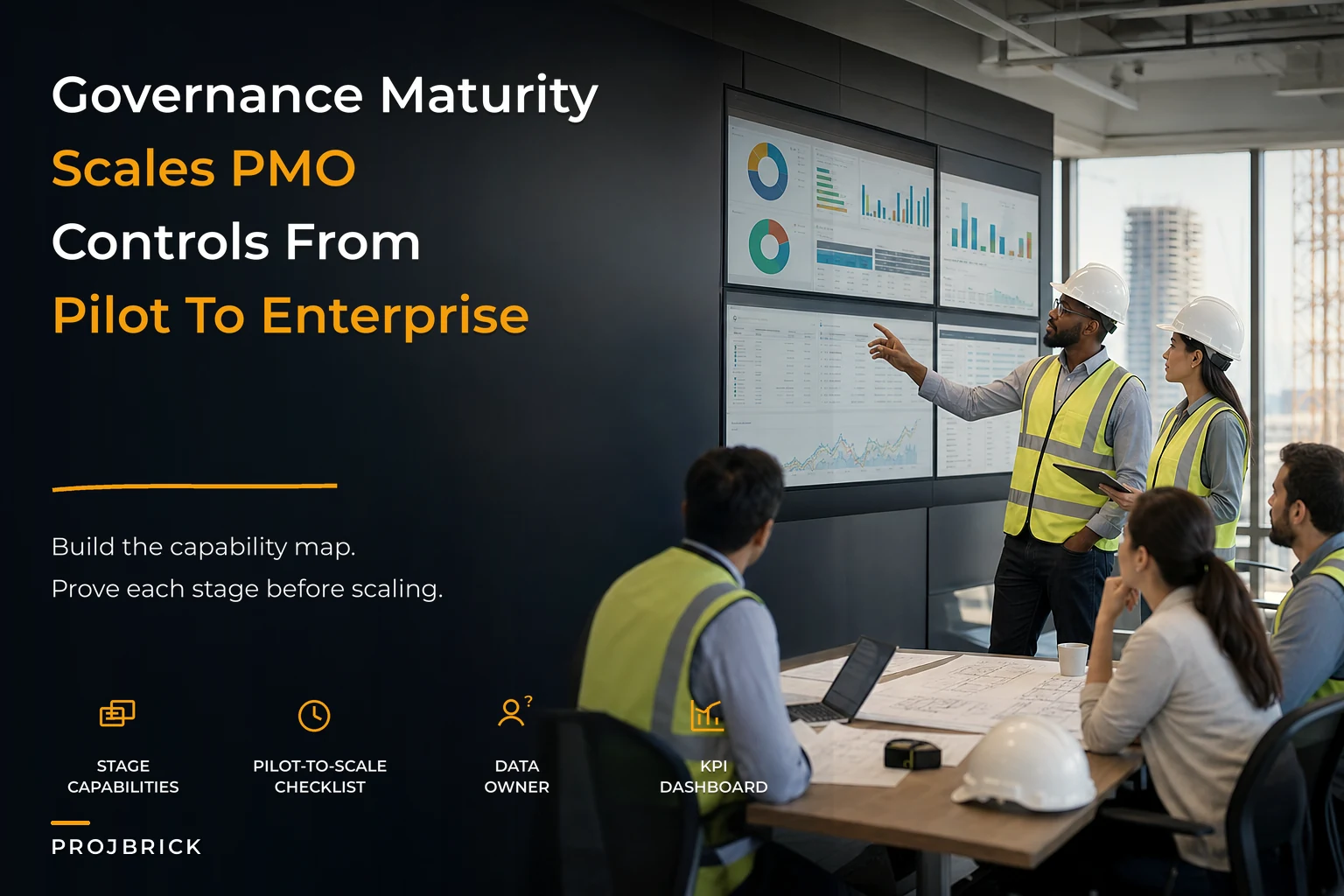

Most PMOs don't fail because they lack controls. They fail because they bolt enterprise-grade controls onto a team that's still operating like it runs one project at a time. The governance model looks great on paper — risk registers, phase gates, change boards, portfolio dashboards — but the field ignores half of it, the data feeding the dashboards is three weeks stale, and the whole thing collapses the moment two projects need to share the same controls.
Governance maturity isn't a switch. It's a progression, and each stage has its own required artifacts, its own KPIs that actually mean something, and its own failure modes. Skip a stage and you get expensive process theater. That's what this maturity model is about — knowing what capability you need to prove before you scale it across the portfolio.
Why governance breaks when it scales (and it always breaks the same way)
A PMO runs a solid pilot on one flagship project. The project controller is sharp, the superintendent buys in, and the reporting is clean because one person is basically manually stitching it together every Friday. Leadership sees the dashboards, declares victory, and says "roll this out across all fifteen active projects."
Then it falls apart. Not because the controls were wrong, but because the pilot's success depended on things that don't scale — one heroic controller, informal handshakes, tribal knowledge about which numbers to trust. Across fifteen projects you can't have fifteen heroic controllers. You need the system to carry the load, not the people.
-
Data ownership gets fuzzy. On the pilot, everyone knew the controller owned the cost report. Across a portfolio, nobody's sure who owns what, so numbers get entered twice or not at all.
-
Definitions drift. "Percent complete" means earned value on one project and physical progress on another. Now your portfolio roll-up is comparing apples to fire trucks.
-
The reporting cadence collapses. Weekly reporting that took one person four hours now takes eight people four hours each, and half of them are late, so the portfolio view is always incomplete.
-
Escalation stops working. On one project, issues walked into the PM's office. Across fifteen, an issue on project #11 sits invisible for two weeks until it's a claim.
A construction governance maturity model exists to prevent exactly this — to make sure the capability underneath the controls is real before you try to replicate it.
The five maturity stages, and what each one actually requires
Think of maturity in five stages. The mistake most PMOs make is jumping from Stage 1 to Stage 4 because leadership saw a nice dashboard. Each stage has to earn its way to the next by proving specific artifacts exist and specific KPIs are being hit consistently — not once, but for a sustained period.
Keep your construction projects on schedule and budget.
Projbrick helps you plan, track, and manage every project phase with precision and ease.
- Real-time project tracking
- Resource & budget management
- Team collaboration tools
No credit card required
| Stage | What it looks like | Required artifacts | KPIs that prove readiness to advance |
|---|---|---|---|
| 1 — Ad hoc | One pilot, manual reporting, hero-driven | Cost report template, basic risk log, defined phase gates | Reports delivered on time 4+ weeks running; single agreed definition of % complete |
| 2 — Repeatable | Same controls on 2–4 projects, shared templates | Standardized WBS, change control log, RACI for data ownership | Cross-project reports use identical definitions; change log <5 days behind reality |
| 3 — Defined | Portfolio-level standards, trained controllers | Governance manual, gate checklists, data schema, escalation matrix | Gate compliance >85%; portfolio roll-up assembled without manual rework |
| 4 — Managed | Metrics drive decisions, forecasting reliable | Forecast-to-complete models, trend dashboards, audit trail | Forecast accuracy within ~8–10%; escalations resolved within SLA >80% of time |
| 5 — Optimized | Continuous improvement, predictive signals | Lessons-learned loop, leading-indicator dashboards, benchmarking | Repeat-issue rate falling quarter over quarter; predictive flags catch problems pre-gate |
The table looks tidy, but reality is messier. Most PMOs sit at different stages for different capabilities. Your cost controls might be at Stage 3 while risk governance is still stuck at Stage 1, where the "risk register" is a spreadsheet nobody's opened since kickoff. That's normal. Maturity isn't uniform, and pretending it is causes half the pain.
Stage 1 to 2: proving the pilot is actually repeatable
The pilot-to-scale jump is where most of the damage happens.
Before you take controls from one project to a handful, run this checklist. Every item has to be a real artifact, not a promise:
-
[ ] There's a written definition of every core metric (percent complete, earned value, committed cost, forecast final) and it's the same definition regardless of who's reporting
-
[ ] Someone is explicitly named as the owner of each data feed — not "the team," an actual person and a backup
-
[ ] The reporting cadence has survived at least a month without slipping, including through at least one busy or bad week
-
[ ] Phase gates have exit criteria that a stranger could apply, not "the PM feels it's ready"
-
[ ] The change control log reflects reality within a few days, not a few weeks
-
[ ] At least one issue was escalated and resolved through the process, not around it
Name backups for each data owner so ownership doesn't collapse when someone is unavailable.
That last one matters more than people think. A governance system that's never been stress-tested by a real escalation is a system you don't actually know works. If every problem on your pilot got solved by someone walking over to the superintendent, you haven't proven your escalation matrix — you've proven you have a good superintendent.
A mid-sized contractor once piloted integrated controls on a $40M mixed-use build. Beautiful reporting. When they rolled it to four projects, the portfolio dashboard was garbage for the first two months because three of the four PMs were quietly using their old "percent complete" method. The controls were fine. The definitions were never enforced. Fixing that one thing — a single-page metric dictionary everyone signed off on — did more for the roll-up than any new software.
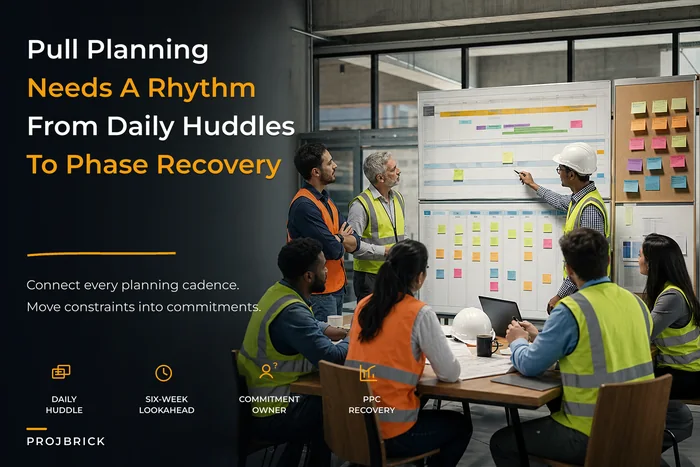
This is also the stage where a repeatable planning rhythm pays off. If your teams have already learned to operationalize pull planning with consistent PPC rhythms and recovery templates, you've got a head start — the discipline of committing to and measuring plan reliability is the same muscle governance maturity depends on.
Stage 2 to 3: from repeatable to genuinely defined
Stage 3 is where governance stops living in one person's head and becomes institutional. The signal you've arrived: a new project controller can be onboarded and producing correct reports within a couple of weeks, using documented standards, without shadowing a veteran for a month.
The artifacts that define this stage are boring and essential — a governance manual, gate checklists, a documented data schema, an escalation matrix with named roles and time thresholds. But the real test isn't whether these documents exist. It's whether the portfolio roll-up can be assembled without manual rework. If your controller is still exporting to Excel and hand-reconciling numbers every reporting cycle, you're not at Stage 3 no matter how thick your governance manual is.
The most common Stage-2 plateau is what I'd call the "documented but unenforced" trap. The manual exists. The templates exist. But there's no mechanism that catches non-compliance until reporting day, so drift accumulates invisibly all month. Mature Stage-3 PMOs move the check upstream — the system won't accept a gate submission missing its required artifacts, so nobody can advance a phase with an incomplete package.
This connects directly to schedule governance. The same discipline that keeps phase slippage from compounding across multi-phase jobs — repeatable planning framework, enforced gates, early slippage detection — is what separates a defined PMO from one that's just repeating templates without teeth.
Stage 3 to 4: when metrics start driving decisions
At Stage 4, the dashboards aren't reports anymore — they're decision tools. A Stage-3 dashboard tells you what happened last period. A Stage-4 dashboard tells you where you're headed and forces a decision. The difference is subtle but it changes everything about how leadership uses the data.
The key capability here is forecast reliability. Anyone can report actuals. A managed PMO forecasts final cost and completion date and is right within a tolerance often enough that leadership acts on the forecast instead of second-guessing it. When your forecast-to-complete lands within roughly 8–10% consistently, executives stop asking for the "real" number and start making commitments off your projections. That's the whole point.
-
Exceptions first — which projects are drifting outside tolerance on cost, schedule, or risk, ranked by severity
-
Trend direction — is each metric improving or degrading over the last few periods, not just its current value
-
Escalation status — which flagged issues are inside SLA and which are breaching, with age visible at a glance
If your dashboard makes someone hunt for the problems, it's a Stage-3 dashboard wearing a Stage-4 outfit.
Stage 4 to 5: the improvement loop that most PMOs never build
Stage 5 is rare, and honestly most organizations don't need to fully live there. But the one capability worth building regardless is the lessons-learned loop that actually changes behavior. Most PMOs run closeout reviews, generate a lessons-learned document, and file it where it dies. That's not Stage 5. That's a graveyard with good intentions.
The mature version feeds recurring issues back into the standards. If three projects hit the same procurement-driven delay, that pattern shows up as a new required check at the relevant gate on every future project. The governance system gets smarter because the data flows back into it — not because someone remembered to read last year's report.
The KPI that proves Stage 5 is simple and brutal: is your repeat-issue rate falling? If the same category of problem keeps generating claims and delays quarter after quarter, all your maturity is cosmetic. Real optimization shows up as problems that used to recur becoming problems that don't, because the system now catches them before the gate.
Where the right infrastructure quietly matters
None of this requires software to be true — the maturity is about capability, not tools. But there's a practical ceiling on how far manual methods scale. Somewhere around Stage 3, reconciliation burden becomes the bottleneck. When definitions are standardized and ownership is clear but your controller still spends two days a cycle stitching exports together, that manual work is what prevents you from reaching Stage 4.
A workflow platform that centralizes project controls earns its keep not by adding features, but by enforcing the definitions you already agreed on, maintaining a single source of truth so the portfolio roll-up assembles itself, and flagging exceptions automatically instead of waiting for someone to notice on reporting day. AI-assisted controls can watch trend lines across the portfolio and surface a project drifting toward a gate failure before it shows up in the weekly review. The value isn't automation for its own sake — it's that the system carries the coordination load your one heroic controller used to carry, which is exactly what breaks when you scale.
A workflow for sequencing platform introduction looks like this:
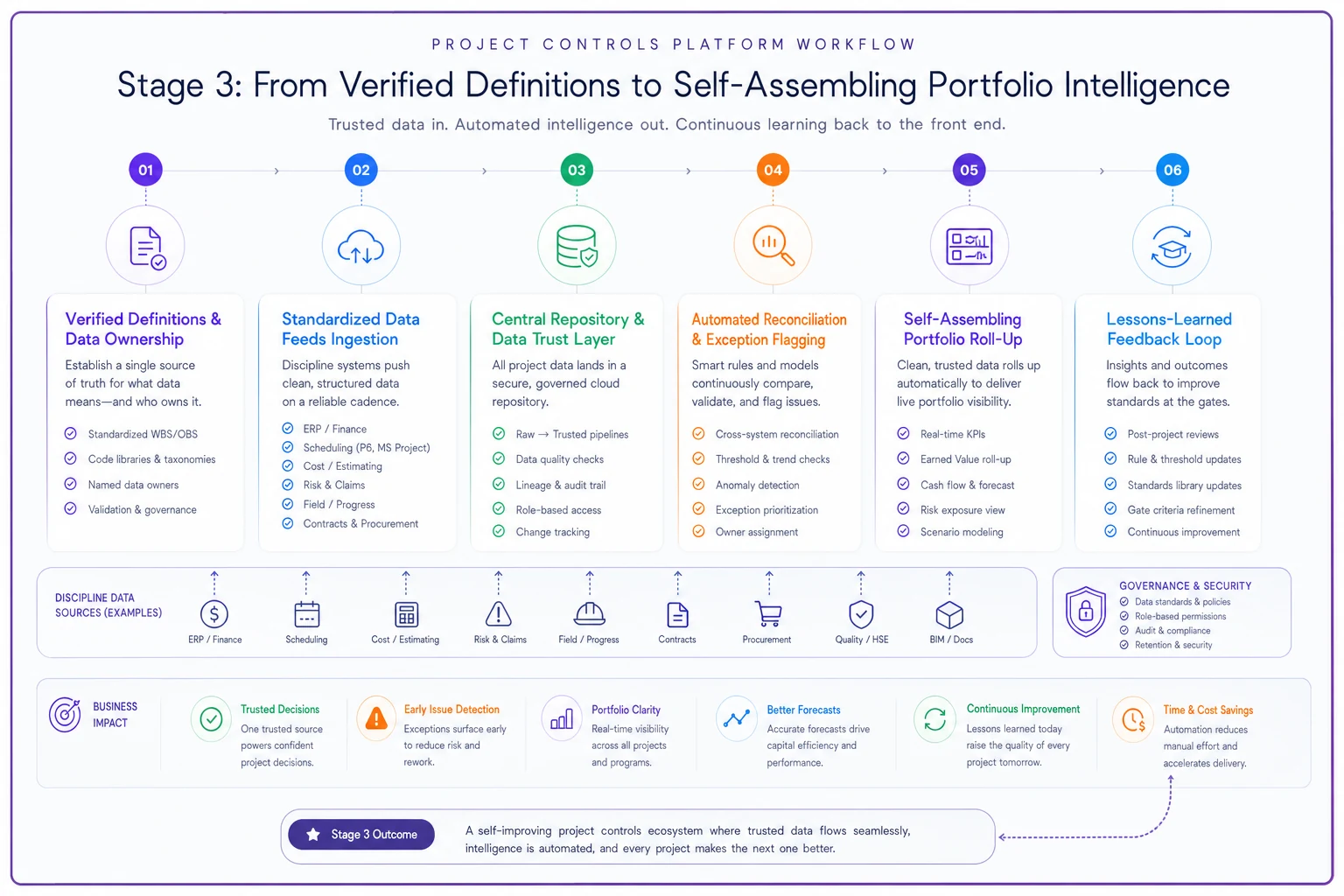
It sequences: lock definitions and ownership → centralize feeds → automated reconciliation → exception surfacing.
When advancing a stage is a bad idea
When advancing makes sense: you're consistently hitting the current stage's KPIs, the field is genuinely using the controls (not working around them), and you have enough active projects that portfolio-level standardization actually pays off.
When it's a bad idea: you're forcing a stage jump because leadership saw a competitor's dashboard, the current stage's KPIs are still shaky, or your team is already stretched and every new artifact you add just gets half-completed. Adding Stage-4 forecasting discipline to a team that can't reliably report actuals doesn't give you forecasts — it gives you confident-looking numbers that are wrong.
Who should probably not do this at all: a firm running one or two projects with a stable, experienced team. If your whole portfolio is two jobs run by people who've worked together for a decade, heavy governance is overhead that buys you very little. Maturity models earn their cost through scale and coordination — with low volume, the informal system is often the right system.
A real scenario: from pilot to eight projects
A regional GC — roughly $120M annual revenue — had strong controls on a single hospital project and wanted to scale across their portfolio of eight active jobs. The initial roll-out stalled hard. Portfolio reporting took nearly two weeks to assemble each month, three of the eight PMs were using inconsistent progress definitions, and two significant issues turned into change-order disputes because nobody escalated them in time.
They stopped trying to be at Stage 4 and honestly assessed they were at Stage 2 for most capabilities. Over about two quarters they did the unglamorous work: locked a one-page metric dictionary, named data owners with backups, built gate checklists with hard exit criteria, and moved compliance checks upstream so incomplete gate packages couldn't advance.
The results weren't dramatic in a headline sense, but they were the right kind. Portfolio reporting dropped from around two weeks to roughly three to four days. Gate compliance climbed to somewhere north of 85%. And critically, the next two escalations went through the process and got resolved before they became claims — which, on jobs that size, is the difference between a rough conversation and a six-figure dispute. Only after that foundation held did they introduce a centralized controls platform to push toward reliable forecasting.
Governance maturity isn't about having more controls — it's about proving each layer of capability is real before you replicate it across the portfolio. The PMOs that scale cleanly are the ones honest about which stage they're actually at, willing to sit at Stage 2 until it's genuinely repeatable, and disciplined about moving compliance checks upstream so drift can't accumulate. Every stage skipped is a failure mode purchased on credit, and the bill always comes due at the worst possible time — usually as a claim on the project you were watching least.
Map your capabilities stage by stage, be ruthless about the KPIs that prove readiness, and only scale what you've truly earned.
Ready to build smarter and faster?
Join 2,000+ construction teams using Projbrick to improve project visibility, reduce delays, and increase profitability.