



Most contracts on a construction job are written to protect against catastrophe and then filed away. They live in a binder or a shared drive folder nobody opens until something goes sideways. The commercial levers inside them — retention, milestone payments, liquidated damages, bonuses — get treated as legal boilerplate instead of what they actually are: the strongest behavioral tools a PM has.
Why most construction contracts punish the wrong behavior at the wrong time
That's the core disconnect. The people who write the contract (legal, commercial, the estimating team) and the people who live inside it every day (the PM, the supers, the subs) rarely speak the same language. The contract says "substantial completion by X or LDs apply." The field says "we're three weeks behind because the elevator sub keeps no-showing." Nobody has translated the commercial consequence into a weekly signal that changes behavior before the deadline hits.
Good contract governance for construction incentives isn't about writing tougher clauses. It's about building a system where the money moves in a way that rewards the schedule and quality outcomes you actually want — and where everyone can see, in near real time, how their performance tracks against the levers that pay them.
The pattern that shows up on almost every troubled job
When a job goes bad commercially, it's rarely one dramatic event. It's a slow accumulation of misaligned incentives that nobody caught because the contract wasn't being operated.
Keep your construction projects on schedule and budget.
Projbrick helps you plan, track, and manage every project phase with precision and ease.
- Real-time project tracking
- Resource & budget management
- Team collaboration tools
No credit card required
A typical example looks like this. A mid-size GC signs a sub on a lump-sum with 10% retention and monthly pay-apps. The sub front-loads the schedule of values — heavy on early activities like mobilization and rough-in, light on the finishes and closeout work they know is a slog. For the first four months, the sub gets paid roughly what they've billed because nobody is checking earned value against physical progress hard enough. By month six, the sub has collected close to 70% of their contract value but has done maybe 55% of the actual work. Now the incentive is inverted: the remaining work is the hardest, least profitable, and they've already got most of their money. Retention alone — that last 10% — isn't enough to pull them through punch and closeout with any urgency.
That's not a bad subcontractor. That's a contract that paid ahead of value and then had no lever left to pull. The commercial structure quietly stopped aligning with the outcome somewhere around the midpoint, and nobody noticed because there was no scorecard tying payment to progress and quality at each gate.
The failure isn't legal. It's operational. The contract was fine on paper. It just wasn't wired into the weekly rhythm of the job.
What actually breaks as the portfolio scales
On a single job, a sharp PM can hold the whole commercial picture in their head. They know which sub is behind, which pay-app is soft, where the retention leverage sits. That intuition doesn't scale.
-
Approval authority gets fuzzy. Who can approve a $180k pay-app? Who signs off on releasing early retention? On one job it's the PM, on another the commercial manager insists on reviewing anything over $100k, and on a third nobody's actually sure — so it just gets approved to keep things moving.
-
Clause language drifts. Every project team edits the last contract they used. Three years later you've got twelve versions of your "milestone payment" clause, some of which don't actually tie payment to a verifiable deliverable.
-
Incentive tiers become theater. The early-completion bonus that looked motivating in the estimate never gets tracked because no single person owns the scorecard that would trigger it.
-
Quality and payment decouple. Pay-apps get approved on percent-complete while defect lists grow in a separate spreadsheet nobody links to the money.
Governance that depended on one person's judgment doesn't survive being spread across many jobs and many people. You need the commercial levers encoded into repeatable frameworks — clause templates, performance tiers, payment gates — so the system enforces alignment instead of relying on whoever happens to be paying attention that week.
The three building blocks that make commercial levers actually work
There are three components that, together, turn a static contract into a governance system. None of them are complicated. The value is in wiring them together and running them on a rhythm.
1. PM-friendly clause templates
Legal clauses fail in the field for one reason: the people who have to enforce them can't tell whether a condition has been met. A clause that says "payment contingent on satisfactory progress" is useless. Satisfactory to whom? Measured how?
A PM-friendly template rewrites the same protection into something a super can verify on a Tuesday morning. Instead of "satisfactory progress," you get "payment gated on: (a) earned value within 5% of planned, (b) zero open Category-1 defects, (c) updated as-built markups submitted for the billed scope." Same commercial intent. Completely different enforceability.
The insight most teams miss: the clause and the verification checklist should be written at the same time, by the same people. If your legal team writes a clause the field can't measure, it's not a governance tool — it's a lawsuit waiting to be argued about.
2. Performance-tier frameworks
Binary contracts — you're either in default or you're not — waste most of the behavioral range. Most underperformance lives in the gray zone: the sub who's a bit slow, a bit sloppy, but not bad enough to terminate.
Performance tiers give you graduated responses that map to graduated consequences. Here's a simplified structure that works across most trade packages:
| Tier | Trigger conditions | Payment treatment | Retention | Escalation |
|---|---|---|---|---|
| Green | On/ahead of schedule, defects closed within SLA | Full pay-app, standard cycle | Standard 5–10% | None |
| Amber | 5–10% behind, or defects aging past SLA | Pay-app approved less a hold on at-risk scope | +2–3% additional hold | Recovery plan required within 5 days |
| Red | >10% behind, repeated quality failures | Partial payment, gated on recovery milestones | Elevated hold + bonus forfeiture | Commercial manager + owner notification |
| Bonus | Ahead of schedule with clean quality record | Standard + milestone bonus on verified gate | Early partial release eligible | Fast-track approval |
The exact numbers flex by trade, risk, and market. The point is that a sub moving from Green to Amber sees a real, immediate financial signal while there's still time to recover — not a surprise deduction at final account eight months later.
3. Payment-gate scorecards
There are the connective tissue. A payment gate is a checkpoint where money can't move until specific, verifiable conditions are met — and the scorecard is the document that records whether they were.
A workable scorecard for a monthly pay-app gate covers:
-
Earned value vs. planned value for the billed period
-
Physical progress verification (field-confirmed, not sub-reported)
-
Open defect count by category and aging
-
Compliance items current (insurance, RAMS, submittals)
-
As-built / QA documentation submitted for billed scope
-
Retention position vs. tier
-
Any active recovery-plan milestones and their status
When the scorecard is filled honestly, the payment decision makes itself. No arguments about "feel." The gate either clears or it doesn't, and the tier framework tells everyone what happens next.
Wiring it together: the enforcement workflow
Templates and scorecards sitting in a folder change nothing. The governance only exists when there's a workflow that runs on a schedule and an approver matrix that says who can do what.
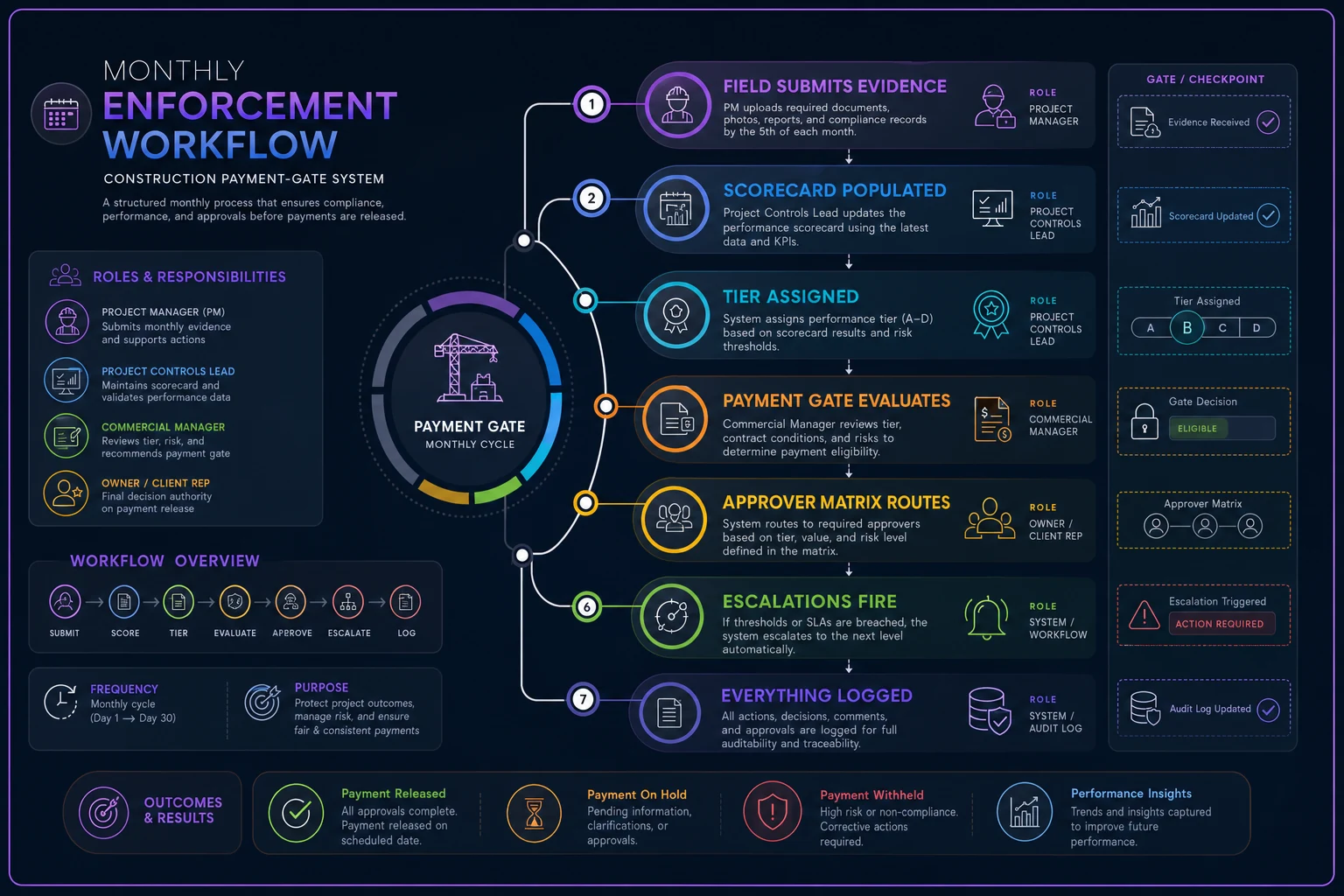
Here's how the monthly cycle runs on a well-governed job:
-
Field submits progress evidence (measurements, photos, completed-work confirmation) against the billed scope — ideally mid-cycle, not the night before the pay-app is due.
-
Scorecard gets populated by the person who owns it (usually the PM or a project controls lead), pulling earned value, defect status, and compliance flags into one view.
-
Tier is assigned based on the scorecard against the performance-tier rules. This is mechanical, not political.
-
Payment gate evaluates — full, partial, or held — following the tier's payment treatment.
-
Approver matrix routes the decision to whoever has authority for that amount and tier. A Green pay-app under a threshold might auto-route to the PM. A Red pay-app with a bonus forfeiture routes up to the commercial manager and triggers owner notification.
-
Escalation actions fire where the tier demands it — recovery plan requests, additional holds, or fast-track bonus verification.
-
Everything is logged so the final account isn't a forensic reconstruction. The record of why each payment moved the way it did already exists.
Here's a simple visual of that monthly enforcement workflow.
The approver matrix deserves special attention because it's where most governance quietly dies. When authority is ambiguous, people default to approving things to avoid being the bottleneck. A clear matrix — amount thresholds crossed with performance tier crossed with named roles — removes the ambiguity. It also removes the awkwardness: the super isn't personally squeezing a sub, the system is, and the super can point to the framework everyone agreed to at award.
This connects directly to how you manage subs across their whole lifecycle. Payment-gate scorecards are the commercial half of the same picture you build during onboarding and performance tracking — the operational side of which is covered in this subcontractor lifecycle governance system. The scorecard that gates payment should feed the same data that scores the sub for future awards. When those two systems are separate, you end up re-hiring the sub who bled you dry last time because the commercial pain never made it into the vendor record.
A real scenario: the fit-out contractor who reversed their closeout problem
A regional fit-out contractor running roughly 8–10 active jobs kept hitting the same wall: strong starts, brutal closeouts. Final accounts routinely dragged 90–120 days past practical completion, and their retention was tied up so long it was a real cashflow drag — somewhere in the range of a few hundred thousand across the portfolio at any given time.
The root cause, once they mapped it, was exactly the front-loaded pattern described earlier. Subs got paid ahead of value early, then had no financial reason to chase punch and documentation at the end.
They didn't rewrite their contracts from scratch. They did three things:
-
Rebuilt their standard sub-agreement with payment gates tied to a scorecard, so pay-apps couldn't clear without field-verified progress and current QA docs.
-
Added a three-tier performance framework with a modest bonus for clean, on-time closeout and an elevated hold for aging defects.
-
Set a clear approver matrix so that any pay-app in Amber or Red automatically routed to the commercial manager instead of getting waved through by a busy PM.
Over the next two or three job cycles, closeout duration came down noticeably — final accounts that used to run four months were closing in six to eight weeks on the better-run jobs. The bonus lever cost them a little on paper, but it was far cheaper than carrying retention for an extra quarter and chasing subs who'd mentally moved on to their next project. The discipline built into gated payments also made their closeout and final-account process dramatically less painful, because the documentation was already collected gate by gate instead of scrambled together at the end.
The interesting part wasn't the money. It was that subs stopped fighting it. Once the rules were visible and applied consistently, the good subs actually preferred the setup — they could see exactly what unlocked their money, and the framework stopped rewarding the sandbaggers they were competing against.
Where software quietly earns its keep
None of this requires software to exist — plenty of teams run versions of it on spreadsheets. But spreadsheets are where governance goes to erode. Someone edits the clause template and doesn't tell anyone. The scorecard on Job A has different fields than Job B. The approver matrix lives in an email from 2022.
-
Scorecards can pull earned-value and defect data automatically instead of being retyped, which is where errors and soft numbers creep in.
-
Tier assignment gets applied consistently from the same rules on every job, so "Amber" means the same thing portfolio-wide.
-
Approval routing happens based on amount and tier, so nothing waits on someone remembering who signs off.
-
Escalations — recovery-plan requests, hold notifications — fire on schedule instead of depending on a PM catching a slip during a busy week.
The value isn't automation for its own sake. It's that the governance keeps running the same way across every job even when your best PM is on leave or you've just onboarded three new project engineers. The system holds the standard so people don't have to hold it in their heads.
When this level of governance makes sense — and when it doesn't
This is real overhead. Building templates, tiers, scorecards, and matrices takes effort, and applying them takes discipline. It's not right for every situation.
When it makes sense:
-
You're running multiple concurrent jobs and can't hold every commercial position in one person's head.
-
You have recurring closeout, retention, or final-account pain that traces back to misaligned incentives.
-
You work with the same subcontractor pool repeatedly and want commercial performance to inform future awards.
When it's overkill:
-
A single small job with two or three trades and a PM who's genuinely across everything. The workflow overhead won't pay for itself.
-
Cost-reimbursable or heavily collaborative delivery models where the whole incentive structure is different and gated payments would work against the partnering intent.
Who should NOT start here:
If your basic pay-app verification and progress measurement aren't reliable yet, don't build a tiered incentive framework on top of shaky data. Garbage into a scorecard produces confident, official-looking garbage out. Get your field-to-office progress verification solid first, then layer the commercial governance on a foundation you trust.
The shift that actually matters
The mental move is to stop treating the contract as a static document and start treating it as an operating system for behavior. Every commercial lever you negotiated at award — retention, milestones, bonuses, holds — is only worth what your ability to operate it in real time is worth.
Most teams negotiate hard at award and then let the leverage evaporate through the life of the job because nobody wired the levers into a weekly rhythm. The teams that win commercially aren't the ones with the toughest clauses. They're the ones who turned their clauses into scorecards, their scorecards into tiers, and their tiers into actions that keep incentives pointed at the schedule and quality outcomes they actually wanted — from the first pay-app to the last dollar of retention.
Most teams negotiate hard at award and then let the leverage evaporate through the life of the job because nobody wired the levers into a weekly rhythm. The teams that win commercially aren't the ones with the toughest clauses. They're the ones who turned their clauses into scorecards, their scorecards into tiers, and their tiers into actions that keep incentives pointed at the schedule and quality outcomes they actually wanted — from the first pay-app to the last dollar of retention.
Ready to build smarter and faster?
Join 2,000+ construction teams using Projbrick to improve project visibility, reduce delays, and increase profitability.