


Most disputes don't start as disputes. They start as a verbal instruction nobody wrote down, a delay nobody attributed to anyone, a quantity nobody measured at the time. By the time it becomes a claim, the money is already spent and the only thing left to argue about is who remembers what. Memory, as anyone who's sat through an adjudication knows, is not evidence.
What separates projects that bleed on disputes from projects that mostly don't isn't talent or luck. It's whether the project runs a loop — a repeatable habit of capturing facts in the moment, logging decisions as they're made, and assembling the record continuously instead of scrambling for it after the relationship has already soured. That loop is what most teams think they have but actually don't.
This article is about building that loop as a system: the evidence standards that make records usable, the decision logs that establish who decided what and when, the adjudication-ready packets that turn scattered files into defensible positions, and — the part everyone skips — the enforcement work that makes people actually follow through.
Why the record always fails at the worst possible moment
Teams are good at producing records when nothing is at stake and terrible at producing them when something is. The daily diary gets filled in religiously for the first three months, then becomes two-line entries by month six. Site instructions get emailed when the PM is thinking about it and get verbal when a trade is standing in front of them at 6:45am asking whether to proceed.
This isn't laziness. Record-keeping competes with the actual work, and the actual work always wins in the moment. Nobody feels the cost of a missing record until months later, when a subcontractor submits a variation claim for $180k and the only supporting trail is a thread of texts and one photo with no timestamp.
A typical example: a groundworks sub hits unexpected rock, mentions it to the super verbally, keeps digging, and raises the delay and cost six weeks later. The super genuinely doesn't remember the conversation the way the sub does. No contemporaneous record of the condition, no measurement of the extent, no instruction trail. Now you're not arguing about whether rock existed — you're arguing about a hole in the ground that's already backfilled. That claim gets paid, or part-paid, not because it's valid but because it's unfalsifiable. You can't disprove what you never recorded.
That's the real cost of weak governance. Not just the claims you lose — it's the claims you settle because you can't afford the uncertainty of fighting them.
The four parts of the loop
A functioning prevention loop has four components, and they only work together. Teams that implement one or two always wonder why they're still exposed.
Keep your construction projects on schedule and budget.
Projbrick helps you plan, track, and manage every project phase with precision and ease.
- Real-time project tracking
- Resource & budget management
- Team collaboration tools
No credit card required
1. Mandatory evidence standards. A rule that says "take photos" is not an evidence standard. A standard specifies what gets captured, when, how it's named, and what makes it admissible. The difference between a photo and evidence is metadata, chain of custody, and context. If your field evidence can't survive a challenge on timestamp or location, it's decoration. (Our photo chain-of-custody approach covers the capture discipline that makes field records hold up and doubles as pay-app support.)
2. Decision logs. Every instruction, approval, deviation, and disputed condition gets logged with a decision-maker, a timestamp, and a reason. Not minutes. Not a diary. A structured log where each entry answers: who decided, what, when, on what basis, and what it affects. This is the single highest-leverage habit most projects don't have.
3. Adjudication-ready packets. The record is assembled continuously into packets organized around events, not documents. When a delay or variation occurs, the packet for it — notice, evidence, measurement, cost, and decision trail — gets built while the facts are fresh, not reconstructed under pressure 90 days later.
4. Enforcement cadence. A weekly rhythm where someone checks that the first three things actually happened. Without this, the whole system decays within a quarter. Every time.
What "mandatory" has to actually mean
The word doing the heavy lifting is mandatory. Most governance documents use it aspirationally — "evidence should be captured contemporaneously." Should. That word is where disputes come from.
Mandatory means the workflow stops if the evidence isn't there. A variation can't enter the register without a notice date and a condition record. A pay application can't be processed without the field evidence packet attached. A change can't be approved without the decision log entry. The record isn't a parallel activity you hope people do — it's a gate inside the process they can't skip.
This is a hard cultural sell, and it's worth being honest about why. Field teams experience mandatory evidence as bureaucracy that slows them down, because the person capturing the record is almost never the person who benefits from it. The super who photographs the rock condition gets nothing today. The commercial team six weeks out gets everything. That split between effort and benefit is the central problem of claims governance, and no amount of software fixes it if you don't address it directly.
A minimum evidence standard worth enforcing
-
Timestamp and location on every field photo (device metadata verified, not just trusted)
-
Naming convention tied to location, element, and date — searchable, not "IMG_4471"
-
Condition records for anything unexpected
measured extent, not just a description
-
Instruction trail — no verbal instruction stands alone; it gets confirmed in writing same day
-
Notice dates captured the moment a potential claim event occurs, independent of whether anyone intends to claim
-
Witness attribution — who was present, so the record has a human anchor
The last one matters more than people expect. A record with a named witness is significantly harder to dispute than an anonymous entry, because it can be corroborated.
The decision log: the thing that actually wins arguments
Evidence proves a condition existed. The decision log proves what you did about it and why — and that's usually the contested ground.
Consider two projects facing the same delay event. Both have photos. Project A has a decision log entry: "March 14, 09:20 — Super instructed groundworks to proceed on alternative sequence pending geotech review, to protect crane window. Delay to Zone B accepted, est. 2 days. Approved by [PM]." Project B has photos and nothing else.
In adjudication, Project A isn't defending a vague position — it's presenting a documented, reasoned, time-stamped decision made by an authorized person at the moment. That's not just defensible; it often ends the argument before it reaches adjudication, because the other side can see there's nothing to exploit.
The pattern on jobs that run clean records is consistent: they log decisions before they know which ones will matter. You can't predict which instruction becomes the $200k dispute. So you log them all, cheaply, in a consistent format. The log is only useful if it's complete, and it's only complete if entering it is near-frictionless.
Reactive vs. prevention-loop governance
The right column isn't more work overall — it's the same work moved earlier, when it's cheap,
| Dimension | Reactive (most projects) | Prevention loop |
|---|---|---|
| When records get built | After a claim surfaces | Continuously, as events occur |
| Evidence quality | Variable, often inadmissible | Standardized, metadata-verified |
| Decision trail | Reconstructed from memory/emails | Logged at point of decision |
| Packet assembly | Weeks of scramble under pressure | Assembled per-event as it happens |
| Typical outcome | Settle to avoid uncertainty | Resolve on documented facts |
| Cost of a disputed event | High + management time | Low, often deflected early |
| What decays over time | Everything | Only enforcement, if ignored |
instead of later, when it's expensive and incomplete.
Building the loop: a rollout sequence that holds
Teams that try to launch all four components at once usually get overwhelmed and abandon it. A staged rollout sticks better.
-
Start with the decision log, nothing else. One structured log, one agreed format, logged daily. This is the cheapest high-value habit and builds the muscle for everything after.
-
Add the evidence standard for a single event type — say, unexpected ground conditions or variation instructions. Don't try to cover everything at once. Get one event type's evidence truly reliable.
-
Introduce per-event packets for that same event type. Prove the packet concept works before scaling it across all claim categories.
-
Wire in the gates. Now make the evidence mandatory — the workflow stops without it. By now people have seen the record save someone's position at least once, so resistance drops.
-
Install the enforcement cadence. A weekly 20-minute review where decision logs, open event packets, and evidence gaps get checked. Assign ownership. No ownership, no cadence.
-
Expand event types one at a time until the loop covers delays, variations, disputed quantities, and instruction compliance.
The sequencing matters because cultural adoption is the binding constraint, not the tooling. You're trying to get people to see the loop pay off before you make it compulsory. That order — prove value, then enforce — is the opposite of how most PMOs roll out governance, and it's why most governance rollouts fail.
A simple visual of the rollout sequence clarifies steps and ownership.
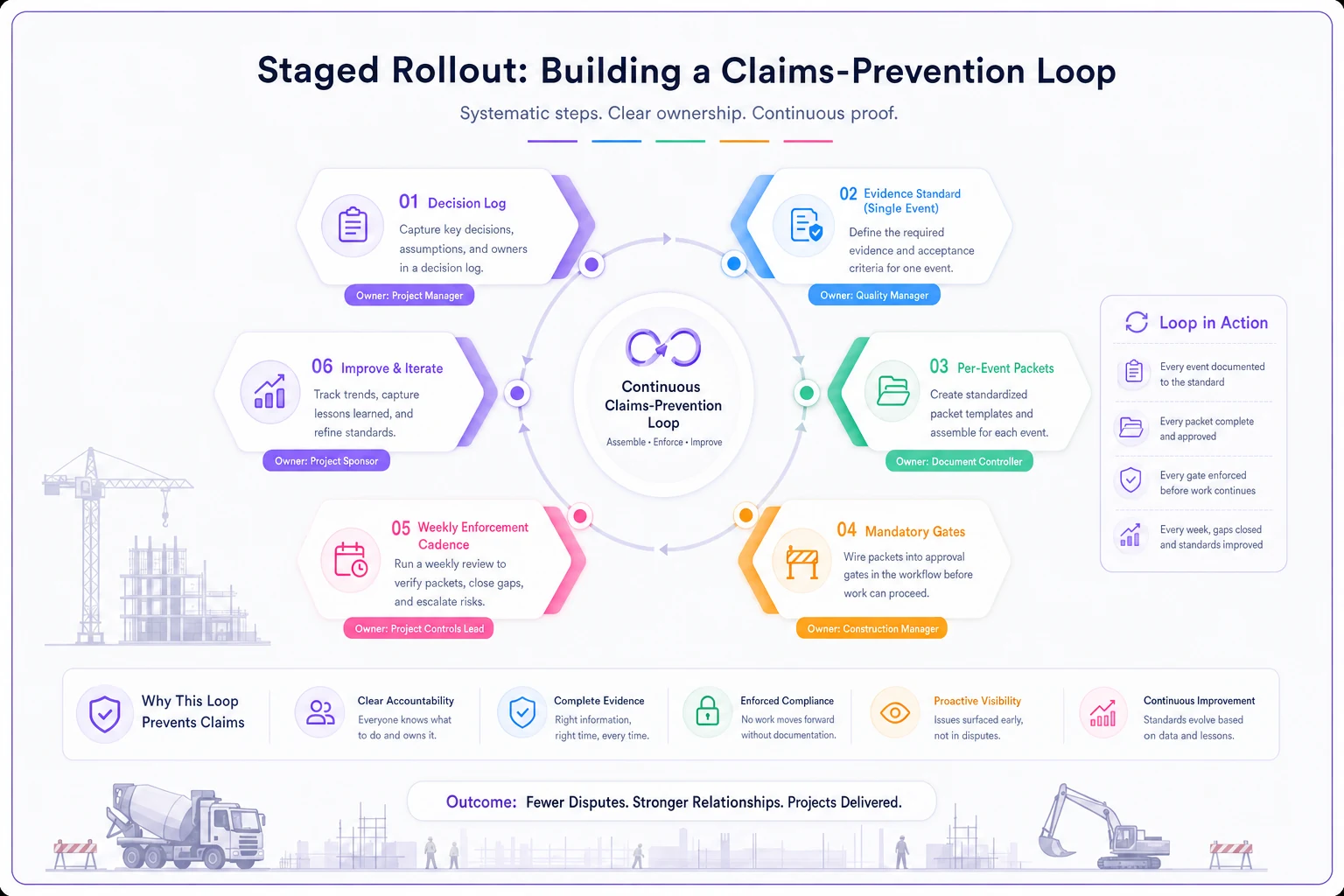
That order — prove value, then enforce — is the operational mantra.
The enforcement cadence nobody wants to own
The loop dies without a cadence, and the cadence dies without a named owner who has the authority to make it uncomfortable to skip.
The failure mode is predictable. Launch goes well. Weeks one through four, logs are full, evidence is clean. By week eight, the PM is firefighting a schedule problem and the review gets skipped "just this week." Week twelve, nobody's checked the logs in a month and they're half-empty. The system didn't fail technically — it failed because no one was accountable for the heartbeat.
Make the weekly review a calendared item with a named backup so it survives short-term staffing pressure.
A workable cadence looks like this: every week, the designated owner reviews whether decision logs are current, whether any open claim events lack their evidence packet, and whether any event type is showing gaps. Anything missing gets chased that day, not next week. The review is short but non-negotiable — it's on the calendar like a safety walk, not "when we get time."
Crucially, the enforcement data itself becomes useful over time. A trade that consistently fails to document conditions is often the same trade generating disputes, and that correlation shows up fast once you're tracking it. This is the same discipline that makes daily crew productivity tracking reliable — a small consistent rhythm beats a big inconsistent effort every time.
Where software earns its place — and where it doesn't
The loop is a discipline first and a tool second. Plenty of projects run a decent version on spreadsheets and shared drives. But at scale, manual assembly becomes the bottleneck: several concurrent projects, each generating dozens of loggable events a week, and a commercial team drowning in reconstruction work.
That's the honest case for an AI-assisted operational platform — not as a magic claims-winner, but as something that removes the friction killing the loop. When evidence capture auto-verifies metadata and flags photos that fail the standard, the "mandatory" gate enforces itself instead of relying on a human to check. When decision log entries can be dictated in the field and structured automatically, the effort-vs-benefit gap that makes field teams resist shrinks considerably. When packets assemble per-event — pulling the notice, the linked evidence, the log entries, and the measured quantities into one place — the 90-day scramble disappears because there's nothing to scramble for.
The point isn't to replace judgment. It's to make the disciplined behavior the path of least resistance, so the loop survives the week the PM is firefighting. Automation handles assembly and gatekeeping; people still decide what the record means.
When this makes sense — and when it doesn't
When it's worth the full build: multi-phase or high-value projects, anything with a history of variation disputes, jobs with a commercially aggressive counterparty, or portfolios where the same claim patterns recur across sites. If your last three projects each settled something you suspect you could've fought, you're already paying for the absence of this system.
When a lighter version is fine: small, short-duration, single-trade jobs with a trusted counterparty. Running full adjudication-ready packets on a six-week fit-out with a long-term partner is governance for its own sake. Keep the decision log, skip the heavy packet machinery.
Who should not do this: teams that won't assign an enforcement owner. If nobody owns the cadence, don't launch the loop — a half-dead governance system is arguably worse than none, because it creates a false sense of coverage. You think you have the record. You don't. That's how you walk into adjudication confident and leave surprised.
A realistic scenario
A mid-sized GC running three concurrent commercial projects was settling variation and delay claims at a rate quietly eating margin — roughly $400k–$500k a year across the portfolio in disputes they either lost or settled rather than fight, most traced back to thin or missing contemporaneous records.
They didn't buy a new system first. They started with the decision log on the most dispute-prone project, added a metadata-verified evidence standard for ground conditions and instructions, and put a 20-minute weekly enforcement review on the ops lead's calendar. Packets got assembled per-event instead of reconstructed after the fact.
Over the following year, the shift wasn't dramatic in any single event — it was the accumulation. Several claims that previously would have been settled got deflected early because the counterparty could see the record was airtight. The team estimated they avoided somewhere in the range of $150k–$220k in settlements they'd historically have conceded. Just as valuable, the commercial team stopped losing weeks to end-of-claim document archaeology. The biggest change wasn't the money — it was that disputes stopped being a source of dread, because the record was simply there.
The real takeaway
Claims prevention isn't about being ready to fight. It's about building a project where fighting is rarely necessary, because the facts were captured cleanly enough and the decisions logged plainly enough that there's nothing ambiguous left to argue over.
The loop — evidence standards, decision logs, per-event packets, and an enforced cadence — is how you get there. Projects that get burned aren't the ones with bad luck. They're the ones that treated the record as something to produce after a problem, instead of something to run continuously so the problem has nowhere to hide. Build the loop while things are calm. You won't have time to build it once the claim lands, and by then, the only record that matters is the one you already have — or don't.
Claims prevention isn't about being ready to fight. It's about building a project where fighting is rarely necessary, because the facts were captured cleanly enough and the decisions logged plainly enough that there's nothing ambiguous left to argue over.
Ready to build smarter and faster?
Join 2,000+ construction teams using Projbrick to improve project visibility, reduce delays, and increase profitability.