


Pull planning works. That's not the problem. Walk onto almost any site where a disciplined last-planner system has taken hold and you'll see cleaner handoffs, fewer surprises, and foremen who actually trust the three-week lookahead. The hard part isn't proving the method on one job. It's getting the second, fifth, and twentieth project to run the same way without you standing in the room.
That gap — between a successful pilot and a portfolio-wide operating rhythm — is where most construction organizations quietly give up. The method gets labeled "a thing we tried on the hospital job" instead of "how we run work here." And the reason it dies has almost nothing to do with the technical side of pull planning and almost everything to do with change management.
This is a systems article, not a list of facilitation tips. It covers how the whole adoption machine works — pilots, micro-training, leader behavior, measurement, and the communications layer that holds it together — and where each piece tends to break as you scale. If you've already read how to operationalize pull planning with PPC rhythms and daily sprints, think of this as the layer above that: the plan for making those rhythms stick across teams that didn't invent them.
The real reason rollouts fail: you scaled a method, not a behavior
The pattern shows up constantly. A project team runs a great pilot. PPC climbs from the low 50s into the 70s. Rework drops. People on that job become believers. Leadership sees the numbers and says "roll it out everywhere."
Then it falls apart — not dramatically, just quietly. The new projects get a two-hour kickoff. Someone hands out a laminated card. A superintendent who wasn't on the pilot runs the weekly meeting the way he's always run it, and within a month it's a status-update meeting wearing a pull-planning costume.
What broke? The organization tried to copy the artifact — the sticky-note wall, the PPC chart — instead of transferring the behavior: crews committing to each other, variances getting examined without blame, commitments being reliable enough to plan around.
Behavior is the hard part because it depends on dozens of small daily habits, and habits don't travel in a PDF. Training transfers knowledge. It doesn't transfer behavior. You can know exactly how a daily huddle should run and still default to your old style the minute you're under schedule pressure. "We trained everyone" is one of the most dangerous sentences in a rollout.
Organizations that scale successfully treat adoption as its own project — with its own plan, owner, milestones, and measurable outcomes. The ones that fail treat it as an announcement.
The five systems that make adoption stick
Scaling an operating rhythm isn't one initiative. It's five interlocking systems, and weakness in any one of them drags down the others. Below is how they connect and where each tends to fail.
Keep your construction projects on schedule and budget.
Projbrick helps you plan, track, and manage every project phase with precision and ease.
- Real-time project tracking
- Resource & budget management
- Team collaboration tools
No credit card required
| System | What it does | Most common failure | What "good" looks like |
|---|---|---|---|
| Pilot design | Proves the method in a controlled setting | Picking an easy or impossible project | A representative, winnable job with a visible scorecard |
| Micro-training | Builds the specific behaviors, not theory | 8-hour classroom dumps | Short, role-specific, repeated reps |
| Leader scripts | Keeps managers reinforcing the right habits | Leaders delegate the behavior | Managers model it, weekly, out loud |
| Measurement | Tells you adoption is real, not theater | Measuring activity, not outcomes | Leading + lagging KPIs on one dashboard |
| Communications | Keeps momentum and surfaces wins/blockers | One kickoff, then silence | A steady cadence tied to KPIs |
These aren't sequential phases you finish and move past. They run in parallel for the entire life of the rollout. A common mistake is treating training as something that "ends," after which communications go quiet and leader scripts get abandoned. The behavior decays almost immediately once reinforcement stops.
Pilot design: pick the project that teaches you something
Most pilot failures are decided before anyone starts. Teams pick the wrong project.
Two bad choices. The first is the too-easy pilot — a simple, well-staffed job with a cooperative GC and no real constraints. It'll produce beautiful numbers that convince nobody, because every skeptic will say "sure, it worked there." The second is the too-hard pilot — a troubled, under-resourced job that leadership hopes pull planning will rescue. When it doesn't perform a miracle, the method takes the blame for problems it was never going to fix.
The right pilot is representative and winnable. Normal complexity, normal trade mix, a superintendent who's skeptical-but-willing. True believers skew your results, and so do active saboteurs. You want a project where success is credible and the lessons actually transfer.
A workable pilot template covers:
-
Scope boundary — which phases or areas are in the pilot, so you're not trying to convert the whole job at once
-
Baseline capture — current PPC, variance reasons, and rework rate before you change anything, measured for at least 3–4 weeks
-
Named roles — who facilitates, who owns the measurement, who's the executive sponsor
-
Success criteria — defined up front, in writing, so nobody moves the goalposts later
-
A fixed review date — the pilot-to-scale decision point, usually 8–12 weeks in
That baseline matters more than people expect. Without it, you'll end a strong pilot and still get the question "but how do we know it was better?" — and you won't have a clean answer.
Micro-training: stop running the eight-hour class
The instinct is to pull everyone into a room for a full day of last-planner theory. It feels thorough. It mostly wastes a day.
Adults don't change work behavior from a lecture. They change it from doing the thing, badly at first, with quick correction, repeated until it's automatic. That's why micro-training beats the marathon class almost every time.
Break the behavior into small modules tied to a specific role and a specific moment in the week:
-
The commitment conversation (15 min) — how a foreman makes a reliable promise and how to say "no, not yet" without it turning into a fight. Practiced live.
-
Running the weekly work plan (20 min) — the actual sequence of the meeting, timed, so it doesn't bleed into an hour of war stories.
-
Variance without blame (15 min) — how to ask "why didn't this happen" in a way that surfaces causes instead of defensiveness.
-
The daily huddle (10 min) — short, standing, same questions every day.
-
Reading the PPC trend (15 min) — so the number means something to the crew, not just the PM.
Each module is short enough to run on-site, between other work, and repeat. One pass isn't training — it's exposure. The behavior tends to set in around the third or fourth rep, which is why the schedule matters as much as the content.
Worth flagging: the people who need the micro-training most are often the experienced superintendents, not the new hires. New people have no habit to overwrite. A 25-year veteran has strong, deeply grooved habits that fight the new rhythm under pressure. Plan your reps accordingly.
How the five systems connect in practice
Understanding how these five systems interact is easier with a picture of how they flow across a rollout. The pilot feeds your baseline data, which informs how micro-training gets structured and sequenced. Leader scripts activate during and after training, reinforcing behavior in real meetings. Measurement tells you whether the behavior is real or theater. And communications keep all of it visible — surfacing wins, flagging blockers, and maintaining momentum as you expand to more projects.
[Pilot Design → Baseline Data] ↓ [Micro-Training Modules] ←→ [Leader Scripts] ↓ ↓ [Measurement Dashboard (PPC + Lagging KPIs)] ↓ [Communications Cadence → Cross-Project Rollout]
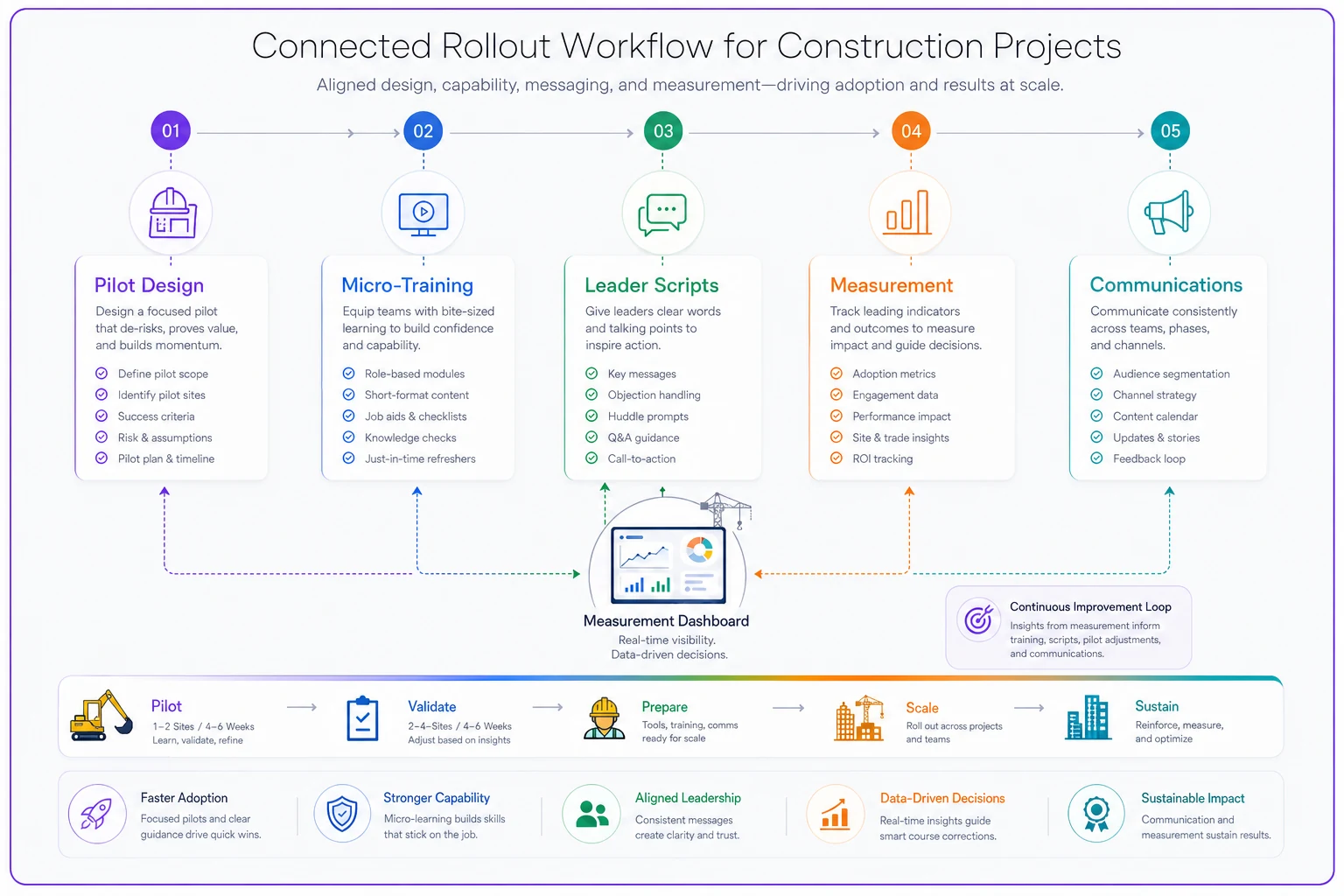
None of these systems fully work in isolation. A strong pilot with no leader scripts means the behavior dies on the second project. Good measurement with no communications means nobody acts on what the data shows. The rollout only compounds when all five stay active simultaneously.
Leader scripts: the behavior dies without reinforcement from above
This is the piece nearly everyone underestimates. You can run flawless pilots and sharp micro-training, and the whole thing still evaporates if managers don't visibly reinforce it.
Crews read what leaders do, not what they say. If a project exec walks into the weekly work plan, checks his phone, and leaves early, every person in that room learns the meeting doesn't actually matter. If that same exec asks "what commitments are at risk this week and what do you need from me," the room learns the opposite.
Leader scripts are simple, almost embarrassingly so — a short set of questions and behaviors managers commit to using consistently:
-
In the weekly plan
"What did we commit to last week, and what's our PPC?"
-
When a variance shows up
"What caused it?" — then stop talking and listen. No jumping to blame.
-
When someone flags a constraint early
visible appreciation, because early flags are exactly the behavior you want more of.
-
In one-on-ones with supers
"Where's the rhythm slipping, and why?"
The reason to script these is that under schedule pressure, managers revert to command-and-control. They start dictating instead of building commitments. The script is a guardrail against that stress reflex. It's not about making leaders robotic — it's about giving them a default that protects the behavior when things get tense.
A good test of whether your leader layer is working: ask a foreman what the project manager brings up every week. If the answer is "the schedule and who's behind," reinforcement is weak. If it's "our reliability and what's blocking us," it's working.
Measurement: track adoption, not activity
A lot of dashboards go wrong here. They measure activity — how many meetings happened, how many people got trained, how many tasks got entered in the system. All of that can be green while the actual behavior is dead.
You need two layers of measurement running together.
Leading indicators tell you whether the rhythm is real:
-
PPC (percent of plan complete) — the backbone metric
-
Variance reasons being captured and categorized, not just "weather" every week
-
Constraint-removal lead time — how far ahead constraints get flagged and cleared
-
Meeting discipline — did the weekly plan run on time, with the right people
Lagging indicators tell you whether it's producing value:
-
Schedule reliability against milestones
-
Rework hours
-
RFI and change-order turnaround
-
Trade-stacking conflicts avoided
The connection between these two layers is the whole point. Rising PPC that doesn't eventually move schedule reliability means people are gaming the number — committing to safe, easy tasks. Falling rework with no corresponding PPC story means you got lucky, not systematic. The dashboard should make both layers visible on one screen so the relationship is obvious.
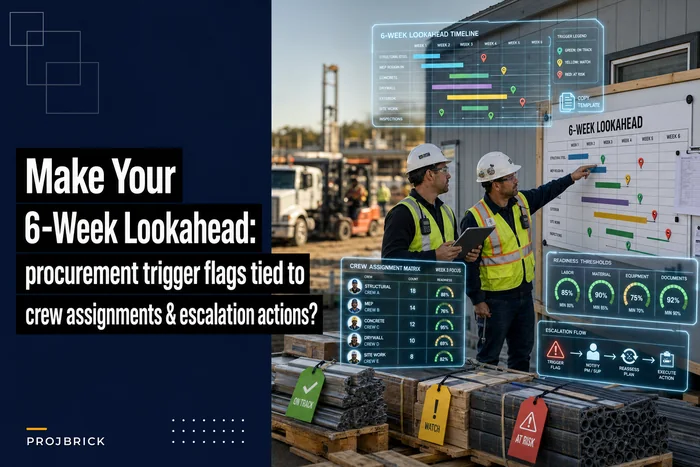
When you tie this measurement back into the actionable six-week lookahead with procurement trigger flags, you start to see constraint-removal lead time and material readiness reinforcing each other — the planning rhythm and the supply chain finally talking.
One practical note on the dashboard itself: the superintendent should be able to update it in under five minutes a week. If measurement becomes a reporting burden, people fake it or skip it. This is where connected workflow or project-management platforms earn their keep — not as the star of the show, but as the thing that quietly pulls PPC, variance reasons, and constraint data together so nobody's rebuilding a spreadsheet every Friday. When the numbers roll up automatically, leaders actually look at them.
Communications: momentum is a maintained thing
Rollouts don't fail with a bang. They fade. The kickoff is energetic, and then month three arrives, nobody's heard anything, and the whole effort feels like last quarter's initiative.
A communications plan fixes this by keeping the rollout continuously visible. Not spammy — just a steady drumbeat tied to real KPI movement:
-
A short weekly or biweekly note to project leadership with the current PPC trend and one blocker
-
A monthly cross-project comparison so teams can see where they stand relative to peers — friendly competition does real work here
-
Visible wins
"the garage pour sequence went off without a single trade conflict because the plan caught it three weeks out"
-
Honest reporting of what's not working, because hiding struggles kills credibility faster than the struggles themselves
The most useful communications are specific. "Adoption is going well" means nothing. "Project A's constraint lead time went from two days to nine, and here's the one change that did it" gives other teams something to actually copy.
A real scenario: from one convinced team to four
A mid-sized GC — roughly a dozen active projects, mostly commercial interiors and mid-rise — ran a strong pilot on a single office fit-out. PPC went from the mid-50s to the mid-70s over about ten weeks. The pilot team was sold.
Then they tried to scale to four more projects at once and immediately hit the wall. Two of the four never got past "meeting theater." PPC on those sat flat around 55. The difference wasn't the crews or the method — it was that the pilot had a dedicated facilitator and an engaged exec, and the new projects had neither. Nobody owned the behavior.
They reset. Instead of a wide, shallow rollout, they went narrow and deep: two projects at a time, each with a named facilitator, micro-training repeated weekly for the first month, and project execs committed to the leader script in every weekly plan. They also moved all the measurement onto one shared dashboard so supers weren't hand-building reports.
Over the next quarter, the two new projects reached PPC in the high 60s. Rework hours dropped somewhere in the range of 15–20%. More importantly, when they rolled to the next two projects, the earlier teams helped train them — the behavior had finally become transferable. That's the real marker of success: adoption that spreads without the original champion in the room.
Pilot-to-scale checklist
Before you expand beyond the pilot, work through this. If you can't check most of these, you're scaling too early.
-
- [ ] Baseline metrics were captured before the pilot started
-
- [ ] Pilot hit its predefined success criteria, not moved goalposts
-
- [ ] PPC improvement is backed by a lagging indicator (rework, reliability)
-
- [ ] Variance reasons are being captured with real categories, not "weather" every week
-
- [ ] A named facilitator exists for each new project — not "the PM will handle it"
-
- [ ] Executive sponsors have committed to the leader script, in writing
-
- [ ] Micro-training modules are built and scheduled to repeat, not run once
-
- [ ] The measurement dashboard updates in under five minutes a week
-
- [ ] A communications cadence is scheduled through the end of the rollout
-
- [ ] You're scaling two projects at a time, not everything at once
This checklist isn't meant to be perfect — it's meant to force an honest conversation before you commit resources. Most teams that rush the scale-up can point back to two or three of these boxes they skipped.
When this is worth it — and when it isn't
When it makes sense: You've got a portfolio of similar projects, repeat crews or trade partners, and enough runway that the behavior has time to set in. Change management of this kind pays off most when you're running the same type of work repeatedly — the investment amortizes across projects.
When it's a bad idea: On a single one-off project with a team that disperses at closeout, a full adoption program is overkill. Run the method, skip the heavy change-management scaffolding. You're not building something that needs to spread.
Who should not attempt this yet: Organizations where leadership won't commit to the leader-script behavior. If your execs see this as "something the PMs do" rather than something they personally reinforce, don't bother scaling. The reinforcement layer isn't optional, and without it you'll spend real money proving, again, that announcements don't change behavior.
The takeaway
Scaling pull planning across a construction portfolio isn't a training problem or a software problem. It's a behavior-transfer problem, and behavior only transfers when five systems — pilot design, micro-training, leader scripts, measurement, and communications — run together and keep running.
The method proves itself easily on one job. Making it how you work across every job takes a deliberate change-management system, owned like any other project, measured against real adoption KPIs, and reinforced long after the kickoff energy fades. Start narrow, go deep, measure what actually matters, and don't scale until the behavior spreads on its own. That last part — adoption that keeps going without the champion in the room — is the only real proof it worked.
Ready to build smarter and faster?
Join 2,000+ construction teams using Projbrick to improve project visibility, reduce delays, and increase profitability.