

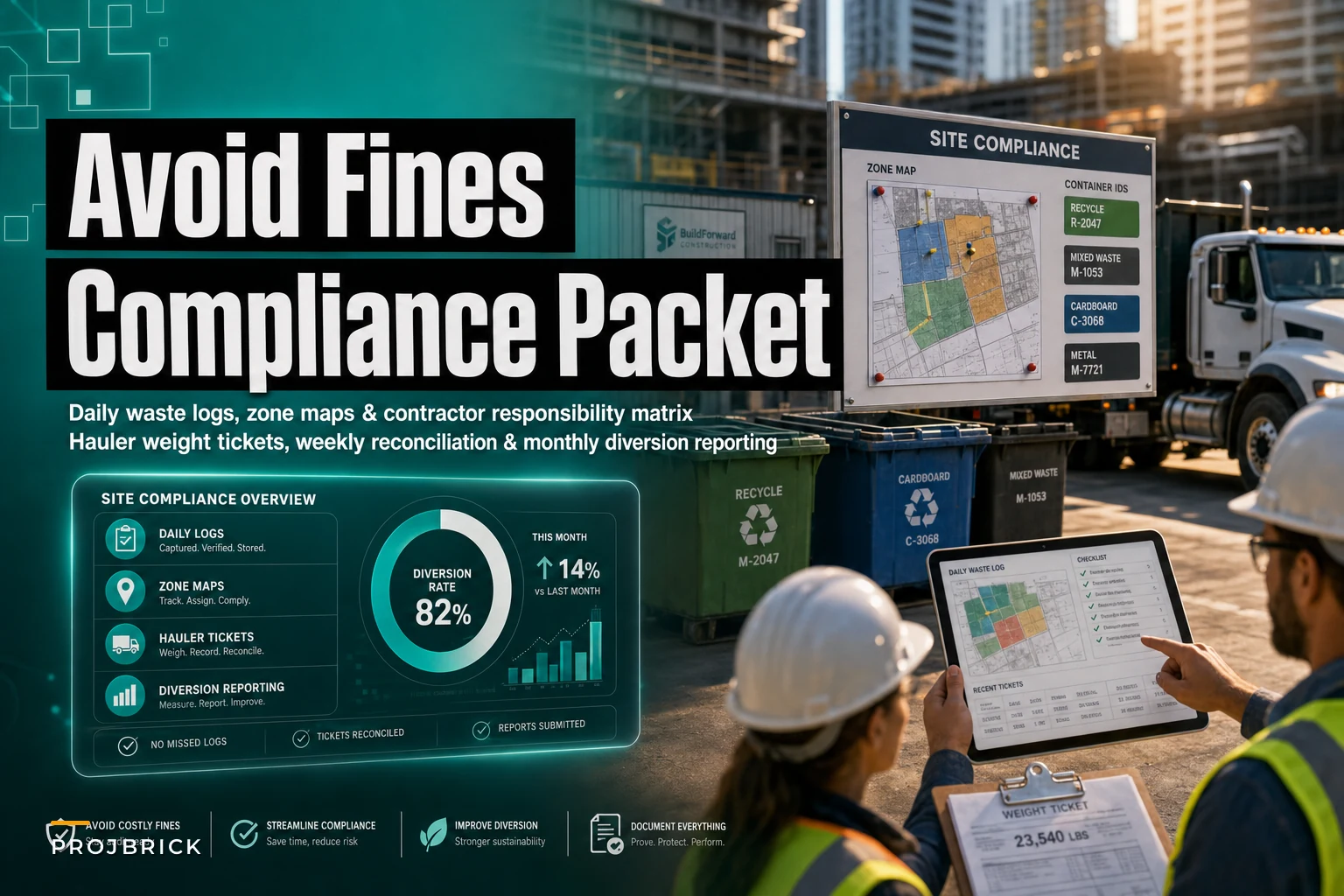

Most PMs treat construction and demolition (C&D) waste as a hauling line item. You call the disposal company, they drop a roll-off, they take it away. Done. But in dense urban jurisdictions, that whole cycle is now governed by diversion mandates, manifest requirements, and reporting deadlines that carry real teeth — and the fines rarely show up as one big number. They show up as a slow drip of $250 here, $1,500 there, sometimes tied per-day to a missed report, until suddenly your project's disposal budget is 20% over and nobody can explain why.
The frustrating part is that almost none of these violations come from actually doing anything wrong on site. They come from missing documentation. You diverted 78% of your waste, hit the mandate, kept everything clean — but you can't prove it in the format the municipality wants, by the date they want it, and that gap alone triggers the penalty. An urban construction waste compliance packet exists to close that gap: to make the proof automatic rather than a scramble at month-end.
This post is about building that packet. Not a philosophy of sustainability — the actual templates, the site zoning that keeps your logs honest, the responsibility matrix so contractors don't point fingers, and a reporting cadence that keeps you ahead of the deadline instead of chasing it.
Where the fines actually come from (it's not what you'd guess)
Talk to any PM who's eaten a sustainability fine on a downtown project, and the story is almost never "we sent recyclables to landfill." It's procedural. The pattern that keeps repeating:
-
The site produced clean, separated waste, but the daily logs were reconstructed from memory at the end of the week, so tonnage doesn't match the hauler's weight tickets.
-
A subcontractor threw mixed debris into the wrong container for three days, contaminating a load, and nobody documented the corrective action — so the diversion rate the city sees is lower than what actually happened.
-
The monthly diversion report was late because the person who compiles it was covering two jobs, and the jurisdiction fines per day past the deadline.
-
The demolition contractor and the fit-out contractor both assumed the other one was tracking gypsum and metal separately.
None of these are engineering problems. They're coordination and record-keeping problems. And that's actually good news, because coordination problems are fixable with templates and a rhythm — you don't need to change how anyone builds.
The mistake most teams make is treating compliance as a reporting task that happens after the waste leaves site. By then the data is gone. Real compliance is a capture task that happens the moment material hits a container.
The four documents that make up the packet
A site-level compliance packet doesn't need to be thick. Across the jobs that stay out of trouble, it's usually four working documents that live together and reference each other.
Keep your construction projects on schedule and budget.
Projbrick helps you plan, track, and manage every project phase with precision and ease.
- Real-time project tracking
- Resource & budget management
- Team collaboration tools
No credit card required
| Document | What it captures | Who owns it | Update frequency |
|---|---|---|---|
| Daily waste log | Material type, container, estimated volume/weight, destination | Site foreman / gate | Daily, per shift |
| Zone map (recycling/staging) | Physical container locations, signage, contamination rules | PM + logistics | Per phase change |
| Contractor responsibility matrix | Which trade handles which waste stream and its separation | PM | At mobilization, revised per trade |
| Corrective-action & reporting log | Contamination events, fixes, monthly diversion submission dates | PM / compliance lead | As events occur + monthly |
Each one is boring on its own. Together, they let you answer any inspector's question in under five minutes with a paper trail that matches the hauler's tickets. That match — log tonnage reconciling to weight tickets reconciling to the diversion report — is the single thing that keeps you clean.
1. The daily waste log (the one people skip)
This is the document that gets neglected first and costs the most. A daily log feels like busywork on a day when nothing went wrong. But the value isn't in any single entry — it's in having a continuous record that reconciles against hauler weight tickets at month-end.
-
Date and shift
-
Material stream (concrete/masonry, metal, wood, gypsum, cardboard, mixed C&D, hazardous)
-
Container ID (must match the zone map)
-
Estimated quantity (volume in the container or weight if metered)
-
Destination / hauler and ticket number when hauled
-
Contamination noted? (yes/no + short note)
Don't ask the foreman to weigh anything. Ask for an estimate tied to container fullness — "3/4 full 30-yard metal roll-off." The actual weight comes from the hauler ticket later, and your reconciliation is the estimate vs. the ticket. When those two drift consistently, you've found either a measurement problem or a contamination problem, and you found it early.
2. Zoning for recycling and staging
Your logs are only as honest as your physical layout allows. If the metal container and the mixed-C&D container sit next to each other with no signage, contamination is guaranteed, and no amount of log discipline will save you. Waste zoning is really an extension of the same thinking behind your general site logistics — if you've already worked through material staging layouts for constrained urban sites, the waste-side zone map slots right into the same drawing.
-
Separates streams physically so throwing debris in the wrong bin takes deliberate effort, not just laziness.
-
Puts the high-volume stream closest to the work face — if the demo crew has to walk 40 meters to the correct container, they won't, and you'll get contamination by convenience.
-
Marks every container with the same ID used in the daily log, so the paper trail and the physical site never disagree.
On tight urban lots where you barely have room for one roll-off, the move is scheduling — you rotate streams through the same footprint by phase rather than parking five containers you don't have space for. That's a coordination call, and it belongs on your phase plan, not left to the hauler.
3. The contractor responsibility matrix
This is where finger-pointing dies. When a load gets contaminated and the diversion rate drops, the argument is always "that wasn't our waste." A responsibility matrix written at mobilization removes the argument entirely because everyone signed off on who handles what.
Structure it as a simple grid: waste stream down the side, trade contractor across the top, and in each cell one of three values — Generates, Separates, or Not applicable. The contractor who generates a stream is the one responsible for putting it in the right container and reporting contamination. No ambiguity.
The pattern worth flagging: overlap streams cause the most disputes. Gypsum offcuts, packaging cardboard, and mixed metal get generated by three or four trades at once. Assign a single accountable trade per stream per phase, even if multiple trades touch it. Shared responsibility is the same as no responsibility.
Corrective-action thresholds: knowing when to actually do something
Not every contamination event needs a formal response. If you escalate everything, people stop reporting anything. The trick is setting thresholds so the response scales with the problem.
-
Level 1 — Single-instance contamination. One wrong item in a container. Fix: log it, remove it, verbal reminder to the crew. No paperwork beyond the log note.
-
Level 2 — Repeat contamination, same crew, same stream, within a week. Fix: written notice to the responsible contractor per the matrix, container re-signage, note in the corrective-action log. This is the level that protects you in an audit.
-
Level 3 — Load rejection or a contaminated haul that drops your monthly diversion below the mandate. Fix: formal corrective-action notice, root-cause note, and a documented plan to recover the diversion rate before month-end. This one goes in the report proactively.
The reason to document Level 2 and 3 formally is subtle: if your diversion rate dips one month, a documented corrective action is often the difference between a fine and a warning. Jurisdictions penalize negligence, not honest problems that you visibly caught and fixed. The corrective-action log is your evidence that you were paying attention.
This mirrors the discipline behind a good temporary works inspection pocket guide — quick, dated evidence captured at the moment it matters, not reconstructed later when it's already too weak to defend you.
The reporting cadence that keeps you off the fine list
Most diversion fines in urban jurisdictions are date-driven. The report is due by the 10th; it lands on the 14th; you're charged per day. The fix isn't working harder at month-end — it's a cadence that treats the deadline as a downstream product of daily work.
-
Daily Foreman completes the waste log at shift end. Two minutes. Non-negotiable.
-
Weekly PM or compliance lead reconciles the week's logs against hauler weight tickets. This is where drift gets caught while it's still fixable.
-
Bi-weekly Running diversion-rate check against the mandate. If you're trending below, you have two weeks to correct — reroute a stream, add separation, address the contamination source.
-
Monthly Compile and submit the diversion report at least three business days before the deadline. The buffer absorbs the one time the hauler ticket is late.
The single most valuable habit here is the weekly reconciliation. Teams that do it never get surprised by their monthly number, because they've been watching it accumulate. Teams that skip it discover on the 8th that they're 6 points under the mandate with two days to fix a month's worth of drift — which is impossible.
A quick real-world scenario
A mid-size interiors contractor running a full-floor commercial fit-out in a diversion-mandate jurisdiction was getting nicked roughly $1,200–$1,800 a month in late-report penalties and one contaminated-load charge. Their actual diversion was fine — around 74%, comfortably over the 70% mandate — but their reports were consistently a few days late because one coordinator was compiling them by hand across two projects, and twice the hauler tickets didn't match their guessed tonnage, which triggered a review.
The change wasn't dramatic. They put the four-document packet in place, moved the metal and gypsum containers so separation took no extra effort, assigned single accountability per stream, and shifted to weekly reconciliation with a three-day report buffer. Over the next quarter the late penalties went to zero, and because the logs now reconciled against tickets, the contaminated-load disputes stopped too. A few thousand dollars recovered per quarter — but the bigger win was that nobody spent the last week of every month scrambling.
When this level of rigor makes sense — and when it's overkill
When it makes sense: Any project in a jurisdiction with a diversion mandate, per-day reporting penalties, or manifest requirements. Any job with multiple trades generating overlapping waste streams. Any demolition-heavy scope where tonnage is high enough that a contaminated load actually moves your diversion rate.
When it's overkill: Small single-trade jobs in jurisdictions with no mandate and no reporting requirement. If your entire waste output is one mixed roll-off and nobody's asking for a diversion report, a full packet is more overhead than the risk justifies — a simple hauler-ticket file is enough.
Who should not lean on this: Teams that won't enforce the daily log. The whole system depends on capture at the source. If the foreman won't spend two minutes at shift end, the packet becomes a fiction that looks compliant on paper and falls apart the moment an inspector cross-checks it against hauler tickets. Better to be honestly minimal than dishonestly thorough.
Keeping it all connected without drowning in spreadsheets
Four documents updated daily, weekly, and monthly across multiple contractors gets messy fast when it lives in loose spreadsheets and someone's email. Logs get versioned wrong, the zone map on site doesn't match the one in the office, and the reconciliation depends on one person remembering to do it.
This is where teams start centralizing the packet in a shared workflow or operational platform — somewhere the daily log, the container IDs, the responsibility matrix, and the reporting deadlines all reference each other and flag drift automatically. When the weekly reconciliation surfaces a mismatch on its own, or the system reminds you three days ahead of a submission deadline, the discipline stops depending on any single person's memory. That's the practical value: not fancy automation for its own sake, but closing the manual gaps where fines actually sneak in.
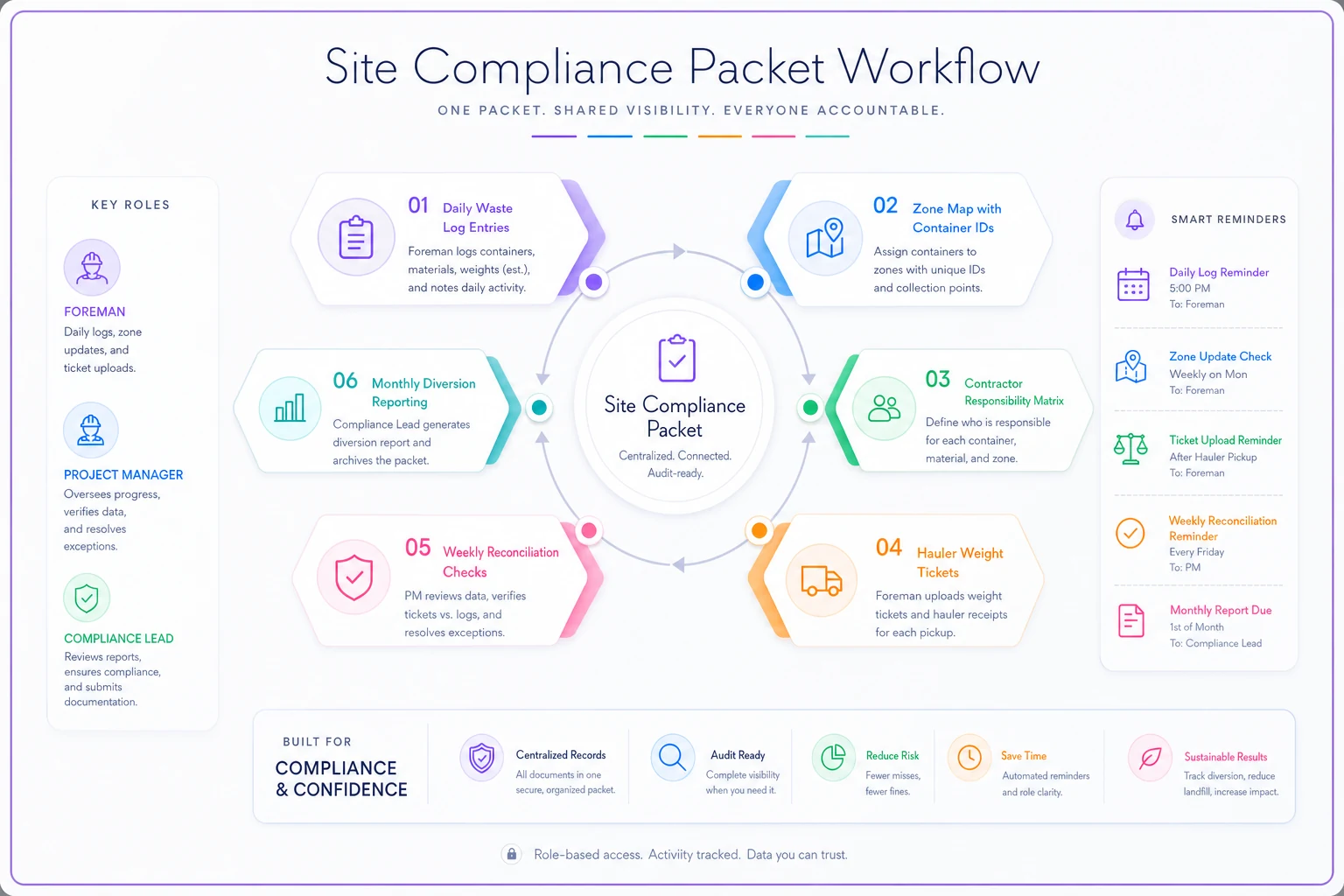
The graphic outlines the shared-workflow process for the packet.
Run your weekly reconciliation on the same weekday each week so it becomes a repeatable habit.
You don't need software to run this well — plenty of clean jobs run it on a shared drive and a wall-mounted zone map. What you do need is the packet itself, real accountability per stream, and a cadence that treats the deadline as the last step of a process you've already completed, not a monthly emergency. Get those three right and the fines simply stop having a way in.
You don't need software to run this well — plenty of clean jobs run it on a shared drive and a wall-mounted zone map. What you do need is the packet itself, real accountability per stream, and a cadence that treats the deadline as the last step of a process you've already completed, not a monthly emergency. Get those three right and the fines simply stop having a way in.
Ready to build smarter and faster?
Join 2,000+ construction teams using Projbrick to improve project visibility, reduce delays, and increase profitability.