

The worst laydown conflicts don't blow up out of nowhere. They've been quietly assembling for days — two POs with overlapping delivery windows, a crane pick scheduled on top of a rebar drop, a subcontractor who assumes their lane is still open when it got reassigned on Tuesday. By the time it surfaces, you've got a truck idling at the gate, a foreman on the phone, and nowhere to put 40 bundles of anything.
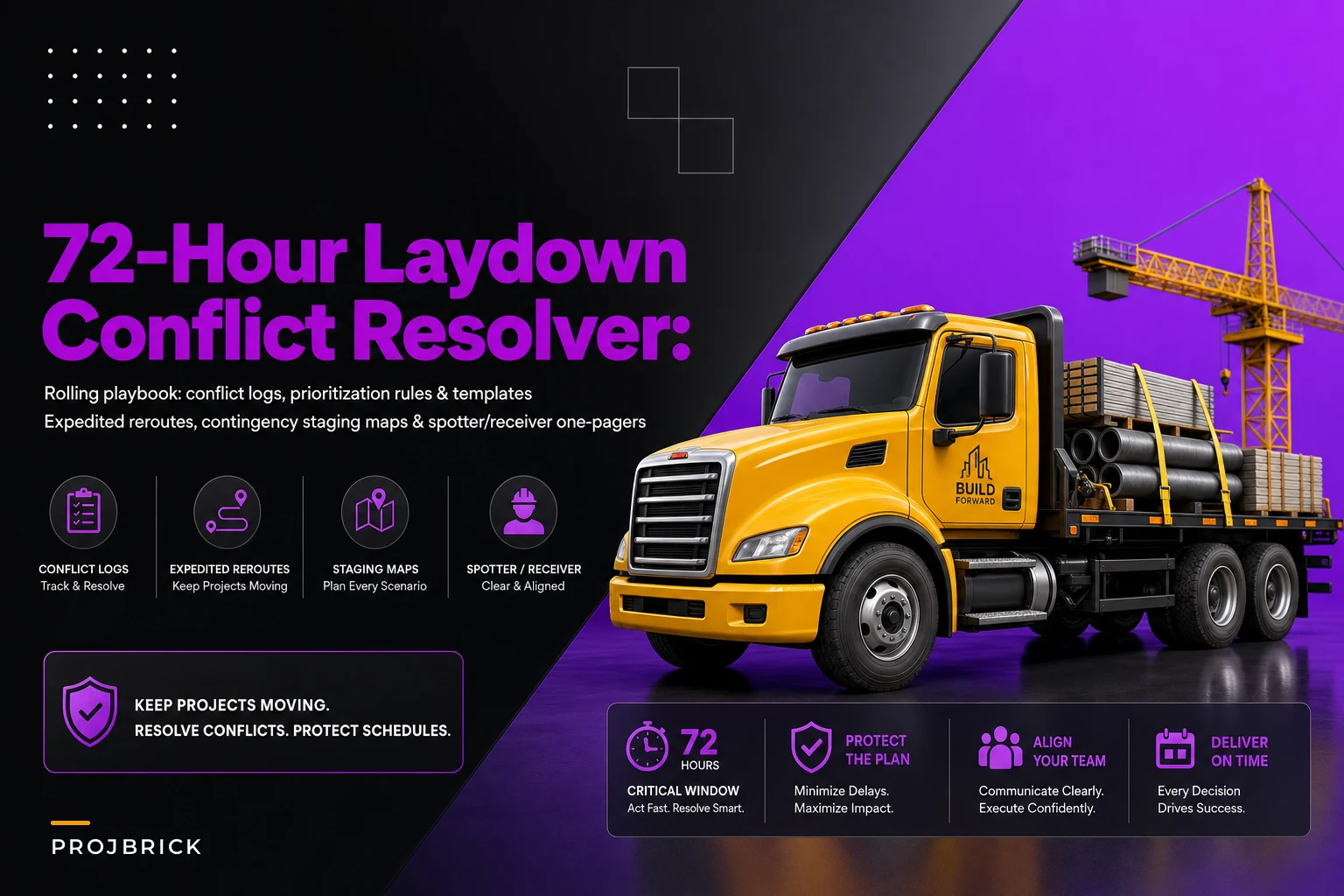
The window where you can actually fix this cheaply is about three days wide. Inside 72 hours, deliveries are confirmed, trucks are dispatched or dispatching, and crews are already planning their day around what they think is coming. That's where this playbook lives. Not the six-week lookahead, not the annual logistics plan — the rolling 72-hour horizon where a clash is close enough to be real but still far enough to reroute.
Why laydown conflicts cluster inside the 72-hour window
Most sites plan staging at the macro level and then let the final 72 hours run on habit and radio chatter. That's the gap. The six-week view tells you roughly when steel, MEP rough-in materials, and formwork show up. It almost never resolves the hour-by-hour reality of where a specific truck parks on a specific Thursday.
A typical breakdown looks like this. Procurement confirms three deliveries for the same morning because each was negotiated separately and nobody cross-checked the gate schedule. The GC's logistics plan assumes Zone C is free, but framing ran two days long and is still using it for offcuts and strongbacks. Meanwhile a crane lift got added late to catch up a slipped pour, and it needs the exact footprint where the duct delivery was supposed to land.
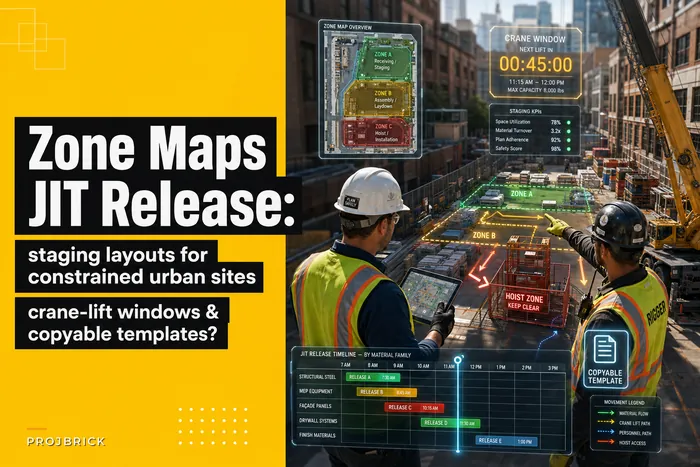
None of these are mistakes exactly. They're independently reasonable decisions that collide because no single person is holding the full picture at the 72-hour range. On constrained sites especially, the problem compounds — there's simply no slack to absorb a double-booking. If you've worked through material staging layouts for constrained urban sites, you already know how little margin exists when zones are measured in square meters and crane windows are measured in minutes.
The other reason these cluster late: deliveries firm up late. A supplier who said "week of the 14th" doesn't become "Tuesday, 7am, two trucks" until a day or two out. So the real conflict data only becomes visible right when you have the least time to act on it.
The conflict log: making the clash visible before it's at the gate
You can't prioritize what you can't see. The first piece is a conflict log that any coordinator, foreman, or spotter can update, and that gets reviewed at a fixed cadence — ideally twice a day during active delivery stretches.
Keep your construction projects on schedule and budget.
Projbrick helps you plan, track, and manage every project phase with precision and ease.
- Real-time project tracking
- Resource & budget management
- Team collaboration tools
No credit card required
The log doesn't need to be fancy. It needs to be consistent and honest about timing. Here's the minimum field set that actually works:
| Field | What it captures | Why it matters |
|---|---|---|
| Conflict ID | Simple sequential tag | So you can reference it on radio/text without ambiguity |
| Window | Date + time block | The 72-hour clock starts here |
| Resource in contention | Zone, gate, crane, forklift, dock | Pins down exactly what's double-booked |
| Parties | Who/what wants it (PO#, trade, lift) | Shows who you'll have to call |
| Impact if unresolved | Idle crew, demurrage, blocked pour | Feeds prioritization |
| Flex available | Can it move? By how long? | Separates hard from soft conflicts |
| Status | Open / Rerouted / Staged / Closed | Keeps it from falling through |
The field that teams skip and later regret is Flex available. Logging that a delivery can slide two hours, or that a trade can't start past 9am without blowing their day, is what turns a vague "we have a problem" into a solvable scheduling puzzle. Capture flex at the moment you learn about the conflict, because by the next review the person who knew is already on another call.
Log suspected clashes the instant someone suspects them; early logging makes rerouting possible.
One practical habit worth keeping: log the conflict the instant someone suspects it, not when it's confirmed. A suspected clash logged at hour 70 is a reroute. A confirmed clash discovered at hour 4 is demurrage.
Prioritization rules: deciding who wins when both can't happen
When two deliveries or activities genuinely cannot share the resource, you need a rule set that decides fast — before it becomes a negotiation between whoever yells loudest. The goal is to protect the critical path and minimize total cost of disruption, not to be "fair."
-
Critical-path protection first. If one item feeds a critical-path activity (a pour, a crane-dependent lift, an inspection gate) and the other doesn't, the critical-path item wins. Full stop.
-
Irreversibility second. A concrete truck can't wait indefinitely. A lift with a booked mobile crane has a hard clock and a day rate. Perishable or clock-bound resources beat flexible ones.
-
Cost of delay third. Compare demurrage, idle crew cost, and knock-on rework. A delivery that costs $400 in truck wait loses to one that idles a six-person crew.
-
Reversibility of the loser. The item that loses should be the one that's easiest to recover — can be rerouted, restaged, or rescheduled with the least downstream damage.
-
Flex you already logged. If one party flagged two hours of flex, they're the natural mover. This is exactly why the flex field matters.
A quick worked example. You've got a steel delivery (two trucks, 7am) and a MEP rough-in material drop (one truck, 7:15am) both assigned to the same gate and the only forklift. Steel feeds the next day's connection work — not critical-path-today. The MEP drop feeds a crew of five that's otherwise idle and a coordination window that closes at 10am. Cost of delay on the MEP side is roughly five idled trades plus a blown coordination slot; the steel can sit on a secondary pad until the forklift frees up around 8:30. Steel loses the gate, MEP wins, and you've avoided idling the crew. The steel's "loss" costs maybe 90 minutes of restaging and no demurrage because you called the carrier at hour 68.
The mistake most teams make is treating every conflict as a one-off debate. Write the rules down once. Then the coordinator applies them in two minutes instead of convening a meeting while a truck burns an hour at the gate.
Expedited reroute: moving a delivery without creating the next clash
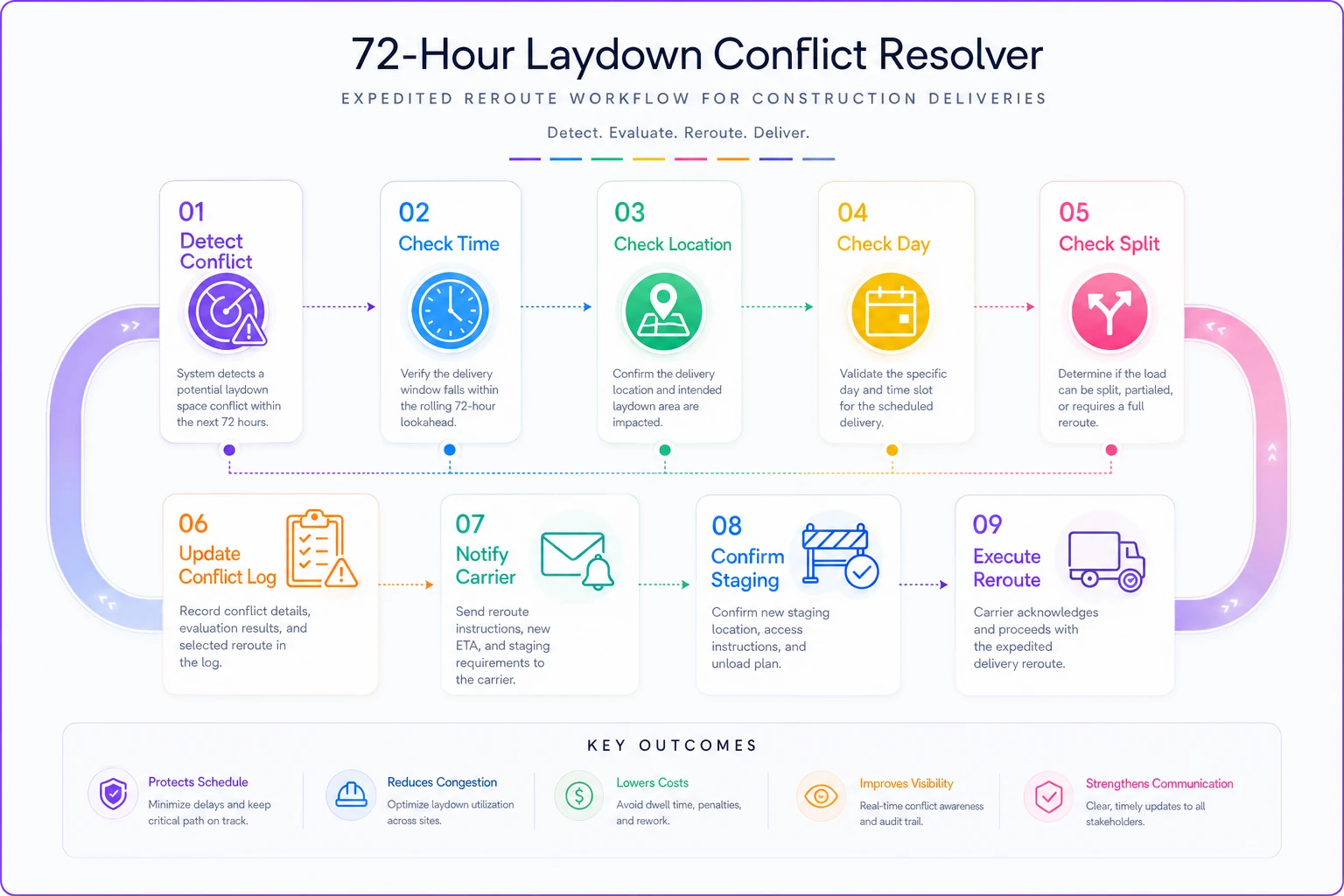
Once prioritization names a loser, you reroute it. The trap is solving today's clash by creating tomorrow's. A good reroute checks downstream before it commits.
-
Can the time move? First ask whether a two-to-four-hour shift clears the conflict entirely. Often it does, and it's the cheapest fix. Confirm the carrier can hold and that the new window doesn't collide with something already logged.
-
Can the location move? If time can't flex, can the delivery land in a secondary staging zone or an off-site holding yard and get shuttled in? This costs double-handling but keeps the primary resource free.
-
Can the day move? If neither works, push to the next day — but only after checking that the next day isn't already loaded. Pushing blindly into tomorrow is how you build a rolling pileup that gets worse each day.
-
Can it split? Sometimes half the load lands now and half later. Underused as an option, but it clears gate pressure when a full truck won't fit the window.
Whatever you choose, update the log and notify the carrier in writing with the new window, gate, and contact. A reroute that lives only in someone's head isn't a reroute — it's a second conflict waiting to happen.
A concise workflow helps make reroutes consistent:
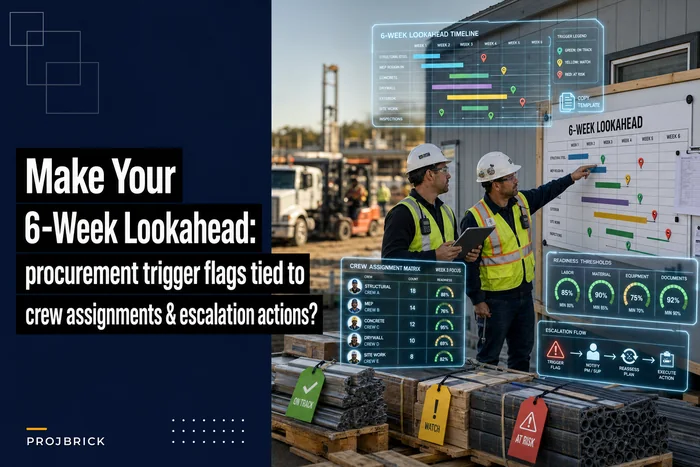
Teams that do this well treat the rolling lookahead as the backstop. When your 6-week lookahead is actually actionable — with real procurement triggers tied to crew assignments — far fewer deliveries even reach the 72-hour window in conflict. The playbook here is the emergency room; the lookahead is the primary care that keeps you out of it.
Contingency staging maps: pre-deciding where overflow goes
The fastest reroutes happen when you've already decided, before any conflict arises, where overflow can go. A contingency staging map is just your normal zone map with pre-designated fallback positions marked and rated.
For each primary staging zone, mark:
-
A first-fallback position (nearest usable space, same or adjacent gate)
-
A second-fallback (further out, more double-handling, still on-site)
-
An off-site holding option with its shuttle lead time
Then rate each fallback for what it can actually take — load type, weight, access for the handling equipment, and whether it blocks anything when occupied. A fallback that works for duct bundles may be useless for steel. A fallback that's clear today becomes a trap if it's on another trade's path tomorrow.
Keep the map current with the 72-hour view. Fallback zones shift daily as work progresses, and the map is only useful if someone owns updating it — which brings us to the reason most of this falls apart: coordination at the gate.
Spotter and receiver one-pagers: the last 50 feet
Everything above is useless if the person at the gate doesn't know the plan. Spotters and receivers operate at the exact moment of conflict, and they often improvise because nobody handed them a decision tool. A one-page sheet per role fixes most of that.
Spotter one-pager — what it needs:
-
Today's confirmed delivery windows and their assigned zones
-
Which zones are hot (in use), cold (available), or fallback
-
Crane/forklift windows that block gate access
-
Who to call for a conflict, in order (coordinator → logistics lead → PM)
-
The three-line version of the prioritization rules, so they can hold a truck for the right reason
Receiver one-pager — what it needs:
-
PO/delivery checklist
what's expected, quantity, condition check
-
Where it goes (primary zone) and where it goes if that's blocked (fallback)
-
The log entry format — so a conflict gets captured, not just radioed and forgotten
-
Demurrage clock awareness
when a waiting truck starts costing money and who decides to release or hold
The single highest-value line on either sheet is the escalation order with names and numbers. When a spotter knows exactly who to call and in what sequence, a conflict that used to eat 40 minutes of gate standoff gets a decision in five.
Reprint these daily. A one-pager from Monday pointing a truck to a zone that framing reoccupied on Wednesday is worse than no sheet at all.
A real scenario: mid-rise fit-out, three trades, one gate
A mid-rise commercial fit-out running MEP rough-in, drywall, and early finishes had a single usable loading gate and two small interior staging zones. Deliveries were scheduled by each sub's own buyer, confirmed late, and coordinated over a group text that nobody treated as authoritative.
Over a typical two-week stretch they were eating roughly three to four delivery clashes a week — trucks waiting, crews standing around, the occasional demurrage charge. Nobody could point to the pattern because nothing was logged; it was all in the thread and in people's heads.
They introduced three things, nothing more: a shared conflict log reviewed every morning and midday, a written prioritization rule set taped by the logistics coordinator's desk, and daily-reprinted spotter/receiver sheets with the fallback zones and escalation order.
The change wasn't dramatic in equipment or headcount. It was just visibility and pre-made decisions. Within about three weeks, conflicts reaching the gate dropped to roughly one a week, and the ones that did show up got resolved in minutes instead of a standoff. Demurrage essentially stopped. The coordinator's rough estimate was somewhere around 6–8 recovered crew-hours a week across the trades — not a transformation, just the end of a steady, dumb leak.
The lesson they took from it: the conflicts weren't a people problem. The information just never existed in one place at the right time.
When this playbook is worth it — and when it's overkill
This system earns its keep on sites where staging is tight, gates are shared, and multiple trades are receiving deliveries on overlapping windows. Constrained urban sites, busy fit-outs, and any job where you've already paid demurrage this month — those are the clear cases.
It's overkill on a sprawling site with acres of laydown and one or two deliveries a day. If a truck can always find somewhere to park and nothing's ever genuinely in contention, a full conflict log is bureaucracy. A simple delivery calendar is enough.
It's also the wrong tool if your real problem is upstream — if deliveries are chronically wrong, late, or unconfirmed, no amount of gate-level rerouting fixes that. That's a procurement and lookahead issue, and the 72-hour resolver will just keep catching the same fires. Fix the forecasting first, then use this to handle the genuine, unavoidable collisions that remain.
Keeping it rolling
What makes this a rolling playbook rather than a one-time cleanup is cadence. Twice-daily log reviews during active delivery stretches. Daily-reprinted one-pagers. A staging map that someone owns and updates as zones open and close.
None of it is complicated, and that's the point — complexity dies at the gate at 7am. Simple, current, and visible beats sophisticated and stale every time.
If you track where your conflicts actually came from — logged with their windows and flex — a pattern shows up within a few weeks. Maybe one supplier always confirms late. Maybe one zone is a chronic chokepoint. Maybe two buyers keep booking the same gate. That log isn't just a firefighting tool; it's the record that tells you which upstream fix will stop the clashes from reaching the 72-hour window at all. The best outcome isn't getting great at resolving conflicts quickly — it's logging enough of them to stop having them.
Ready to build smarter and faster?
Join 2,000+ construction teams using Projbrick to improve project visibility, reduce delays, and increase profitability.