

Most sustainability programs on construction portfolios fall apart in the same quiet way. The targets get set during design, they look great in the pitch deck, and then somewhere between tender award and handover they drift into the background. By the time the owner's facilities team is running the building, nobody can tell you whether the low-energy glazing actually pays back, whether the specified HVAC was ever commissioned to its design efficiency, or who signed off on swapping a 25-year roof membrane for a 12-year one to save $40k on the capital budget.
The reason this keeps happening isn't a lack of ambition. It's that sustainability and cost live in separate governance systems. Sustainability sits with the design team and ESG reporting. Cost sits with commercial and the PMO. When those two things never share a decision table, the capital budget always wins the day-to-day tradeoffs — because it's the number everyone is actually measured against. Lifecycle cost, the thing that would justify the sustainable spec, never enters the room when the real decisions get made.
This article is about wiring those systems together. Not through more reporting, but through governance triggers tied to total cost of ownership, procurement scorecards that weight lifecycle outcomes, and handover deliverables that prove what was actually delivered. The goal is a portfolio where sustainability decisions survive contact with value engineering.
Why the capital budget always beats the lifecycle case
Here's the pattern you see across portfolios that are serious about ESG on paper but inconsistent in delivery: the people making procurement and VE decisions are not holding a lifecycle number. They're holding a capital number, a schedule, and a contingency position. A building services engineer can tell you the specified chiller will run at a certain efficiency for 20 years. But when the commercial team is $600k over budget in month eight, that 20-year story isn't in the spreadsheet they're cutting from.
So the decision defaults to first cost. The high-performance curtain wall gets value-engineered to a cheaper assembly. The specified LED controls get stripped back to simple switching. The envelope air-tightness target quietly loosens because nobody's being measured on it at practical completion. Each of these is defensible in isolation. Together, across a portfolio of a dozen assets, they hollow out the sustainability case the owner thought they were buying.
What makes it worse is timing. Sustainability tradeoffs usually surface during the parts of the project when the team has the least bandwidth to evaluate them properly — mid-construction cost pressure, late procurement, a last-minute substitution when a specified product has a 16-week lead time nobody planned for. The decision gets made in a hurry, documented thinly, and inherited by whoever operates the building.
The core insight: sustainability doesn't erode through one big decision. It erodes through dozens of small, locally rational tradeoffs that never had a total-cost-of-ownership number sitting next to the capital number. Governance isn't about adding conviction — it's about forcing the right number into the room at the moment of the tradeoff.
Procurement scorecards that actually weight lifecycle outcomes
Most procurement scoring on sustainability is cosmetic. You'll see a tender evaluation matrix with a line item called "sustainability" worth 10%, assessed on whether the bidder submitted an environmental policy document. That's not governance — it's paperwork. It changes nobody's behavior and it certainly doesn't influence which product gets installed.
Keep your construction projects on schedule and budget.
Projbrick helps you plan, track, and manage every project phase with precision and ease.
- Real-time project tracking
- Resource & budget management
- Team collaboration tools
No credit card required
A scorecard that actually moves decisions has to do three things. It has to be weighted heavily enough to change the ranking. It has to assess specific lifecycle attributes, not generic policy. And it has to carry through from tender award into the procurement of substitutions, because that's where the spec quietly changes.
Here's a weighting structure that forces tradeoffs into the open on major packages:
| Evaluation criteria | Typical "paper" weighting | Lifecycle-governed weighting | What it's actually scoring |
|---|---|---|---|
| Capital price | 55% | 40% | Installed first cost |
| Programme / lead time | 25% | 20% | Delivery certainty |
| Lifecycle cost (energy, maintenance, replacement) | 0% | 20% | Modelled 20–30 yr operating cost |
| Durability / replacement interval | 5% | 10% | Service life vs. design life |
| Sustainability compliance | 10% | 5% | Certifications, EPDs, embodied carbon data |
| Commissioning & handover support | 5% | 5% | Vendor's O&M deliverables |
The shift from 0% to 20% on lifecycle cost is the one that changes outcomes. It means a bidder with a 6% higher capital price but a meaningfully lower modelled operating cost can actually win — and more importantly, when someone later proposes a cheaper substitution, there's a scoring framework that shows what it costs over the asset life, not just what it saves today.
One practical note from real delivery: the scorecard only works if the lifecycle numbers are pre-modelled for the packages that matter. You cannot ask a procurement lead to generate a 30-year operating model under tender pressure. The envelope, primary mechanical plant, lighting and controls, the roof, and any major finishes with short replacement cycles — model those up front. For everything else, capital price is fine.
Pre-model lifecycle numbers for the envelope, primary plant, lighting/controls and roof before tender so procurement can rank bidders quickly and accurately.
Governance should be concentrated where the lifecycle stakes are high, not spread thin across every fastener.
Governance triggers tied to total cost of ownership
The scorecard sets the baseline. Triggers are what protect it once the project is moving and the pressure arrives. A governance trigger is a rule that says: when this type of decision comes up, it cannot be approved without a lifecycle cost view. Without triggers, every substitution and VE proposal flows through the same capital-only approval path, and sustainability loses by default.
The trigger logic is straightforward. You define the categories of decision that have material lifecycle consequences, and you route those through a different approval path than routine changes. A paint color swap doesn't need a TCO analysis. A change to the glazing spec, insulation value, mechanical plant, or any component with a defined replacement interval absolutely does.
| Decision type | Capital impact | Lifecycle impact | Required before approval |
|---|---|---|---|
| Like-for-like substitution, same performance | Any | None | Standard change log |
| Spec downgrade on envelope / insulation | Savings <$50k | High | TCO comparison + payback period |
| Mechanical / controls VE | Any | High | Modelled energy delta + O&M cost delta |
| Shorter replacement-interval product | Savings any | Medium–High | Replacement cost over hold period |
| Deferred commissioning scope | Schedule gain | High | Performance risk sign-off by owner |
| Renewable / efficiency scope removal | Savings >$25k | Very High | Portfolio sustainability lead veto right |
The last row matters more than it looks. Some decisions should not be delegable to the project commercial team at all. If removing a scope item undermines a portfolio-level ESG commitment the owner has made publicly or contractually, that decision needs to sit above the project. A trigger that escalates it is the difference between a coordinated portfolio position and twelve projects each quietly making the same erosion.
In real operations, the failure mode is that triggers exist on paper but nobody's tracking which decisions hit which threshold. The commercial team processes a substitution through the normal change workflow, the trigger never fires, and the sustainability lead hears about it for the first time during an ESG audit two years later. Triggers only work when they're embedded in the change workflow itself — when the system logging the change also knows it touched a governed category and halts it until the TCO view is attached.
Integrating lifecycle cost into the live project, not the business case
Lifecycle cost analysis usually dies in the business case. It's done once, beautifully, to justify the project, and then never updated as actual decisions diverge from the assumptions. By handover, the delivered building bears only a loose resemblance to the TCO model that approved it, and nobody reconciled the gap.
The fix is treating the lifecycle model as a living register that the commercial process updates — the same way a cost report gets updated. Every governed decision that changes a spec should write back to the lifecycle model: new assumed service life, new energy profile, new maintenance burden. That keeps a running answer to the question the owner actually cares about — what will this building cost to run and maintain over the hold period, given what was actually built?
This is where sustainability governance connects directly to financial governance. The same discipline that keeps a project's forecast-to-complete finance controls honest about cashflow should extend past practical completion into operating cost forecasting. A VE decision that saves $40k in capital but adds an estimated $7k–$9k a year in energy and maintenance isn't a saving — it's a cost transfer from the capital budget to the owner's operating budget, with interest. If your governance can't see that transfer, it isn't governing; it's just approving.
The pattern worth naming: capital savings are visible, immediate, and credited to the person who made them. Lifecycle costs are diffuse, delayed, and nobody owns them until the building is operating. Everything above — scorecards, triggers, the living model — is mechanism for making the delayed cost visible at the moment of the immediate decision.
How decisions flow through a governed sustainability process
Getting the logic on paper is one thing. Understanding how it actually moves through a project is another.
Below is a simplified view of how a substitution or VE proposal should travel when lifecycle governance is working properly.
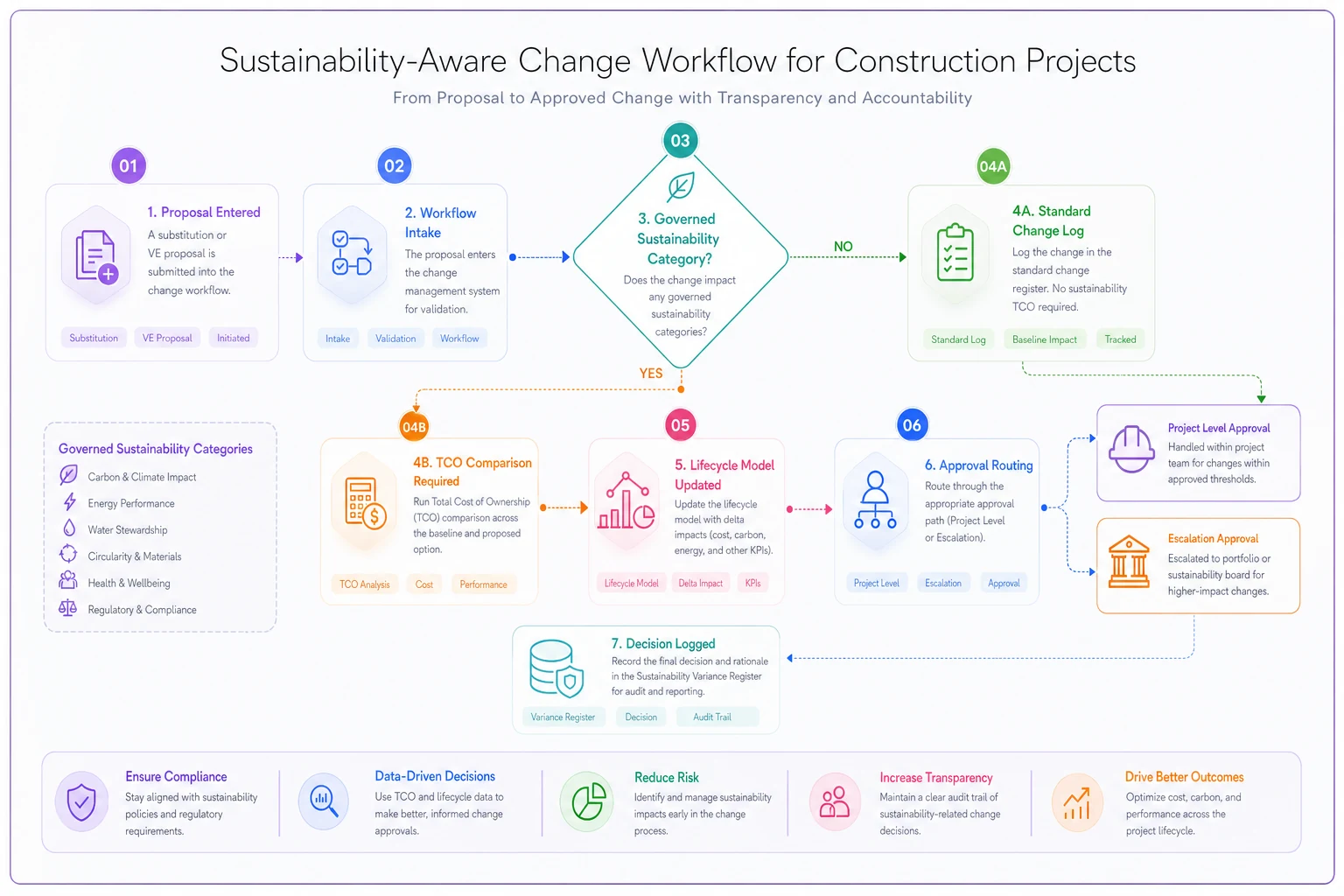
The key step most teams skip is the middle one — the check that catches whether a decision touches a governed category before it gets processed as a routine change. Without that check, the trigger never fires. The decision clears on capital merit alone, the lifecycle model never gets updated, and the variance register stays empty until the ESG audit arrives.
This is also where AI-powered operational software starts earning its keep on complex portfolios. When the change workflow is running through a platform with automation built in, the governed-category check doesn't rely on someone remembering to apply it. The system flags it, routes it correctly, and won't let the change close out without the required TCO attachment. That's not exotic — it's the same logic a good expense approval workflow uses. The difference is that here, the stakes are a 25-year operating cost, not a dinner receipt.
Handover deliverables that prove sustainability was actually delivered
This is where most portfolios fall short. You can set targets, weight your procurement, and enforce triggers, and still end up with a building where the sustainability performance was never verified at handover. The specified low-flow fixtures might be installed — or a plumber might have swapped them for what was in the van. The BMS might be configured to optimize energy — or it might still be running in a default commissioning mode nobody ever tuned out. Without handover deliverables that prove performance, the entire governance chain ends in a shrug.
Sustainability handover is fundamentally a data and verification problem, which means it belongs alongside your broader handover discipline. The same rigor that goes into a structured digital-handover lifecycle with metadata, asset tags and gated acceptance needs to extend to sustainability-specific evidence. Asset tags should carry the energy and maintenance attributes that feed the operating model. Gated acceptance should refuse to close out until the sustainability deliverables are present and verified — not just submitted.
A sustainability handover packet that's worth the name includes:
-
As-installed energy model reconciliation — the delivered building's modelled consumption versus the design target, with explained variances
-
Commissioning records for energy-critical systems — proof the HVAC, controls, and lighting were tuned to design intent, not just switched on
-
Metered baseline for the first operating period — so the owner can measure actual performance against the model, not just trust it
-
Replacement schedule with intervals and costs — every short-life component the owner needs to budget for, with dates
-
Product and material register with EPDs — what was actually installed, so embodied carbon and warranty claims are defensible
-
Variance log of every governed sustainability decision — the trail of what changed from spec, why, and who approved it
That last item is what closes the loop. If every trigger-governed decision writes to a log, the handover variance report assembles itself. The owner receives not just a building but an honest account of where the delivered asset differs from the sustainable asset they commissioned — and why each difference was justified on a lifecycle basis.
When this level of governance makes sense — and when it doesn't
This isn't free. Modelling lifecycle cost on major packages, maintaining a living TCO register, and enforcing triggers through the change workflow all take real effort. On a single small project, it's probably overkill.
When it clearly makes sense:
-
You're an owner-operator holding assets long-term, where operating cost is your cost, not someone else's
-
You run a portfolio where the same erosion pattern repeats across projects and the cumulative lifecycle leak is significant
-
You've made public or contractual ESG commitments that a quiet VE decision could breach
-
Your assets have energy-intensive operations where a few efficiency points compound into real money over a hold period
When it's probably the wrong investment:
-
Single, short-hold, build-to-sell projects where operating cost lands on the buyer and the market doesn't price it
-
Small fit-outs where the lifecycle stakes genuinely don't justify the modelling overhead
-
Portfolios without any central PMO or governance function to enforce triggers — the system collapses without an owner
Who should not attempt this yet: teams that haven't got basic change governance working. If substitutions and VE decisions aren't already flowing through a disciplined, logged change process, bolting sustainability triggers onto a broken workflow just adds friction without control. Fix the change workflow first, then layer the sustainability triggers onto it. The triggers need a reliable pipe to attach to.
A short real scenario
A mid-sized developer holding around nine commercial assets kept hitting the same problem: every project delivered under its design sustainability targets, and nobody could say exactly where the performance leaked away. The ESG report said one thing; the actual utility bills said another.
The leak turned out to be VE. Across the portfolio, mechanical and envelope substitutions made under capital pressure were quietly adding somewhere in the range of $6k–$11k a year in operating cost per building — none of it visible at decision time because no lifecycle number ever accompanied the VE proposal. Across nine assets over a typical hold period, that's not a rounding error.
What changed wasn't a new sustainability policy. It was a governance mechanism: lifecycle cost pre-modelled on the five package types that mattered most, a trigger that halted any governed substitution until a TCO comparison was attached, and a handover variance log that forced every deviation into the open. The capital savings didn't disappear — some VE decisions still went ahead because they genuinely made lifecycle sense. The ones that only looked good on first cost got caught.
Within two project cycles, the gap between design targets and operating reality narrowed to something the ESG team could actually defend. The outcome wasn't dramatic on any single project. It was consistent across the portfolio, which is the entire point. Governance doesn't win big; it stops the slow, repeated losses that nobody was tracking.
Pulling it together
Sustainability governance in construction fails when it stays separate from cost governance. The targets are set by people who don't make the day-to-day tradeoffs, and the tradeoffs are made by people who never see the lifecycle number.
The weighted procurement scorecard, the TCO-tied triggers, the living lifecycle model, the handover variance log — all of it exists to collapse that separation and force total cost of ownership into the room at the exact moment a decision would otherwise default to first cost. None of these mechanisms are complicated individually. The difficulty is maintaining all of them in parallel, across multiple concurrent projects, without letting any one of them quietly fall away under delivery pressure. That's where the operational infrastructure — the platforms, the workflows, the automation that flags a governed change before it slips through — does more work than any policy document.
The teams that get this right aren't the ones with the most ambitious sustainability policies. They're the ones who treat sustainability as a cost decision with a long time horizon, and who build the governance plumbing to make that long horizon visible when it matters. On a single project, you can get away without it. Across a portfolio you hold and operate, the erosion compounds — quietly, decision by decision — until the building you're running is nothing like the one you thought you commissioned. Governance is how you stay honest about the difference before it's too late to see where it went.
Ready to build smarter and faster?
Join 2,000+ construction teams using Projbrick to improve project visibility, reduce delays, and increase profitability.