

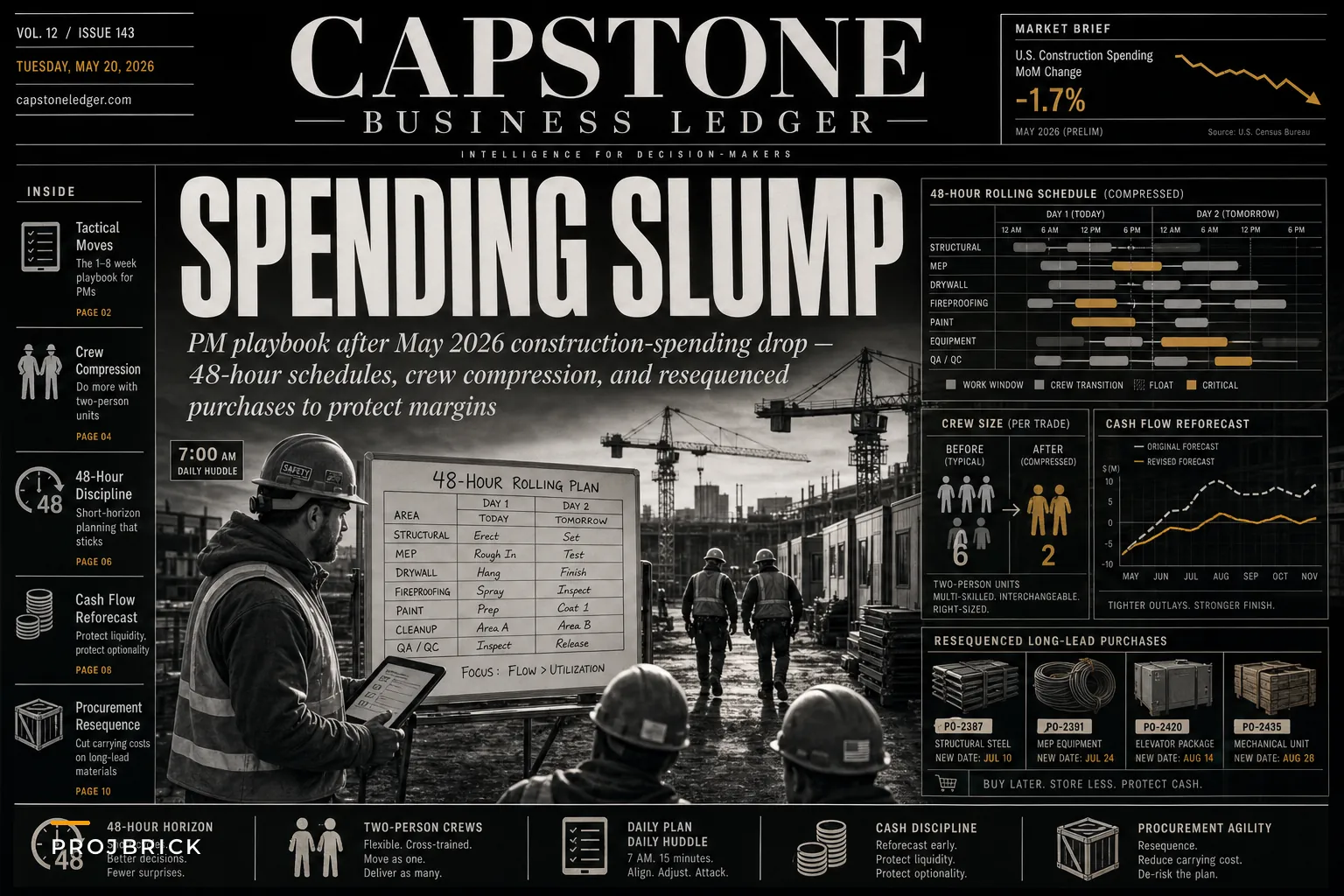

The construction spending slowdown hit faster than most PMs expected. May's numbers from the Census Bureau showed spending barely creeping up 0.1% month-over-month while falling 1.5% year-over-year. Private residential construction—the bread and butter for many mid-size contractors—continues to weaken with no clear bottom in sight.
This isn't just another blip on a government report. When spending softens like this, the operational impacts cascade through every active project. Owners suddenly want to stretch phases. GCs start squeezing subs on every change order. Your carefully planned crew rotations get blown up when the next project gets pushed back three months. And everyone starts fighting over a shrinking pool of profitable work.
The PMs who make it through these contractions aren't the ones who just cut costs and wait. They restructure their operational approach—compressing crews, reworking procurement timelines, and building flexibility into schedules that used to run like clockwork.
The Hidden Operational Damage of Slowing Pipelines
Most PMs focus on the obvious problem: fewer projects, less revenue. But the real damage happens in the gaps.
Take crew utilization. You've got a framing crew finishing Phase 2 of a mixed-use project next Tuesday. The next project was supposed to break ground the following Monday. Now it's delayed six weeks. Do you keep the crew on payroll burning $18,000 a week? Split them across other projects and risk quality issues? Let them go and potentially lose them to a competitor when things pick back up?
Procurement gets equally messy. That steel order you placed eight weeks ago for a July start? The project just shifted to September. Now you're sitting on $140,000 in materials with nowhere to install them. Your supplier wants payment, your warehouse is full, and the carrying costs are eating into margins that were already thin.
Cash flow turns into a daily battle. Payment applications that used to process in 21 days now take 35. Retention that should release at substantial completion gets held for "final documentation review." Meanwhile, you're still paying crews, suppliers, and overhead on the same schedule as before.
Then there's the scheduling complexity that multiplies when projects slow down but don't stop. Instead of running four concurrent phases at full capacity, you're running seven phases at 40% capacity. Each one needs supervision, quality control, safety oversight—but none generates enough revenue to justify dedicated resources. Your superintendent ends up bouncing between sites, missing critical inspections, letting small problems turn into expensive rework.
Tactical Crew Compression: Making 12 People Do the Work of 20
When revenue drops but work continues, crew compression becomes survival. But this isn't just about cutting headcount—it's about restructuring how work gets done.
Keep your construction projects on schedule and budget.
Projbrick helps you plan, track, and manage every project phase with precision and ease.
- Real-time project tracking
- Resource & budget management
- Team collaboration tools
No credit card required
Start with actual productivity data from the last six months. Which tasks does each crew member genuinely excel at versus what their job title says? That carpenter who always gets pulled for layout work? Make them your dedicated layout specialist across multiple projects. The laborer who picks up finish work faster than anyone else on the crew? Cross-train them formally and bump their rate $3/hour—still cheaper than carrying a dedicated finish carpenter.
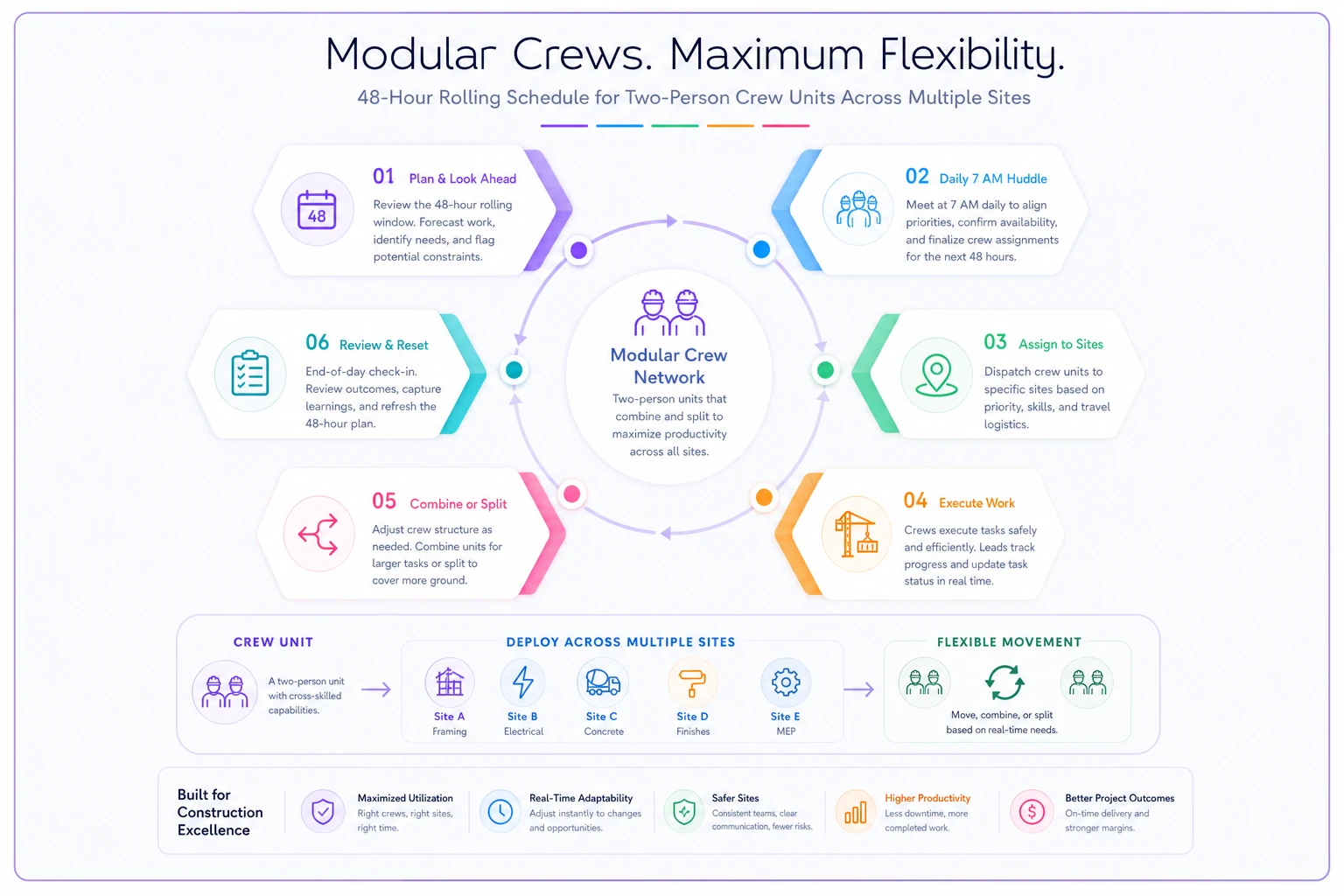
Build modular crew units instead of fixed teams. Instead of dedicated four-person framing crews, create two-person modules that combine based on daily needs. Monday: two modules work together on a large wall assembly. Tuesday: they split to different sites for punch work. Wednesday: three modules combine for a concrete pour. This flexibility means you're never carrying idle capacity, but you can still scale up for critical path work.
The scheduling system needs restructuring to support this. Traditional weekly schedules don't work when crews float between projects daily. Build a 48-hour rolling schedule that locks in tomorrow's assignments by 2 PM today. Use a simple priority matrix: critical path work gets first pick of resources, then deadline-driven tasks, then productivity work. Everything else waits.
Daily huddles become non-negotiable—7 AM, 15 minutes max.
Visualizing the modular crew units and the 48-hour rolling schedule can make implementation clearer for field teams.
Document the skill matrix and keep it updated. A simple grid—crew members down the left, skills across the top, proficiency levels (1–5) in each cell—updated monthly based on actual performance, not assumptions. When you need someone who can run both rough electrical and basic HVAC, you know exactly who qualifies without guessing.
Communication structure changes too. Daily huddles become non-negotiable—7 AM, 15 minutes max. Each crew module leader reports: yesterday's completion, today's assignment, tomorrow's needs, any blockers. No discussion, just information transfer. Problem-solving happens offline.
Reworking Procurement for Volatile Pipelines
Standard procurement assumes predictable project flow. Order eight weeks out, receive two weeks before installation, maintain a 10% buffer. That model collapses when projects shift by months.
Switch to demand-pull ordering with staged releases. Instead of ordering all Phase 3 materials at once, break them into weekly packages. Place the full order to lock pricing, but structure delivery as multiple releases. You pay a 3–5% premium for the flexibility, but that's cheaper than carrying costs or rushed reorders when schedules shift.
Build explicit hold-points into your procurement timeline. Every major material order gets three decision gates: initial order (locks price), release to fabrication (commits to specifications), release to delivery (triggers shipping). At each gate, you can pause, modify, or cancel based on project status. Suppliers don't love this. But in a soft market, they'll take the deal over losing the order entirely.
Map supplier relationships by flexibility, not just price. That electrical supplier who's 8% more expensive but lets you return unopened materials within 60 days? They just became your primary. The concrete supplier who can shift delivery dates with 24-hour notice? Worth the extra $3/yard when schedules compress.
| Supplier | Characteristic | Reason |
|---|---|---|
| Electrical supplier | 8% more expensive but lets you return unopened materials within 60 days | They just became your primary. |
| Concrete supplier | Can shift delivery dates with 24-hour notice | Worth the extra $3/yard when schedules compress. |
Build a material reallocation system between projects. Project A delays two months and has $30,000 in copper wire sitting in laydown. Project B needs copper next week. Instead of ordering new materials for B while A's inventory sits idle, create an internal transfer protocol. Track it properly for job costing, move the materials immediately.
On financing—traditional net-30 terms don't hold up when cash flow gets unpredictable. Negotiate extended terms with key suppliers (net-45 or net-60) in exchange for committed volume across all projects. Some suppliers offer 2% early payment discounts. Take them when cash allows, skip them when it doesn't.
Schedule Manipulation: Creating False Urgency and Flexible Milestones
Break long phases into micro-milestones. Instead of "complete framing by August 15," create five intermediate targets:
-
first floor walls by July 20
-
second floor deck by July 25
-
second floor walls by August 1
-
roof structure by August 8
-
sheathing by August 15
Each milestone gets its own inspection, sign-off, and mini-payment application. This maintains cash flow and keeps crews focused on immediate targets rather than a distant finish line.
Use weather windows as forcing functions. That foundation pour scheduled for "sometime in late July"? Lock it to July 23–25, the last dry window before typical August storms. This creates real urgency without artificial pressure. Crews understand weather; they don't understand arbitrary deadlines.
Build schedule buffers at phase transitions, not within phases. Most PMs spread float throughout. Instead, compress work phases to minimum durations, then add explicit buffer periods between phases. You get urgency during active work and flexibility when delays inevitably show up.
Run parallel critical paths instead of single sequences. Traditional CPM scheduling assumes linear progression. In compressed markets, run multiple workstreams simultaneously even when it adds coordination complexity. Framers work the east wing, electricians rough the west wing, finishers complete the north wing. When any single trade slows, you don't lose overall velocity.
Move to weekly schedule updates with daily hot lists. Every morning, identify the three tasks that, if delayed, will impact tomorrow's work. Focus supervision there exclusively.
Margin Protection Through Scope Surgery
When bids get desperate, margins evaporate. The only real defense is surgical scope management.
Start with finish specifications. That imported tile specified for common areas? Push for domestic alternatives that look 90% as good at 60% of the cost. The triple-coat paint system? Propose a quality two-coat with extended warranty. These aren't quality cuts—they're value engineering that maintains functionality while reducing cost.
Examine every temporary structure and general condition. Do you need full perimeter fencing, or can you secure just active work areas? Can the construction trailer downsize once rough work completes? Will the owner accept porta-potties instead of a temporary bathroom trailer for the last couple of months?
Restructure supervision ratios. Senior supers handle critical work and inspections; junior supers manage routine work. A $120k/year superintendent supervising a slow-moving project is burning $600/day. Split their time across three projects and each only carries $200/day in supervision cost.
Attack the change order process. In soft markets, owners get aggressive about rejecting changes. Document everything—photos, emails, RFIs, meeting minutes. Submit change orders within 48 hours of identification, not monthly. Include schedule impacts alongside cost impacts. Make rejection harder than approval.
Renegotiate subcontractor terms before anyone fails. When subs are struggling with cash flow, they cut corners or disappear. Get ahead of it: offer accelerated payment (net-15 instead of net-30) in exchange for 5–8% discounts. You help their cash flow, reduce your costs, and keep them solvent through the downturn.
The Technology Integration That Actually Matters Now
During contractions, operational efficiency determines survival. AI-powered operational software isn't a nice-to-have right now—it's a margin protector.
Modern construction management platforms use AI automation to catch the problems humans miss when juggling compressed schedules. They'll flag when your concrete pour is scheduled but the rebar inspection isn't. They'll alert you when material deliveries cluster on the same morning. They'll identify crew assignments that create skill gaps before work starts.
The real value is centralizing information that usually lives scattered across different systems—schedule in P6, costs in QuickBooks, submittals in Procore, daily reports in Excel. When a drawing revision comes through, the platform can cross-reference which materials have been ordered, which work is complete, and what needs to change. That used to take a half-day of digging.
For teams running compressed crews across multiple sites, AI-assisted platforms handle coordination complexity that would otherwise eat up your superintendent's mornings. Who has which certifications, who worked where yesterday, who's approaching overtime limits—instead of juggling spreadsheets, you get crew assignments based on skill requirements, travel time, and labor regulations.
The procurement chaos from volatile schedules also gets more manageable when a platform is tracking every order across every project. It can surface reallocation opportunities you'd never catch manually—like when Project A pushes their structural steel delivery just as Project B needs additional beams. The system flags the transfer opportunity and handles the job costing adjustments automatically.
Positioning for the Rebound
Downturns end. The PMs who emerge strongest aren't the ones who just survived—they're the ones who came out with better operations than they had going in.
The crew cross-training you build now becomes a competitive advantage when demand returns. Instead of scrambling for specialized workers in a tight labor market, you've got a flexible workforce that scales up or down based on project needs. Those multi-skilled crews that kept you alive during the downturn become your margin drivers during the recovery.
Supplier relationships you rebuild now determine your ability to capture opportunity later. Vendors remember who kept ordering—even at reduced volumes—during tough times. When materials get scarce again, those are the contractors who get priority allocation.
The schedule compression tactics you develop become permanent tools too. Why go back to bloated schedules when you've proven work completes faster? The operational discipline forced by tight margins becomes the foundation for higher margins when pricing power returns.
Document what you learn during this period. Which crew combinations actually worked? Which suppliers proved flexible? Which scope cuts did owners accept without pushback? That becomes your playbook for the next cycle—and there's always a next cycle.
The Reality of Riding Out Construction Cycles
The construction spending slowdown Reuters reported isn't a crisis—it's a test of operational adaptability. Some PMs will retreat, cut blindly, and wait. Others will compress intelligently, protect quality, and come out with stronger operations.
The difference is tactical execution. Crew compression isn't just headcount reduction—it's workforce transformation. Procurement flexibility isn't just payment terms—it's supply chain restructuring. Schedule manipulation isn't just deadline pressure—it's workflow optimization.
Every adjustment you make now builds resilience for the next cycle. The construction industry has always been cyclical. The PMs who come out ahead are the ones who use downturns to rebuild their operational foundation rather than just reduce costs until the phone starts ringing again.
The spending will recover. Projects will accelerate. Labor will tighten. When that happens, you'll either be scrambling to rebuild capabilities you cut, or deploying the flexible, efficient operation you built during the soft market. That choice gets made now.
Ready to build smarter and faster?
Join 2,000+ construction teams using Projbrick to improve project visibility, reduce delays, and increase profitability.