

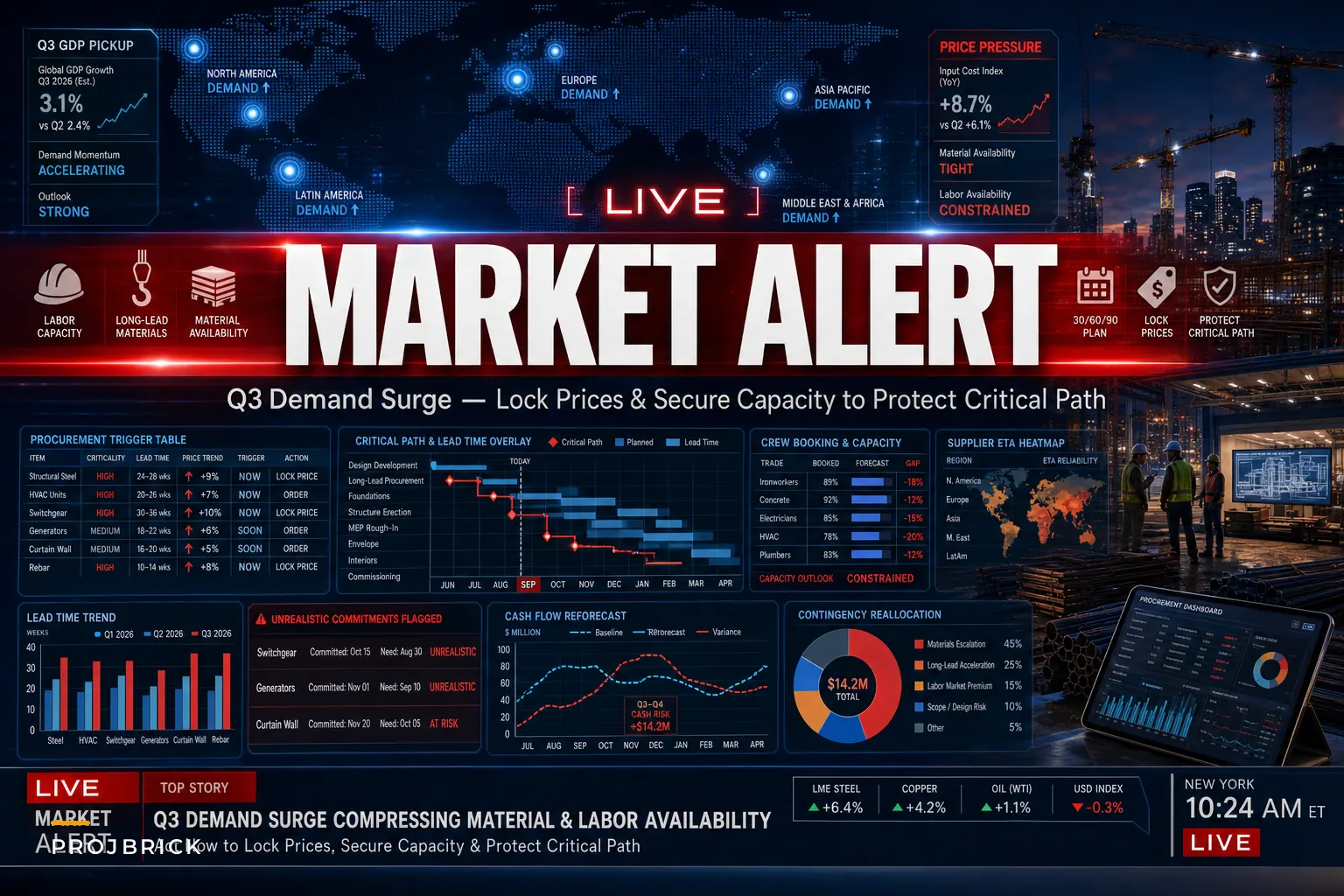

The numbers came in stronger than most people planned for. Reuters reported in late October that U.S. economic growth accelerated in the third quarter, and a separate piece flagged that business activity is staying elevated with price pressures building underneath. For most industries that's a headline you skim and move on from. For anyone managing a construction schedule and a procurement log, it's a signal to go reopen a few spreadsheets this week.
The macro story isn't really the point though. What matters is what a demand surge does to the mechanics of your project. It doesn't hit as a single dramatic event. It shows up as a steel quote that's $40/ton higher than the one you pulled four weeks ago, a drywall sub who suddenly "can't commit past January," and a switchgear lead time that quietly stretched from 14 weeks to 22. Individually, each is a nuisance. Together, they eat contingency faster than any PM's forecast assumed.
So skip the economics lecture — here's what actually changes on the ground, and the moves worth making right now.
The real mechanism: it's not price, it's slack
When people hear "input costs are rising," they reach for escalation clauses and call it handled. The more dangerous effect of a demand surge isn't the price line though — it's the disappearance of slack across every system you depend on.
Slack is the quiet buffer baked into everything. The supplier who usually has HRC sitting in the yard. The sub who normally has a crew between jobs. The equipment rental house that always "can get you one by Thursday." In a soft market, that slack is everywhere and invisible, which is exactly why most forecasts silently assume it. In a hot market, it evaporates — and your plan, which was built on assumptions nobody wrote down, starts missing in ways that are hard to trace.
A typical example looks like this: a mid-market PM has a 9-month fit-out with roughly $2.1M in procured materials and three key subs. The schedule was built assuming "normal" availability. Nothing in the plan is technically wrong. But when demand tightens, the electrical sub takes a bigger job across town, the steel supplier quotes a longer window, and the elevator package slips three weeks. No single failure. The critical path just quietly loses its breathing room, and now every minor hiccup turns into a slip because there's nothing left to absorb it.
That's the underlying problem a surge exposes: most resource and procurement plans are built on slack that was never explicitly accounted for. When conditions are easy, the plan looks accurate. It was just lucky.
What to reprice and reconfirm first (not everything at once)
The instinct when costs move is to reforecast the entire budget. Don't. You'll burn two weeks and still be working off stale quotes by the time you finish. Prioritize by two factors: how much the item moves the budget, and how exposed it is to lead-time volatility.
Keep your construction projects on schedule and budget.
Projbrick helps you plan, track, and manage every project phase with precision and ease.
- Real-time project tracking
- Resource & budget management
- Team collaboration tools
No credit card required
| Category | Budget sensitivity | Lead-time volatility | Priority |
|---|---|---|---|
| Structural steel / HRC | High | High | Reprice + reconfirm now |
| Switchgear / long-lead MEP | Medium–High | Very High | Lock orders now |
| Finishes (tile, joinery, specialty glass) | Medium | Medium | Re-quote, watch |
| Key subcontractor labor | High | High | Reconfirm commitments |
| Commodity consumables | Low | Low | Monitor only |
The mistake most PMs make is treating every line with equal urgency. You've got limited attention this month. Spend it on the top two rows. A $300 swing on consumables doesn't matter when your steel package can move $60k on a single market tick.
The procurement moves worth making this quarter
A few concrete actions that tend to pay off when slack is disappearing:
-
Convert soft quotes to firm POs on your top long-lead items. A quote from six weeks ago is a historical document now, not a commitment. If switchgear or structural steel sits on your critical path, get price and delivery locked before the next market move.
-
Shorten your quote validity assumptions. If you're still treating supplier quotes as good for 30 days by default, you're exposed. Reconfirm anything older than two weeks on volatile categories.
-
Build secondary sourcing for your single-point-of-failure items. Not to actually switch — to have a credible alternative that keeps your primary supplier honest and gives you a fallback if they slip.
-
Pull forward deposits where it protects a slot. In a tight market, a deposit buys you a place in the production queue. That slot is worth more than the cash-flow cost of paying early.
-
Renegotiate escalation language going forward, not retroactively. For bids still in play, make sure escalation clauses actually track the index your supplier prices against, not a generic one.
The point isn't to panic-buy. It's to spend the contingency you do have on protecting the sequence that can't slip, instead of discovering too late that it's gone.
Where the forecasting actually breaks
Resource forecasting in most shops runs on static assumptions. Someone builds the crew-loading and procurement plan at kickoff, it gets blessed, and then it sits — rarely revisited unless something goes visibly wrong. In a stable market, that's survivable. In a surge, static plans are the single biggest source of avoidable slip.
A better pattern is forecasting that updates when inputs change, not on a calendar. When a lead time moves, the downstream crew assignment and the cash-flow curve should move with it — automatically, not after someone remembers to check. This is exactly the failure mode we broke down in detail in the resource-forecasting method that keeps schedules from blowing up, and a demand surge is the environment where those mistakes get expensive fastest.
What tends to separate the PMs who weather a tightening market from the ones who don't isn't contingency size — it's whether their plan is connected. A changed delivery date for the curtain wall should immediately flag the glazing crew booking, the inspection window, and the milestone cash draw. The disconnected shops find out about the collision in the field, three weeks later, when it's a rework problem instead of a scheduling decision.
This is the quiet value of operational software that links procurement, scheduling, and resource data in one place rather than three spreadsheets and an email thread. Not because dashboards are exciting — they're not — but because when a lead time shifts, you want the system to surface every downstream task it touches without a human manually tracing the chain. AI-assisted reforecasting helps here in a mundane but real way: flagging which commitments just became unrealistic the moment an input changes, so you're reacting in days instead of discovering the gap at the next look-ahead.
A reforecast workflow you can run in a week
You don't need a full PMO exercise. You need a tight loop you can run quickly and repeat as conditions move.
-
Pull your critical-path items and their current procurement status. Just the ones that can actually move the end date.
-
Reconfirm live pricing and lead times on the top 5–8. Phone and email, not last quarter's quotes.
-
Overlay the new lead times against crew bookings. Look specifically for collisions where a slipped delivery now lands on a committed crew window.
-
Flag every commitment that just became unrealistic. These are your decisions for the week.
-
Reallocate contingency toward protecting the sequence, not spreading it thin across every line.
-
Re-run your cash-flow curve with the updated delivery and draw timing so finance isn't surprised.
-
Lock, deposit, or dual-source the exposed items based on what step 4 surfaced.
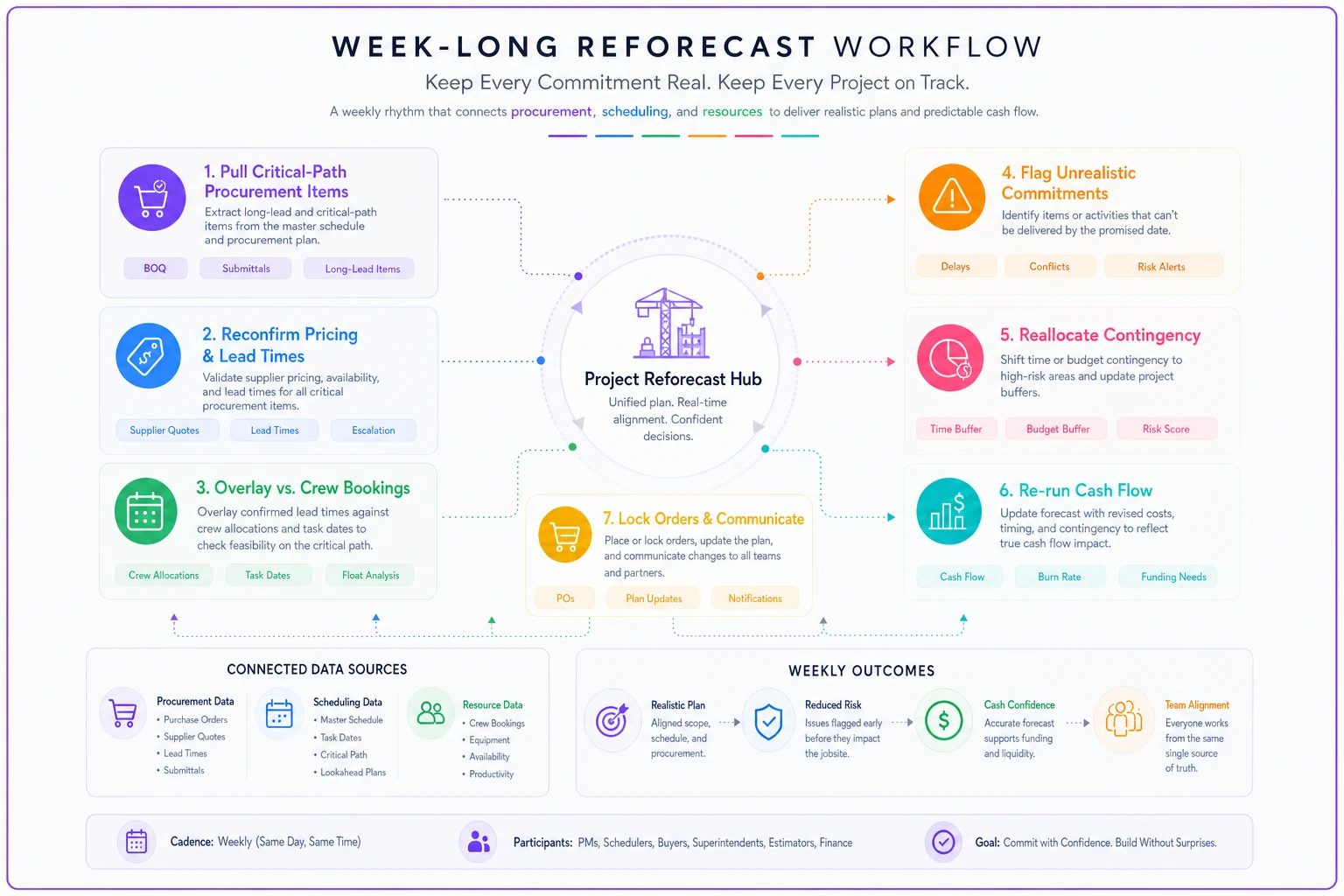
The whole thing is maybe two days of focused work if your data lives in one place. It's two weeks of archaeology if it's scattered — which is itself a useful signal about where your real bottleneck is.
A real scenario
A regional GC running a portfolio of three concurrent mid-market projects — call it roughly $18M in combined value — hit this exact squeeze last cycle. Their steel and MEP packages were quoted in a calmer window. By the time they went to confirm, HRC pricing had drifted up and the switchgear lead time on their largest job had stretched by about five weeks.
Working from static plans, they'd have found out when the switchgear didn't show. Instead, because their procurement and schedule data sat together, the stretched lead time flagged against a committed electrical crew window immediately. They had the collision in front of them weeks early — which turned it from a rework scramble into a choice. They pulled a deposit forward to hold a production slot on the switchgear, shifted the electrical crew to a different building's rough-in, and resequenced two milestone draws.
The net wasn't magic. They still ate some cost escalation — you can't dodge a market. But they avoided what would've been an estimated 3–4 week critical-path slip on the flagship job, and they didn't blow through contingency reacting blind. A few tens of thousands protected on one project, mostly by seeing the collision early enough to make it a decision instead of an emergency.
When to act hard — and when not to overreact
Lock things down aggressively when: the item is on your critical path, has high lead-time volatility, and has a single credible supplier. That combination is where a surge does maximum damage. Protect it even if it costs a little carrying cash.
Don't overreact when: the item is cheap, abundant, and easily resourced. Panic-buying consumables or front-loading low-value materials just ties up cash and warehouse space while the actual risk sits untouched in the MEP package.
This is the wrong move for you if your projects are short, nearly complete, or already fully procured. A surge mostly threatens work that's still being bought and bid. If your packages are locked and your crews are set, your job is to monitor and protect, not to churn a plan that's already committed.
The broad mistake in a hot market is spreading effort evenly across everything. Tightening conditions don't hit evenly — they concentrate on your most exposed, highest-leverage items. Your response should concentrate there too.
Bottom line
A demand surge doesn't break projects with a single dramatic shock. It erodes the invisible slack your plan quietly depended on, and the shops that get hurt are the ones running static forecasts that assumed that slack would always be there. The fix isn't a bigger contingency or a crystal ball on prices. It's a plan that's connected enough that when one input moves, you see every downstream task it touches — fast enough to decide instead of react.
Go reconfirm your top long-lead items this week. Overlay the new dates against your crew bookings. Find the collisions while they're still decisions. That's the whole game right now.
Go reconfirm your top long-lead items this week. Overlay the new dates against your crew bookings. Find the collisions while they're still decisions. That's the whole game right now.
Ready to build smarter and faster?
Join 2,000+ construction teams using Projbrick to improve project visibility, reduce delays, and increase profitability.