

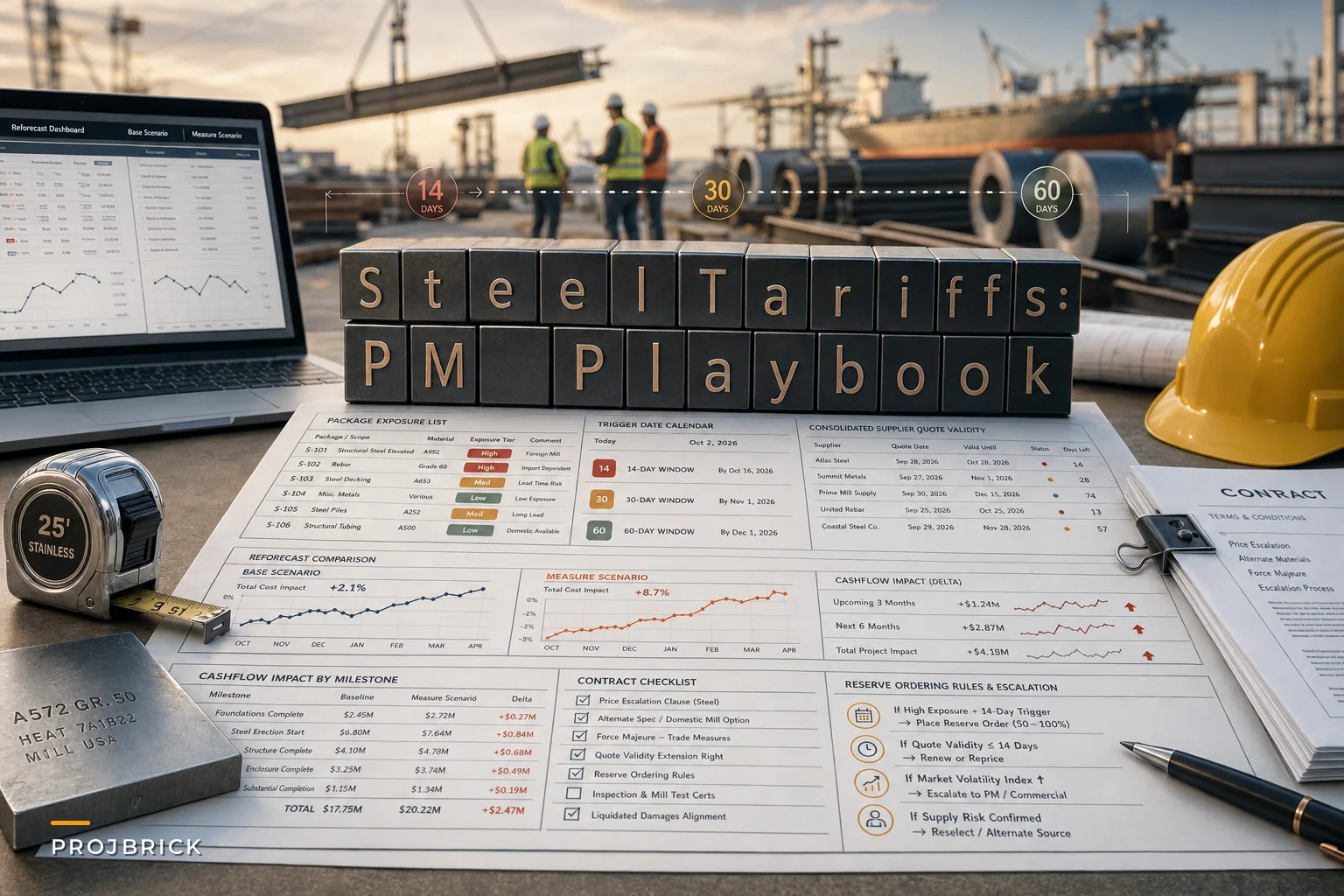

On September 30, U.S. trade officials rolled out a new framework aimed at excess foreign steel capacity, signaling an appetite for tighter tariffs or import restrictions. The timing is awkward — business activity is running at a five-year high with inflation pressure already building, which means demand is strong, supply is tight, and any new duty has a clear runway to push prices up fast.
If you're holding structural steel, rebar, or long-lead metal packages on an active job, the headline isn't really the point. What matters is what happens to your locked budgets and fabrication slots in the 60–120 days after a measure like this gets teeth. That's the window where PMs either get ahead of it or spend Q1 writing change orders explaining why they didn't.
This isn't a politics piece or a tariff explainer. It's about what trade uncertainty exposes in how most construction teams handle metal procurement — and the specific moves that protect your margin.
The real exposure isn't the tariff rate — it's your contract structure
Most PMs think about tariff risk as a percentage. "If duties go up 15%, my steel line goes up 15%." That math is comforting because it's simple. It's also usually wrong.
-
How your supplier quote is dated and caveated. Mill and fabricator quotes typically carry a validity window of 15–30 days, with escalation language buried in the terms. When trade noise hits, suppliers start quoting shorter validity and wider escalation clauses almost overnight. Your "locked" number is only locked until the quote expires.
-
Where in the supply chain your package sits when the rule lands. Material already rolled and sitting at a domestic service center behaves completely differently from an import order still on the water or not yet placed. Same tonnage, radically different risk.
-
Whether your fabricator can even hold your slot. This is the one teams miss most often. A duty change doesn't just move prices — it reroutes demand toward domestic mills and fabricators, and shop capacity fills. You can have the budget and still lose weeks because your detailing-to-fabrication window slipped behind a dozen other owners who called first.
The teams that get hurt worst aren't the ones with the thinnest contingency. They're the ones who assumed a quote was a commitment and never mapped which of their packages were actually import-dependent.
A quick way to triage your metal packages by exposure
Before you touch a budget, sort your packages. Not every ton carries the same risk, and treating them the same wastes contingency where you don't need it.
Keep your construction projects on schedule and budget.
Projbrick helps you plan, track, and manage every project phase with precision and ease.
- Real-time project tracking
- Resource & budget management
- Team collaboration tools
No credit card required
| Package status | Price exposure | Schedule exposure | First move |
|---|---|---|---|
| Rolled & at domestic service center | Low | Low | Confirm hold/storage terms, lock release schedule |
| Ordered, domestic mill, pre-rolling | Medium | Medium | Verify quote validity + escalation language now |
| Ordered, import, in transit | Medium-High | Medium | Confirm landed cost basis, duty-at-entry risk |
| Specified but not yet placed | High | High | Reselect source, accelerate PO decision |
| Design-dependent (detailing not complete) | Highest | Highest | Flag to design team, compress approval cycle |
The bottom two rows are where your attention goes first. A package that's "specified but not placed" feels fine on a schedule because nothing's technically late yet — but it's the most exposed thing on your job. You're holding an unhedged position and calling it progress.
One pattern worth naming: teams tend to fixate on the big structural steel number because it's visually dominant on the budget, while rebar quietly slips. Rebar packages get placed later, sourced more loosely, and assumed to be commodity-available. In a tight market with trade pressure, that assumption is exactly how foundations and slabs end up waiting on steel.
Why reforecasting beats stockpiling (most of the time)
The reflex move when tariff talk starts is to buy ahead — pull material forward, beat the price increase. Sometimes that's right. Usually it's more expensive than it looks.
Carrying cost is the part everyone underestimates. Pulling a large rebar or structural package forward means:
-
Storage and laydown space you may not have on a constrained site
-
Double-handling and crane time when you move it to stage it properly
-
Degradation and corrosion risk on rebar sitting exposed for months
-
Capital tied up early, which hits your cashflow curve and can cost more in financing than the duty would have
A realistic scenario: a mid-rise job carrying roughly $2.1M in combined structural steel and rebar considers pulling the full package forward by four months to dodge a possible duty bump. The feared increase is maybe 8–12%, somewhere in the $170k–$250k range. But the early buy means financing that capital four months early, renting additional secured laydown, and eating double-handling on a constrained site — landing somewhere around $90k–$140k in carrying and handling costs, before any corrosion rework risk on rebar sitting through a wet season.
The honest answer is usually somewhere in the middle: pull forward the highest-exposure, lowest-carrying-cost packages, and hold the rest while tightening your reforecasting rhythm. Blanket stockpiling is a blunt instrument for a problem that needs a scalpel.
When pulling material forward actually makes sense
There are clear cases where buying ahead is the right call:
-
The package is on or near your critical path and a lead-time slip directly moves a milestone
-
You have genuine covered, secured storage with no incremental rental cost
-
The material isn't corrosion-sensitive or can be properly protected
-
Detailing and shop drawings are complete — you're not buying material you might have to modify
-
Supplier capacity, not just price, is the binding constraint
If three or more of those are true, forward-buying usually pencils out. If you're mostly chasing a price fear with no schedule or capacity driver behind it, slow down.
The underlying problem: metal procurement runs on stale assumptions
Trade uncertainty is the stress test. What it exposes is that most metal procurement workflows rest on a set of quiet assumptions that only break when something external pushes on them:
-
The quote we got is the price we'll pay
-
The fabricator slot is ours because we're a good customer
-
Rebar is always available
-
Our contingency covers normal swings
-
Finance has the current numbers
Every one of those is a failure point under trade pressure. And the deeper issue is that the information needed to challenge them is scattered — quote validity dates live in someone's inbox, fabrication slots live in a conversation, contingency math lives in a spreadsheet from two months ago, and the schedule impact lives in the PM's head.
This is the same discipline that drives a resilient long-lead procurement schedule that prevents material-driven stoppages — the difference is that trade events compress the timeline. You don't get a slow-building problem. You get a fast one, and your systems have to surface it before the market does.
A reforecasting workflow that survives a fast-moving trade event
The point here isn't complexity — it's making sure the right trigger fires before a decision becomes a crisis.
-
Tag every metal package with its exposure tier (from the table above) and the single piece of data that defines its risk — quote expiry date, in-transit status, or detailing completion date.
-
Set a trigger date per package, not a trigger price. The decision to act should fire on time because you often can't see the price move until it's too late to respond.
-
Pull supplier quote validity into one view so you can see, at a glance, which commitments expire in the next 14, 30, and 60 days.
-
Run a two-scenario reforecast — a base case and a "measure implemented" case — on your highest-exposure packages only. Don't boil the ocean. Model the five packages that actually move your number.
-
Tie each scenario to a cashflow and milestone impact, so when you present to the owner or finance lead, you're showing schedule and money together, not just a scary material line.
-
Escalate on the trigger, not the headline. When a quote-expiry trigger fires, that's your cue to decide — renew, reselect, or forward-buy — while you still have options.
Here's a quick visual of the workflow.
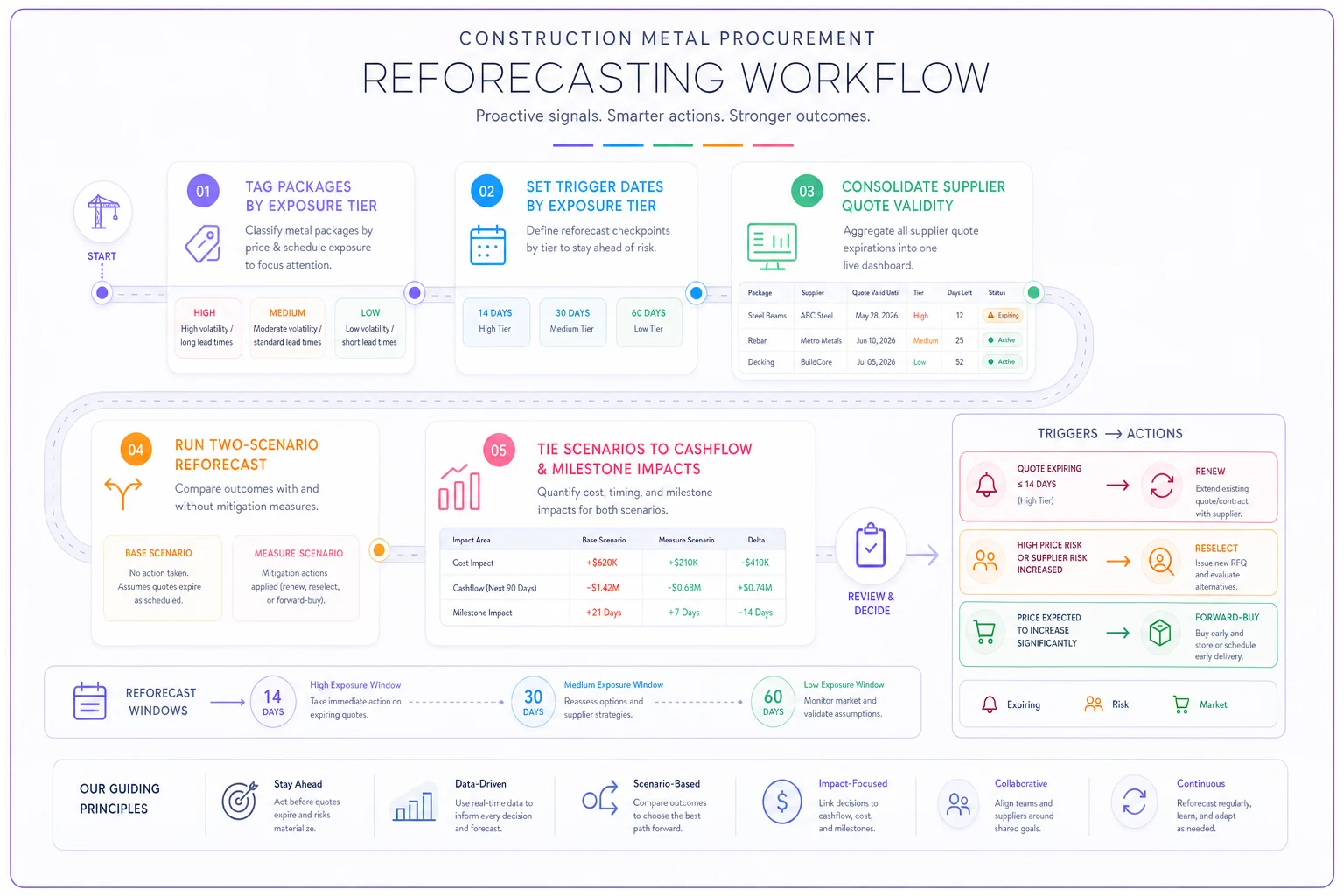
Link quote-expiry fields to calendar alerts so triggers fire automatically instead of relying on memory.
The teams that handle trade shocks well aren't smarter forecasters. They just have fewer blind spots, because the data driving the decision is visible instead of buried in inboxes.
A field-ready checklist for the next 30 days
If you want to act this week rather than wait for a rule to land, work through this:
-
[ ] List every open metal package and mark its exposure tier
-
[ ] Pull quote validity dates and escalation clauses into one sheet
-
[ ] Flag any import-dependent package that isn't yet placed
-
[ ] Call your top two fabricators and confirm current slot availability, not just price
-
[ ] Check rebar packages specifically — don't let the structural steel number eat all your attention
-
[ ] Identify which packages have secured, covered laydown available (this decides forward-buy feasibility)
-
[ ] Run a base-vs-measure reforecast on your top five exposure packages
-
[ ] Review contingency against the measure-case number, not the base case
-
[ ] Brief finance now, so a fast move isn't the first they've heard of it
-
[ ] Set trigger dates and assign an owner to each
If you want to act this week rather than wait for a rule to land, work through this:
Where good project controls earn their keep
A lot of this comes down to how fast you can see the state of your packages when something external changes. Teams running everything through email threads and a monthly cost report are, by definition, working with a stale picture. By the time the budget spreadsheet gets updated, the quotes have expired and the fabrication slots are gone.
The fix isn't exotic. It's keeping procurement status, quote validity, lead times, and cost impact in one place that updates as things change — so when a trigger date hits, the person who needs to act sees it without hunting for it. Project controls platforms that centralize this and use automation to flag expiring quotes or slipping lead times before they become emergencies turn a frantic reforecast into a routine one. The value isn't in clever software. It's that nothing important sits unseen in someone's inbox while the market moves.
That's the whole game with trade uncertainty. You can't control the policy. You can control whether your team finds out about a problem on day two or day twenty — and on a long-lead metal package, those eighteen days are the difference between a quiet reselection and a missed milestone.
Bottom line
Renewed steel trade measures aren't a reason to panic-buy or freeze. They're a reason to look hard at which of your metal packages are actually exposed, fix the assumptions hiding in your quotes and fabrication slots, and build a reforecasting rhythm that fires on time triggers instead of waiting for the price to show up on an invoice. The PMs who come through this cleanly won't be the ones with the biggest contingency — they'll be the ones who could see their exposure clearly enough to act while they still had choices.
Ready to build smarter and faster?
Join 2,000+ construction teams using Projbrick to improve project visibility, reduce delays, and increase profitability.