


Edouard came ashore on the upper Texas–Louisiana coast on September 1, 2026, dropping heavy rain, pushing storm surge inland and knocking out power across southeastern Texas and southwestern Louisiana. USA TODAY covered the landfall, rainfall totals and surge across the region, and by the time wind dropped below headline strength, the real problem for construction had already started — not the storm itself, but the two-week logistics hangover that follows every major landfall.
If you're running work in Houston, Beaumont, Port Arthur, Lake Charles, or anywhere pulling materials through that corridor, the storm is over but your schedule risk is just beginning. This isn't about weatherproofing your site. It's about the first 72 hours to six weeks after landfall — and the operational moves that separate crews that recover clean from crews that quietly absorb three weeks of slippage they never planned for.
The real damage isn't the water. It's the queue.
Most PMs brace for the obvious stuff: flooded excavations, saturated subgrade, water-damaged stored material, wind-scattered temp works. That damage is visible and you'll deal with it fast because you can see it.
What blows schedules is invisible in week one. It's the port backlog. It's trucking capacity that got redirected to emergency loads. It's the rebar shipment that was three days out, now sitting in a yard behind hundreds of other orders. It's your ready-mix supplier prioritizing municipal and utility repairs over your commercial pour because those contracts pay faster and carry political weight after a disaster.
A recent CNBC report on Edouard's approach focused on flooding and outage risk across the region — but from an operations chair, the outage story matters less than what it does to your supply chain's sequencing. Power comes back in days. The delivery queue you just got pushed to the back of takes weeks to clear, and every project in the corridor is fighting for the same trucks and the same crane operators at the same time.
That's the problem a storm exposes: your lookahead was built assuming normal lead times, and normal lead times just disappeared for everyone at once.
The first move: revalidate the lookahead before you touch the site
The instinct after a storm is to send everyone to the site and start assessing damage. Do that — but someone in the office needs to be tearing apart the 6-week lookahead the same morning, in parallel.
Keep your construction projects on schedule and budget.
Projbrick helps you plan, track, and manage every project phase with precision and ease.
- Real-time project tracking
- Resource & budget management
- Team collaboration tools
No credit card required
The order matters more than people think. Spend three days on damage assessment and then revalidate procurement, and you've burned three days where you could have been re-flagging deliveries and calling suppliers before the queue hardened. The suppliers who get called on day one get slotted first. By day four, everyone has called them.
The lookahead revalidation isn't a full replan. It's a targeted pass with three questions per line item:
-
Did this activity's inputs get delayed, damaged, or destroyed?
-
Is the crew or equipment for this activity still available in the window I planned?
-
Does the downstream sequence still hold if this item slips 5, 10, or 15 days?
Anything that fails one of those questions gets flagged and moves to the top of your call list. Everything else can wait for the normal weekly cycle. This is exactly the kind of situation where a lookahead built with real procurement trigger flags tied to crew assignments pays for itself — because if your triggers were already mapped, you're re-firing them, not building them from scratch mid-crisis.
Here's a simple workflow visualization of the revalidate-to-escalate sequence.
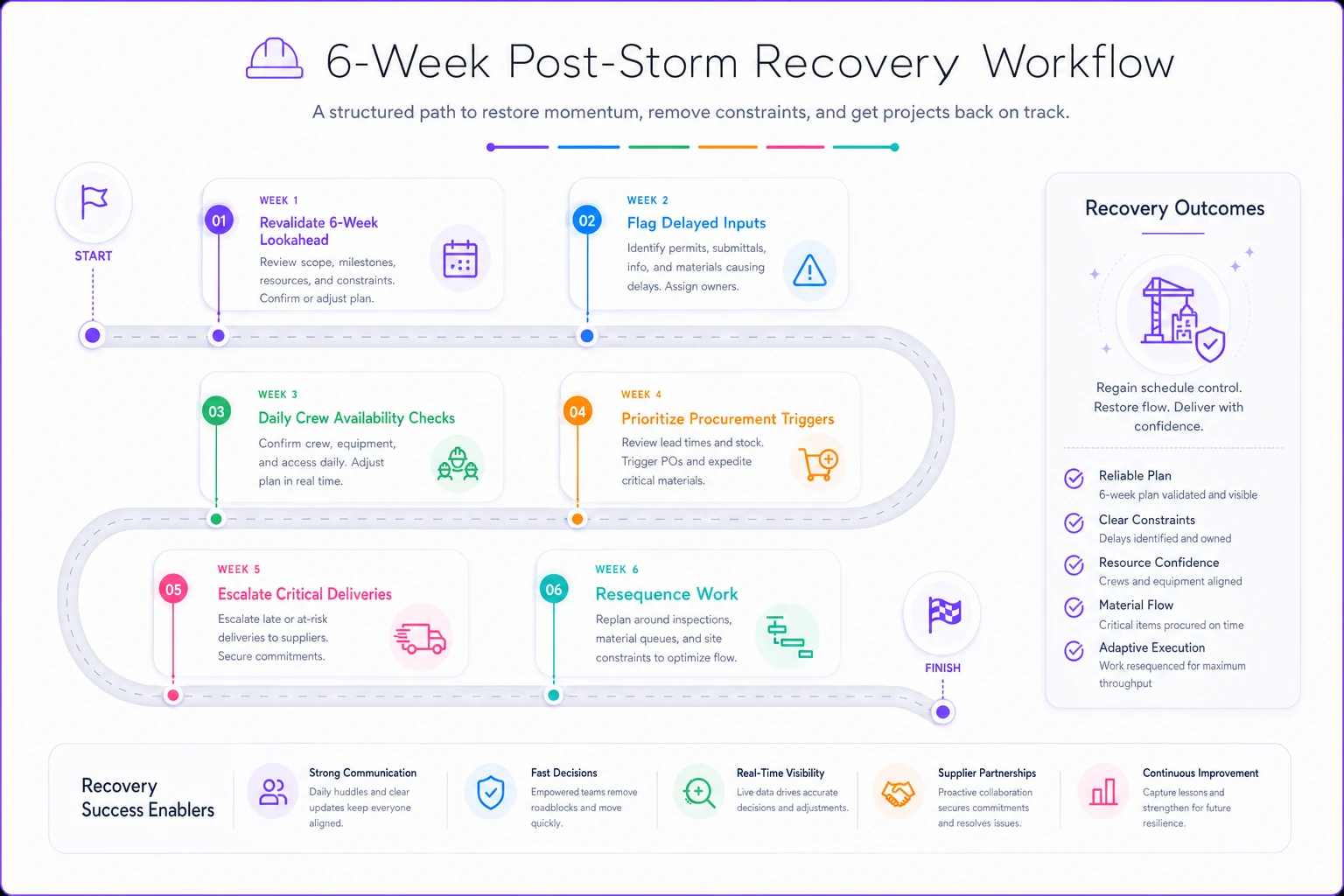
This is exactly the kind of situation where a lookahead built with real procurement trigger flags tied to crew assignments pays for itself — because if your triggers were already mapped, you're re-firing them, not building them from scratch mid-crisis.
Procurement triggers: what to pull forward, hold, or cancel
Post-storm procurement isn't about ordering more. It's about deciding fast which orders to accelerate, which to freeze, and which to re-source locally at a premium because waiting is more expensive than paying up.
The mistake that keeps happening: PMs treat every delayed delivery as equally urgent and blast every supplier with the same "where's my order" energy. That burns goodwill and gets you nowhere. Suppliers can't move everyone up. You need to know which two or three deliveries actually sit on your critical path and fight hard for those only.
Here's a decision breakdown for common material categories in the first two weeks:
| Material / Input | Typical post-storm delay | Move | Why |
|---|---|---|---|
| Ready-mix concrete | 1–3 weeks (repair priority) | Lock pour slots early, secure backup plant | Suppliers reprioritize to municipal/utility work |
| Structural steel / rebar | 2–4 weeks (port + trucking) | Confirm ship date in writing, pre-stage receiving | Port backlog compounds daily |
| MEP long-lead (switchgear, chillers) | 3–6+ weeks | Escalate immediately, check factory not just freight | These were already tight; storm makes them worse |
| Local finishes / drywall | Days to 1 week | Hold, re-source locally if needed | Cheap to replace, don't burn escalation energy here |
| Fuel / generators / pumps | Immediate spike in demand | Reserve now, expect rental premium | Emergency demand drives rental rates up fast |
The pattern is straightforward: cheap, locally available stuff you can afford to lose. Long-lead, port-dependent, single-source items are where you spend all your attention. A PM who protects a drywall delivery while a switchgear order quietly slips six weeks has the whole thing backwards.
When accelerating procurement is a mistake
Confirm on-site dry storage and protective staging before escalating deliveries to avoid moving the supplier's damage risk onto your site.
Not everything should be pulled forward. If you accelerate deliveries to a site that still has standing water and no dry storage, you've just moved your water-damage problem from the supplier's yard to yours. Pull forward only what you can receive and protect. Otherwise, let it sit in their covered yard and eat the storage cost — it's their liability there, yours here.
Crew moves: reallocate before you re-mobilize
Crews are the piece PMs get most emotional about and least systematic with. After a storm, a good portion of your labor has personal problems — flooded homes, evacuated families, no power. Attendance is unpredictable for a week to ten days, and you can't plan around people who don't know if they're coming in.
Stop planning crew by name and start planning by capability, at least temporarily. If you've got a foundation crew that can't work because the excavation is flooded, and a framing package that's ready but understaffed, the question isn't "who's assigned to framing" — it's "who can safely do framing work this week."
A practical reallocation sequence for the first two weeks:
-
Confirm availability daily, not weekly. Post-storm attendance is a moving target. Monday's roster is wrong by Wednesday.
-
Map work that's actually ready — dry, accessible, materials on hand — against available bodies.
-
Redeploy idle crews to ready work, even if it's outside their normal scope, using skill-crossover where it's safe and legal.
-
Protect your specialists. Don't burn a scarce crane operator or certified welder on cleanup they don't need to be doing.
-
Document the reallocation so productivity tracking and any delay claims later reflect what actually happened.
The crews that recover fastest aren't the ones with the most people. They're the ones whose PMs stopped waiting for the "right" crew to become available and moved ready bodies to ready work within 48 hours.
Resequencing the critical path around the queue
Your critical path assumed a delivery and inspection cadence that no longer exists. Two things break it after a storm: material queues and inspector availability.
The inspection piece gets overlooked every time. Local building departments after a disaster are swamped — emergency structural assessments, damage certifications for insurance, utility restoration inspections — before they ever get to your routine framing or MEP rough-in. If your critical path has an inspection gate in the next two weeks, assume it slips and resequence so you're not sitting idle waiting on an inspector who's booked out.
Pull forward every activity that has no external dependency — no delayed material, no inspection gate, no absent specialist — and push those that do. You're buying time on the constrained activities by front-loading the unconstrained ones. It doesn't shorten the overall queue, but it keeps crews productive while things clear instead of paying them to wait.
A real scenario: mid-size commercial job in the Beaumont corridor
Take a general contractor running a roughly $14M commercial build near Beaumont, with the structure topped out and MEP rough-in underway when Edouard hit. The site took minor flooding — no structural damage, but the ground-floor material staging area went under about a foot of water for a day.
The visible loss was maybe $18k–$22k in ruined finishes and insulation sitting in the staging zone. Annoying but manageable. The real hit was buried in the schedule: a switchgear delivery that was two weeks out got pushed roughly five weeks because of port and trucking backlog, and the electrical inspector was booked solid on damage assessments for close to ten days.
The team that handled it well didn't chase the ruined drywall. They spent day one on the phone getting the switchgear ship date confirmed in writing, found a partial backup order to keep the electrical room moving, and resequenced framing and interior partition work — which had no external dependency — to run ahead of schedule while the MEP inspection gate cleared. Net result: instead of 4–5 weeks of slippage, they absorbed it down to about 8–10 working days.
The crew that handled it badly on a similar job nearby waited on the inspector, kept its framing crew on partial hours "until we know more," and re-ordered material to a site with no dry storage. They ate close to three weeks and a round of rework when re-delivered material got wet again.
Same storm. Same corridor. The difference was entirely in how fast the office revalidated the plan and how disciplined they were about what to actually fight for.
Cashflow: reforecast the near-term before it surprises you
Storm recovery quietly wrecks cashflow from two directions at once. Costs spike — emergency rentals, premium local sourcing, cleanup overtime — while billing slips because pay-app milestones tied to delayed work push right along with the schedule.
The 6-week cash view is the reforecast most PMs skip: what you'll actually spend versus what you'll actually bill during the recovery window. If your milestone billing was tied to a switchgear install that just slipped five weeks, that revenue slipped with it, but the recovery costs are landing now. That gap is entirely predictable in week one. Feeling it in week four is optional.
Flag every billing milestone that depends on a delayed activity, and get ahead of the conversation with the owner about revised timing. Owners handle a milestone shift you flag on day three a lot better than one they discover when the pay app comes up short.
The recovery checklist for the first six weeks
Pin this somewhere your team actually sees it:
-
[ ] Revalidate the 6-week lookahead within 24 hours — flag every item with a delayed input, absent crew, or inspection gate
-
[ ] Identify your 3 true critical-path deliveries and escalate only those with suppliers
-
[ ] Confirm all long-lead and port-dependent ship dates in writing
-
[ ] Assess dry storage before accelerating any delivery
-
[ ] Move to daily crew-availability confirmation for the first two weeks
-
[ ] Redeploy idle crews to ready work using safe skill-crossover
-
[ ] Resequence to front-load activities with no external dependency
-
[ ] Assume inspection gates slip; plan around inspector backlog
-
[ ] Reserve fuel, pumps, and generators before the rental spike hardens
-
[ ] Reforecast the 6-week cash view — flag every billing milestone tied to delayed work
-
[ ] Document all reallocations and delays for later claims and productivity tracking
-
[ ] Communicate revised milestone timing to the owner proactively
Pin this somewhere your team actually sees it:
What separates clean recoveries from expensive ones
The storm is a leveler — everyone in the corridor gets hit with the same queue, the same port backlog, the same inspector shortage. What varies is response speed and discipline.
The teams that recover cleanly aren't lucky. They revalidated the plan in hours, not days. They fought for the two or three things that actually mattered instead of spreading attention across every delayed pallet. They kept crews producing on unconstrained work while everyone else sat waiting for things to clear.
None of that requires heroics. It requires a lookahead that was already built to flag dependencies and trigger reallocations — so that when a storm forces a replan, you're re-firing a system you already have rather than improvising under pressure. Edouard will clear. The corridor will dry out and the trucks will move again. The projects that come out ahead are the ones whose PMs treated the first 72 hours as a procurement and sequencing problem, not a cleanup problem.
None of that requires heroics. It requires a lookahead that was already built to flag dependencies and trigger reallocations — so that when a storm forces a replan, you're re-firing a system you already have rather than improvising under pressure.
Edouard will clear. The corridor will dry out and the trucks will move again. The projects that come out ahead are the ones whose PMs treated the first 72 hours as a procurement and sequencing problem, not a cleanup problem.
Ready to build smarter and faster?
Join 2,000+ construction teams using Projbrick to improve project visibility, reduce delays, and increase profitability.