


When you run a single project, cashflow is a math problem. You forecast, you bill, you collect, you pay. When you run a portfolio, cashflow becomes a prioritization problem — and that's a completely different animal. Every PM on your bench believes their draw is the urgent one. Every one of them has a subcontractor threatening to slow down, a supplier holding material hostage, a retention release that's "already late." And finance is stuck in the middle trying to decide who gets funded this cycle when incoming collections don't cover all the outgoing obligations.
The failure mode isn't dramatic. It's quiet. A project that's actually low-risk gets fully funded because its PM is loud and organized, while a project sitting on a milestone risk — a permit that hasn't cleared, a pour that failed inspection, a change order that hasn't been priced — quietly drains reserves it shouldn't have access to yet. Six weeks later that second project is the one that blows up, and now there's no cushion left because it got spent smoothing over a project that never needed the help.
Portfolio cashflow governance in construction is really about answering one question consistently: given what we know about each project's risk right now, who gets money, how much, and in what order? The answer shouldn't depend on who emailed the CFO first.
Why portfolio cash decisions break down
The core problem is that draw requests arrive as amounts, not as risk-adjusted amounts. A $400k draw on a project tracking clean and a $400k draw on a project that just missed a phase gate look identical on a payment run. Finance sees two numbers. They don't see that one of those projects is about to eat its contingency and the other is coasting.
-
PMs optimize locally. Every PM is measured on their own project's cashflow, so every PM pulls cash forward as aggressively as they can. Nobody is incentivized to leave money on the table for the portfolio. That's not greed — it's just how the reporting lines are drawn.
-
Escrow and reserve rules live in people's heads. Ask three finance managers when a reserve can be tapped and you'll get three different answers. "When the project needs it" is not a rule. It's a vibe.
-
Risk signals and cash decisions live in different systems. The schedule slippage is in the scheduling tool. The failed QA gate is in a spreadsheet. The draw request is in accounting. Nobody connects them at the moment the payment decision actually gets made.
The result is a portfolio where cash flows toward noise instead of toward need. The projects generating the most cash-related emails are usually not the ones carrying the most actual risk. The genuinely risky ones are often quiet — because the PM either doesn't see the risk yet or is hoping to fix it before anyone notices.
What actually breaks at scale
At two or three concurrent projects, a good CFO can hold the whole picture in their head. They know which jobs are shaky. They make gut calls that are usually right. This is why small contractors often think they don't have a governance problem — because their governance is one experienced person's memory.
Keep your construction projects on schedule and budget.
Projbrick helps you plan, track, and manage every project phase with precision and ease.
- Real-time project tracking
- Resource & budget management
- Team collaboration tools
No credit card required
Reserves get double-committed. Reserve pools mentally earmarked for Project A's retention risk quietly get spent on Project D's supplier crisis. There's no ledger tracking why reserves are being held, so the same dollar gets counted as available three times.
Draw timing stops matching milestone reality. On a single project you naturally sync draws to real progress. Across a portfolio, draws start syncing to the billing calendar instead — everyone submits on the same schedule regardless of whether the work behind the draw has actually cleared its gate. You end up funding percent-complete that hasn't been de-risked.
Escrow logic gets inconsistent by PM. Strong PMs negotiate favorable draw and escrow terms. Weaker PMs accept whatever the owner offers. Now your portfolio has wildly different escrow release conditions with no central view of the aggregate exposure, and finance can't forecast when cash actually lands.
Phase gates become paperwork instead of cash controls. This is the big one. Most firms already run phase gates for quality and schedule — the QA/QC-to-phase-gate approach is common at closeout. But the gate almost never controls cash. A project can fail its structural gate and still pull a full draw next cycle, because the gate lives in operations and the draw lives in finance and the two never talk.
Tying draw priority to project-risk metrics
The fix isn't a smarter forecast. It's a rule that turns risk into draw priority automatically, so the decision doesn't depend on persuasion.
-
Milestone/phase-gate status — has the current phase passed its gate, or is it funding work that hasn't cleared?
-
Schedule variance — is the project ahead, on, or behind its baseline on the critical path?
-
Approved-vs-pending change exposure — how much unpriced or unapproved change is sitting in the project?
-
Collections health — is the owner paying on time, or is your draw going out faster than money's coming back?
-
Retention/escrow position — how much is locked up, and when does it realistically release?
-
QA/rework signal — any open failed inspections or defect triage that could force redo work?
Then you bucket projects into draw-priority tiers based on those scores. Here's the logic that tends to work in practice:
| Risk profile | Draw priority | Reserve access | Escrow rule |
|---|---|---|---|
| Green — gate passed, on schedule, owner paying, low change exposure | Full draw, funded first | Normal access to project reserve | Standard release schedule |
| Amber — one soft signal (minor slip, some pending change, slow-ish owner) | Draw funded, but capped to de-risked work only | Reserve access requires PM justification | Hold escrow release until signal clears |
| Red — failed gate, behind on critical path, high unpriced change, or owner not paying | Draw deferred or partial; funds gated behind evidence | Reserve frozen — no access without governance approval | No escrow release; escalate |
The key insight buried in that table: a red project should generally get less discretionary cash, not more. This feels backwards to most PMs, and it's the source of most fights. The instinct is "the project's in trouble, throw money at it." But funding a project before you understand why it failed its gate usually just moves the loss forward a cycle and burns the reserve you'll need when the real number comes due.
Reserve is for known, priced problems — not for buying time on unknown ones.
The reserve allocation decision rules
Reserves are where portfolios quietly bleed. The problem is almost always that reserve is treated as one big pool anyone can dip into, rather than allocated against specific, named risks.
A cleaner approach separates reserve into three layers, each with its own release rule:
-
Project contingency — carried inside each project's budget, released against that project's identified risks only. This never crosses project lines. If Project B's contingency runs out, that's a project-level escalation, not a quiet transfer from Project F.
-
Portfolio reserve — a central pool for cross-project shocks (a shared supplier failing, a regional labor spike, a weather event hitting multiple sites). Access requires a governance decision, not a PM request.
-
Draw-smoothing float — short-term working capital specifically for covering the gap when collections lag committed spend. This gets replenished every cycle and is not a source of last resort for a struggling project.
The decision rule that keeps this honest: reserve is released against a documented risk with an owner, a trigger, and an expected resolution date — never against a feeling that a project "needs it." If a PM can't name the risk and when it resolves, the reserve stays locked.
This connects directly to how you run forecast-to-complete finance controls on each project. Your portfolio reserve decisions are only as good as the individual project FTCs feeding them. If a PM's forecast-to-complete is optimistic — and they usually are, especially the ones asking for reserve — your reserve allocation is being made on bad inputs. Governance has to be willing to challenge the FTC before releasing against it.
Governance meeting artifacts that make this run
None of this works as a policy document sitting in a folder. It works as a recurring meeting with a fixed agenda and a small set of artifacts that get updated every cycle. The meeting is short if the artifacts are good.
The portfolio cash council. Weekly or bi-weekly, depending on portfolio velocity. Attendees: finance lead, portfolio/operations director, and PMs rotate in only for projects flagged amber or red. Green projects don't need airtime — that's the whole point. The meeting exists to arbitrate scarce cash, not to review projects that are running fine.
The artifacts that make the meeting fast:
-
The draw-priority sheet — every active draw request, its risk tier, and its funding recommendation, pre-populated before the meeting. The meeting confirms or overrides; it doesn't build this from scratch.
-
The reserve ledger — every reserve dollar, which layer it's in, what named risk it's held against, and its current status. This is the single most valuable artifact because it kills double-committing.
-
The escrow/collections calendar — a forward view of when cash actually lands per project, so draw sequencing matches incoming reality instead of the billing calendar.
-
The exception log — every time governance overrode the risk-based recommendation and funded a red project anyway. This one matters more than people think. Reviewing overrides a month later is how you find out whether your instincts or your rules are more accurate. Usually the rules win, and the log is what proves it.
A quick checklist for whether your governance is actually functioning:
-
[ ] Every draw request carries a current risk tier before it hits the payment run
-
[ ] No reserve dollar is committed to more than one named risk
-
[ ] Phase-gate status can block a draw, not just flag it
-
[ ] Overrides are logged and reviewed, not just made
-
[ ] Finance can see owner-collection health per project, not just per portfolio
-
[ ] The council spends most of its time on amber/red, almost none on green
If you can't check most of those boxes, you don't have governance — you have a payment run with meetings attached.
The weekly cycle below only works if the inputs are ready before the meeting starts. If someone is pulling schedule variance and gate status the morning of, the council ends up reactive instead of deliberate — which is exactly the problem you're trying to solve.
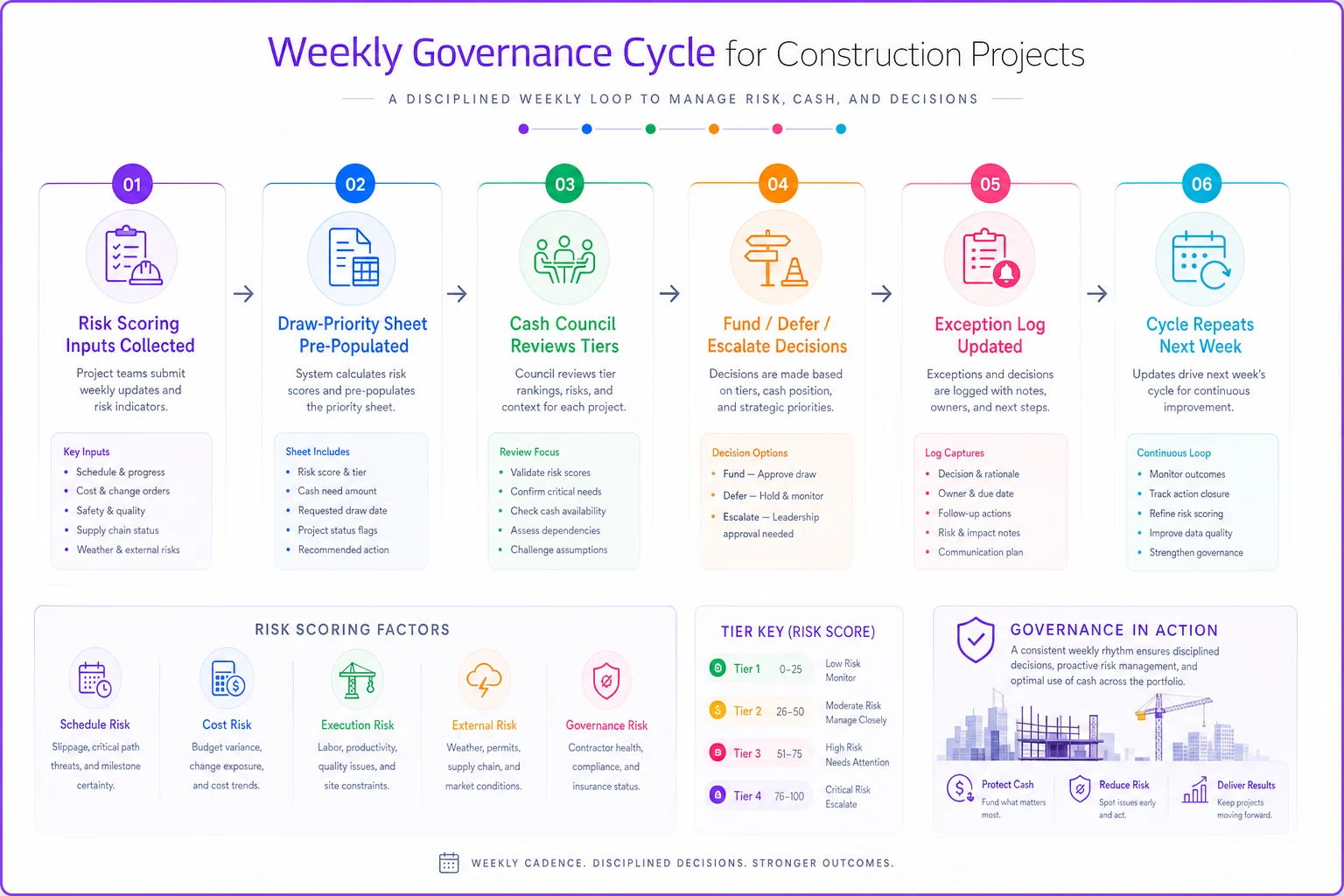
Weekly governance cycle — risk scoring inputs collected → draw-priority sheet pre-populated → cash council reviews tiers → fund/defer/escalate decisions made → exception log updated → cycle repeats next week
A real scenario
A mid-sized commercial contractor running about nine concurrent fit-out and shell projects, somewhere in the $60–70M range of active work. Their process was standard: PMs submitted draws on a monthly cycle, finance funded whatever collections allowed, and shortfalls got covered from a general reserve on a first-come basis.
The specific problem surfaced on a hospital fit-out that had failed a structural gate but kept pulling full monthly draws for two cycles while the PM "worked through it." By the time the real rework number landed — north of $500k — the portfolio reserve was already thin, because it had been quietly funding that same project's smoothing draws the whole time. Two other projects tracking clean got squeezed on their draws to cover the hole, and one of them nearly lost a key subcontractor over a delayed payment.
What changed wasn't the amount of cash available. It was the sequencing rule. They moved to a risk-tiered draw priority with a reserve ledger that tagged every reserve dollar to a named risk. Within a couple of cycles, the failed-gate project was correctly bucketed red — draws capped to de-risked work only, reserve frozen until the rework was actually priced. That forced the real number to surface faster instead of dripping out disguised as normal draws.
The outcome wasn't a magic number. The reserve stopped getting spent on projects that hadn't earned access to it, the clean projects stopped getting squeezed, and the portfolio stopped funding surprises it couldn't see coming. Cash didn't increase — it just started flowing toward actual need instead of toward whoever asked loudest.
When this makes sense — and when it doesn't
When it's worth it: Once you're running roughly five or more concurrent projects, or when your projects share resources, suppliers, or a common credit line so that one project's cash stress genuinely threatens another. If your projects are financially independent silos, portfolio governance adds overhead without much payoff.
When it's overkill: Two or three projects run by one experienced finance person who genuinely holds the picture. Formalizing this too early just adds meetings. The right time is when you notice you can't answer "who's most at risk right now" without calling three people.
Who should be careful: Firms where PMs are compensated purely on individual project cashflow. If you install portfolio governance without adjusting those incentives, you'll get constant friction — PMs will fight every deferral because their bonus depends on pulling cash forward. Fix the incentive alongside the process, or the process loses.
Bringing risk and cash into the same view
The reason this stays broken at most firms isn't that people don't understand it. It's that the risk signals and the cash decisions live in separate places, so connecting them requires manual effort every single cycle — pulling schedule variance from one place, gate status from another, collections from accounting, and reconciling it all by hand before the council meets. That manual reconciliation is exactly what falls apart when the portfolio gets busy.
This is where an operational platform that centralizes project-risk metrics alongside draw and reserve tracking earns its place — not because it makes the decisions, but because it puts the risk tier, the reserve ledger, and the collections calendar in front of the people making them, updated automatically, so the council spends its time judging tradeoffs instead of assembling spreadsheets. When a failed phase gate on Tuesday automatically flags that project's draw request before Friday's payment run, the governance rule actually holds instead of depending on someone remembering to connect the dots.
Portfolio cashflow governance isn't a finance function bolted onto operations. It's the place where your risk data and your cash decisions are supposed to meet. Get that connection running consistently, and the loud draw request stops beating the quiet risk — which is the whole game.
Ready to build smarter and faster?
Join 2,000+ construction teams using Projbrick to improve project visibility, reduce delays, and increase profitability.