

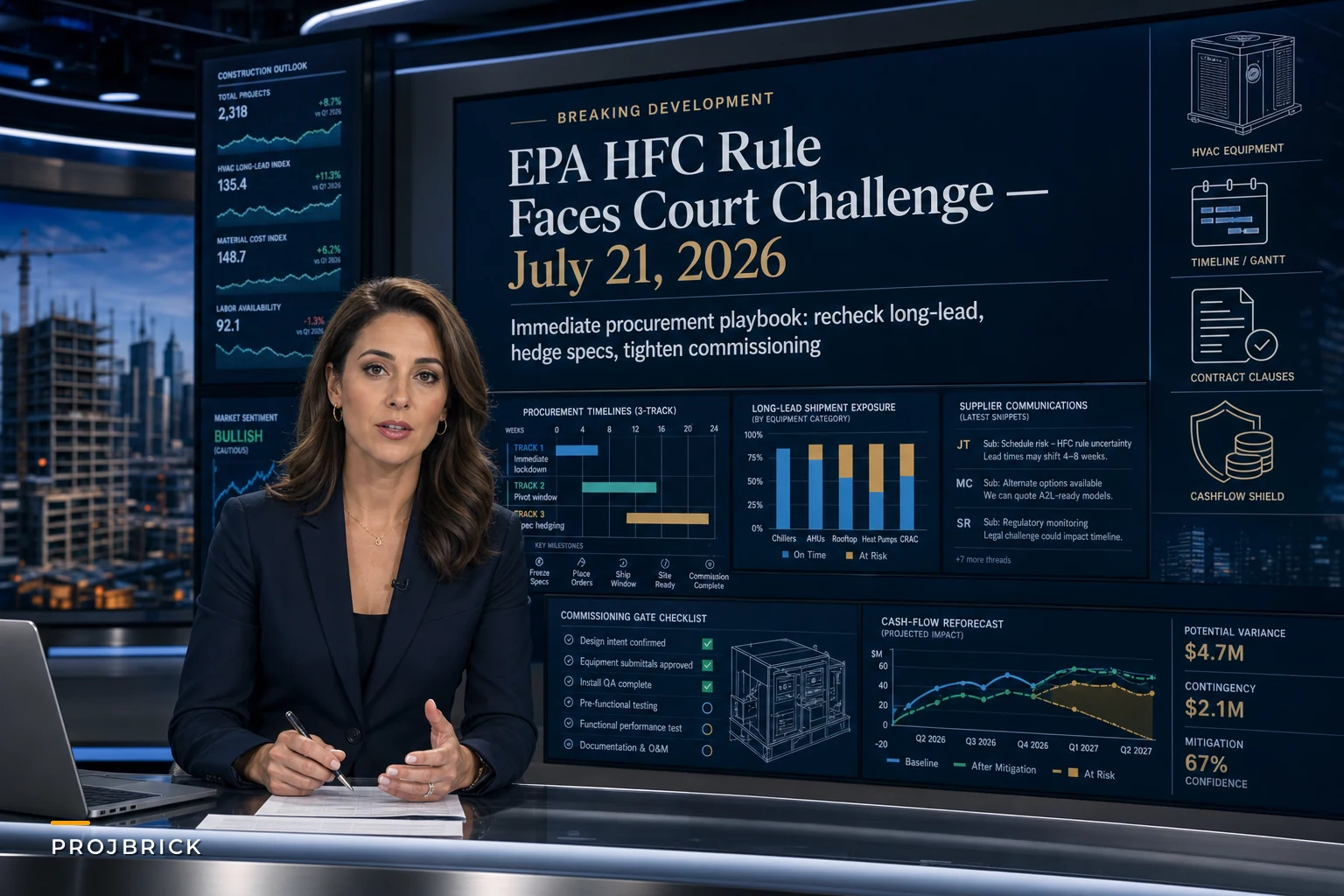

Monday morning, I'm reviewing procurement schedules for a 180,000-square-foot medical office building when my MEP lead calls. "That chiller order we placed three weeks ago? Manufacturer just flagged potential spec changes pending the HFC litigation."
Twenty minutes later, our HVAC sub sends an urgent RFI about whether the rooftop units specified for phase two still meet code. By noon, four different mechanical contractors are asking about refrigerant availability for commissioning schedules set 8-12 weeks out.
This is happening across commercial projects right now. A coalition of 18 states plus D.C. and New York City just sued the EPA over delayed HFC phasedown deadlines, creating immediate uncertainty for any project with mechanical equipment on order or about to spec. The legal challenge could reverse the rollback, accelerate it, or freeze everything in regulatory limbo for months.
For construction PMs, this isn't some abstract policy debate. It's hitting active procurement cycles, delivery schedules, and commissioning timelines right now.
The procurement trap nobody saw coming
Most PMs treat HVAC equipment like structural steel — lock the spec, place the order, track delivery. Refrigerant regulations create a different risk profile that standard procurement workflows miss entirely.
What's actually breaking down: manufacturers are hedging by producing equipment for multiple regulatory scenarios at once. They're stockpiling certain refrigerants while letting others run low. Distribution channels are fragmenting as some suppliers bet on rollback permanence while others prepare for reversal.
A mechanical contractor in Phoenix mentioned they're seeing 15-20% price swings on identical equipment depending on refrigerant type, with delivery windows varying by 6-8 weeks based purely on which compliance pathway the manufacturer assumes will stick.
The core problem isn't just regulatory uncertainty — it's that procurement systems treat all long-lead items the same way. We track delivery dates, not regulatory exposure. We monitor pricing, not compliance pathways. We verify submittals against specs, not against shifting refrigerant availability.
Why standard contingency planning fails here
Traditional procurement contingency covers supplier bankruptcy, shipping delays, quality issues. Nobody's risk matrix includes "equipment becomes non-compliant between order and delivery" or "commissioning refrigerant unavailable at substantial completion."
Keep your construction projects on schedule and budget.
Projbrick helps you plan, track, and manage every project phase with precision and ease.
- Real-time project tracking
- Resource & budget management
- Team collaboration tools
No credit card required
This played out last month on a casino project in Nevada. The PM had solid procurement tracking — every long-lead item mapped, alternates identified, escalation triggers defined. But when refrigerant regulations shifted, his carefully sequenced MEP schedule collapsed. Chillers arrived on time but couldn't be charged. Rooftop units passed inspection but failed commissioning. Kitchen refrigeration worked fine but didn't meet updated efficiency standards for certificate of occupancy.
His contingency budget covered price escalation. Schedule float covered delivery delays. Nobody had modeled regulatory divergence risk into the procurement workflow.
The three-track procurement system that actually works
After watching multiple projects scramble through refrigerant transitions, here's the procurement approach that holds schedule certainty:
Track One: Immediate lockdown (0-4 weeks out) For equipment needed within a month, you're largely stuck with current inventory. But you can still protect the project. Get written refrigerant availability guarantees from suppliers — not just equipment delivery dates. Add commissioning refrigerant sourcing to your MEP coordination meetings now, not two weeks before startup. Document current code interpretations from your AHJ in writing, including their position on pending regulatory changes.
Track Two: Pivot window (4-12 weeks out) This is where you have room to move. Split large equipment orders into smaller batches to maintain flexibility. Include regulatory change clauses in purchase orders that allow spec modifications without cancellation penalties. Get pre-approval from owners for equipment substitutions if regulations shift — establish those alternate approval pathways now, not when you're under pressure.
Here's a quick visual of the three-track approach.
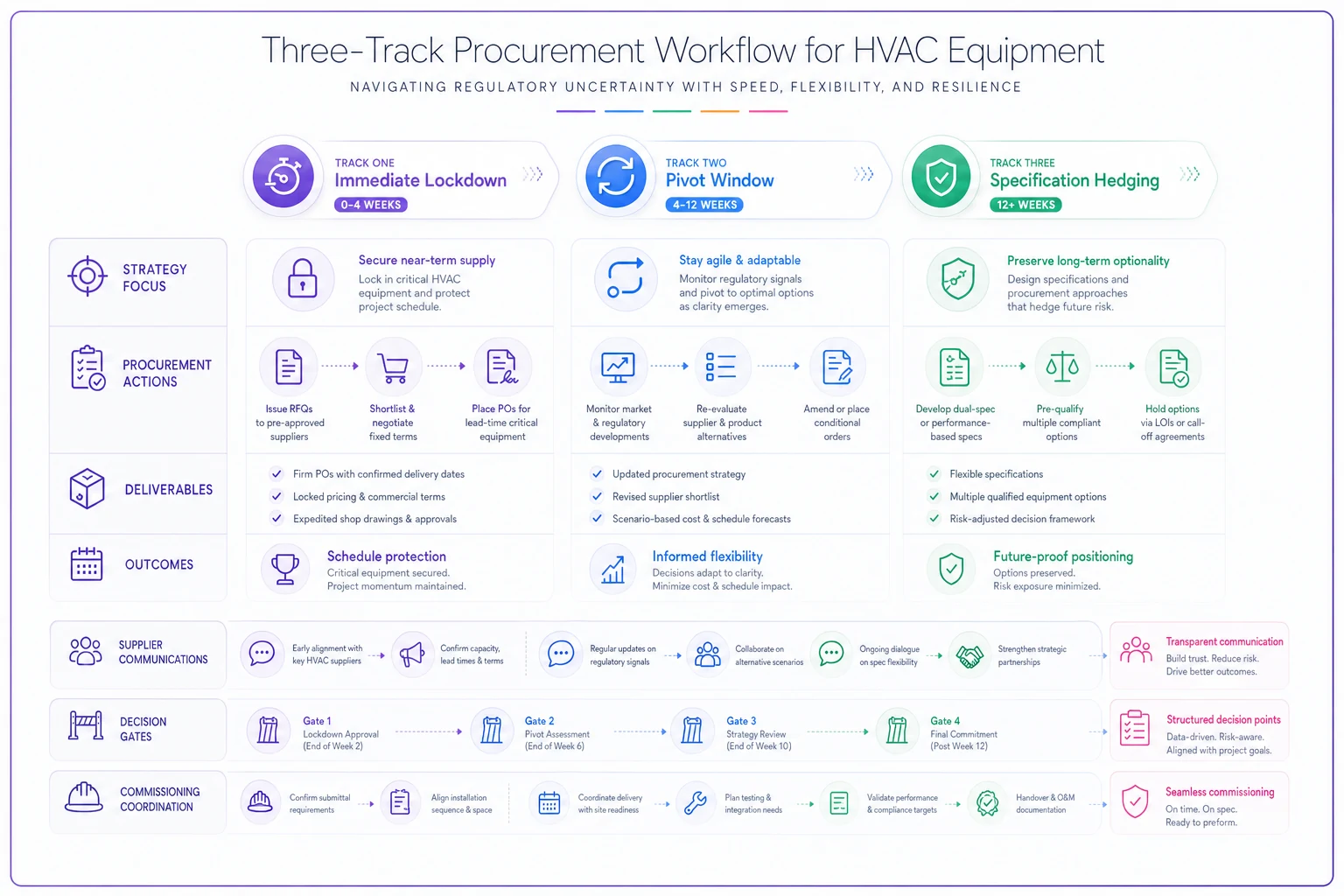
Track Three: Specification hedging (12+ weeks out) For equipment not needed for months, avoid locking specs entirely. Write performance-based specifications rather than model-specific ones. Include multiple compliance pathways in your submittals. Build owner decision gates into the schedule where final equipment selection can pivot based on regulatory clarity.
Immediate commissioning adjustments to prevent handover delays
The biggest schedule killer isn't equipment delivery — it's commissioning failures when refrigerant availability doesn't match equipment requirements. Standard commissioning schedules treat refrigerant like any other consumable. When regulations flux, commissioning teams show up and find they literally cannot charge systems.
Verify refrigerant sourcing at submittal review, not at pre-commissioning.
A few changes that need to happen now in your commissioning workflow:
Start verifying refrigerant sourcing at submittal review, not at pre-commissioning. Add a specific line item for refrigerant type and availability confirmation. Get written commitments from mechanical subs about who supplies refrigerant for testing versus permanent charge.
Create commissioning alternates for different refrigerant scenarios. If your chiller might use R-134a or R-513A depending on regulatory outcomes, document both commissioning procedures now. Define acceptance criteria for each pathway.
Separate functional testing from efficiency validation where you can. You can verify equipment operates correctly even if efficiency standards remain uncertain. This lets you maintain schedule momentum while regulatory details work themselves out.
Budget impacts that standard contingency misses
Everyone knows to budget 5-10% contingency for mechanical equipment. HFC rule changes create costs that hide outside normal line items:
-
Hidden Cost #1
Resubmittal cycles
When refrigerant specs change, you're not just reordering equipment. You're regenerating submittal packages, re-running energy models, potentially redesigning electrical feeds for different equipment efficiency profiles. A grocery chain project burned through roughly $45,000 in design coordination because refrigeration specs changed three times during procurement. -
Hidden Cost #2
Stranded inventory
Mechanical subs often pre-order equipment to lock pricing. When regulations shift, that inventory becomes a negotiation point. Who owns equipment that's suddenly non-compliant? Standard purchase orders don't address this. -
Hidden Cost #3
Commissioning rework
If you commission with one refrigerant then have to change for permanent operation, you're essentially commissioning twice. The labor cost isn't enormous, but the schedule impact compounds across every affected piece of equipment.
If you commission with one refrigerant then have to change for permanent operation, you're essentially commissioning twice. The labor cost isn't enormous, but the schedule impact compounds across every affected piece of equipment.
Real-time tracking matrix for regulatory procurement risk
Stop treating HVAC procurement like a simple delivery tracking exercise. Here's the monitoring framework that actually prevents surprises:
| Equipment Category | Regulatory Risk Level | Monitoring Frequency | Decision Trigger |
|---|---|---|---|
| Chillers >150 tons | Critical | Weekly | Any EPA filing or court decision |
| RTUs with economizers | High | Bi-weekly | Manufacturer advisory or code update |
| Split systems <5 tons | Moderate | Monthly | Refrigerant price shift >10% |
| Kitchen refrigeration | High | Weekly | Local health code interpretation change |
| Computer room units | Moderate | Bi-weekly | Owner efficiency requirement update |
For each category, track three variables: refrigerant availability at your commissioning date (not just delivery), code interpretation status in your specific jurisdiction, and manufacturer production pathway commitments.
Converting owner anxiety into decisive action
Owners are getting hit from every direction right now with confusing information about HFC regulations — climate impact, cost implications, compliance risks. As PM, your job is to cut through that noise with operational clarity.
Don't explain the regulation. Explain the decision points.
Build a simple decision matrix: "If regulations stay rolled back, we proceed with Option A equipment at baseline cost. If rollback gets reversed, we switch to Option B at roughly 8% premium but same schedule. If litigation creates extended uncertainty past [date], we recommend Option C with a flexible compliance pathway."
Give them trigger dates: "We need refrigerant type decision by September 30 for November commissioning. Final equipment selection by October 15 for January delivery."
Separate must-decide-now from can-wait issues. Owners appreciate knowing that choosing a refrigerant pathway for the central plant is critical this week, while finalizing tenant improvement standards can sit for two months.
Stop treating HVAC like it's still 2019
The stable procurement environment where you could spec equipment in design development and revisit it at submittal review is gone. HFC regulations are just one example — building performance standards, grid interaction requirements, and emissions tracking are all creating similar procurement complexity.
But this complexity creates a real edge for teams with better operational systems. While competitors scramble through ad-hoc refrigerant sourcing, you can maintain schedule certainty through systematic tracking. While others absorb commissioning delays, you move forward with pre-documented alternates.
The question isn't whether regulations will stabilize. They won't. The question is whether your procurement workflow can handle constant regulatory flux without blowing schedule and budget.
The teams that get through this don't try to predict which way regulations will go. They build procurement systems that can pivot quickly when changes hit.
Your mechanical equipment procurement probably follows the same basic workflow you've used for years. That worked when refrigerant specs were stable. Now, with HFC regulations in active litigation and more changes coming, that static approach guarantees surprises.
Our deep dive on preventing material-driven stoppages covers the systematic approach to long-lead procurement when specifications might shift. The principles apply whether you're dealing with structural steel availability or refrigerant regulation changes — identify exposure points, create decision gates, and build alternates into your workflow from day one.
Making this systematic, not heroic
Individual PMs can muscle through one regulatory change on sheer effort. But when refrigerant rules, efficiency standards, and emissions requirements all shift at the same time, heroic effort stops being enough. You need operational systems that handle complexity without constant intervention.
Start by accepting that procurement complexity has fundamentally changed. Your MEP lead shouldn't have to become a regulatory expert. Your procurement coordinator shouldn't need to track court cases. Your commissioning agent shouldn't be sourcing alternative refrigerants at the last minute.
Build these contingencies into your standard workflow instead. Make regulatory pathway tracking as routine as RFI logs. Treat refrigerant availability like crane scheduling — a critical path item that needs active management, not passive monitoring.
New York's Attorney General filing makes clear this litigation isn't going away quietly. The teams doing fine despite HFC chaos aren't smarter or working harder. They've accepted that regulatory stability is gone and rebuilt their procurement workflows around that reality. The sooner you stop waiting for clarity and start planning for continued uncertainty, the sooner these disruptions stop derailing your projects.
The sooner you stop waiting for clarity and start planning for continued uncertainty, the sooner these disruptions stop derailing your projects.
Ready to build smarter and faster?
Join 2,000+ construction teams using Projbrick to improve project visibility, reduce delays, and increase profitability.